To choose a matcha supplier, verify five things before you ever place an order: valid certifications, batch-specific lab reports, supply-chain control, transparent MOQ and pricing, and a clean compliance record for your import market. Here’s the problem most buyers hit: they pick a supplier on a low quote and a glossy website, then discover the real cost months later.
That cost is brutal. A café that chooses on price alone gets color and flavor that drift between batches, and customers notice. An importer who skips compliance checks can have a container held at the U.S. border under FDA rules. A brand that never audits its source ends up reselling mislabeled green tea powder, a risk that has surged since the 2024 matcha supply crunch pushed low-grade powder into the market. Knowing how to choose a matcha supplier is the single most consequential sourcing decision you will make. This checklist walks through every verification step a serious buyer runs, and shows how a vertically integrated source like AdoroHu Matcha answers each one.
Choose a matcha supplier by verifying certifications, batch-specific Certificates of Analysis, supply-chain control, and import compliance before ordering. Prioritize suppliers who own their estate and processing, because that is what guarantees the same color and flavor batch after batch. Request samples and current lab reports, confirm MOQ and packaging terms, and treat unusually low pricing as a warning sign. For importers, confirm the supplier meets your market’s food-safety rules, such as the FDA’s FSVP requirements, to avoid customs holds.
In short: the right matcha supplier is verified on certifications, lab reports, supply-chain control, and compliance, not chosen on price and a polished pitch.
Key points:
- Certifications and batch-specific COAs are the minimum proof, not optional extras.
- Supply-chain control (owned estate and milling) is what makes quality repeatable.
- For importers, compliance with rules like FDA FSVP prevents costly customs holds.
What should a matcha supplier checklist cover first?
A matcha supplier checklist should start with the non-negotiables: certifications, lab reports, supply-chain control, and compliance. Here’s why order matters: if a supplier fails any of these four, nothing else, not price, not packaging, is worth evaluating. These are gates, not preferences.
Think of it as a filter that removes risk before you spend time on details. A supplier missing a Certificate of Analysis (COA) or current organic certificate is an immediate disqualification. The remaining checks, MOQ, pricing, samples, then rank the survivors. This is also where the distinction between a manufacturer and a trader becomes decisive, because only a supplier controlling matcha sourcing end to end can answer every gate with evidence rather than promises.
The four gating criteria
Run every candidate supplier through these before anything else.
- Valid, current certifications matched to your target market.
- Batch-specific COAs covering contaminants and microbiology.
- Documented control of cultivation and processing.
- Compliance with your import market’s food-safety rules.
Key Takeaway: Start your matcha supplier evaluation with four gates, certifications, COAs, supply-chain control, and compliance; a supplier failing any one is disqualified before price even enters the conversation.
How do you verify a matcha supplier’s certifications?
You verify a matcha supplier’s certifications by requesting the actual certificates and confirming both their scope and renewal dates. Here’s the trap buyers fall into: they accept a logo on a website as proof. A logo is not a certificate, and expired paperwork is worse than none.
A credible matcha supplier holds certifications matched to where you sell. For organic claims, that means USDA Organic (NOP), EU Organic, or JAS Organic, each a separate audited standard. For food safety, ISO 22000 and FDA registration signal managed process control. The detail competitors gloss over: certificates expire, often annually, so a document dated more than 12 months back may be void at customs. AdoroHu holds organic certification across 150 hectares of its estate, spanning China Organic, USDA (NOP), EU Organic, JAS, Halal, Rainforest Alliance, ISO 22000, and FDA registration, which means one source can clear multiple markets without you chasing separate suppliers.
Key Takeaway: Demand the actual certificates, not logos, and check renewal dates; an expired or scope-mismatched certificate can stall your shipment at customs even when the matcha itself is fine.
Why do lab reports matter when choosing a matcha supplier?
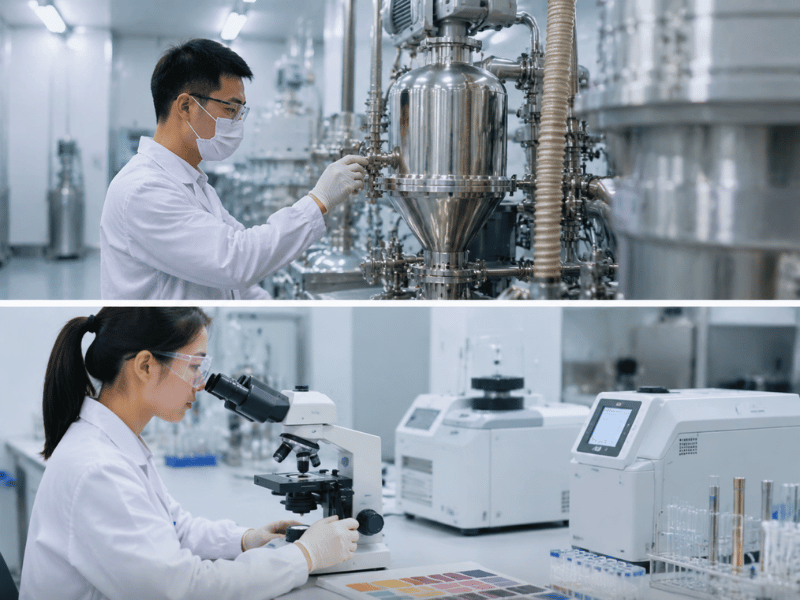
Lab reports matter because matcha is consumed as a whole powdered leaf, so you ingest anything the powder contains. Here’s what separates a sourcing decision from a gamble: a batch-specific COA from an accredited lab is the only document that proves a shipment is safe. A generic, year-old COA tells you nothing about the batch on your pallet.
A complete COA covers the categories that decide whether a shipment is legal and safe.
- Heavy metals: lead, cadmium, mercury, and arsenic.
- Pesticide residue: a broad panel matched to your market’s maximum residue limits.
- Microbiology: total plate count, E. coli, Salmonella, plus yeast and mold.
Skipping this is where real money is lost. A rejected container, a forced recall, or a failed retail audit each cost far more than the testing would have. AdoroHu backs every batch with a 1,000 m² purification workshop, two German metal-detection systems, and a Japanese sterilization line, so the lab data reflects controlled processing, not a one-off sample. That is the difference between a number on paper and a number you can trust at scale.
Key Takeaway: Insist on a batch-specific COA tied to your actual lot; a generic or outdated report leaves you exposed to the rejected shipments and recalls that cost far more than testing.
How does a matcha supplier’s supply chain affect quality?
A matcha supplier’s supply chain directly determines whether quality is repeatable, because control of cultivation and milling is what holds color and flavor steady. Here’s the question that exposes a trader: can they promise batch 500 matches batch 1? A supplier buying from scattered farms cannot.
The real worry for any growing brand is consistency, not a single good sample. Shade-growing, stone-milling, and ultrasonic screening all influence the final color and particle size, and only a supplier that owns those steps can keep them stable. AdoroHu operates a 350-hectare self-owned estate feeding a single processing chain with a 3,000-tonne annual capacity, which is precisely what makes the same green repeatable order after order. A trader sourcing from multiple gardens is, in effect, shipping you a different product each time, and your customers taste the difference before your QC catches it.
Key Takeaway: Supply-chain control is the hidden driver of consistency; a supplier owning its estate and milling can promise the same color and flavor every batch, while a trader buying from many farms cannot.
What MOQ and pricing terms should you expect from a matcha supplier?
You should expect a matcha supplier to quote MOQ and pricing tied to grade, volume, and packaging, not a single flat rate. Here’s the reality that catches new buyers: a “cheap” per-kilo price often hides higher true cost once you add shipping, duties, and waste from poor shelf life.
The number that actually governs profitability is cost-per-serving, not the sticker price. At roughly 1.5 grams per drink, a 1-kilogram bag yields about 660 servings, so a small per-gram difference compounds across thousands of cups. Because AdoroHu prices by grade and quality and sets lead time against order volume, you get a figure tied to your real specification. Sourcing in bulk supply (20 kg or 25 kg cartons with sealed food-grade liners) lowers per-gram cost sharply versus retail packs, and you can request a wholesale quote matched to your grade and volume rather than guessing from a list price.
Key Takeaway: Expect MOQ and pricing scaled to grade and volume, and judge cost-per-serving, not sticker price; a low headline rate often hides higher true cost once shipping, duties, and waste are counted.
How important are samples before committing to a matcha supplier?
Samples are essential, because they are the only way to confirm a matcha supplier’s claims against the actual powder before money is at stake. Here’s a hard-won lesson: a “ceremonial grade” label on a dull, gritty sample is meaningless, and you only learn that by testing it yourself.
Evaluate a representative sample for vivid jade-green color, ultra-fine texture, fresh grassy aroma, and a smooth, low-bitterness taste. Then cross-check it against the supplier’s own COA to confirm the paperwork matches the powder. For a matcha latte program, also test blend performance in milk, since color retention and suspension matter as much as dry-powder appearance. AdoroHu supports sample requests precisely so buyers can verify color, flavor, and blend behavior before a wholesale or private-label commitment. Skipping this step to save a week is how brands end up locked into a full order of the wrong product.
Key Takeaway: Always test a sample and match it against the COA before committing; a grade label proves nothing, and a few days of evaluation prevents being locked into a full order of underperforming matcha.
What import compliance must a matcha supplier meet?
A matcha supplier must meet the food-safety rules of your import market, and for the United States that centers on FDA requirements under FSMA. Here’s the detail most sourcing guides skip entirely: compliance is partly the importer’s legal duty, not just the supplier’s.
Under the FDA’s Foreign Supplier Verification Program, importers must verify that each foreign supplier produces food meeting U.S. safety standards. Since July 24, 2022, FSVP entries must carry a recognized unique facility identifier (a DUNS number) at the time of customs entry, and electronic filings lacking it are rejected. A supplier that understands these rules and supplies the documentation you need makes your FSVP obligations far easier to meet. For other markets, the EU enforces its own maximum residue limits and labeling rules. Choosing a supplier fluent in your destination’s requirements is what keeps containers moving instead of sitting in a customs hold.
Key Takeaway: Confirm your supplier meets your market’s rules and can supply the documents you need; under FDA FSVP the importer is legally responsible for verification, so a compliance-fluent supplier directly protects your shipments.
What red flags signal a matcha supplier to avoid?
The clearest red flags are missing documentation, vague origin claims, and pricing far below market. Here’s the pattern experienced buyers watch for: each red flag maps to a specific, costly failure down the line.
Treat these as disqualifiers, not minor concerns.
- No batch-specific COA, or reluctance to share one, points to unverified safety.
- Vague labeling like “Japan-style” without true origin signals possible mislabeling.
- Prices far below market often mean diluted, oxidized, or over-harvested leaves.
- No estate or processing control means consistency cannot be guaranteed.
This matters more than ever. Since the 2024 supply crunch, lower-grade green tea powder has been mislabeled and sold as authentic matcha, a documented trend that turns due diligence from optional into essential. A supplier offering full private label and OEM support with complete documentation is the opposite profile: transparent, traceable, and accountable.
Key Takeaway: Treat missing COAs, vague origins, and below-market pricing as disqualifiers; since the 2024 supply crunch, mislabeled green tea powder sold as matcha makes ignoring these red flags a direct route to a compromised product.
Why choose a vertically integrated matcha supplier over a trader?
Choose a vertically integrated matcha supplier because owning the chain from estate to packaging is what makes quality, compliance, and consistency provable rather than promised. Here’s the bottom line that ties the whole checklist together: a trader can claim every box, but only an integrated producer can prove them.
A vertically integrated matcha supplier controls shade-growing, stone-milling, screening, testing, and packaging under one roof, so every COA and certificate traces to a single accountable source. AdoroHu’s model, a 350-hectare estate, a 1,000 m² purification workshop, 150 hectares of organic certification, and a 3,000-tonne capacity, exists to answer each checklist gate with first-party evidence. For a brand wanting certified organic matcha or a custom blend, that single point of accountability removes the finger-pointing that happens when a trader’s farm, mill, and lab are three separate companies.
Key Takeaway: A vertically integrated supplier can prove every claim from one accountable source; that single point of traceability is what converts a checklist from hopeful questions into verified answers.
FAQ
- What is the single most important factor when choosing a matcha supplier?
- Supply-chain control is the most important factor, because it determines whether quality is repeatable. A supplier that owns its estate and processing can guarantee the same color and flavor batch after batch, while a trader buying from scattered farms cannot. Certifications and COAs then verify that control.
- What documents should I request before placing a wholesale matcha order?
- Request a batch-specific Certificate of Analysis covering heavy metals, pesticide residue, and microbiology, plus current organic certificates (USDA, EU, or JAS) and food-safety credentials like ISO 22000 and FDA registration. Confirm renewal dates, since expired certificates can stall shipments at customs.
- How do I avoid buying mislabeled matcha?
- Insist on documented origin and a batch-specific COA, and be wary of vague labels like “Japan-style” or prices far below market. Since the 2024 supply crunch, lower-grade green tea powder has been mislabeled as matcha, so verifying origin and testing a sample against the paperwork is essential.
- What compliance rules apply when importing matcha into the US?
- Importers must comply with the FDA’s Foreign Supplier Verification Program under FSMA, verifying that each foreign supplier meets U.S. safety standards. Since July 24, 2022, entries must include a recognized unique facility identifier (a DUNS number) at customs, or the electronic filing is rejected.
- Can one matcha supplier serve multiple markets and grades?
- Yes, if the supplier holds the right certifications and controls its production. AdoroHu offers ceremonial, premium, culinary, and organic grades across its EU and Organic grade series, with certifications spanning USDA (NOP), EU, and JAS, so a single source can supply several markets and applications.
Conclusion
Choosing a matcha supplier is a verification process, not a price comparison: confirm certifications, batch-specific COAs, supply-chain control, and import compliance before you commit, and treat missing documents or below-market pricing as disqualifiers. The practical takeaway is to favor a vertically integrated source that can prove every claim from one accountable point rather than a trader who can only promise. To run this checklist against a real supplier, contact AdoroHu Matcha to request samples, certifications, and a wholesale quote matched to your market and volume.