Culinary Matcha for
Bakery & Food Manufacturing
Heat stable under 380°C fixation. Vivid color that survives high-temperature baking. Designed for production-scale consistency — batch after batch.





What Is Culinary Matcha — and Why Does Grade Matter?
Not all matcha performs the same under heat. Culinary grade is purpose-built for food manufacturing: engineered to hold color, maintain flavor intensity, and control cost at scale.
Engineered for Heat Stability
Culinary matcha uses leaves with higher chlorophyll density, processed via a 380°C hot-air fixation method that locks in color. Where ceremonial grade fades in the oven, culinary grade stays vivid — giving your baked products the green appearance customers expect.
Built for Production-Scale Use
Standardized batch-to-batch color values and particle fineness mean your formulation behaves predictably every run. Whether you produce 50 kg test batches or 5-ton monthly orders, the matcha performs identically.
Cost-Efficient for Long-Term Supply
Culinary matcha is priced for industrial volumes without compromising quality where it matters. The flavor is bold enough to carry through recipes while keeping your ingredient cost per unit well within margin targets.
How Culinary Matcha Compares
| Criteria | Culinary Matcha | Premium Matcha | Ceremonial Matcha |
|---|---|---|---|
| Intended Use | Food manufacturing & baking | Lattes, blended drinks | Direct drinking, pure experience |
| Heat Stability | Excellent (380°C process) | Moderate | Limited |
| Color After Baking | Vivid green retained | Some fading | Significant fading |
| Flavor Profile | Bold — carries through recipes | Balanced | Delicate, nuanced |
| Cost at Scale | Most cost-efficient | Mid range | Premium pricing |
| Batch Consistency | Standardized for production | Good | Variable by harvest |
Not sure which grade fits your recipe? Request a free sample set and test both grades side by side in your production environment.
Request a Free Sample SetFour Reasons Food Manufacturers Choose Culinary Matcha
When your margins depend on reliable color, consistent flavor, and predictable supply — the grade of matcha you source is a production decision, not just a culinary one.
Color Survives the Oven
High-temperature fixation locks chlorophyll at the cellular level. After baking at 180°C for 20+ minutes, your matcha cake, cookie, or mochi stays visibly green — not yellow-brown. Consistent color means fewer quality rejections and stronger shelf appeal.
Flavor Holds Through Processing
Our culinary matcha carries a naturally bold umami-vegetal profile that remains detectable even after mixing into batter, cream, or chocolate. Your end product tastes distinctly like matcha — not a faint hint of it.
Standardized for Scalable Formulation
Every production lot is tested for color value (CIE L*a*b*), particle size (D50 ≤10 μm), and moisture. Your recipe works with batch one — and with batch one hundred. No reformulation needed as volumes grow.
Lower Cost Per Unit of Flavor
Because culinary matcha is priced for industrial volumes, switching from premium grade can reduce your matcha ingredient cost by 30–50% without any perceptible difference to the end consumer in baked or frozen applications.
Ready to test it in your production line? We provide technical support and custom spec matching for your application.
Talk to Our Food Tech TeamWhere Culinary Matcha Performs Best
From high-temperature baking to frozen desserts — our culinary matcha is validated across the four most demanding food manufacturing categories.

Cakes & Bakery
Vivid green maintained through full bake cycles. Ideal for sponge cakes, Swiss rolls, and laminated doughs.

Cookies & Pastry
Withstands 180–200°C oven temperatures. Delivers consistent matcha flavor and green appearance in every batch.

Ice Cream & Desserts
Bold flavor intensity that holds through freezing and thaw cycles. Works seamlessly in gelato, soft-serve, and mochi bases.

Chocolate & Snacks
Excellent dispersibility in cocoa butter and fat-based systems. Maintains appealing green hue even after tempering.
Working on a specific application? Share your product type and processing conditions — we'll recommend the right spec.
Discuss My Application Download Product SheetCulinary Matcha — Product Specifications
Every parameter is tested per production lot to ensure consistent performance across your formulation. Request a Certificate of Analysis with your sample order.
| Parameter | Specification | Significance for Food Production |
|---|---|---|
| Color After Processing | CIE a* ≥ −10 (vivid green) | Maintains visible green hue after baking at 180–200°C; reduces consumer rejection rates |
| Particle Size | D50 ≤ 10 μm / 325 Mesh | Ensures smooth texture in batter and cream; no grittiness in finished product |
| Moisture Content | ≤ 5% | Prevents clumping during mixing; extends shelf stability in dry ingredient blends |
| Heat Stability | Rated for 380°C fixation process | Color and flavor preserved through standard industrial baking cycles |
| Recommended Applications | Baking · Ice Cream · Chocolate · Snacks · Beverages | Validated across all high-heat and fat-based food production environments |
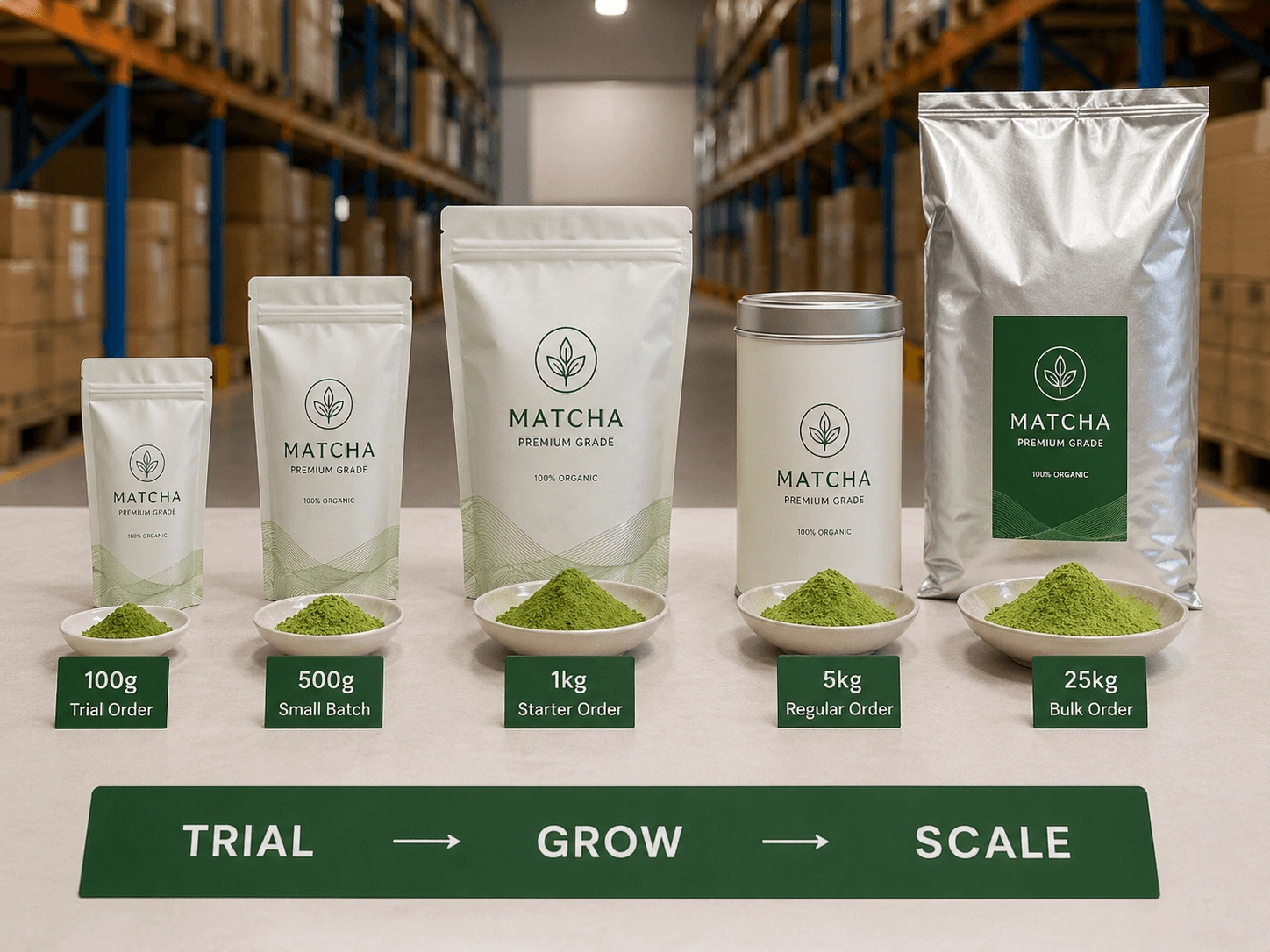
| Packaging Options | 25 kg / 5 kg / 1 kg | Flexible pack sizes for R&D sampling through full production scale |
| Shelf Life | 24 months (sealed, cool & dry) | Supports long-term procurement planning and inventory management |
| Certifications | ISO 22000 · FDA · Halal | Meets compliance requirements for export to US, EU, and Asia-Pacific markets |
Standard production pack. Food-grade kraft paper inner liner with aluminum foil barrier. Palletized for easy warehouse storage. Best value for high-volume manufacturers.
Ideal for recipe development and small-batch production. Resealable zip closure with oxygen absorber. Shelf-stable for 24 months when stored below 25°C in a dry environment.
Entry-level sampling for new product development. Includes a QR-linked COA for full traceability. Minimum lead time — ships within 5 business days of order confirmation.
The Real Costs of Sourcing the Wrong Matcha
Food manufacturers lose margin — and customers — when matcha fails in production. Here are the four pain points we hear most from procurement and R&D teams.
Color Yellowing After Baking
Products arrive from the oven with a yellow-brown tint instead of the expected vivid green. Shoppers notice. Return rates climb. The culprit is almost always low-grade matcha with poor chlorophyll retention — a processing issue, not a recipe issue.
Flavor Loss During Processing
High baking temperatures and extended mixing cycles strip out delicate flavor compounds. By the time the product cools, the matcha taste is a ghost of what was measured at the ingredient stage — forcing reformulators to over-dose at significant cost.
Ingredient Cost Eating Into Margin
Using ceremonial or premium-grade matcha in baked goods means paying 2–4× the cost for nuanced qualities — shade-grown terroir, delicate sweetness — that the production process destroys. The investment disappears in the oven before it reaches the customer.
Batch Inconsistency Disrupts Production
Different harvests, different suppliers, different processing methods — the result is color and flavor variance between production runs. QC holds increase. Reformulation costs mount. Customer complaints about product appearance erode brand equity over time.
Recognise any of these issues in your current supply? Let us show you how our culinary matcha solves each one — with data.
See Our SolutionsFour Engineering Decisions That Protect Your Production
Every specification in our culinary matcha exists to directly counter the problems above. Here is the engineering behind each solution.
380°C Hot-Air Fixation for Color Lock
Our proprietary hot-air fixation process rapidly deactivates the enzymes responsible for chlorophyll degradation. The result: a green that holds through 200°C oven cycles. Independent color measurement (CIE a*) confirms performance every batch.
High-Aroma Processing for Flavor Durability
Our high-aroma production pathway concentrates key flavor compounds during grinding — specifically the catechins and amino acids that define matcha's umami profile. When your recipe reaches 180°C, enough flavor survives to deliver a detectable, satisfying result.
Industrial Pricing for Production Economics
Culinary matcha is purpose-priced for the volumes food manufacturers actually need. At 25 kg+ quantities, you gain access to factory-direct pricing that reduces ingredient cost by 30–50% versus premium grades — without sacrificing the color or flavor performance your product depends on.
Lot-Level QC for Zero Batch Variance
Every production lot is tested for color (CIE L*a*b*), particle size (D50), moisture, and pesticide residue before it ships. COA numbers are tied to each bag. If your QC team flags a discrepancy, we trace it to the leaf harvest date and fix it.
Want to verify our specs against your current supplier? Request a parallel sample and run your own side-by-side bake test.
Request a Comparison Sample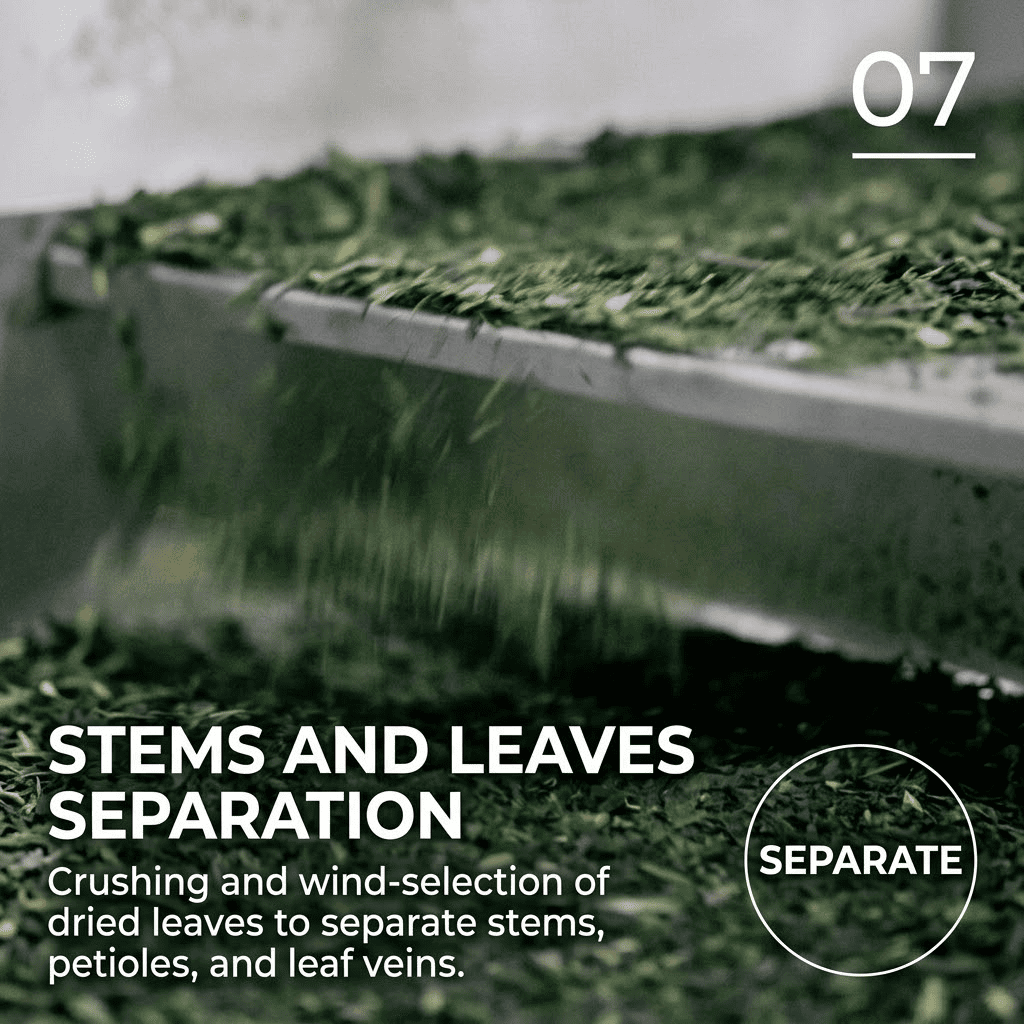
Why the Processing Method Changes Everything
Most matcha manufacturers use steam fixation — an effective method for ceremonial and premium grades. We developed a hot-air fixation pathway specifically for food manufacturing applications, where performance under heat is the non-negotiable requirement.
Raw material is sourced exclusively from our 3,500-acre certified gardens in Zhejiang Province. Leaves are harvested during the optimal first-flush window and transported to the factory within 6 hours to preserve chlorophyll integrity before fixation begins.
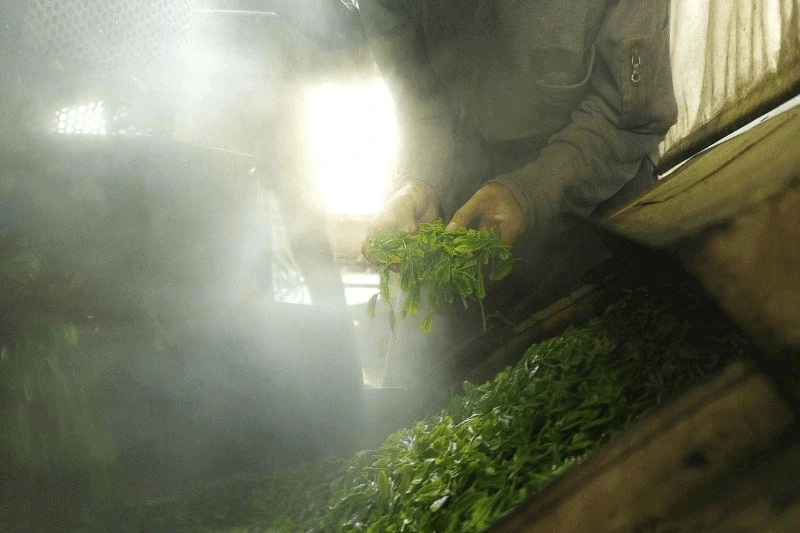
Leaves pass through a precision-controlled hot-air tunnel at 380°C for a calibrated duration. This rapidly deactivates polyphenol oxidase — the enzyme responsible for color degradation — while preserving the flavor-active catechins and chlorophyll structures needed for downstream baking performance.
Stone-milled and cryogenic-ground to a D50 particle size of ≤10 μm. This fineness ensures complete dispersion in batter systems, eliminates grittiness in finished products, and maximizes surface area contact for color and flavor release during processing.

Interested in a virtual factory tour? Our food tech team can walk you through the full production process via video call.
Schedule a Factory TourWhy Leading Food Brands Source Their Culinary Matcha From Us
Three decades of dedicated matcha production — not a commodity supplier that added matcha to a catalog, but a manufacturer built around it from day one.
Three Decades of Matcha Expertise
Our food scientists and agronomists have spent 20+ years understanding how matcha behaves across different processing environments. That institutional knowledge is built into every production parameter — not guessed at.
Vertically Integrated from Garden to Bag
We own and manage the gardens our culinary matcha comes from. No middlemen, no third-party raw material risk. Full traceability from harvest date to shipment lot — available on demand for your compliance team.
Steam & Hot-Air: Two Technologies, One Supplier
We operate both steam-fixation and hot-air-fixation production lines. This means we can match the right process to your specific application — and switch routes if your product formulation evolves — without changing suppliers.
State-Recognized R&D Infrastructure
Our facility holds national-level R&D center designation from the Chinese Ministry of Agriculture — recognizing our technical capabilities in tea processing. This infrastructure supports custom spec development, application testing, and formulation consultation for OEM clients.
Every Lot Verified Before It Leaves Our Facility
Quality control is not a final inspection step — it runs in parallel with every stage of production. By the time your order ships, it has cleared four independent verification gates and a third-party residue panel.

Every Single Lot.
Every harvest is evaluated against 12 incoming quality criteria — color, moisture, aroma, and microbial load — before entering the production floor. Non-compliant batches are rejected at the gate, not caught after processing.
CIE L*a*b* color values, particle size (D50/D90), and moisture are measured for every production lot. Results are linked to a bag-level lot number — your QC team can request the data file for any order at any time.
Pesticide and heavy metal testing conducted quarterly by SGS or Eurofins — results consistently below EU MRL limits. Full reports are available for download and can be included in your import documentation package.
The sample you approve is manufactured using the same process parameters and raw material source as your full production order. Samples retained for 12 months — any discrepancy traced within 48 hours of notification.
22000
The highest global standard for food safety management in manufacturing — required by most Tier-1 food retail and CPG brands worldwide.
Validates GMP compliance and food safety practices. Commonly required by US food manufacturers and retailers when qualifying new ingredient suppliers.
9001
Certifies our documented, auditable production processes for end-to-end consistency — from raw material receipt through finished product dispatch.
The Real ROI of Switching to Culinary Grade
For food manufacturers running matcha as a key ingredient at scale, grade selection is a margin decision. Here is what the numbers look like when you optimize for production — not for the tea ceremony.
Versus premium grade at equivalent production volumes — without detectable quality loss in finished baked goods
Lower ingredient cost creates room to invest in packaging, marketing, or SKU expansion — without raising retail price
Longer shelf stability enables bulk purchasing at better per-unit rates while reducing the risk of ingredient write-offs
Full batch documentation on every order eliminates audit preparation time and reduces supplier compliance overhead
Want a cost-per-unit breakdown for your specific recipe and volume? Share your monthly usage and we will prepare a detailed sourcing analysis.
Get a Cost AnalysisYour Formulation. Our Manufacturing Capability.
We do not just supply matcha — we help food manufacturers build products around it. From private label to fully custom spec development, our team supports every stage of the process.
Private Label Packaging
We manufacture to your brand's specification, pack under your label, and ship directly to your warehouse or fulfillment center. Full MOQ flexibility from 100 kg pilot runs to full container loads. Artboard-ready packaging templates provided on request.
Custom Flavor Development
Our R&D kitchen works directly with your product development team to create matcha blends optimized for your specific application — adjusting bitterness, sweetness balance, aroma intensity, and color concentration to match your recipe target profile.
Color, Bitterness & Aroma Adjustment
Not all products need the same matcha profile. Cookies can carry more bitterness than ice cream; chocolate products need stronger color than beverages. We tune each parameter independently — so the matcha in your formulation performs exactly as your recipe requires.
Food Factory Formulation Support
For manufacturers scaling a new matcha product line, our technical team provides on-site consultation, application-specific dosage guidance, and process integration support. We can liaise directly with your production manager and food scientist to ensure your ramp-up is smooth from Day 1.
Have a product concept but not a final spec? Our R&D team can work from a brief and develop a custom matcha formulation for you.
Start OEM Discussion Download OEM GuideResults Our Clients Achieved in Real Production
Two manufacturers. Two different challenges. One ingredient solution — with measurable outcomes they could see on the production floor and the balance sheet.

Color Fading in High-Temperature Bake Cycles
A mid-scale bakery brand in the US was producing matcha Swiss rolls and layered cakes. Their existing supplier's matcha turned visibly yellow-brown after a 185°C / 22-minute bake — triggering shelf-placement rejections from their largest grocery retail partner. They had reformulated twice with no improvement, as the issue was upstream in the raw material, not the recipe.
We supplied our hot-air fixation culinary matcha at the same dosage level. After a parallel bake test, the customer's QC team recorded an a* color value improvement of +4.2 units — sufficient to pass the retailer's green color standard. The product went back on shelf within one production cycle.

Matcha Ingredient Cost Compressing Margins on Frozen Desserts
A frozen dessert manufacturer was producing matcha mochi and ice cream at 8-ton monthly volume. Their premium-grade matcha supplier had increased prices twice in 12 months, and the cost per unit was making the product line increasingly difficult to justify against competing SKUs. They needed cost relief without reformulation or consumer-visible quality change.
We introduced our culinary grade at a matched flavor and color profile. After a blinded consumer panel test — same recipe, new ingredient — no statistically significant preference was detected between the two versions. The switch reduced their matcha ingredient cost by 38% at their monthly volume.
Facing a similar challenge in your production? Tell us your application and volume — we will map a solution based on your specific conditions.
Discuss My Production ChallengeQuestions Procurement Teams Ask Before Their First Order
Answers to the questions we hear most from R&D managers, QC teams, and procurement leads — before they place their first trial order.
Have a question not covered here? Our food tech team responds to all technical enquiries within one business day.
Ask a Technical QuestionStart Your Matcha Partnership with a Reliable Source
We grow, process, and export our own matcha. No middlemen — which means better quality, more stable pricing, and a supply chain you can depend on season after season.
Thank you — a member of our team will respond within one business day.