Matcha for retailers means sourcing retail-ready, packaged product, not bulk powder, then building a shelf range across grades and formats that sells to end consumers at a healthy margin. Here’s the distinction that trips up new retail buyers: sourcing matcha to put on a shelf is a completely different task from sourcing it as an ingredient, and treating them the same leads to the wrong product and poor sell-through.
That mismatch costs shelf space and cash. A retailer who buys bulk powder ends up repackaging it themselves, absorbing cost and risk. One who stocks only one grade misses the customers who want a different price point. One who picks pretty packaging that fades the matcha gets returns and dead stock. Matcha for retailers is about choosing the right formats, range, and supplier so the product moves off the shelf and customers come back. This guide covers exactly that, and shows how a supplier offering retail-ready matcha wholesale and private label fits a retail program.
Matcha for retailers means sourcing retail-ready packaged matcha to sell directly to consumers, rather than bulk powder used as an ingredient. Retailers should prioritize finished retail formats (tins, pouches, single-serve sachets), a range across ceremonial, premium, and culinary grades to hit multiple price points, packaging that protects the powder on the shelf, and a supplier offering low minimums to test products. Private-label options let retailers build their own branded line. Healthy retail margins depend on a low, stable sourcing cost.
In short: matcha for retailers is about sourcing retail-ready formats and a shelf range across grades, with protective packaging, low test minimums, and a stable cost that protects margin.
Key points:
- Retailers need retail-ready packaged formats, not bulk powder to repackage themselves.
- A range across grades hits multiple price points and customer types on one shelf.
- Packaging must protect matcha on the shelf, and low minimums let retailers test demand.
How is sourcing matcha for retailers different from bulk buying?
Sourcing matcha for retailers is different because retailers sell finished packaged product to consumers, not powder as an ingredient. Here’s the core distinction: a retailer needs shelf-ready units with labels, barriers, and branding, while a café or manufacturer just needs the powder itself.
This shapes every sourcing decision. A retailer buying bulk powder would have to repackage, label, and seal it themselves, adding cost, equipment, and food-safety risk. Buying retail-ready product, or private-label units, removes that burden. The format, the label, and the shelf life until a consumer opens it all matter to a retailer in ways they do not to an ingredient buyer. A retailer stocking culinary grade matcha for baking-focused customers needs it in consumer pack sizes, not 20 kg cartons. This is why retail sourcing starts with finished formats.
Key Takeaway: Retailers sell finished packaged product, not ingredient powder, so they need shelf-ready units with labels and barriers; buying bulk to repackage adds cost and food-safety risk, so retail sourcing should start from finished formats.
What retail-ready formats should retailers stock for matcha?
Retailers should stock matcha in consumer formats: tins, resealable pouches, and single-serve sachets, each matched to a shopper type. Here’s the logic that drives sell-through: different shoppers want different formats, so a smart shelf offers more than one.
Each format serves a distinct purchase motivation.
- Tins, often premium and gift-friendly, suit ceremonial grade and higher price points.
- Resealable pouches offer everyday value, ideal for regular culinary or premium use.
- Single-serve sachets capture trial, gifting, and grab-and-go shoppers.
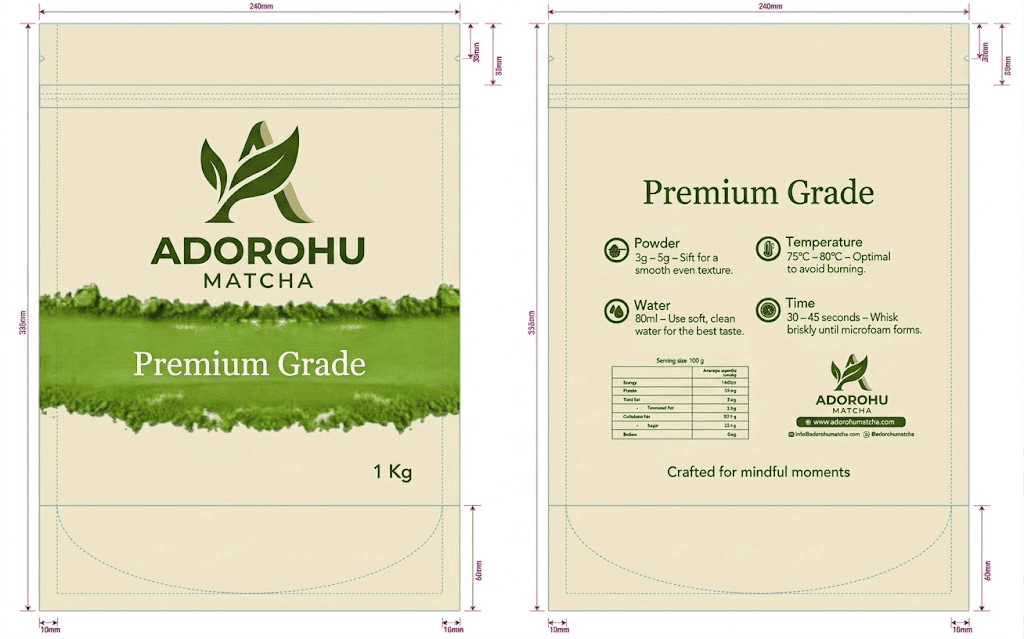
Matching format to shopper widens your market on the same shelf space. AdoroHu offers retail formats spanning zip-lock pouches (30 g–500 g), tins and aluminium boxes (30 g–100 g), and single-serve 1–3 g sachets, so a retailer can stock a tin for the gift buyer, a pouch for the regular, and a sachet for the first-timer. The experienced judgment: lead with a sachet or small pouch as a low-risk trial entry, since converting a curious first-timer is how a retail matcha category grows.
Key Takeaway: Stock multiple retail formats, tins for gifting and premium, pouches for everyday value, sachets for trial, since matching format to shopper type widens your market on the same shelf and a low-risk trial size converts curious first-timers.
What grades should a retailer carry to maximize matcha sales?
A retailer should carry a range of grades to hit multiple price points and customer types. Here’s the merchandising principle: a single grade serves a single customer, while a tiered range captures the budget shopper, the regular, and the connoisseur on one shelf.
Range is what builds a category rather than a single product. Ceremonial grade anchors the premium tier for connoisseurs and gift buyers, premium grade serves the committed regular, and culinary grade captures budget-conscious and baking-focused shoppers. Offering all three lets a retailer upsell and cross-sell rather than turning customers away on price. AdoroHu organizes its range into an EU Grade Series (E-1 to E-7) and an Organic Grade Series (O-1 to O-6), so a retailer can build a clear good-better-best tier. The judgment from experience: stock at least a premium anchor and an accessible entry grade, because a shelf with only expensive ceremonial loses every price-sensitive shopper who walks by.
Key Takeaway: Carry a tiered grade range, ceremonial to anchor premium, culinary for accessible entry, because a good-better-best shelf captures budget shoppers, regulars, and connoisseurs alike, while a single-grade shelf turns away everyone outside its price point.
Why does packaging matter for retailers selling matcha?
Packaging matters for retailers because it must both sell the product on the shelf and protect the powder until a consumer opens it. Here’s the dual demand unique to retail: the package is a marketing tool and a preservation tool at once, and failing either loses the sale or the repeat purchase.
On the shelf, packaging drives the impulse to buy in a visual, shareable category. But matcha is light- and oxygen-sensitive, so a package that looks good but lets the powder fade produces a disappointing first cup and no second purchase. The experienced rule: never stock clear-glass or low-barrier packaging that exposes matcha to light, however attractive, because oxidation will dull the color and flavor on your shelf. Opaque tins and high-barrier pouches protect the chlorophyll and aroma. A retailer should treat packaging as protecting the quality that earns repeat customers, not just catching the eye once.
Key Takeaway: For retailers, packaging must sell on the shelf and protect the powder until opening; a beautiful clear package that fades the matcha kills the repeat purchase, so insist on opaque, high-barrier formats that preserve color and flavor in-store.
How can retailers use private label for matcha?
Retailers can use private label to sell matcha under their own brand, capturing more margin and customer loyalty. Here’s the strategic upside: a private-label line turns a retailer from a reseller of others’ brands into the owner of a product customers associate with the store.
Private label lets a retailer differentiate and build equity. Instead of competing on the same national brands as every other store, a retailer’s own matcha line is exclusive to them, and the margin is not shared with a brand owner. The practical entry path is to start with standard packaging and a supplier’s existing grades under your label, then expand. A retailer building a private label line should match the grade and format to its customer base, then grow the range as it sells. The judgment: private label rewards retailers with steady traffic, since an exclusive product builds loyalty that a resold national brand cannot.
Key Takeaway: Private label lets retailers sell an exclusive matcha under their own brand, capturing fuller margin and building loyalty; start with standard packaging and a supplier’s grades under your label, then expand the range as the line proves itself.
What MOQ and margins should retailers expect for matcha?
Retailers should expect low minimums for retail-ready product and healthy margins driven by matcha’s premium perception. Here’s what makes retail entry accessible: many suppliers offer low minimums on packaged product so a retailer can test demand without overextending inventory.
Low minimums matter because shelf space and cash are finite. Stocking a new product at a high minimum risks dead stock, so a low-MOQ trial protects the retailer while testing what sells. On margin, matcha supports strong retail markups thanks to its premium and wellness positioning, but the margin depends on a low, stable sourcing cost, since every dollar of purchase price compresses the spread. The experienced approach is to start with a low-minimum trial across a couple of formats, see what moves, then scale the winners. Sourcing at a stable cost lets a retailer request a wholesale quote and model real shelf margins before committing inventory.
Key Takeaway: Expect low minimums on retail-ready matcha and strong margins from its premium positioning; start with a low-MOQ trial across formats to protect shelf space and cash, then scale the winners, since margin still depends on a stable sourcing cost.
How do retailers keep matcha fresh on the shelf?
Retailers keep matcha fresh by managing stock rotation and storage, because matcha degrades over time even in good packaging. Here’s the retail-specific risk: product can sit on a shelf for weeks, so freshness management protects both quality and your reputation.
The fundamentals are turnover and conditions. Most guidance recommends consumers use opened matcha within about 60 to 90 days, and unopened sealed product also degrades slowly with light, heat, and time. A retailer should rotate stock first-in-first-out, avoid displaying matcha in direct light or heat, and order at a cadence matched to real sell-through rather than over-stocking. Nitrogen-sealed and high-barrier formats extend shelf life, but rotation still matters. The judgment: do not over-order a slow-moving grade for a bulk discount, because matcha that fades on your shelf becomes markdown or waste, erasing the saving.
Key Takeaway: Keep shelf matcha fresh with first-in-first-out rotation, light-and-heat-free display, and ordering matched to sell-through; even well-packaged matcha degrades, so over-stocking a slow grade for a discount risks markdowns that erase the saving.
What should retailers look for in a matcha supplier?
Retailers should look for a supplier offering retail-ready formats, a full grade range, low minimums, private-label options, and reliable documentation. Here’s what separates a retail-friendly supplier from a bulk-only one: the ability to deliver shelf-ready product and the flexibility a retailer’s inventory needs.
The retail supplier checklist is specific.
- Retail-ready packaging formats, not just bulk cartons.
- A full grade range to build a tiered shelf.
- Low minimums to test products without overextending.
- Private-label capability for an own-brand line.
- Certifications and COAs for consumer-facing quality claims.
A supplier covering all of these lets a retailer build a complete shelf from one relationship. AdoroHu provides retail formats, a full grade range, private-label support, and certifications including USDA (NOP), EU Organic, and JAS, so a retailer offering certified organic matcha can source the whole category, and complementary lines like hojicha powder, from a single source.
Key Takeaway: Choose a supplier offering retail-ready formats, a full grade range, low minimums, private label, and documentation; this lets a retailer build a complete tiered shelf and own-brand line from one relationship rather than piecing it together.
What mistakes do retailers make sourcing matcha?
The biggest mistake is sourcing matcha like an ingredient buyer rather than a retailer, getting the wrong format and range. Here’s the pattern across slow-moving shelves: each mistake maps to a specific loss of sales or stock.
Watch for these traps, each with a named consequence.
- Buying bulk powder to repackage, absorbing cost and food-safety risk.
- Stocking only one grade, turning away every shopper at a different price point.
- Choosing clear or low-barrier packaging, letting matcha fade on the shelf.
- Over-ordering a slow grade for a discount, ending in markdowns or waste.
- Sourcing from a bulk-only supplier, unable to get retail formats or private label.
Each is avoidable by sourcing as a retailer, not an ingredient buyer. A supplier built for retail, with formats, range, and private label in one place, lets a store build a shelf that actually sells.
Key Takeaway: Stop sourcing matcha like an ingredient buyer; retailers need retail-ready formats, a tiered range, and protective packaging, because each misstep, from repackaging bulk to single-grade shelves, costs sales or becomes dead stock.
FAQ
- What kind of matcha should retailers buy to sell?
- Retailers should buy retail-ready packaged matcha, in tins, resealable pouches, and single-serve sachets, rather than bulk powder meant for ingredient use. Stocking finished formats avoids the cost, equipment, and food-safety risk of repackaging, and lets a retailer build a shelf that sells directly to consumers.
- What matcha grades should a retail store carry?
- A retail store should carry a tiered range: ceremonial grade to anchor the premium and gift tier, premium grade for committed regulars, and culinary grade for budget-conscious and baking-focused shoppers. A good-better-best range captures multiple customer types and price points on one shelf.
- Can retailers sell matcha under their own brand?
- Yes. Private label lets a retailer sell matcha under its own brand, capturing fuller margin and building customer loyalty since the product is exclusive to the store. A practical start is using standard packaging and a supplier’s existing grades under your label, then expanding the range as it sells.
- How do retailers keep matcha fresh on the shelf?
- By rotating stock first-in-first-out, keeping matcha out of direct light and heat, and ordering at a cadence matched to real sell-through. Matcha degrades over time even when sealed, with opened powder best used within about 60 to 90 days, so over-stocking a slow grade risks markdowns or waste.
- What should retailers look for in a matcha supplier?
- Retailers should look for retail-ready packaging formats, a full grade range to build a tiered shelf, low minimums to test products, private-label capability for an own-brand line, and certifications with batch COAs for consumer-facing quality claims. This lets a retailer build a complete category from one supplier.
Conclusion
Matcha for retailers is about sourcing retail-ready formats and a tiered grade range, in packaging that both sells on the shelf and protects the powder, from a supplier offering low minimums and private label so you can test and scale. The decisive takeaway is to source as a retailer, with finished formats and a good-better-best range, not as an ingredient buyer, and to protect margin with a stable sourcing cost. To build a shelf-ready matcha range and own-brand line from one source, contact AdoroHu Matcha to request samples, retail formats, and a wholesale quote matched to your store and volume.