The matcha private label process runs through seven stages: choosing your manufacturing model, selecting a grade, developing a formula, designing packaging, confirming MOQ and pricing, mapping the production timeline, and meeting compliance for your market. Here’s the problem most first-time brand owners hit: they picture private label as “put my logo on a bag,” then discover a dozen decisions sitting underneath that simple idea.
That gap is where launches stall and budgets blow up. Pick the wrong model and you overpay tens of thousands in development fees you did not need. Skip the spec lock and your second production run looks nothing like your first. Miss a labeling rule and your inventory gets seized at customs. Knowing the full matcha private label process, in order, is what separates a clean launch from an expensive false start. This guide walks every stage, then shows where a manufacturer offering full matcha private label and OEM support fits each step.
The matcha private label process has seven stages: choose a model (white label, private label, or full OEM), select a grade matched to your positioning, develop the formula or blend, design light-proof packaging, confirm MOQ and pricing, map a production timeline (often 22 to 30 days), and meet labeling and food-safety compliance for your market. White label is fastest and cheapest to launch; full OEM offers the most differentiation at higher cost. Lock your specifications before scaling to protect batch consistency.
In short: matcha private label is a seven-stage process from model choice to compliant launch, where locking your grade, formula, and specs early protects both cost and consistency.
Key points:
- White label, private label, and OEM differ sharply in cost, speed, and differentiation.
- Grade and formula choices set your brand positioning before packaging is even designed.
- Locking specifications and meeting labeling compliance prevents costly reruns and customs holds.
What is the matcha private label process, step by step?
The matcha private label process is the end-to-end workflow of turning a manufacturer’s matcha into your own branded product. Here’s the mindset that prevents costly mistakes: private label is a sequence of locked decisions, not a single order, and each stage constrains the next.
Skipping ahead is where money leaks. Designing packaging before you confirm grade and fill weight means redesigning later. The stages run in a deliberate order, and a manufacturer controlling matcha sourcing end to end can carry you through all of them under one roof.
The seven stages in order
Work through these sequentially, locking each before moving on.
- Choose a manufacturing model: white label, private label, or full OEM.
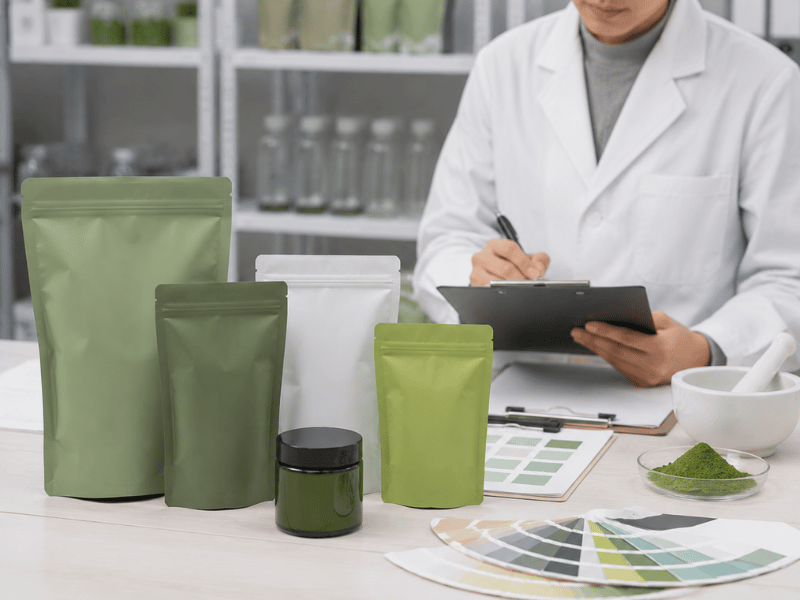
- Select a grade matched to your positioning and price point.
- Develop the formula, whether a single-origin powder or a functional blend.
- Design packaging that protects the powder and carries your brand.
- Confirm MOQ, pricing, and sample approval.
- Map the production and shipping timeline.
- Meet labeling and food-safety compliance for your market.
Key Takeaway: Treat matcha private label as seven sequenced, locked decisions rather than one order; each stage constrains the next, so working in order prevents the expensive backtracking that derails first launches.
White label, private label, or OEM: which model fits your matcha brand?
The right model depends on how much you compete on product specifics versus brand identity. Here’s the distinction that decides your whole budget: white label and private label put your brand on an existing product, while OEM builds a custom formula you own.
This is the most consequential early choice. White label is the fastest and cheapest route, ideal for validating demand before you invest. Full OEM offers the deepest differentiation but carries development fees that industry sources place in the USD 3,000 to 35,000 range, which only amortize sensibly across real volume. The experienced judgment: start white label or standard private label to prove your market, then graduate to OEM once demand is confirmed, because paying OEM development costs at launch volume can push your per-unit price beyond what the market will bear.
| Model | What you control | Cost & speed | Best for |
|---|---|---|---|
| White label | Logo and label only | Lowest cost, fastest | Validating demand quickly |
| Private label | Label, packaging, grade choice | Moderate | Brand-led differentiation |
| Full OEM | Custom formula you own | Highest, slowest | Product-led differentiation |
Key Takeaway: Match the model to your competitive edge; start white or private label to validate demand cheaply, and reserve full OEM, with its USD 3,000 to 35,000 development fees, for when confirmed volume can absorb the cost.
How do you choose the right grade for private label matcha?
You choose the grade by matching it to your brand positioning and price tier, because grade sets your customer and margin before anything else. Here’s the trap to avoid: defaulting to ceremonial grade because it sounds premium, then pricing yourself out of your actual market.
Grade is positioning. Ceremonial grade suits a premium, whisk-neat retail line, while culinary and premium grades power lattes, baking, and functional products at a workable cost. For a private-label latte mix or a matcha baking ingredient, a bold culinary grade outperforms ceremonial, whose delicate nuance is lost in milk and heat. AdoroHu organizes its range into an EU Grade Series (E-1 to E-7) and an Organic Grade Series (O-1 to O-6), so a brand can dial in the exact color-and-flavor point its product needs rather than overpaying for a tier the application wastes.
Key Takeaway: Let grade follow positioning, not prestige; ceremonial suits premium neat-drink lines, while culinary and premium grades serve lattes, baking, and blends, so match the grade to where your product actually competes.
What formula and blend options exist in matcha private label?
Private label matcha ranges from a single-origin powder to custom functional blends, and the choice shapes both your margin and your defensibility. Here’s the strategic move smart brands make: a custom blend escapes the “pure matcha” commodity trap where everyone competes on price.
Functional blending is the fastest-growing differentiation lever. Brands increasingly “stack” matcha with complementary ingredients, popular 2026 combinations include matcha with collagen for “beauty from within” positioning and matcha with lion’s mane for nootropic claims. A custom formula raises both your margin and your defensibility, since a competitor cannot copy a recipe they do not have. AdoroHu supports custom formula development and can pre-mix matcha with complementary tea powders for a signature blend, turning a commodity ingredient into a product only you sell.
Key Takeaway: Move beyond “pure matcha” with a custom blend; pairing matcha with functional ingredients like collagen or lion’s mane raises margin and creates a recipe competitors cannot copy, escaping pure price competition.
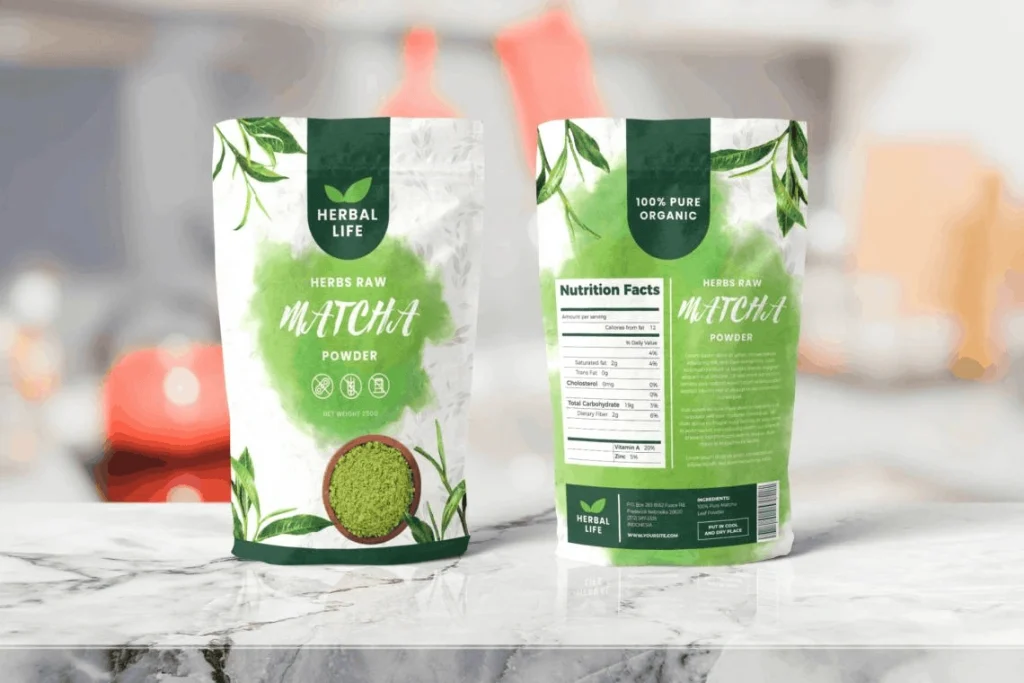
What packaging should you choose for private label matcha?
You should choose packaging that protects matcha from light and air while carrying your brand, because the wrong format degrades the product before the customer opens it. Here’s the non-negotiable: matcha is light- and oxygen-sensitive, so packaging is preservation first, aesthetics second.
The format choice ties directly to shelf life and cost. Tins with nitrogen flushing during sealing offer a 100 percent light and air barrier and can extend shelf life to 12 to 24 months, the gold standard for ceremonial grade. High-barrier foil-lined resealable pouches are cost-effective for culinary and bulk use, while single-serve sachets suit grab-and-go and sampling. AdoroHu offers retail formats spanning zip-lock pouches (30 g–500 g), tins and aluminium boxes (30 g–100 g), and single-serve 1–3 g sachets, so you can match format to grade and price tier.
Matching format to product
Choose the format that fits your grade and channel.
- Tins with nitrogen flush: premium grades, 12 to 24 month shelf life.
- High-barrier foil pouches: culinary and bulk, cost-effective.
- Single-serve sachets: grab-and-go, sampling, and trial sizes.
Key Takeaway: Choose packaging as preservation first; nitrogen-flushed tins protect premium grades for 12 to 24 months, while foil pouches and sachets suit culinary and trial formats, so match the barrier to your grade and shelf-life needs.
What MOQ and pricing should you expect in matcha private label?
Expect MOQ and pricing to scale with your model and packaging, from low pilot runs to larger committed orders. Here’s the number that protects your cash flow: a realistic starting MOQ lets you validate a channel before betting on volume.
Many origin manufacturers now support low pilot runs, with industry sources citing pilot MOQs as low as 5 kg to test channels without heavy inventory risk. Standard packaging keeps your entry cost down by avoiding custom mold fees, while custom tooling adds upfront cost. The deeper metric, as always, is cost-per-serving on landed cost, not the unit quote. Because AdoroHu prices by grade and quality and sets lead time against order volume, and supports sample approval first, a brand can request a private label quote structured around a realistic pilot rather than an oversized first commitment.
Key Takeaway: Start with a realistic pilot MOQ, as low as 5 kg in the industry, and lean on standard packaging to avoid mold fees; validating a channel before scaling protects cash flow far better than an oversized first order.
How long does the matcha private label process take?
The matcha private label process typically takes a few weeks to a couple of months, depending on customization and shipping. Here’s what first-time brands underestimate: production is only part of the clock, with sampling, approval, and freight stacked around it.
A streamlined private-label run, using standard packaging, can move quickly, with industry sources citing predictable end-to-end cycles of 22 to 30 days for origin-factory production. Custom formula development, bespoke packaging tooling, and sea freight each extend that. The experienced approach is to lock your specifications, color, mesh size, flavor, and fill weight, before scaling, because changes discovered after a production run mean starting the clock over. AdoroHu controls cultivation and milling in-house with a 3,000-tonne annual capacity, which keeps production timing predictable rather than dependent on a third-party mill’s queue.
Key Takeaway: Plan the full timeline, not just production; a standard-packaging run can move in 22 to 30 days, but custom tooling and sea freight extend it, so lock every specification before scaling to avoid restarting the cycle.
What compliance and labeling rules apply to private label matcha?
Private label matcha must meet your market’s food-safety and labeling rules, and the brand owner carries much of that legal responsibility. Here’s the risk that catches new brands: a beautiful product with a non-compliant label still gets seized at customs.
Two areas demand attention. First, facility-level food safety, where ISO 22000 and HACCP demonstrate a rigorous Food Safety Management System, alongside organic certifications matched to your market. Second, label claims: health statements like “boosts metabolism” must be phrased carefully, because the U.S. FDA’s rules on structure/function claims limit what a food label may say, and the EU enforces its own claims regulation through EFSA. The practical safeguard: confirm your manufacturer’s certifications are current and verifiable, and have label claims reviewed before printing. AdoroHu holds ISO 22000, FDA registration, USDA (NOP), EU Organic, and JAS, so a brand building a certified organic matcha line starts from a compliant foundation.
Key Takeaway: Treat compliance as a launch gate, not an afterthought; match facility certifications and organic credentials to your market, and have health claims reviewed against FDA or EFSA rules before printing, since the brand owner bears the labeling risk.
What mistakes derail a matcha private label launch?
The biggest mistake is treating private label as just branding and skipping the locked decisions underneath. Here’s the pattern across stalled launches: each shortcut maps to a specific, costly failure.
Watch for these traps, each with a named consequence.
- Paying full OEM development fees at launch volume, pricing yourself out of the market.
- Defaulting to ceremonial grade for a latte line, wasting margin on lost nuance.
- Skipping the spec lock, so batch two does not match batch one.
- Choosing pretty packaging without a light barrier, degrading the product on the shelf.
- Printing health claims without compliance review, risking a customs seizure.
Each is avoidable with sequencing and the right partner. A vertically integrated manufacturer offering complementary lines like hojicha powder and full documentation removes most of these risks in one relationship.
Key Takeaway: Stop treating private label as branding alone; lock your model, grade, specs, packaging barrier, and label compliance in sequence, because each skipped decision carries a specific cost that can derail the entire launch.
FAQ
- What is the difference between white label, private label, and OEM matcha?
- White label and private label put your brand on an existing matcha product, with white label being the fastest and cheapest to launch. Full OEM builds a custom formula you own, offering the most differentiation but carrying development fees often in the USD 3,000 to 35,000 range that only amortize across real volume.
- What is the minimum order quantity for private label matcha?
- MOQ varies by model and packaging. Many origin manufacturers now support low pilot runs, with industry sources citing pilots as low as 5 kg to test a channel without heavy inventory risk. Using standard packaging avoids custom mold fees and keeps the entry cost down before scaling.
- How long does it take to launch a private label matcha product?
- A streamlined run using standard packaging can move in a predictable 22 to 30 day end-to-end cycle at an origin factory. Custom formula development, bespoke packaging tooling, and sea freight each extend that, so lock all specifications before scaling to avoid restarting the timeline.
- What grade of matcha should I use for a private label brand?
- Match the grade to your positioning. Ceremonial grade suits a premium, whisk-neat retail line, while culinary and premium grades power lattes, baking, and functional products at a workable cost. Defaulting to ceremonial for a latte or baking line wastes margin on nuance lost in milk and heat.
- What compliance is required for a private label matcha product?
- You need facility-level food safety such as ISO 22000 and HACCP, plus organic certifications matched to your market like USDA, EU, or JAS. Health claims must be phrased to comply with FDA structure/function rules in the US or EFSA rules in the EU, since non-compliant labels can get inventory seized at customs.
Conclusion
Matcha private label is a seven-stage process, from choosing a model and grade through formula, packaging, MOQ, timeline, and compliance, where locking each decision in order protects both cost and consistency. The practical takeaway is to start with a model that matches your competitive edge, lock specifications before scaling, and partner with a vertically integrated manufacturer that carries you through every stage. To build your brand from grade selection to compliant launch, contact AdoroHu Matcha to request samples, a custom formula consultation, and a private label quote matched to your volume.