In today’s hyper-competitive wellness market, consumers are no longer satisfied with generic health claims; they demand functional ingredients that deliver measurable results. For many brands, the challenge lies in differentiating a product line without sacrificing margins or supply chain stability. If your business fails to leverage science-backed ingredients, you risk losing shelf space to more innovative competitors. By integrating high-quality green tea powder into your formulations, you can capitalize on the extensive matcha benefits that health-conscious demographics actively seek. Utilizing a premium ceremonial grade ensures your brand meets the highest standards of taste and efficacy.
The primary matcha benefits backed by science include high concentrations of EGCG antioxidants for metabolic health, L-theanine for sustained cognitive focus without the “caffeine crash,” and chlorophyll for detoxification. For B2B entities, these benefits translate into high-demand functional properties for food, beverage, and nutraceutical product development.
Summary Section
In short:
Matcha provides a multifaceted nutritional profile that enhances both physical and mental performance, making it a versatile ingredient for modern B2B applications.
Key points:
- Superior antioxidant density compared to standard steeped teas.
- Synergistic caffeine and L-theanine for “calm alertness.”
- Clean-label appeal for health-conscious and organic-focused markets.
Why should your business prioritize the unique matcha benefits for long-term commercial success?
Prioritizing the unique matcha benefits allows your business to align with the global shift toward functional “superfoods” that offer more than just basic nutrition. In the current B2B landscape, the matcha benefits of high antioxidant content and cognitive enhancement are significant drivers for consumer purchasing decisions. Here is the truth: a product that solves a consumer’s need for both energy and stress management will always outperform a one-dimensional stimulant.
Market Advantages
- Consumer Trust: Science-backed claims build brand authority.
- Premium Positioning: Matcha commands higher price points than standard green tea.
- Versatility: Applicable in everything from RTD beverages to skincare.
Key Takeaway: Businesses that lead with functional benefits capture a more loyal and less price-sensitive customer base.
How do different matcha grades impact wholesale pricing and the perceived benefits of matcha in your product line?
Different matcha grades directly influence the cost-of-goods-sold (COGS) and the specific benefits of matcha that your end consumer experiences. While ceremonial grades provide the best color and amino acid profile for lattes, culinary matcha offers a stronger flavor profile and cost-efficiency for industrial baking and large-scale food manufacturing. But that is not all: the grade also determines the antioxidant yield per serving, which is critical for labeling accuracy.
| Grade | Primary Use Case | Flavor Profile | Color Intensity | |
|---|---|---|---|---|
| Ceremonial | Traditional Whisking | Delicate, Sweet | Vibrant Jade | |
| Premium | Lattes & Smoothies | Balanced, Creamy | Bright Green | |
| Culinary | Baking & Confectionery | Robust, Astringent | Olive Green |
Key Takeaway: Matching the correct grade to your specific application optimizes both the sensory experience and the nutritional delivery.
What should procurement teams look for in a supplier to guarantee consistent matcha health benefits across batches?
Procurement teams must prioritize suppliers that offer rigorous testing protocols and origin transparency to ensure that the matcha benefits remain consistent across every shipment. Fluctuations in soil quality or harvest timing can significantly alter the levels of L-theanine and catechins in the final powder. Look at it this way: your product’s efficacy is only as reliable as your supplier’s last lab report.
Supplier Vetting Checklist
- Batch Testing: COAs (Certificates of Analysis) for heavy metals and radiation.
- Origin Documentation: Direct sourcing from reputable regions like Uji or Kagoshima.
- Processing Standards: Verification of granite stone-milling versus high-heat pulverization.
Key Takeaway: A transparent supply chain is the only way to safeguard the functional integrity of your matcha-infused products.
Which quality standards and certifications best validate the organic benefits of matcha powder to global buyers?
The most effective way to validate the organic benefits of matcha powder is through internationally recognized certifications like USDA Organic, JAS, and EU Organic. For B2B buyers, these seals of approval are shorthand for a lack of synthetic pesticides and a commitment to soil health, which directly impacts the purity of the matcha benefits your brand promotes. To meet the demands of the “clean-label” movement, sourcing organic matcha is no longer optional—it is a requirement.
| Certification | Region | Key Requirement | |
|---|---|---|---|
| USDA Organic | United States | No synthetic fertilizers or prohibited pesticides. | |
| JAS | Japan | Strict adherence to Japanese Agricultural Standards. | |
| EU Organic | European Union | Rigorous inspection of the entire production chain. |
Strategic Certification Value
- Market Access: Essential for entry into major retail chains.
- Consumer Transparency: Satisfies the demand for “farm-to-table” visibility.
- Risk Mitigation: Reduces the likelihood of chemical contamination recalls.
Key Takeaway: Certifications provide the empirical evidence necessary to support high-level marketing claims about purity and health.
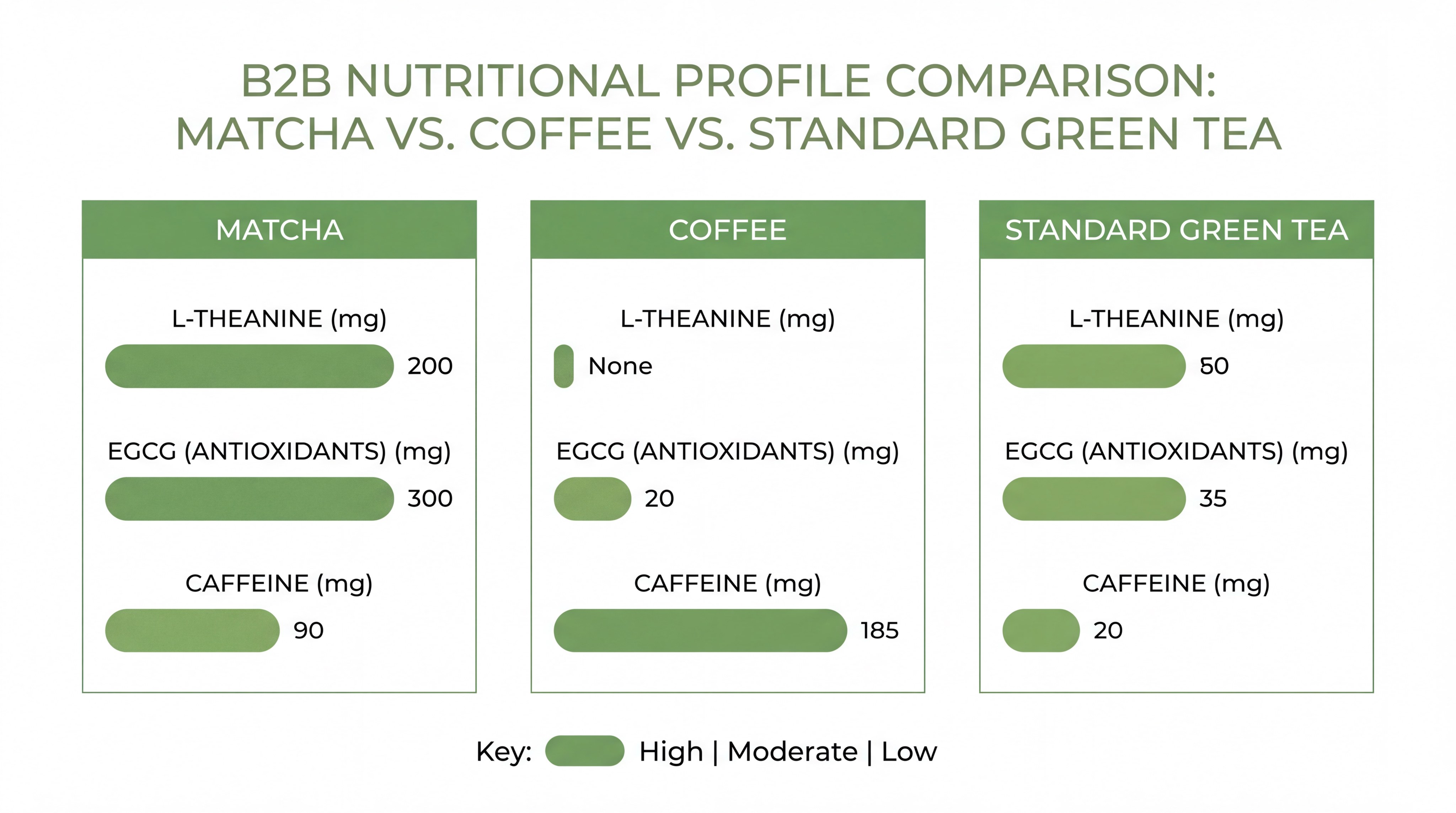
How do the functional nutritional benefits of matcha compare to coffee and standard green tea extracts in a competitive market?
Matcha offers a superior nutritional profile compared to coffee and standard green tea extracts because it provides a slow-release energy boost without the jittery side effects. The primary matcha benefits stem from the fact that consumers ingest the entire leaf, rather than just the water extract, resulting in significantly higher concentrations of polyphenols. Think about this: one serving of matcha can contain up to 137 times more EGCG than certain varieties of steeped green tea.
Comparison Points
- Energy Delivery: Coffee spikes cortisol; matcha provides sustained focus.
- Antioxidant Load: Matcha far exceeds coffee in ORAC (Oxygen Radical Absorbance Capacity) values.
- L-Theanine Content: Absent in coffee, but abundant in matcha for stress reduction.
Key Takeaway: Positioning matcha as the “smarter” alternative to coffee allows brands to target the high-performance and biohacking market segments.
What are the high-growth use cases for incorporating matcha tea benefits into food, beverage, and supplement formulations?
High-growth use cases for matcha tea benefits are currently concentrated in the RTD (Ready-to-Drink) beverage, functional snacking, and “beauty-from-within” supplement sectors. Developers are increasingly using matcha in baking and food manufacturing to create products that appeal to the wellness-conscious professional. Here is the truth: the vibrant green hue of matcha is a powerful “Instagrammable” asset that drives organic marketing growth.
Top Growth Sectors
- Functional Beverages: Matcha-based energy drinks and protein shakes.
- Confectionery: Health-focused chocolates and energy balls.
- Nutraceuticals: Nootropic capsules and weight-management powders.
| Sector | Application | Consumer Benefit | |
|---|---|---|---|
| Sports Nutrition | Pre-workout powder | Metabolic boost & focus | |
| Personal Care | Face masks | Antioxidant skin protection | |
| Beverage | Bottled lattes | Convenient healthy energy |
Key Takeaway: Innovation in application is the key to unlocking new revenue streams within the matcha category.
How can a private label or OEM strategy help your brand capture the value of premium matcha-derived benefits?
A private label or OEM strategy enables your brand to bring high-quality products to market quickly, allowing you to focus on marketing the matcha benefits while experts handle the technical production. By partnering with a specialized private label matcha provider, you gain access to established supply chains and R&D expertise. But that is not all: OEM partners often have existing certifications that would take years for a new brand to acquire independently.
Benefits of OEM Partnerships
- Speed to Market: Reduce development timelines by months.
- Quality Control: Leverage the manufacturer’s existing QA/QC protocols.
- Customization: Develop unique blends tailored to specific demographic needs.
Key Takeaway: Outsourcing production to a matcha specialist allows for rapid scaling without the overhead of manufacturing facilities.
What role do logistics and MOQs play in maintaining the potency of fresh matcha benefits for wholesale buyers?
Logistics and Minimum Order Quantities (MOQs) are critical factors because they determine the freshness and, consequently, the nutritional potency of the matcha benefits provided to your customers. Matcha is highly susceptible to oxidation; once exposed to light, heat, or air, its vibrant color and antioxidant levels begin to degrade. Look at it this way: a massive bulk order might save on unit cost, but if the product sits in a warehouse for six months, the quality—and your brand reputation—will suffer.
Logistics Best Practices
- Small, Frequent Shipments: Keeps inventory fresh and vibrant.
- Cold Chain Storage: Essential for maintaining the amino acid profile.
- Opaque Packaging: Prevents UV degradation of chlorophyll.
Key Takeaway: Optimizing your supply chain for freshness is just as important as the initial ingredient selection.

Which common purchasing mistakes undermine the actual matcha benefits received by B2B clients?
Common purchasing mistakes, such as prioritizing the lowest price over origin or color, directly undermine the actual matcha benefits and the efficacy of your final product. Many buyers mistakenly choose low-quality powders for cafe and latte applications , resulting in a bitter, unappealing beverage that drives customers away. Think about this: saving 10% on ingredient costs can lead to a 50% drop in customer retention if the taste profile is compromised.
Mistakes to Avoid
- Buying by Price Alone: Often leads to “sencha powder” being sold as matcha.
- Ignoring Harvest Dates: Older powder loses its functional potency.
- Poor Storage Planning: Failing to use airtight, temperature-controlled environments.
Key Takeaway: Quality-first procurement is a long-term investment in brand equity and product performance.
What future industry trends will redefine how businesses market science-backed matcha benefits to modern consumers?
Future industry trends suggest a shift toward hyper-specific marketing of matcha benefits, focusing on gut health, neuroprotection, and personalized nutrition. As consumers become more educated, they will look for secondary powders like hojicha powder for lower-caffeine alternatives or specialized matcha blends for specific health goals. Here is the truth: the brands that survive will be those that can back their marketing with transparent, data-driven claims.
Emerging Trends
- Micro-dosing in Snacks: Low-dose matcha integration for subtle focus.
- Traceability Tech: QR codes on packaging showing the exact farm of origin.
- Synergistic Blends: Combining matcha with mushrooms or adaptogens for enhanced effects.
Key Takeaway: Staying ahead of the trend curve requires a deep understanding of both the science and the shifting consumer psyche.
FAQ
- Q: Is matcha more effective for weight loss than standard green tea?
- Yes, because you consume the whole leaf in powder form, the concentration of EGCG—which is linked to thermogenesis and fat oxidation—is significantly higher in matcha.
- Q: How does the caffeine in matcha differ from coffee?
- Matcha contains L-theanine, an amino acid that promotes relaxation without drowsiness, which slows the absorption of caffeine for a steady 4-6 hour energy boost.
- Q: Can matcha be used in high-heat baking without losing health benefits?
- While some delicate antioxidants are heat-sensitive, many of the minerals and robust polyphenols remain intact, especially when using a high-quality culinary grade.
- Q: What is the shelf life of wholesale matcha powder?
- When stored in a cool, dark place in airtight containers, matcha maintains peak freshness for 6-12 months, though it is best used within 2 months of opening.
- Q: Why is organic matcha often more expensive?
- Organic farming requires more labor-intensive pest management and specialized fertilizers, but it guarantees the absence of synthetic chemicals in the final concentrated powder.
Conclusion
The science-backed benefits of matcha present a transformative opportunity for B2B brands looking to innovate in the functional food and beverage space. By understanding the nuances of grades, certifications, and supply chain logistics, your business can deliver products that truly resonate with the modern, health-conscious consumer. Whether you are launching a new latte line or developing a high-performance supplement, the foundation of your success lies in the quality of your raw materials.
Ready to elevate your product line with premium, wholesale matcha? Contact us today for a custom quote and samples tailored to your brand’s unique needs.