Ceremonial vs Culinary Matcha: Which Grade Should You Source?
Ceremonial and culinary matcha differ in leaf selection, flavor, color, and intended use: ceremonial grade comes from the youngest first-harvest leaves and is made for whisking neat, while culinary grade uses slightly later leaves with a bolder flavor built for lattes, baking, and blends. Here’s the problem that trips up most buyers: they assume “ceremonial” simply means “better” and pay a premium for the wrong grade.
That assumption is expensive. A café paying ceremonial prices for a latte base wastes margin on subtle umami that milk and syrup erase. A bakery buying a cheap, dull culinary powder ends up with grey, bitter pastries that hurt repeat sales. A private-label brand that never matches grade to product launches something inconsistent and overpriced. Getting ceremonial vs culinary matcha right is a sourcing decision, not a taste preference. This guide breaks down every real difference, then shows which grade to order for each application and how to spec it from a supplier like AdoroHu Matcha so you pay for performance, not prestige.
Ceremonial matcha is made from the youngest first-flush (ichibancha) shade-grown leaves, stone-milled for a smooth, sweet, umami-rich flavor meant to be whisked with water and drunk neat. Culinary matcha uses slightly more mature leaves with higher catechin content, giving a bolder, more astringent flavor that holds up in lattes, baking, smoothies, and desserts. Neither is universally “better”; the right grade depends entirely on the end product.
In short: ceremonial is built for drinking neat, culinary is built for mixing, and the correct choice depends on your application and budget, not on prestige.
Key points:
- Ceremonial uses first-harvest leaves for smooth, sweet, drink-neat flavor.
- Culinary uses later leaves for bold flavor that survives milk, sugar, and heat.
- For B2B buyers, the deciding factors are application, cost-per-serving, and consistency.
What is the core difference between ceremonial vs culinary matcha?
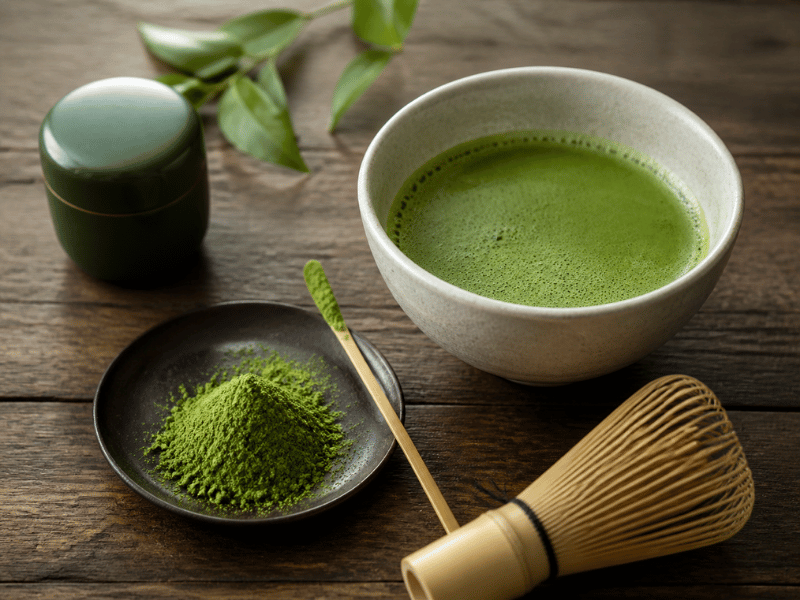
The core difference between ceremonial vs culinary matcha lies in which leaves are used and what the powder is designed to do. Ceremonial grade is made from first-flush spring leaves, called ichibancha, picked from the youngest tips of bushes shaded for roughly 20 to 30 days. That shading builds chlorophyll and L-theanine, producing a smooth, sweet, umami-forward powder for whisking neat.
Here’s what sets culinary apart: it uses leaves harvested slightly later or lower on the bush, with more sun exposure. Those leaves carry higher catechin levels, which read as bolder and more astringent. The result is a robust flavor that cuts through milk, sugar, and butter. Both grades are real matcha from the same plant, Camellia sinensis, and both can be high quality. AdoroHu produces both across an EU Grade Series (E-1 to E-7), so a buyer can pick an exact point on the spectrum rather than a vague “grade.”
Key Takeaway: Ceremonial uses the youngest first-flush leaves for drinking neat; culinary uses later leaves for a bolder flavor built to mix, and both are legitimate matcha.
How do ceremonial vs culinary matcha compare side by side?
Side by side, ceremonial vs culinary matcha differ across six measurable traits: harvest, color, texture, flavor, price, and use. Rather than memorize prose, most buyers find a direct comparison faster to act on. Here’s how the two grades stack up on the attributes that affect a purchasing decision.
| Attribute | Ceremonial grade | Culinary grade |
|---|---|---|
| Leaf / harvest | First flush (ichibancha), youngest tips | Later flush or lower leaves, more sun |
| Color | Deep, vivid jade-green | Strong green, can be slightly more subdued |
| Texture | Ultra-fine, talc-like | Fine, occasionally slightly coarser |
| Flavor | Smooth, sweet, umami, low bitterness | Bold, robust, more astringent |
| Relative price | Highest | More cost-efficient |
| Best use | Whisked neat, tasting | Lattes, baking, smoothies, blends |
Notice the pattern: as you move toward mixed applications, culinary grade delivers more usable flavor per dollar. For drink-neat products you’d specify ceremonial grade matcha, while culinary grade matcha is engineered for recipes and blended drinks.
Key Takeaway: Compare across harvest, color, texture, flavor, price, and use; the table shows culinary wins on cost-efficiency for mixing while ceremonial wins on neat-drinking smoothness.
Why does ceremonial vs culinary matcha taste so different?
Ceremonial vs culinary matcha taste different because leaf age and sun exposure change the balance of two key compounds. Let’s break down the chemistry simply. Younger, heavily shaded leaves are rich in L-theanine, the amino acid behind matcha’s sweetness and smooth umami. That’s why ceremonial grade tastes mellow enough to drink with water alone.
Culinary grade tells the opposite story. Its leaves get more sunlight, which raises catechin content, the polyphenols responsible for bitterness and astringency. That bolder profile is a feature, not a flaw: it lets the matcha flavor survive dilution by milk, sweetener, or batter. Think of it like cooking wine versus a sipping wine; each is made for a different job. This is exactly why a robust grade outperforms a delicate one in a latte or a cake.
Key Takeaway: Shading and leaf age shift the L-theanine-to-catechin balance; ceremonial tastes sweet and smooth for sipping, while culinary tastes bold to survive mixing.
Which grade wins on color, and why does it matter commercially?
For pure visual punch, ceremonial grade usually shows the most vivid green, but a quality culinary grade still delivers strong color that matters more commercially. Here’s the thing buyers overlook: in a finished product, color sells. A bright green latte or pastry signals freshness and quality, and that visual often drives the repeat order.
Color comes from chlorophyll, which shade-growing maximizes. Ceremonial’s heavier shading gives it the deepest jade tone. But for mixed applications, a vivid culinary grade holds enough color to read as bright green even after blending, at a fraction of ceremonial’s cost. AdoroHu controls shading at its own 350-hectare estate and finishes through a 20-unit stone mill with ultrasonic screening, so green is built into the leaf and preserved through milling. For a matcha latte menu, that engineered color is a commercial asset.
Key Takeaway: Ceremonial shows the deepest green, but a vivid culinary grade delivers commercially sufficient color for mixed products at lower cost, so match color spend to where the drink is seen.
How big is the price gap between ceremonial vs culinary matcha?
Ceremonial grade consistently costs more than culinary grade because first-flush leaf selection is far more restrictive. Let’s put real logic behind the number. Ceremonial uses only the youngest spring tips, a small, labor-intensive yield, while culinary draws on later, more abundant harvests. That supply difference drives the price gap.
For a B2B buyer, the figure that actually matters is cost-per-serving, not the price on a tin. At around 1.5 grams per drink, a 1-kilogram bag yields roughly 660 servings, so paying a ceremonial premium across thousands of mixed drinks burns margin on flavor customers cannot detect. Because AdoroHu prices by grade and quality and quotes lead time against order volume, buyers get a number tied to their real spec. Sourcing in bulk supply (20 kg or 25 kg cartons with sealed food-grade liners) lowers per-gram cost sharply, and you can request a quote matched to grade and volume.
Key Takeaway: Ceremonial costs more due to scarce first-flush leaves; for mixed products, calculate cost-per-serving and avoid overpaying for nuance that blending erases.
Which grade should you choose for lattes, baking, and beverages?
For lattes, baking, smoothies, and most beverages, culinary grade is the right choice, while premium or ceremonial grade suits drinks where matcha is the star. The deciding question is simple: does the matcha flavor need to survive other ingredients, or shine alone? That answer points to the grade.
Matching grade to application
Use this framework to match the grade to your product line.
- Whisked neat or tasting menus: ceremonial grade for smooth, sweet flavor.
- Signature or “clean-label” lattes: premium grade for balance that holds up in milk.
- High-volume café lattes, smoothies, iced drinks: culinary grade for bold, cost-efficient flavor.
- Baking, pastry, ice cream, desserts: culinary grade to cut through sugar, fat, and heat.
For matcha baking, a robust culinary grade keeps true green color and flavor after the oven, where a delicate ceremonial powder would simply fade.
Key Takeaway: Choose culinary grade for anything mixed or baked, and reserve ceremonial or premium for products where matcha is meant to be tasted on its own.
Do ceremonial vs culinary matcha differ in health benefits?
No, ceremonial vs culinary matcha do not differ meaningfully in core health benefits, since both are whole-leaf green tea powders from the same plant. Here’s a myth worth clearing up: many buyers assume ceremonial is “healthier.” Both grades deliver antioxidants, catechins like EGCG, caffeine, and L-theanine.
The nuance is in the ratio, not the presence. Ceremonial’s younger leaves carry more L-theanine, giving calmer, smoother energy. Culinary’s later leaves carry more catechins, the very compounds many antioxidant claims rest on. So neither is universally “more nutritious.” For a brand making a wellness claim, this matters: you can position a cost-efficient culinary grade on its antioxidant profile without overpaying for ceremonial.
Key Takeaway: Both grades share the same nutrient family; the difference is a ratio of L-theanine to catechins, so neither is universally healthier and culinary supports wellness positioning too.
Which grade is right for private label and OEM products?
The right grade for a private-label or OEM product depends on your market position, and most beverage and food brands build their lines on culinary or premium grade. Think about it: a retail latte mix, a bakery ingredient, or a grab-and-go sachet all need bold, consistent flavor at a workable cost, which points to culinary or premium rather than ceremonial.
AdoroHu supports full private label and OEM production, from grade selection and custom formula development to retail-ready packaging. Practical formats span single-serve 1–3 g sachets, zip-lock pouches (30 g–500 g), tins and aluminium boxes (30 g–100 g), and bulk cartons. A brand can even commission a custom blend that pre-mixes a chosen grade with complementary tea powders for a signature product no competitor can copy.
Key Takeaway: Match grade to market position; culinary or premium grade powers most private-label launches, and a custom blend with tailored packaging turns a commodity into a branded product.
How do you verify ceremonial vs culinary matcha quality before ordering?
You verify grade quality before ordering by combining sample evaluation with documentation, because a grade label alone proves nothing. Here’s what experienced buyers check: both the sensory signs and the paperwork, since a “ceremonial” sticker on a dull powder is meaningless.
Evaluate a sample for vivid color, ultra-fine texture, fresh aroma, and the flavor profile that matches the claimed grade. Then confirm a batch-specific Certificate of Analysis (COA) covering heavy metals, pesticide residue, and microbiology. AdoroHu backs quality with a 1,000 m² purification workshop, two German metal-detection systems, a Japanese sterilization line, and certifications including ISO 22000, FDA registration, USDA (NOP), EU Organic, and JAS. A buyer building a certified organic matcha line should match the certificate to the target market.
Key Takeaway: Verify the actual powder, not the label; pair sample evaluation against a batch-specific COA and certifications so the grade you pay for is the grade you receive.
What mistakes do buyers make choosing ceremonial vs culinary matcha?
The biggest mistake is treating ceremonial vs culinary matcha as a quality ranking instead of a use-based choice. Buyers repeatedly fall into the same traps, and each one carries a cost. Let’s name them clearly.
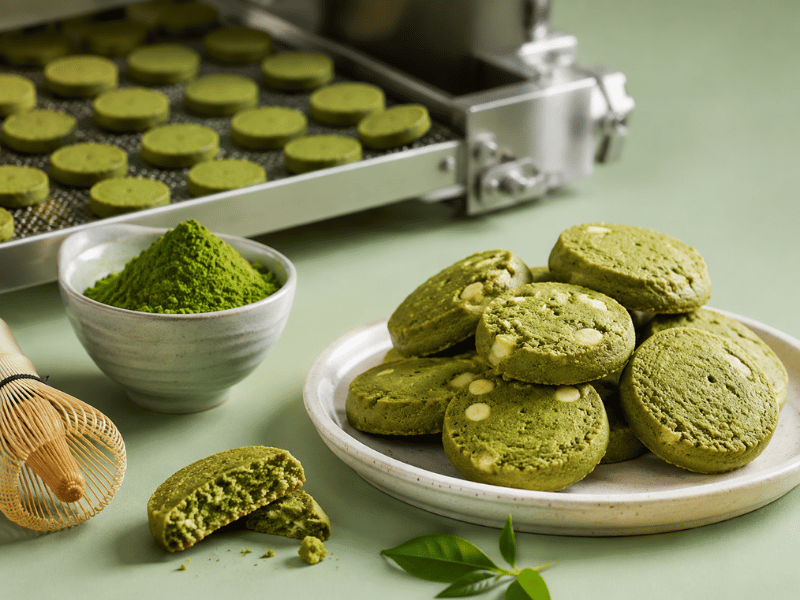
First, over-buying ceremonial grade for mixed drinks, paying for nuance that milk and sugar destroy. Second, under-buying a dull, bitter culinary powder that turns lattes and pastries grey. Third, ignoring cost-per-serving and only comparing tin prices. Fourth, sourcing from a trader with no estate control, so color and flavor drift between batches. A supplier that owns its premium matcha supply chain end-to-end removes that last and most damaging risk.
Key Takeaway: Stop ranking the grades and start matching them to use; evaluate application, cost-per-serving, and batch consistency to avoid the errors that quietly drain margin.
FAQ
- Is ceremonial matcha better than culinary matcha?
- Not universally. Ceremonial grade is made from younger first-flush leaves for drinking neat, while culinary grade is built for mixing into lattes, baking, and smoothies. Neither is “better”; the right grade depends entirely on your intended application and budget.
- Can I use culinary matcha for lattes, or do I need ceremonial?
- Culinary grade works very well for lattes because its bolder flavor holds up against milk and sweetener at a lower cost. Premium grade is a step up for signature drinks, while ceremonial is usually best reserved for whisking neat.
- Why is ceremonial matcha more expensive?
- Ceremonial grade uses only the youngest first-flush spring leaves, a limited and labor-intensive harvest. Culinary grade draws on more abundant later harvests, making it more cost-efficient. For mixed products, cost-per-serving matters more than the tin price.
- Do ceremonial and culinary matcha have different health benefits?
- Both are whole-leaf green tea powders with antioxidants, catechins, caffeine, and L-theanine. Ceremonial has more L-theanine and culinary has more catechins, but neither is meaningfully healthier; the difference is a ratio, not the presence of nutrients.
- Which grade should I choose for a private-label product?
- Most private-label lattes, baked goods, and retail products use culinary or premium grade for bold, consistent flavor at a workable cost. AdoroHu supports grade selection, custom formula development, and packaging from single-serve sachets to bulk cartons.
Conclusion
Ceremonial vs culinary matcha is a sourcing decision, not a quality ranking: ceremonial is built for drinking neat, culinary for mixing, and the right grade depends on your product and cost-per-serving. The practical takeaway is to match grade to application and verify quality with samples plus a COA from a vertically integrated supplier. To match the right grade to your product and get pricing tied to your volume, contact AdoroHu Matcha to request a sample or a wholesale quote.