Matcha and green tea powder are not the same: matcha is a shade-grown, stone-milled powder made from tencha leaves, while green tea powder is usually unshaded green tea like Sencha simply ground into powder. Here’s the confusion that costs buyers real money: the two terms get used interchangeably, yet they differ in processing, flavor, cost, and, critically, in how they can legally be labeled.
That mix-up has consequences. A manufacturer who pays matcha prices for what is really ground green tea powder overspends; one who sells ground Sencha powder as “matcha” in the U.S. or EU risks a labeling violation, since enforcement against mislabeled green tea powder has tightened since 2024. A beverage brand that picks the wrong powder ends up with the wrong color, flavor, and cost structure. The matcha vs green tea powder distinction is a sourcing and compliance decision. This guide breaks down every real difference, then shows which to source for each application and how to spec it from a supplier like AdoroHu Matcha.
Matcha is made from shade-grown tea leaves (tencha) that are steamed, de-stemmed, de-veined, and stone-milled into an ultra-fine powder meant to be whisked and consumed whole. Green tea powder is typically unshaded green tea, such as Sencha, ground into powder, with a bolder, more astringent flavor, a coarser texture, and a lower cost. Both come from Camellia sinensis, but only shaded, tencha-derived powder qualifies as true matcha in major markets.
In short: matcha is shaded, stone-milled tencha built for whisking, while green tea powder is usually unshaded ground leaf at a lower cost, and the two are not interchangeable for labeling.
Key points:
- Matcha comes from shade-grown tencha; most green tea powder is unshaded Sencha simply ground.
- Matcha tastes smoother and costs more; green tea powder is bolder and cheaper.
- For buyers, the labeling distinction matters: only tencha-derived powder is true matcha in the U.S. and EU.
What is the core difference between matcha vs green tea powder?
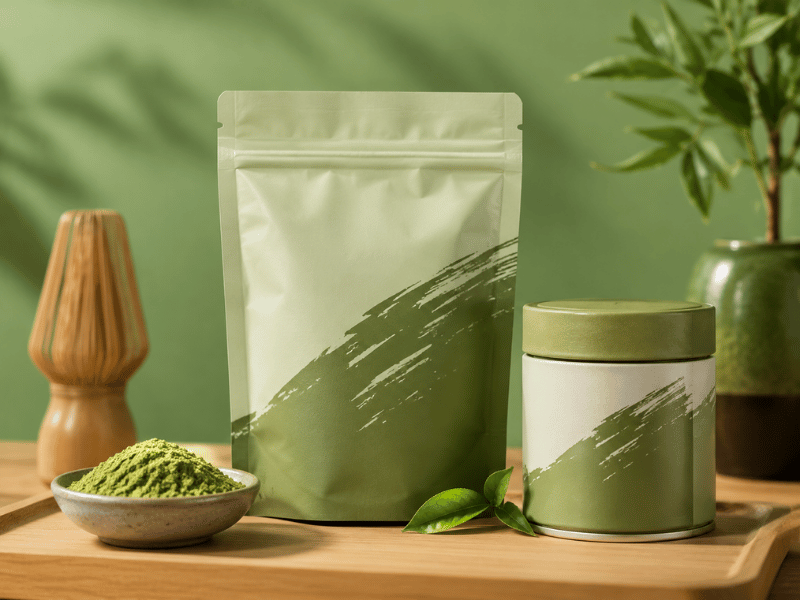
The core difference between matcha vs green tea powder is shade-growing and milling, not just the fact that both are powders. Matcha starts as tencha: leaves shade-grown for about three weeks, then steamed, de-stemmed, de-veined, and slowly stone-milled. Green tea powder, by contrast, is usually Sencha or similar unshaded leaf simply ground into powder.
Here’s why that matters: shading builds chlorophyll and L-theanine, giving matcha its vivid green and smooth umami. Unshaded leaves get full sun, raising catechins and producing a bolder, more astringent powder. Both come from Camellia sinensis, but the processing diverges sharply. AdoroHu produces true matcha through a 20-unit stone mill plus ball-mill lines, and separately offers a green tea powder line, so buyers can source the exact category they need from one estate.
Key Takeaway: Matcha is shaded tencha that is stone-milled; most green tea powder is unshaded leaf simply ground, so the difference is cultivation and processing, not just particle form.
How do matcha vs green tea powder compare side by side?
Side by side, matcha vs green tea powder differ across cultivation, processing, color, texture, flavor, and price. Rather than parse prose, most buyers act faster on a direct comparison. Here’s how the two categories stack up on the traits that drive a purchasing decision.
| Attribute | Matcha | Green tea powder |
|---|---|---|
| Cultivation | Shade-grown (~3 weeks) | Usually unshaded (full sun) |
| Source leaf | Tencha | Sencha or similar |
| Processing | Steamed, de-veined, stone-milled | Leaf ground into powder |
| Color | Vivid jade-green | Lighter to olive green |
| Texture | Ultra-fine (around 10 microns) | Coarser, more variable |
| Flavor | Smooth, sweet, umami | Bolder, grassier, astringent |
| Relative cost | Higher (labor-intensive) | Lower |
Notice the trade-off: matcha costs more for smoothness and color, while green tea powder offers a cost-efficient green tea flavor for mixing. For products where matcha quality matters, you would specify premium matcha rather than a generic ground powder.
Key Takeaway: The table shows matcha winning on color, texture, and smoothness while green tea powder wins on cost; match the category to whether appearance and flavor purity justify the premium.
Why does matcha cost more than green tea powder?
Matcha costs more than green tea powder because shade-growing and stone-milling are far more labor-intensive. Let’s break down where the cost goes. Shading requires covering the bushes for weeks, which lowers yield. De-stemming and de-veining add labor. Stone-milling is slow, producing an ultra-fine powder around 10 microns.
For a B2B buyer, the figure that matters is cost-per-serving against your real order. Ground green tea powder skips shading and the tencha process, so it lands at a notably lower price point and suits high-volume ingredient use. Because AdoroHu prices by grade and quality and quotes lead time against order volume, buyers get a number tied to their spec, not a fixed markup. Sourcing in bulk supply (20 kg or 25 kg cartons with sealed food-grade liners) lowers per-gram cost, and you can request a quote matched to category and volume.
Key Takeaway: Matcha’s premium reflects shading, de-veining, and slow stone-milling; for cost-sensitive ingredient use, green tea powder delivers green tea character at a lower price, so judge by cost-per-serving.
Do matcha vs green tea powder differ in caffeine and nutrients?
Yes, matcha generally delivers more concentrated caffeine and nutrients than steeped green tea, though ground green tea powder narrows that gap. Here’s the key mechanism: because matcha is consumed as a whole powdered leaf, you ingest everything, unlike steeped tea where leaves are discarded.
A standard 2-gram serving of matcha delivers roughly 60 to 80 mg of caffeine, while a cup of steeped green tea averages about 25 to 40 mg. Both contain L-theanine, the amino acid that smooths caffeine’s effect, and catechins like EGCG. Green tea powder, since it is also consumed whole, carries more concentrated compounds than steeped tea, but its unshaded leaves typically have less L-theanine than shaded matcha. The nutrient story depends on whether the powder is whisked-and-consumed or steeped.
Key Takeaway: Matcha is the most concentrated because you consume the whole shaded leaf; green tea powder consumed whole is also potent, but steeped green tea delivers less since the leaves are discarded.
Which is better for lattes and beverages, matcha vs green tea powder?
For lattes and signature beverages, matcha is usually the better choice because its color and umami carry through milk, while green tea powder suits cost-led or functional drinks. Here’s the practical reality: a matcha latte sells partly on its vivid green and smooth taste, which an unshaded ground powder struggles to match.
Matcha’s fine particle size suspends evenly in milk and holds a bright jade tone, key for a photogenic drink. Green tea powder can work in RTD or functional beverages where a green tea flavor and lower cost matter more than premium color. For a matcha latte program, a culinary or premium matcha is the right base. A bolder profile that survives milk and ice points to culinary grade matcha rather than a generic green powder.
Key Takeaway: Choose matcha for lattes and signature drinks where color and umami sell; reserve green tea powder for cost-led or functional beverages where premium appearance is not the priority.
Which performs better in baking and food manufacturing?
For baking and food manufacturing, the choice depends on whether true matcha color and flavor are essential or a cost-efficient green note will do. Think about it this way: in a high-heat or sugar-heavy product, you need a powder bold enough to survive, and that can favor either category depending on your goal.
Matching the powder to the product
Use this logic to decide between matcha and green tea powder.
- Premium bakery and confectionery where green color sells: culinary matcha for vivid, stable color.
- High-volume RTD, supplements, or fortification: green tea powder for cost-efficient antioxidant and flavor input.
- Ice cream and dessert where appearance is central: matcha for true jade tone.
- Cost-driven mixes where a green tea note suffices: ground green tea powder.
For a matcha baking line, a robust culinary matcha keeps real green color after the oven, where a cheaper ground powder may turn dull or brown.
Key Takeaway: Use culinary matcha when true green color and flavor are essential to the finished product; choose green tea powder for cost-led fortification where a simpler green note is acceptable.
What labeling rules separate matcha vs green tea powder?
Labeling is where matcha vs green tea powder becomes a compliance issue, because only shaded, tencha-derived powder is recognized as true matcha in major markets. Here’s the trap that catches importers: selling unshaded ground green tea powder as “matcha” can trigger a labeling violation.
In the U.S., the FDA has no formal matcha definition, but the informal industry standard requires shaded, tencha-derived powder, and enforcement against mislabeled Sencha powder as matcha has increased since 2024. Sencha-derived products should be labeled “green tea powder.” The EU applies its own labeling rules. For a brand importing into regulated markets, this distinction protects against seized or relabeled shipments. A supplier that produces and documents both categories correctly removes that risk.
Key Takeaway: Only shaded tencha-derived powder qualifies as matcha in the U.S. and EU; label unshaded ground leaf as “green tea powder” to avoid violations, since enforcement has tightened since 2024.
How do you choose between matcha vs green tea powder for private label?
For private label, choose between matcha vs green tea powder based on your price tier, application, and the labeling claim you need to make. Here’s the strategic question: does your product need the matcha name and premium positioning, or a cost-efficient green tea ingredient?
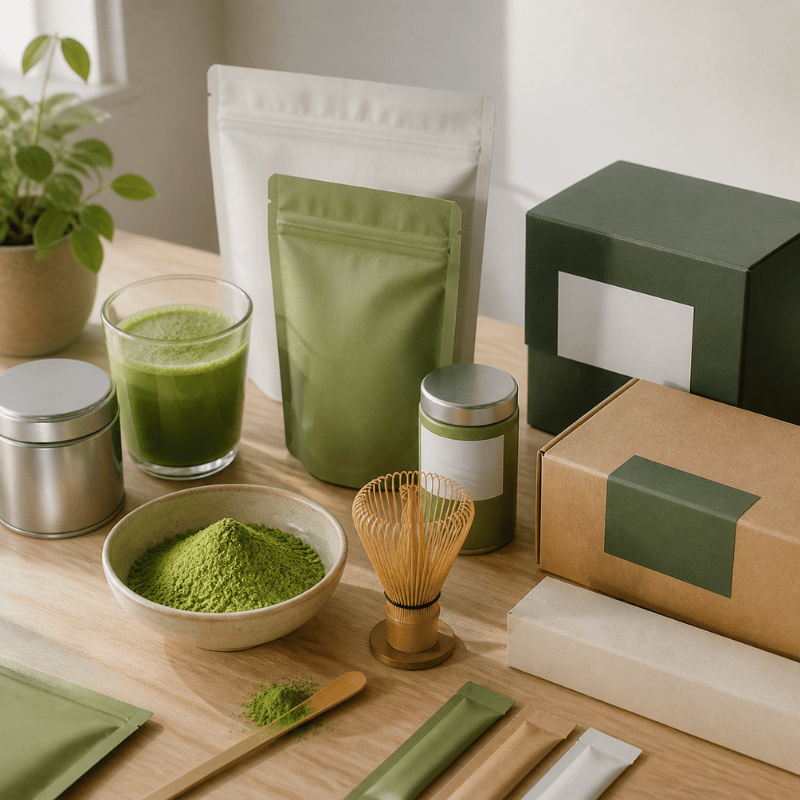
AdoroHu supports full private label and OEM production across both categories, including grade selection, custom formula development, and retail-ready packaging. Practical formats span single-serve 1–3 g sachets, zip-lock pouches (30 g–500 g), tins and aluminium boxes (30 g–100 g), and bulk cartons. A brand can even commission a custom blend that combines matcha with complementary tea powders for a signature product, as long as the finished label reflects the true contents.
Key Takeaway: Let price tier and labeling claim guide the private-label choice; use matcha for premium, name-driven products and green tea powder for cost-led lines, and keep the label honest to the contents.
How do you verify quality when sourcing matcha vs green tea powder?
You verify quality by combining sample evaluation with documentation, because a “matcha” label alone does not prove the powder is shaded tencha. Here’s what experienced buyers check: the sensory signs and the paperwork together, since mislabeling is a known risk in this category.
Evaluate a sample for vivid color, ultra-fine texture, fresh aroma, and the right flavor profile. Then confirm a batch-specific Certificate of Analysis (COA) covering heavy metals, pesticide residue, and microbiology. AdoroHu backs quality with a 1,000 m² purification workshop, two German metal-detection systems, a Japanese sterilization line, and certifications including ISO 22000, FDA registration, USDA (NOP), EU Organic, and JAS. A buyer wanting certified organic matcha should match the certificate to the target market.
Key Takeaway: Verify the actual powder, not the label; pair sample evaluation with a batch-specific COA and certifications so you confirm whether you are buying true matcha or ground green tea powder.
What mistakes do buyers make with matcha vs green tea powder?
The biggest mistake is treating matcha and green tea powder as interchangeable, which leads to overspending or mislabeling. Buyers fall into the same traps repeatedly, and each carries a named cost. Let’s spell them out.
First, paying matcha prices for what is actually ground green tea powder. Second, the reverse: labeling unshaded Sencha powder as “matcha” and risking a compliance violation. Third, expecting green tea powder to deliver matcha’s vivid color in a latte, then getting a dull result. Fourth, sourcing from a trader who cannot document which category they actually ship. A supplier that controls cultivation, milling, and documentation, and offers complementary lines like hojicha powder, removes most of these risks at once.
Key Takeaway: Stop treating the two as interchangeable; confirm the category, label honestly, and verify with samples plus documentation to avoid overspending and compliance trouble.
FAQ
- Is green tea powder the same as matcha?
- No. Matcha is made from shade-grown tencha leaves that are steamed, de-veined, and stone-milled into an ultra-fine powder. Most green tea powder is unshaded green tea like Sencha simply ground into powder. They differ in cultivation, processing, flavor, cost, and how they can be labeled.
- Can I label ground green tea powder as matcha?
- Generally no in major markets. In the U.S. the informal standard requires shaded, tencha-derived powder for the matcha name, and enforcement against mislabeled Sencha powder has tightened since 2024. Unshaded ground leaf should be labeled “green tea powder.”
- Why is matcha more expensive than green tea powder?
- Matcha requires weeks of shading, de-stemming, de-veining, and slow stone-milling into a roughly 10-micron powder, all labor-intensive steps that lower yield. Green tea powder skips shading and the tencha process, so it lands at a lower price point.
- Which has more caffeine, matcha or green tea powder?
- A 2-gram serving of matcha delivers roughly 60 to 80 mg of caffeine, more than a cup of steeped green tea at about 25 to 40 mg, because you consume the whole leaf. Green tea powder consumed whole is also concentrated, but shaded matcha typically carries more L-theanine.
- Can I source both matcha and green tea powder from one supplier?
- Yes. AdoroHu produces true stone-milled matcha and a separate green tea powder line, with organic certification spanning USDA (NOP), EU, and JAS, available in bulk cartons and retail formats. Pricing is quoted by grade and quality, and lead time is set against order volume.
Conclusion
Matcha vs green tea powder is a sourcing and compliance decision, not a question of one always being better: matcha is shaded, stone-milled tencha for premium color and flavor, while green tea powder is a cost-efficient ground leaf for ingredient use. The practical takeaway is to match the category to your application and labeling needs, then verify with samples and a COA. To choose the right powder for your product and get pricing tied to your volume, contact AdoroHu Matcha to request a sample or a wholesale quote.