
A matcha COA (Certificate of Analysis) is the batch-specific lab document proving what is actually in the powder you are buying, and reading it properly means checking the header, the accredited lab, the actual numbers with units, and the detection limits, not just looking for the word “pass.” Here’s the mistake that costs buyers most: treating the COA as a formality to file, when it is one important batch record that must be interpreted with the specification, sampling plan, test method, and destination-market requirements.
That mistake has consequences. A buyer who accepts a COA showing only “pass” learns nothing about how close a result sat to the legal limit. One who never checks the lot number files a document that may describe a completely different batch. One who sees “ND” and relaxes may be looking at a test so insensitive it could not have detected a problem anyway. Reading a matcha COA is a skill, and it is the cheapest quality control you will ever perform.
This guide walks through the document section by section, and shows what a rigorous matcha supplier should be putting in front of you.
The checks that make a COA useful
A matcha COA should be batch-specific and produced by a competent laboratory using methods and accreditation scope appropriate to the decision, and tied by lot number to the shipment you are receiving. Read it in five parts: the header (product, lot, dates, lab accreditation), physicochemical results (moisture, particle size, colour Lab*, theanine, catechins, ash), microbiology (total plate count, E. coli, Salmonella, yeast and mould), pesticide residues against your destination market’s MRLs, and heavy metals (lead, cadmium, arsenic, mercury) by ICP-MS.
Request actual numbers with units where quantitative reporting is appropriate, not “pass,” and on stated LOD/LOQ values, since “not detected” is meaningless without knowing the detection limit.
In short: read a matcha COA in five sections, verify the lab is ISO 17025-accredited and the lot number matches, and demand real numbers with detection limits rather than “pass.”
Key points:
- The COA should be batch-specific and lot-matched to the shipment being assessed.
- Demand numeric results with units and stated LOD/LOQ, not “pass” or “ND” alone.
- Check pesticide results against your destination market’s MRLs, not the origin country’s.
What is a matcha COA and why does it matter more than for other teas?
A matcha COA is a laboratory report certifying the quality and safety of one specific production lot. Here’s what makes it more critical for matcha than for leaf tea: you consume the entire leaf, so anything present in the powder goes into the final product at full concentration.
The concentration effect changes the risk maths. When someone drinks brewed green tea, only what dissolves into water is consumed and the leaf is discarded. With matcha, the whole ground leaf is suspended and swallowed, so heavy metals, residues, and microbial load are ingested in full rather than partially extracted. That is why testing standards applied to brewed tea are not sufficient here, and why a batch-level COA matters far more.
The judgment from experience: treat the COA as your primary evidence of safety, not a courtesy document, and require one for every lot rather than a single sample report reused across shipments. This connects directly to the documentation obligations you should be writing into a matcha supply contract.
Key Takeaway: A matcha COA certifies one specific lot, and it matters more than for leaf tea because you consume the whole ground leaf, so contaminants are ingested at full concentration rather than partially extracted, making batch-level testing evidence essential rather than optional.
What should the COA header tell you before you read any results?
The header should identify the exact product, lot number, dates, and the laboratory, and it is where most invalid COAs are exposed. Here’s the check that takes ten seconds and saves shipments: confirm the lot number on the COA matches the lot number on your shipment.
Match the report to the supplier, lot, and laboratory
Four header items decide whether the document is even valid.
- Product name and description: must match precisely what you ordered, including grade.
- Lot or batch number: must match your shipment; if it does not, the COA verifies nothing.
- Sampling and report dates: should be recent and correspond to your production run.
- Laboratory name and accreditation: check whether the laboratory’s ISO/IEC 17025 accreditation scope covers the reported method.
The critical judgment: a COA from the supplier’s own in-house laboratory serves a different assurance role from an independent laboratory report. In-house testing has real value for process control, but for buyer assurance use an appropriately competent laboratory whose accreditation scope, method, sampling, and chain of custody match the decision. Our own facility runs in-house microbiology and physico-chemical laboratories for continuous process control and pairs them with third-party accredited testing for the documentation buyers rely on, which is the combination worth asking any matcha supplier to demonstrate.
Key Takeaway: Verify product description, lot number, dates, and lab accreditation before reading any result; a mismatched lot number means the report does not establish results for the received lot, and an in-house lab report, however competent, is not independently verifiable the way ISO/IEC 17025 accredited third-party testing is.
How do you read the physicochemical section of a matcha COA?
The physicochemical section quantifies quality attributes you would otherwise judge by eye, turning subjective impressions into comparable numbers. Here’s why this section is your commercial section: it tells you whether you received the grade you paid for.
These are the parameters typically reported.
- Moisture content: commonly specified at 5% or below, since higher moisture shortens shelf life and promotes clumping.
- Particle size: fine matcha typically sits around 10 µm, with finer particles giving smoother mouthfeel and better suspension.
- Colour values (L, a, b): the a value quantifies greenness, with more negative numbers indicating more vivid green.
- Theanine and catechin content: theanine tracks with umami sweetness and shade-growing, catechins with astringency.
- Total ash: an indicator of mineral content and, at abnormal levels, of possible adulteration.
The experienced use of this section: compare these figures against your approved sample’s COA, not just against a generic spec, since grade disputes are won or lost on measured deltas rather than opinions. A supplier whose milling and screening are controlled in-house, in our case 20 stone mills, 56 ball mills and 8 continuous ball-mills feeding ultrasonic screening, can hold these values stable, which is what makes a ceremonial grade matcha reproducible batch to batch rather than a lucky lot.
Key Takeaway: The physicochemical section quantifies grade, moisture and particle size against buyer-defined limits and validated methods, colour Lab*, theanine, catechins, and ash; compare these numbers against your approved sample’s COA, since grade disputes are settled on measured deltas, not opinions.
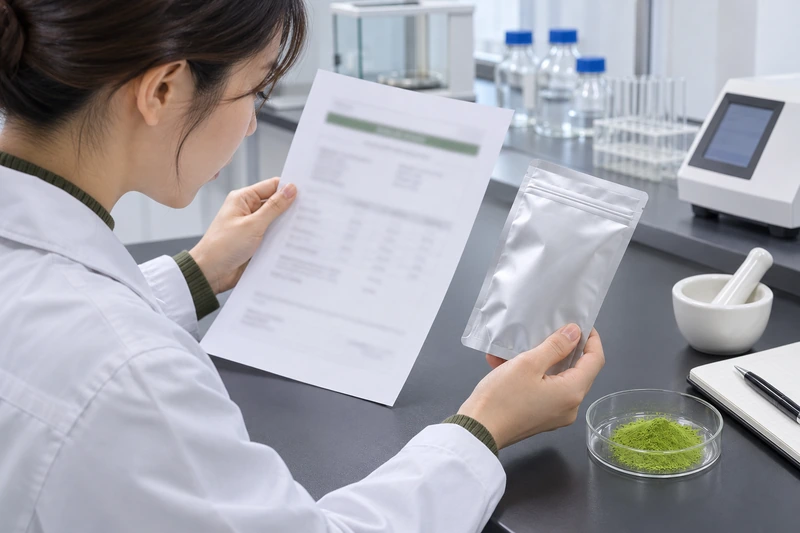
What microbiological results should a matcha COA show?
The microbiology section should report the organisms, sampling plan, method, units, and acceptance criteria selected through the buyer’s hazard analysis, intended use, destination-market rules, and customer requirements. A COA result supports a release decision only when those controls are defined.
Read this section for both compliance and process insight. Total plate count indicates overall hygiene of the production environment, while specific pathogen tests (E. coli, Salmonella) are pass-fail safety gates, and yeast and mould counts flag moisture and storage problems. Because matcha is typically added to drinks or foods without cooking, contamination is not corrected downstream. The judgment: low microbial counts are not just a safety result, they are evidence of the production environment, which is why clean-room manufacturing matters.
Our matcha is produced in two Class-100,000 clean workshops with Japanese flash high-temperature sterilisation, the kind of process control that keeps these numbers consistently low rather than occasionally acceptable across every culinary grade matcha run.
Key Takeaway: Microbiology should report the method-defined results required by the buyer’s hazard analysis, intended use, destination market, and customer programme; interpret each result against the approved specification and sampling plan.
How do you check pesticide residues on a matcha COA?
Check pesticide residues against the Maximum Residue Limits of your destination market, not the country of origin. Here’s the compliance trap that stops shipments at the border: a residue level that passes in the producing country can exceed the limit in the market you are importing into.
MRLs are set nationally and they differ. The EU applies particularly strict limits, and there are documented cases of a substance sitting below the detection threshold under one country’s testing regime while exceeding the EU standard. For US-bound goods, identify applicable pesticide tolerances through the EPA pesticide-tolerance framework and the current commodity/residue entries; do not substitute a generic compound count for that review.
So the practical question is not “did it pass?” but “did it pass against my market’s MRL list?” The experienced approach: tell your supplier the destination market before testing, so the panel and the limits applied match where the goods are going, and request a screen wide enough to cover your market’s list rather than a narrow default panel. This is the same market-specific logic that governs matcha import regulations generally. The EPA’s pesticide tolerance framework defines what applies for US-bound goods.
Key Takeaway: Pesticide results must be judged against your destination market’s MRLs, since a residue passing at origin can exceed EU limits; specify the destination market before testing so the panel and limits match, and request a screen broad enough to cover that market’s compound list.
What heavy metal results matter on a matcha COA?
The heavy metals section should report lead, cadmium, arsenic, and mercury as numeric values, tested by ICP-MS. Here’s why this section deserves the most scrutiny: heavy metals accumulate from soil and processing, and with whole-leaf consumption they are ingested in full.
Read for method, units, reporting limits, sampling, and the rule or buyer specification used for comparison. FDA adulteration provisions and action levels, where applicable, must be checked in their current context. California Proposition 65 uses exposure-based safe-harbor concepts rather than a universal lead concentration for matcha; consult current OEHHA guidance and qualified regulatory counsel instead of converting a daily-exposure value into an unsupported mg/kg product limit. Organic certification does not by itself establish a heavy-metal result.
The judgment: for certified organic matcha, organic status controls inputs but does not by itself guarantee low heavy metals, since soil geology contributes independently. The FDA’s guidance on food imports sets the wider compliance context.
Key Takeaway: Define the relevant metals, sampling, validated method, reporting limits, and acceptance criteria from the destination market, intended use, exposure assessment, and buyer specification. Do not present a Proposition 65 exposure criterion as a universal mg/kg product limit.

Why does “ND” or “pass” on a matcha COA mean almost nothing?
“ND” and “pass” are conclusions without evidence, and a rigorous COA replaces them with numbers plus detection limits. Here’s the technical point most buyers miss: “not detected” only means something if you know how sensitive the test was.
Detection limits define the result’s meaning. The limit of detection (LOD) is the lowest concentration the method can reliably detect, and the limit of quantification (LOQ) the lowest it can reliably measure. If a laboratory reports “ND” without stating the LOD, the finding is uninterpretable, because a sufficiently insensitive method will report “not detected” for a level that would still breach your market’s MRL.
The same logic applies to “pass” or “within limits”: without the actual figure, you cannot see whether a result sat comfortably clear or a fraction under the threshold, and that distinction is exactly what tells you how much margin a supplier is operating with. The experienced demand: specific results with units, referenced test methods, and stated LOD/LOQ on every parameter, on every lot, from the sample order stage onward, so you are comparing evidence rather than assurances.
Key Takeaway: “ND” and “pass” are conclusions without evidence: without a stated LOD, “not detected” may simply mean the method was insensitive, and without the actual figure you cannot tell whether a result cleared the limit comfortably or barely, so demand numbers, methods, and detection limits.
How does the COA connect to organic and traceability documentation?
For organic matcha, the COA should link to the organic certificate number, issuing body, and lot number, forming a traceable chain. Here’s what turns a claim into evidence: documents that reference each other by lot, so a shipment can be traced back to a certified production run.
Organic compliance is a documentation chain, not a logo. The COA, the organic certificate, and the transaction certificate should share the lot reference, allowing an auditor or customs officer to connect the powder in front of them to a certified batch. A generic “organic certified” statement with no per-lot linkage is not defensible under audit, and gaps here are a common cause of clearance delays, since a COA is frequently required for quarantine, customs, and buyer verification.
The judgment: check that the certificate scope actually covers the exact product and batch you bought, not merely the facility, and confirm the issuing body is recognised in your destination market. With 6,000 mu of our tea gardens certified organic, that per-lot linkage is what makes the claim auditable, and it is the standard any serious organic matcha sourcing programme has to meet.
Key Takeaway: For organic matcha, the COA, organic certificate, and transaction certificate should share a lot reference so the shipment traces to a certified run; a generic organic claim without per-lot linkage fails audit and is a common cause of customs delay.
What are the red flags that should stop a matcha order?
The clearest red flags are missing documentation, unverifiable labs, and results reported without evidence. Here’s the pattern across bad outcomes: each shortcut in the COA maps to a specific risk you inherit.
Watch for these signals, each with a named consequence.
- Reluctance to provide a COA at all, meaning you carry unverified safety risk.
- A lot number that does not match your shipment, meaning the document describes other goods.
- An in-house lab report presented as third-party verification, which is not independently checkable.
- “Pass” or “ND” with no figures, methods, or LOD, leaving results uninterpretable.
- A stale COA reused across multiple shipments, hiding batch-to-batch variation.
- Unusually low pricing alongside thin documentation, a combination that frequently signals compromised quality.
Each of these is avoidable by specifying documentation requirements before you order rather than after. A supplier operating in-house microbiology and physico-chemical laboratories alongside accredited third-party testing should be able to produce complete, lot-matched COAs as a matter of routine, including across complementary lines like hojicha powder.
Key Takeaway: Stop on missing COAs, mismatched lot numbers, in-house reports passed off as third-party, results without figures or detection limits, reused stale certificates, or cheap pricing paired with thin paperwork; specify documentation requirements before ordering, not after a problem appears.
FAQ
- What should a matcha COA include?
- A matcha COA should identify the product and lot, laboratory, dates, methods, units, and results required by the buyer’s approved specification. Select physicochemical, microbiological, pesticide-residue, and heavy-metal parameters from the intended use, hazard analysis, destination-market rules, customer requirements, and validated methods rather than applying one universal panel.
- How do I know if a matcha COA is trustworthy?
- Check that the lot and product match the shipment, the dates fit the production and testing sequence, and the laboratory’s competence and accreditation scope cover the reported methods where accreditation is required. Interpret results with the sampling plan, units, reporting limits, specification, and destination-market criteria; an in-house and an independent report may serve different assurance roles.
- Why is “not detected” not good enough on a matcha COA?
- Because “not detected” only has meaning relative to the limit of detection (LOD). If the laboratory does not state the LOD, an insensitive method could report “ND” for a residue level that would still exceed your market’s limit. Request stated LOD and LOQ values when they are needed to interpret the applicable limit and method alongside results so you can interpret what was actually measured.
- Which heavy metals matter most in matcha and what limits apply?
- Select relevant metals and validated methods from the destination market, intended use, exposure assessment, hazard analysis, and buyer specification. Limits and exposure criteria vary by legal framework. California Proposition 65 is exposure-based and should not be converted into a universal matcha concentration limit without a defensible exposure assessment.
- Do I need a new COA for every matcha shipment?
- Require lot-relevant evidence at the frequency defined by the buyer’s specification, risk assessment, customer programme, destination-market duties, and agreement. A prior-lot COA does not establish results for a new lot. Define document timing and the release decision explicitly rather than assuming one universal testing frequency or payment condition.
Conclusion
Reading a matcha COA properly means working through five sections, the header, physicochemical results, microbiology, pesticide residues, and heavy metals, while insisting on an accredited third-party laboratory, a lot number that matches your shipment, and numeric results with stated detection limits rather than “pass” or “ND.” The decisive takeaway is that a COA is evidence, not paperwork: it is the cheapest quality control available to a B2B buyer, and the discipline of reading it carefully is what separates buyers who catch problems from those who discover them in finished product.
To review full lot-matched documentation for your grade and destination market, contact AdoroHu Matcha to request samples, certifications, and a wholesale quote.