
A matcha spec sheet is the document that defines, in measurable numbers, exactly what every batch you buy must deliver, covering particle size, colour, moisture, amino acids, microbiology, contaminants, and packaging. Here’s the distinction that changes how you buy: a COA reports what one batch measured, but a spec sheet dictates what every batch is required to measure, and without one you have no objective basis to reject anything.
That gap is where disputes are lost. A buyer who orders on the word “ceremonial” has bought a marketing term with no regulatory definition. One who complains that batch 40 looks duller than batch 1 has no agreed colour value to point to. One who accepts a supplier’s own spec sheet without reviewing it has let the seller define the pass mark. Writing your own specification, or rigorously vetting theirs, is the difference between a supply relationship built on evidence and one built on hope.
This guide covers what belongs on the sheet and how to make it binding, drawing on how a matcha supplier with in-house laboratories actually controls these parameters.
The requirements a usable specification must define
A matcha spec sheet should define measurable acceptance criteria across five areas: physical parameters (particle size D50 and D90, colour in CIELAB Lab*, moisture, bulk density), chemical parameters (L-theanine, catechins, total ash), microbiological limits (total plate count, yeast and mould, E. coli, Salmonella), contaminant limits (heavy metals, pesticide residues against your destination market’s MRLs), and packaging and shelf-life requirements. Each parameter needs a target value plus a realistic tolerance range, and the sheet should be referenced in your supply contract so a batch outside spec is contractually rejectable.
In short: a matcha spec sheet defines what every batch must deliver, with target values and tolerances, while a COA only reports what one batch actually measured.
Key points:
- The spec sheet sets acceptance criteria; the COA is checked against it.
- Every parameter needs a target plus a tolerance range, not a single ideal number.
- Reference the spec sheet in your contract, or it has no commercial force.
What is a matcha spec sheet and how does it differ from a COA?
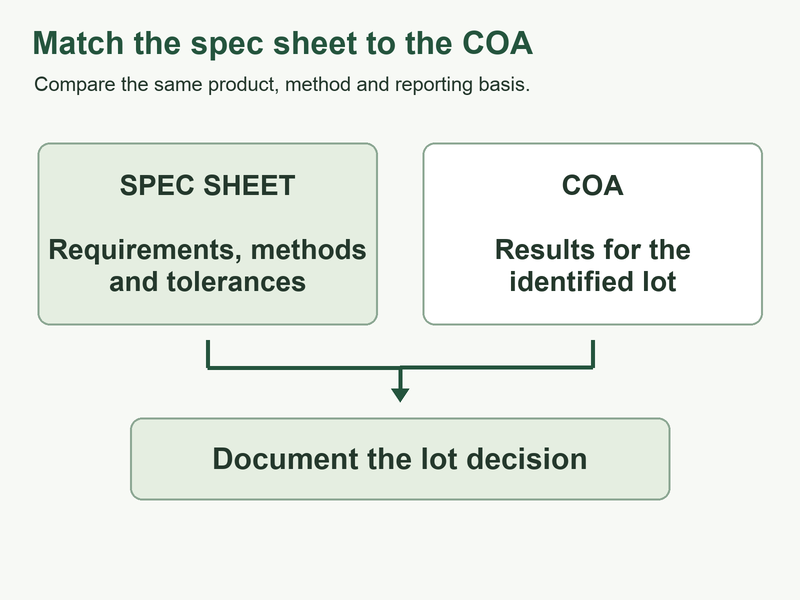
A matcha spec sheet is the agreed standard every batch must meet, while a COA is the lab report showing what one specific batch actually delivered. Here’s the relationship that governs your quality control: the spec comes first, and the COA is judged against it.
The two documents do opposite jobs. The specification is forward-looking and contractual, defining acceptance criteria before production; the matcha COA is backward-looking and evidential, reporting measured results after production. Without a spec, a COA is just a set of numbers with nothing to compare them to, so you cannot say whether a result is good, marginal, or unacceptable. The experienced practice: issue your specification during qualification, get the supplier to sign off that they can meet it, then check every incoming COA line by line against it.
That sequence turns quality from a conversation into an audit.
Key Takeaway: A spec sheet defines forward-looking acceptance criteria while a COA reports backward-looking measured results; without a spec, COA numbers have nothing to be judged against, so issue the specification during qualification and check every COA against it line by line.
Which physical parameters belong on a matcha spec sheet?
The physical parameters define how the powder behaves in your product, and they are where most performance failures originate. Here’s why these numbers matter more than a grade name: “ceremonial grade” has no regulatory definition, but a D50 value does.
Define measurable appearance and processing limits
Specify these physical parameters with target and tolerance.
- Particle size: state both D50 (median) and D90, since D90 catches the coarse tail that causes grittiness. Use validated particle-size methods and buyer-defined acceptance limits tied to the approved sample and application. ISO/TR 21380:2022 provides terminology and definitions for matcha, but it is not a universal commercial grade specification.
- Colour: use CIELAB L, a, b* values rather than adjectives. Set CIELAB targets from the approved reference sample, instrument geometry, illuminant, sample preparation, and application rather than a universal grade cutoff.
- Set moisture acceptance criteria from product validation, packaging, shelf-life evidence, method, and applicable market or customer requirements.
- Bulk density: relevant for filling equipment, dosing accuracy, and packaging fit.
Evaluate whether particle-size changes are material through a validated method and application trial; do not infer sensory or colour failure from an unsupported universal delta. Controlled milling is what makes these figures repeatable, and our combination of 20 stone mills, 56 ball mills and 8 continuous ball-mills feeding ultrasonic screening exists precisely to hold particle distribution steady across large repeat orders of ceremonial grade matcha.
Key Takeaway: Specify validated particle-size metrics, instrument-defined CIELAB targets, a validated moisture limit, and bulk density where each is relevant to the approved application; grade labels alone do not provide measurable acceptance criteria.
Which chemical parameters should the spec sheet define?
The chemical parameters describe flavour and composition, and they are how you specify quality rather than merely appearance. Here’s what they buy you: an objective handle on the taste profile your product depends on.
Three chemical markers do most of the work. L-theanine is the amino acid responsible for umami sweetness and correlates with proper shade-growing. Catechins drive astringency and bitterness, so the balance between theanine and catechins effectively defines the flavour character you are buying. Total ash indicates mineral content and, at abnormal levels, can flag adulteration or excessive stem material. The practical view: amino acid content varies naturally with harvest and season, so the buyer should set tolerances from method uncertainty, natural variation, retained samples, and application validation.
Specifying a floor rather than a narrow band is usually more workable, and it still protects you from a supplier quietly downgrading the leaf between orders, an issue explored further in our matcha quality guide.
Key Takeaway: Define any L-theanine, catechin, and total-ash criteria from the intended application, validated methods, approved sample, and buyer risk assessment; do not treat generic grade cutoffs as universal.
What microbiological and contaminant limits should you set?
Microbiological and contaminant limits are the safety half of the specification, and they should be stated as numeric limits, not as “compliant.” Here’s why buyers must set them explicitly: matcha is consumed as whole leaf without a kill step, so the powder you receive is what your customer ingests.
Set these limits explicitly in the sheet.
- Choose microbiological organisms, sampling plans, methods, and limits from the destination market, intended use, hazard analysis, customer requirements, and validated process; a generic internet limit is not a substitute for that assessment.
- Heavy metals: numeric limits for lead, cadmium, arsenic and mercury, tested by ICP-MS.
- Pesticide residues: a multi-residue screen judged against your destination market’s MRLs, run by an ISO/IEC 17025 accredited laboratory.
The critical judgment: contaminant limits must reference the market you are selling into, not the country of production, because a residue that passes at origin can breach EU limits, a point covered in detail in our guide to matcha import regulations. Production environment is what keeps microbial numbers consistently inside spec rather than occasionally, which is why our two Class-100,000 clean workshops, Japanese flash high-temperature sterilisation and in-house microbiology laboratory sit behind every culinary grade matcha batch.
Key Takeaway: State method-defined microbiological acceptance criteria derived from the destination market, intended use, hazard analysis, customer requirements, and validated process plus heavy metal and pesticide limits referenced to your destination market’s MRLs, since matcha is consumed whole-leaf with no kill step.
How do you set realistic tolerance ranges?
Tolerance ranges acknowledge that matcha is an agricultural product while still protecting your product’s consistency. Here’s the balance that makes a spec workable: demand absolute uniformity and you will get rejections and price increases, demand nothing and you will get drift.
Tolerances should reflect how much each parameter naturally varies. Set tolerances from method uncertainty, observed lot variation, the approved reference sample, shelf-life and application validation, and the consequence of failure. Physical parameters that are process-controlled, particle size and moisture in particular, can carry tighter tolerances because they depend on milling and drying rather than on the season. The experienced approach is to set the tolerance against your approved reference sample rather than an abstract ideal, so the standard is a real batch your team has already validated in production.
Also define what happens at the edges: whether a marginal batch is rejected, accepted with concession, or reworked. Batch-to-batch consistency at scale is exactly what separates an estate-controlled producer from a trader assembling lots, a distinction explored in our matcha grading guide.
Key Takeaway: Set tolerances by how much each parameter naturally varies, from validated methods, observed variation, the approved sample, and application risk; anchor tolerances to your approved reference sample and define what happens to marginal batches.
What packaging and shelf-life requirements belong in the spec?
Packaging and shelf-life belong in the specification because they determine whether the quality you paid for survives to your production line. Here’s the failure that catches buyers out: matcha can meet every chemical parameter at dispatch and still arrive degraded.
Specify the protective conditions, not just the product. Define the packaging format and barrier properties, whether inner bags are nitrogen-flushed, the carton and liner specification, and the labelling required, including lot code, production date and best-before date. State the shelf life you require from date of receipt rather than date of production, since a technically in-date batch that has spent months in a warehouse gives you far less usable life.
Add storage and transport conditions, because matcha is heat and light sensitive and a long, warm transit can dull colour that was vivid at packing. The practical rule: specify inbound inspection points too, so on arrival your team checks carton integrity, seal condition, lot codes matching the COA, and no bulging or punctured inner bags. Packaging format also drives minimum order economics, which we cover in our matcha MOQ guide.
Key Takeaway: Specify packaging format, barrier and nitrogen flushing, labelling with lot codes and dates, plus shelf life measured from receipt rather than production, and storage and transport conditions, since matcha can meet every chemical parameter at dispatch yet arrive degraded.

How do you make a matcha spec sheet contractually binding?
A spec sheet only has commercial force when it is referenced in your supply agreement with defined consequences for non-conformance. Here’s the step most buyers skip: an agreed specification with no contractual link is a wish list.
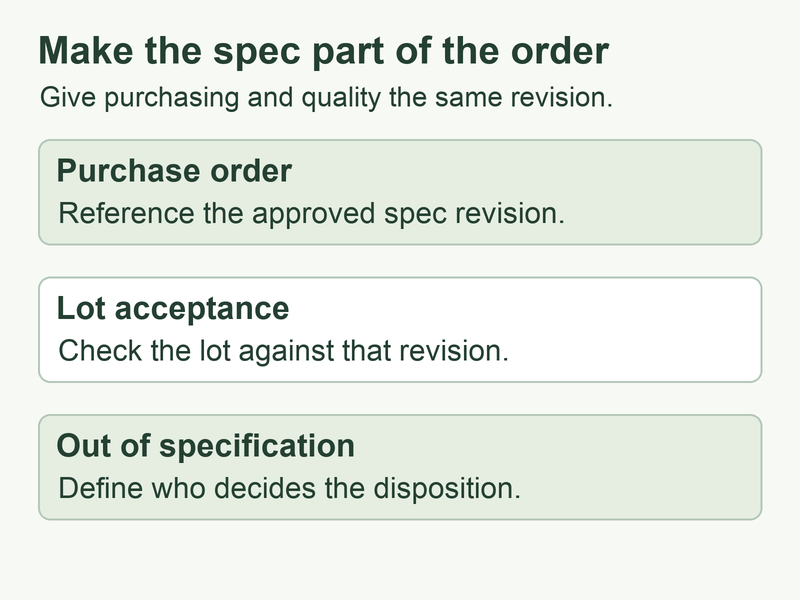
Binding a specification takes three connected moves. First, attach the spec sheet as an annex to the supply contract and reference it explicitly in the quality clause, so “conforming goods” has a defined meaning. Second, state the consequence of a batch falling outside spec, whether that is rejection, replacement at supplier cost, concession with a price adjustment, or compensation for your downtime. Third, define the verification mechanism: which laboratory, whose sample, and what happens if buyer and supplier results disagree, typically by naming an independent referee laboratory in advance.
The judgment from experience: agree the dispute mechanism before you need it, because the moment you are holding an off-spec container is the worst possible time to negotiate one. These clauses sit naturally alongside the other protections covered in our guide to matcha supply contracts.
Key Takeaway: Attach the spec sheet as a contract annex referenced in the quality clause, state the consequence of non-conformance (rejection, replacement, concession, downtime compensation), and pre-agree the verification and referee-laboratory mechanism before a dispute arises.
What mistakes do buyers make with matcha specifications?
The most common mistake is relying on grade names instead of measured parameters. Here’s the pattern behind spec failures: each shortcut removes your ability to reject something objectively.
Watch for these errors, each with a concrete consequence.
- Buying on “ceremonial grade” alone, without measurable acceptance criteria.
- Accepting the supplier’s spec sheet unreviewed, letting the seller set the pass mark.
- Specifying a single ideal value with no tolerance, guaranteeing either rejections or quiet non-compliance.
- Omitting D90 and specifying only average particle size, missing the coarse tail that causes grittiness.
- Leaving packaging and shelf life out, so a compliant batch arrives degraded.
- Failing to reference the spec in the contract, leaving its contractual status unclear.
Each is avoidable by writing the specification before you order rather than after a problem. A producer that controls cultivation, milling and testing in-house can commit to tight parameters across grades and complementary lines such as hojicha powder, because the variables sit inside one system rather than across several suppliers.
Key Takeaway: Stop buying on grade names; the recurring spec errors, unreviewed supplier sheets, single values with no tolerance, missing D90, omitted packaging and shelf life, and no contractual reference, each remove your ability to reject a batch objectively.
FAQ
- What should a matcha spec sheet include?
- It should define measurable acceptance criteria across physical parameters (particle size D50 and D90, CIELAB colour values, moisture, bulk density), chemical parameters (L-theanine, catechins, total ash), microbiological limits (total plate count, yeast and mould, E. coli, Salmonella), contaminant limits (heavy metals and pesticide residues against your destination market’s MRLs), and packaging, labelling and shelf-life requirements. Each parameter needs a target value plus a realistic tolerance range.
- What is the difference between a matcha spec sheet and a COA?
- A spec sheet is forward-looking and contractual, defining what every batch must deliver. A COA is backward-looking and evidential, reporting what one specific batch actually measured. The spec sets the acceptance criteria and the COA is checked against it, so without a spec, COA figures have nothing to be judged against.
- What particle size should I specify for matcha?
- Use D50 and D90 when both are relevant to the application, but define the preparation, instrument, calculation method, and sampling plan before setting limits. Establish buyer-specific acceptance criteria from a validated method, the approved reference sample, and performance in the intended product; do not use a ceremonial-grade label or a universal micrometre cutoff as the specification.
- What tolerance ranges are realistic for matcha specifications?
- Set tolerances from method uncertainty, observed lot variation, the approved reference sample, shelf-life and application validation, and the consequence of failure. Do not apply a generic percentage to every supplier or method.
- How do I make a matcha specification enforceable?
- Reference the approved specification by title, version, and date in the supply contract, and define how conformity is tested, how discrepancies are reviewed, and which negotiated remedies may apply. The agreement and governing law determine enforceability, rejection rights, replacement, damages, liability limits, and dispute procedures.
Conclusion
A matcha spec sheet turns quality from an opinion into measurable acceptance criteria by defining measurable targets and tolerances across physical, chemical, microbiological, contaminant, packaging and shelf-life parameters, then referencing that document in the supply contract with reviewed consequences for non-conformance. The decisive takeaway is that grade names carry no regulatory weight, so measured criteria provide a clearer basis for release and dispute review than a grade name alone, and the supplier best able to meet them is one controlling cultivation, milling and testing under a single system.
To align a specification with a producer able to hold those parameters batch after batch, contact AdoroHu Matcha to request samples, full documentation and a wholesale quote.