Matcha for food manufacturers means sourcing ingredient-grade matcha that delivers consistent color and flavor across production runs, holds up under processing, and arrives with the QA documentation co-manufacturing requires. Here’s the challenge that defines manufacturing use: matcha is not just a product on a shelf here, it is an input in a formula, so any variation or instability multiplies across your entire production batch.
That multiplication is the risk. A manufacturer whose matcha shifts color batch to batch ships an inconsistent product that fails QC or erodes brand trust. One who picks a grade that bakes off in the oven loses the green and flavor customers expect. One who cannot get a Certificate of Analysis cannot make the label claims its market requires. Matcha for food manufacturers is about consistency, stability, and documentation at scale, not just buying powder. This guide covers each requirement and shows how a vertically integrated matcha wholesale manufacturer supports formulation-grade supply.
Matcha for food manufacturers means sourcing ingredient-grade matcha for use in formulated products like beverages, baked goods, RTD drinks, snacks, and supplements. The priorities differ from retail: batch-to-batch consistency in color and flavor, stability under heat and processing, defined specifications for R&D, and full QA documentation (COA, certifications) for co-manufacturing and label claims. Culinary or ingredient-grade matcha usually fits best, since its bold flavor survives processing while ceremonial nuance is lost. A vertically integrated supplier is key to the consistency manufacturing demands.
In short: matcha for food manufacturers prioritizes batch consistency, processing stability, defined specs, and QA documentation, with ingredient-grade matcha usually the right fit.
Key points:
- Manufacturers need batch-to-batch consistency, since variation multiplies across a production run.
- Heat and processing stability matter, so bold ingredient grades beat delicate ceremonial.
- Full QA documentation (COA, certifications) is required for co-manufacturing and label claims.
How is sourcing matcha for food manufacturers different?
Sourcing matcha for food manufacturers is different because matcha is used as a formulation ingredient, not a finished product. Here’s the shift in priorities: a manufacturer cares less about a single beautiful tin and more about whether batch 500 performs identically to batch 1 in its recipe.
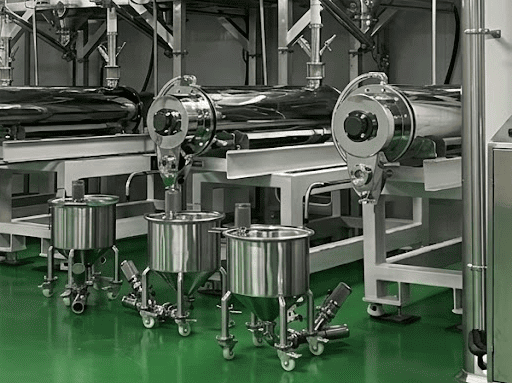
This changes what matters. Consistency, processing stability, defined specifications, and documentation outrank packaging and presentation entirely. A small variation that a consumer might forgive in a loose tin becomes a quality-control failure when it shifts the color of ten thousand units of product. Manufacturers also need their matcha in bulk formats for production lines, not retail packaging. A manufacturer using culinary grade matcha as a recipe base needs it specified, consistent, and documented, since it becomes part of a product the manufacturer is legally responsible for.
Key Takeaway: For food manufacturers, matcha is a formulation ingredient, so consistency, stability, specs, and documentation outrank packaging; a variation a consumer might forgive in a tin becomes a QC failure across thousands of manufactured units.
Why is batch consistency the top matcha priority for manufacturers?
Batch consistency is the top priority because any variation in the matcha multiplies across the entire production run. Here’s the manufacturing reality: when matcha is one ingredient in a formula made at scale, inconsistent input means inconsistent output, every single unit.
The stakes are higher than in any other use. A color or flavor shift between batches means a product that looks or tastes different from one production run to the next, which fails QC, triggers customer complaints, and damages brand trust. This is why batch consistency is non-negotiable, and why source control matters so much. Only a supplier owning its shade-growing and stone-milling can hold color and flavor stable across large repeat orders. AdoroHu’s 350-hectare self-owned estate feeding a single processing chain is precisely what makes that repeatability possible, while a trader assembling lots from scattered farms ships variation that surfaces in a manufacturer’s finished product.
Key Takeaway: Batch consistency is paramount because inconsistent matcha multiplies into inconsistent product across an entire run; only a supplier controlling its own estate and milling can guarantee the color and flavor repeatability that manufacturing at scale demands.
What grade of matcha should food manufacturers use?
Food manufacturers should usually use culinary or ingredient-grade matcha, not ceremonial, because bold flavor survives processing while delicate nuance does not. Here’s the cost-and-performance judgment: paying for ceremonial grade in a baked or blended product wastes money on subtlety the process destroys.
Grade should match the application. Ingredient and culinary grades deliver robust, earthy flavor and bold color that hold up in recipes, sauces, and high-temperature applications. Ceremonial grade’s delicate umami, by contrast, is lost once mixed with sugar, dairy, or heat, so using it in matcha baking or a sweetened RTD drink is paying a premium the oven or the formula erases. The experienced rule: select the lowest grade that delivers the color and flavor your product needs after processing, not before. A premium-culinary or dedicated ingredient grade is typically the manufacturing sweet spot, balancing vivid color and bold flavor against cost.
Key Takeaway: Use culinary or ingredient-grade matcha, not ceremonial, for manufactured products; bold flavor and color survive processing while ceremonial’s nuance is destroyed by heat and sugar, so select the lowest grade that performs after processing, not before.
How does matcha behave under heat and processing?
Matcha behaves variably under heat and processing, which manufacturers must account for in formulation. Here’s the technical reality that catches new formulators: matcha’s vivid green and fresh flavor are sensitive to high temperatures, prolonged heat, and oxidation during processing.
Understanding this protects the finished product. High baking temperatures can dull matcha’s color from vibrant green toward olive or brown, and extended heat affects flavor. This is why bold ingredient grades, with stronger color and flavor to begin with, hold up better in baking and high-temperature applications than delicate ceremonial grade. For cold or minimally heated applications like RTD drinks and smoothies, color retention is easier but oxidation and suspension still matter. The experienced approach is to test the matcha in your actual process, not just in water, since how it performs at 180°C or in an acidic RTD formula is what determines the finished result. Match the grade and dose to your specific process.
Key Takeaway: Matcha’s color and flavor are heat- and oxidation-sensitive, so test it in your actual process, not just in water; bold ingredient grades survive baking and high temperatures better than delicate ceremonial, which dulls and flattens under processing.
What specifications do food manufacturers need from matcha?
Food manufacturers need defined, documented specifications to formulate consistently and pass quality control. Here’s what separates a formulation-ready supplier from a generic one: the ability to provide exact specs your R&D team can build a repeatable recipe around.
The specifications that matter for formulation are concrete and measurable.
- Particle size in microns, which affects texture, suspension, and mouthfeel.
- Color values, for consistent appearance in the finished product.
- Flavor profile and L-theanine level, for taste consistency.
- Moisture content and microbiological specs, for stability and safety.
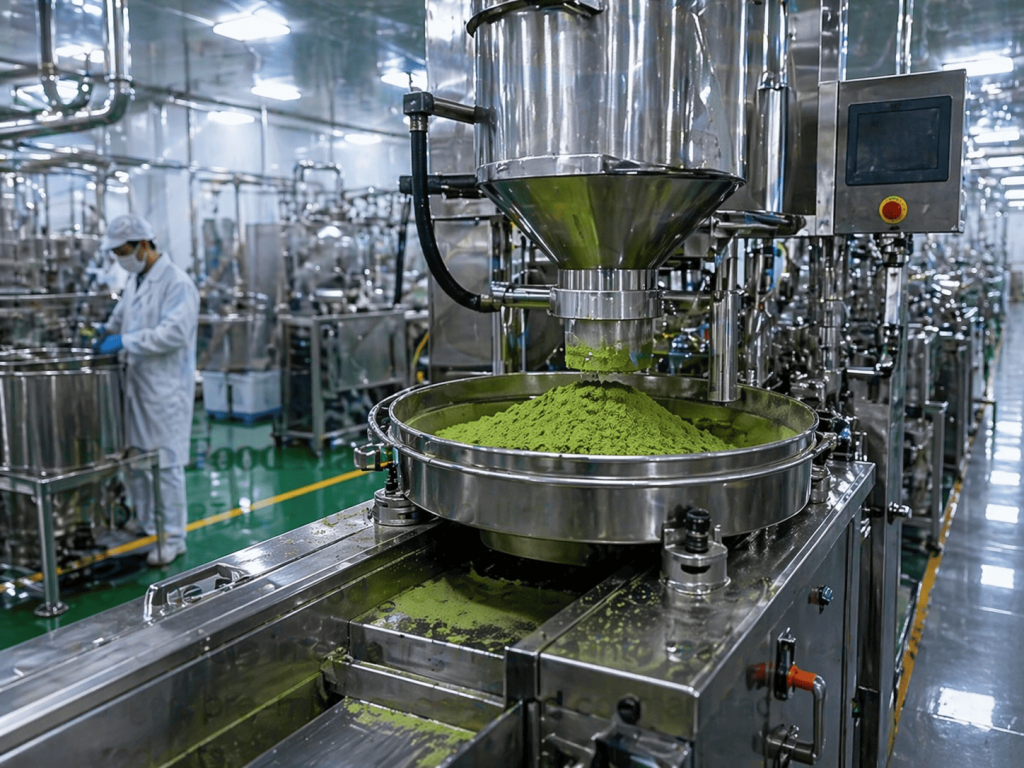
A supplier that documents these lets your R&D lock a formula that reproduces batch after batch. A vague “premium matcha” with no spec sheet forces guesswork. AdoroHu’s controlled processing, including ultrasonic screening for ultra-fine particle size, lets it supply matcha to a defined spec rather than an approximate one, which is what formulation-grade supply requires.
Key Takeaway: Manufacturers need documented specs, particle size, color, flavor, L-theanine, and microbiology, to build repeatable formulas; a supplier providing a real spec sheet enables consistent production, while a vague “premium” claim with no specs forces R&D guesswork.
What QA documentation must matcha suppliers provide manufacturers?
Matcha suppliers must provide manufacturers with full QA documentation, because co-manufacturing and label claims depend on it. Here’s the compliance chain: a food manufacturer’s own certifications and label claims require supporting documents from its ingredient suppliers.
The documentation set is essential, not optional, for manufacturing.
- Batch-specific Certificate of Analysis covering heavy metals, pesticides, and microbiology.
- Food-safety certifications like ISO 22000, HACCP, and FDA registration.
- Organic certifications (USDA, EU, JAS) for organic-labeled products.
- Specialty documentation such as kosher or gluten-free statements where claimed.
Without these, a manufacturer cannot make compliant label claims or pass its own audits. The supplier’s documentation effectively becomes part of the manufacturer’s compliance file. AdoroHu holds ISO 22000, FDA registration, USDA (NOP), EU Organic, JAS, Halal, and Rainforest Alliance, so a manufacturer formulating a certified organic matcha product receives documentation that supports its own claims and audits.
Key Takeaway: Suppliers must provide batch COAs, food-safety and organic certifications, and specialty statements, because a manufacturer’s label claims and audits depend on them; the supplier’s documentation becomes part of the manufacturer’s own compliance file.
How do food manufacturers ensure scalable, reliable matcha supply?
Food manufacturers ensure scalable supply by partnering with a producer that has the capacity and stability to grow with their volume. Here’s the production risk: a manufacturing line cannot tolerate a supply gap, since a stockout halts production and breaks downstream commitments.
Reliability at scale has two dimensions. First, capacity, the supplier must handle increasing volume as the manufacturer’s product grows. Second, stability, the supplier must maintain consistent supply and pricing despite raw-material market swings. A producer buying at volatile auction prices or from scattered farms cannot offer either reliably. AdoroHu’s 3,000-tonne annual capacity and self-owned estate provide both the scale and the stability that a growing manufacturing operation needs, so a manufacturer can forecast and commit without fearing a supply gap. The judgment: choose a supplier whose capacity exceeds your current need, leaving headroom to scale.
Key Takeaway: Ensure scalable supply by choosing a producer with capacity headroom and price stability, since a manufacturing line cannot tolerate a stockout; a supplier with large capacity and a self-owned estate offers the reliability volatile traders cannot.
What mistakes do food manufacturers make sourcing matcha?
The biggest mistake is sourcing matcha like a retail buyer, ignoring the consistency, stability, and documentation manufacturing demands. Here’s the pattern across failed formulations: each mistake maps to a specific production or compliance failure.
Watch for these traps, each with a named consequence.
- Sourcing without batch consistency, shipping product that varies run to run.
- Using ceremonial grade in baked or sweetened products, wasting cost on lost nuance.
- Not testing matcha in the actual process, then seeing color dull at production scale.
- Sourcing without a spec sheet, leaving R&D unable to lock a repeatable formula.
- Choosing a supplier lacking certifications, unable to make required label claims.
Each is avoidable by sourcing as a manufacturer. A vertically integrated supplier offering documented specs, full certifications, and complementary lines like hojicha powder for product-range extension removes these risks in one relationship.
Key Takeaway: Stop sourcing matcha like a retail buyer; manufacturing demands batch consistency, process-tested grade selection, documented specs, and certifications, because each overlooked requirement becomes a specific production failure or a blocked label claim.
FAQ
- What grade of matcha is best for food manufacturing?
- Culinary or ingredient-grade matcha is usually best, because its bold flavor and color survive processing, heat, and mixing with other ingredients. Ceremonial grade’s delicate nuance is lost in baked, sweetened, or high-temperature products, so paying its premium for manufacturing wastes money on subtlety the process destroys.
- Why is batch consistency so important for matcha in manufacturing?
- Because matcha is one ingredient in a formula made at scale, so any color or flavor variation multiplies across the entire production run. Inconsistent input means inconsistent finished product, which fails quality control and damages brand trust. Only a supplier controlling its own estate and milling can guarantee consistency.
- Does matcha lose color when baked or heated?
- It can. Matcha’s vivid green and fresh flavor are sensitive to high temperatures and prolonged heat, which can dull the color toward olive or brown. Bold ingredient grades hold up better than delicate ceremonial, so manufacturers should test matcha in their actual process rather than just in water.
- What documentation do food manufacturers need from a matcha supplier?
- Manufacturers need batch-specific Certificates of Analysis covering heavy metals, pesticides, and microbiology, plus food-safety certifications like ISO 22000 and FDA registration, organic certifications where claimed, and specialty statements such as kosher or gluten-free. This documentation supports the manufacturer’s own label claims and audits.
- Can a matcha supplier scale with a growing food manufacturer?
- Only if it has the capacity and supply stability to do so. A manufacturing line cannot tolerate a stockout, so manufacturers should choose a supplier whose capacity exceeds current need and who maintains stable supply despite market swings. A producer with a large self-owned estate offers more reliability than a volatile trader.
Conclusion
Matcha for food manufacturers is about sourcing an ingredient that delivers consistent color and flavor across runs, survives your specific process, comes with documented specifications, and carries the QA paperwork your label claims and audits require. The decisive takeaway is to source as a manufacturer, prioritizing consistency, stability, and documentation over presentation, and to choose a vertically integrated supplier with the capacity to scale. To formulate on a consistent, fully documented matcha supply, contact AdoroHu Matcha to request samples, specifications, and a wholesale quote matched to your formulation and volume.