The right matcha powder for a bakery business is a robust culinary grade that holds its flavor and color through the oven, used with techniques that prevent the browning and bitterness heat causes. Here’s the frustration every bakery hits: you measure carefully, bake a beautiful green batter, and it comes out olive-brown and bitter, because standard recipes do not account for matcha’s delicate chemistry.
That failure is expensive at commercial scale. A bakery that uses the wrong grade or technique wastes premium ingredient cost on dull, bitter results, then either discards the batch or sells a disappointing product. One that over-doses to chase color gets bitterness instead. One that ignores the 2025 price surge erodes its margin. Matcha powder for a bakery business is about choosing a heat-stable grade and mastering the chemistry, so results are vibrant, flavorful, and profitable. This guide covers grade, browning, technique, and cost, and shows how sourcing the right matcha for baking supports a consistent bakery program.
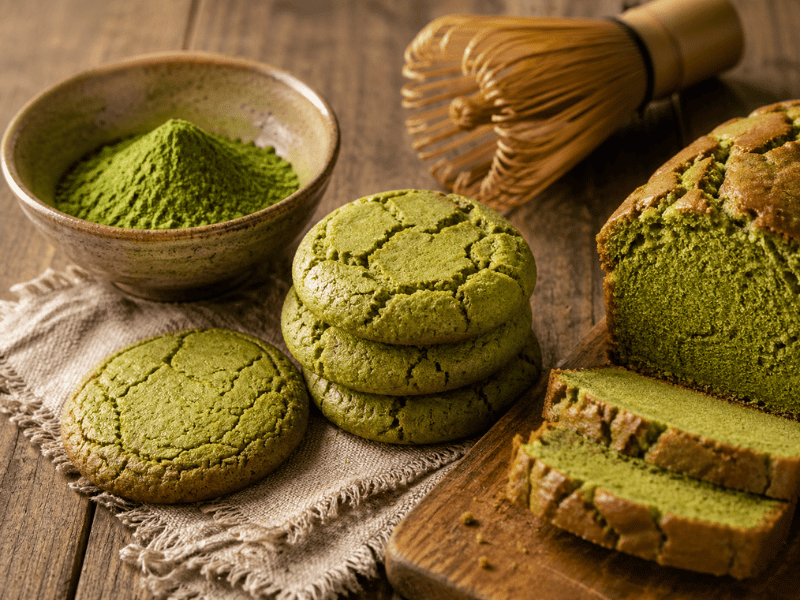
The best matcha powder for a bakery business is a robust culinary grade, not ceremonial, because ceremonial’s delicate flavor is destroyed by heat while culinary grade maintains a strong “matcha punch” through baking. Matcha browns in the oven because heat and acid convert its green chlorophyll into olive-brown pheophytin, especially above about 175°C (350°F). Prevent this with the fat-coating technique (mixing matcha into butter or oil first), using baking powder rather than baking soda, and measured dosing. Culinary grade is also far more cost-effective for baking.
In short: bakeries should use a robust culinary grade and prevent oven browning with fat-coating, baking powder over soda, and measured dosing, since heat and acid turn matcha brown.
Key points:
- Culinary grade beats ceremonial for baking, since heat destroys ceremonial’s delicate nuance.
- Matcha browns when heat and acid convert chlorophyll to olive-brown pheophytin above ~175°C.
- Fat-coating, baking powder over soda, and measured dosing preserve color and flavor.
What grade of matcha powder is best for a bakery business?
The best matcha powder for a bakery business is a robust culinary grade, not ceremonial. Here’s the judgment professional bakers stress: ceremonial grade’s premium characteristics are destroyed by heat, so paying for them in a baked product is wasted money.
Grade should match the application’s demands. Culinary grade is more robust, with a bolder flavor that maintains a recognizable “matcha punch” through the oven and against sugar, flour, and dairy that mute tea notes. Ceremonial grade, designed to be whisked neat, loses its subtle character in a baked good while costing far more. A measured, application-led choice matters more than a familiar grade name. AdoroHu organizes its range so a bakery can select a baking-optimized grade rather than defaulting to ceremonial, and a purpose-made culinary grade matcha is built to deliver bold flavor and color that survive heat. The exception: for unbaked elements like buttercream or cream cheese frosting, color retention is excellent, so premium or even ceremonial grade can shine there.
Key Takeaway: Use a robust culinary grade for baked goods, since ceremonial’s delicate nuance is destroyed by heat and costs far more; reserve premium or ceremonial grade for unbaked elements like frostings, where color and flavor survive intact.
Why does matcha turn brown when baked?
Matcha turns brown when baked because heat and acid convert its green chlorophyll into olive-brown pheophytin. Here’s the chemistry every bakery should understand: the vivid green comes from chlorophyll, a molecule with a central magnesium ion, and heat plus acid displaces that magnesium, browning the color.
Understanding the reaction is the first step to preventing it. The conversion accelerates above about 175°C (350°F) with extended baking, and moisture and acid supply the hydrogen ions that drive it. This is why a cake batter that looks vibrant green can emerge dull and brownish from the oven. There is also a competing reaction: Maillard browning, accelerated in alkaline conditions. Knowing both reactions lets a bakery control them through temperature, pH, and grade rather than guessing. A robust, high-chlorophyll culinary grade starts greener and holds color better, giving more margin before browning shows. Controlling the bake, not just the ingredient, is what protects the green.
Key Takeaway: Matcha browns because heat and acid convert green chlorophyll into olive-brown pheophytin, accelerating above about 175°C; understanding this lets a bakery control color through temperature, pH, and a robust high-chlorophyll grade rather than guessing.
How do bakeries keep matcha green and flavorful in baked goods?
Bakeries keep matcha green and flavorful by controlling fat, pH, dose, and temperature with proven techniques. Here’s the technique professional bakers rely on most: the fat-coating method, which encapsulates the matcha particles before they meet moisture and acid.
These methods work together to protect color and flavor.
- Fat-coating: mix matcha into softened butter or oil before adding any liquids, to shield particles from the moisture and acid that brown them.
- Use baking powder, not baking soda, since the alkaline environment of soda accelerates browning.
- Measure thoughtfully, because excess powder darkens the batter and adds bitterness rather than more green.
- Manage temperature, avoiding prolonged high heat above about 175°C where possible.
The experienced rule: technique matters as much as the ingredient, so even a great culinary grade browns if the chemistry is ignored. Sifting the powder also prevents clumps for even color. A bakery building a matcha baking line should standardize these techniques across recipes so results are consistent batch to batch.
Key Takeaway: Keep matcha green with the fat-coating technique, baking powder instead of soda, measured dosing, and controlled temperature; technique matters as much as grade, since even a great culinary matcha browns if the chemistry is ignored.
How much matcha powder does a bakery need per recipe?
The right matcha dose balances visible green and flavor against bitterness, and more is not better. Here’s the counterintuitive rule bakers learn fast: excess matcha darkens the batter and introduces bitterness rather than improving the color.
Dosing is about precision, not volume. A measured amount preserves a pleasing color while keeping flavor balanced, whereas over-dosing both browns the result and makes it astringent. The exact amount varies by recipe, but the principle is to start modest and adjust to taste rather than overloading. This also matters for cost control at commercial scale, since matcha is the expensive ingredient and over-dosing wastes it while worsening the result. For cost planning, note that a bold culinary grade lets a bakery use an efficient dose because its flavor carries, unlike a weak powder that tempts over-dosing. Pairing matcha with complementary flavors like white chocolate, vanilla, almond, or coconut also lets a measured dose read as more present.
Key Takeaway: Dose matcha precisely, since excess darkens and embitters rather than improving color; a bold culinary grade carries flavor at an efficient dose, controlling both quality and the cost of an expensive ingredient at commercial scale.
How does matcha pricing affect a bakery business?
Matcha pricing significantly affects a bakery’s margins, especially after recent sharp price increases. Here’s the cost reality bakeries must plan around: matcha prices rose dramatically in 2025, with some sources citing increases of 160 percent or more, making grade selection critical to profitability.
The pricing pressure makes smart sourcing essential. Because ceremonial grade is far more expensive and its benefits are destroyed by baking, using it in baked goods wastes money on quality the oven erases, a costly error when prices are high. A robust culinary grade delivers the needed color and flavor at a fraction of the cost. The judgment: in a high-price environment, strategic grade selection is no longer optional, it directly determines whether a matcha product line is profitable. Sourcing at a stable cost from a vertically integrated producer also insulates a bakery from the volatility, and a bakery can request a wholesale quote to model real ingredient cost per item before menu pricing.
Key Takeaway: Matcha prices rose 160 percent or more in 2025, so grade selection is now critical to profitability; using ceremonial grade in baked goods wastes money the oven erases, while a robust culinary grade delivers the result at a fraction of the cost.
What matcha quality should a bakery look for?
A bakery should look for a vibrant green, fresh culinary grade, because oxidized or dull matcha bakes into a poor result. Here’s the quality signal that predicts baking performance: a bright, vivid green powder starts with more chlorophyll and bakes greener, while a dull, olive or yellowish powder is already oxidized and will only worsen in the oven.
Quality shows before baking. Bitterness in a finished bake is often caused by low-quality, oxidized matcha or over-dosing, so starting with fresh, vibrant powder is half the battle. Freshness also matters, since matcha oxidizes over time, so a bakery should source from a supplier with good turnover and proper packaging. A high-quality powder bakes into clearer color and cleaner flavor at an efficient dose. AdoroHu’s stone-milling and ultrasonic screening produce a fine, vibrant powder, and its sealed packaging protects freshness, so the matcha that reaches a bakery’s oven starts vivid rather than already fading.
Key Takeaway: Choose a vibrant green, fresh culinary grade, since dull or oxidized matcha only worsens in the oven and causes bitterness; bright color signals high chlorophyll that bakes greener, so quality and freshness are half the baking result.
How should a bakery store matcha powder?
A bakery should store matcha cool, dark, and airtight, because it degrades quickly when exposed to light, air, and heat. Here’s the storage reality for a busy bakery: matcha oxidizes fast, so poor storage turns expensive vibrant powder into dull, bitter waste before it is even used.
Proper storage protects the investment. Keep matcha in an airtight, opaque container away from light and heat, ideally refrigerated or frozen for longer-term stock, and always use a clean, dry spoon to avoid introducing moisture. Most guidance recommends using opened matcha within about 60 days for peak quality, though it stays usable longer. For a bakery buying in volume, this means matching order size to real usage so stock is used while fresh, not held until it dulls. The judgment: do not over-buy for a bulk discount if you cannot use it before it oxidizes, since faded matcha undermines every recipe it touches. Sealed, food-grade bulk packaging helps protect stock between uses.
Key Takeaway: Store matcha cool, dark, and airtight, using opened stock within about 60 days, since it oxidizes fast; match bulk order size to real usage, because over-buying for a discount that dulls before use undermines every recipe and wastes the investment.
What mistakes do bakeries make with matcha powder?
The biggest mistake is treating matcha like an ordinary ingredient, ignoring the grade and chemistry that baking demands. Here’s the pattern across brown, bitter results: each mistake maps to a specific, avoidable failure.
Watch for these traps, each with a named consequence.
- Using ceremonial grade in baked goods, paying a premium the oven destroys.
- Ignoring the fat-coating technique, letting moisture and acid brown the matcha.
- Using baking soda instead of powder, accelerating browning with alkalinity.
- Over-dosing to chase color, getting a dark, bitter result instead.
- Storing matcha poorly, baking with dull, oxidized powder that tastes bitter.
Each is avoidable with the right grade, technique, and supplier. A vertically integrated supplier offering baking-optimized grades and complementary lines like hojicha powder for a roasted-flavor dessert option removes much of the risk in one relationship.
Key Takeaway: Stop treating matcha as an ordinary ingredient; the mistakes that ruin bakery matcha, wrong grade, no fat-coating, baking soda, over-dosing, and poor storage, each cause brown, bitter results, and all are avoidable with the right grade and technique.
FAQ
- What grade of matcha is best for baking?
- A robust culinary grade is best for baking, not ceremonial. Ceremonial grade’s delicate, premium characteristics are destroyed by oven heat, so paying for them is wasted money, while a bolder culinary grade maintains a recognizable matcha flavor and color through baking and against sugar, flour, and dairy.
- Why does my matcha turn brown when baked?
- Because heat and acid convert matcha’s green chlorophyll into olive-brown pheophytin, a reaction that accelerates above about 175°C (350°F) with extended baking. Moisture and acid supply the hydrogen ions that drive it, which is why a vibrant green batter can emerge dull and brown from the oven.
- How do I keep matcha green in baked goods?
- Use the fat-coating technique, mixing matcha into softened butter or oil before adding liquids, to shield the particles. Also use baking powder rather than baking soda, since alkalinity accelerates browning, dose the matcha precisely, and avoid prolonged high heat. Starting with a fresh, vibrant culinary grade helps too.
- Is ceremonial grade matcha worth using for baking?
- Generally no. Ceremonial grade is delicate and expensive, and its subtle nuances are lost when mixed with sugar and flour and exposed to heat. A robust culinary grade is more cost-effective and performs better in baked goods. The exception is unbaked items like frostings, where premium grades retain color and flavor.
- Why does my matcha bake taste bitter?
- Bitterness usually comes from using low-quality, oxidized matcha or adding too much powder to the batter. Ensure your matcha is fresh and vibrant green rather than dull olive, dose it precisely rather than over-loading, and store it airtight away from light, air, and heat to prevent oxidation.
Conclusion
Matcha powder for a bakery business is about choosing a robust culinary grade that survives the oven, then controlling the chemistry with fat-coating, baking powder over soda, and measured dosing to keep results vibrant green and flavorful, not brown and bitter. The decisive takeaway is that grade selection plus technique, not just a familiar grade name, determines both quality and profitability, especially as matcha prices rise. To build a consistent, cost-effective matcha bakery line on a vibrant, heat-stable culinary grade, contact AdoroHu Matcha to request baking samples and a wholesale quote matched to your production volume.