
Matcha mochi commercial formulation starts with the rice-flour system, because flour behavior can change stickiness, shape, and freeze-thaw stability before matcha is added. A buyer who changes flour and matcha lots together cannot tell which material caused a failed batch. Start with one glutinous-rice base, then test culinary matcha for mochi trials against a fixed process.
That discipline prevents a common scale-up problem: an attractive green bench sample becomes difficult to deposit, cut, pack, or thaw. The answer is a controlled matrix that follows gelatinization through forming and storage.
"Fix the rice flour, water, solids, cook profile, and forming method before comparing matcha lots. Approve fresh and frozen mochi separately because freezing changes the starch gel even when the original formula is identical."
In short:
Key points:
- Hold the glutinous-rice base constant before testing matcha dose or supplier lots.
- Measure gelatinization, adhesion, texture, color, and forming loss at fixed process points.
- Validate freeze-thaw behavior in the intended package instead of assigning shelf life from an adjacent study.
Which glutinous-rice base should a matcha mochi trial fix?
A matcha mochi trial should fix one cultivar, flour treatment, and particle specification before any powder comparison. The 2025 study The impact of gelatinization property differences based on amylopectin structure variations on the glutinous rice flour properties and quality of Daifuku found that flour source changed pasting behavior, water mobility, adhesion, and sensory texture in non-matcha Daifuku.
That finding does not validate a matcha formula. It shows why flour identity belongs in the trial record. Buyers should keep certificates and retained samples for both flour and matcha lots.
| Control | Keep fixed | Record |
|---|---|---|
| Rice base | Cultivar, flour treatment, particle specification | Lot and certificate |
| Formula | Flour, water, sugar, fat, filling | Weight and solids basis |
| Process | Mixing, heating, hold, forming | Time and temperature |
Key Takeaway: Compare matcha lots only within the same rice-flour and process system.
How should matcha mochi gelatinization be measured?
Measure pasting temperature, peak viscosity, final viscosity, cook time, and product temperature before forming. These values describe the starch state that receives matcha and determine whether the mass flows, stretches, or tears.
Use the same instrument program or production heating profile for every trial. Record the point at which the white starch core disappears, if relevant to the process, and the endpoint temperature before depositing.
The commercial decision is practical: a formula that reaches color and flavor targets but misses the depositor's viscosity window is not ready for scale-up.
Key Takeaway: Approve the gelatinization window and the finished flavor together.
What matcha mochi water correction is defensible?
Set water through matched-solids trials rather than borrowing a universal ratio. Matcha contributes insoluble solids and can change apparent consistency, but the available Daifuku evidence does not provide a transferable matcha hydration number.
Run a control and a small dose ladder. Adjust water only after recording total solids, endpoint temperature, mass loss, and forming consistency. If water changes, treat that cell as a new formula rather than a repeat.
| Trial result | Likely next check | Buyer consequence |
|---|---|---|
| Mass tears during forming | Gelatinization and water distribution | Higher scrap and stoppage |
| Mass spreads after depositing | Final viscosity and cooling | Misshapen units |
| Surface remains wet | Cook loss and cooling rate | Pack sticking |
Key Takeaway: Tie every water correction to solids and process data.
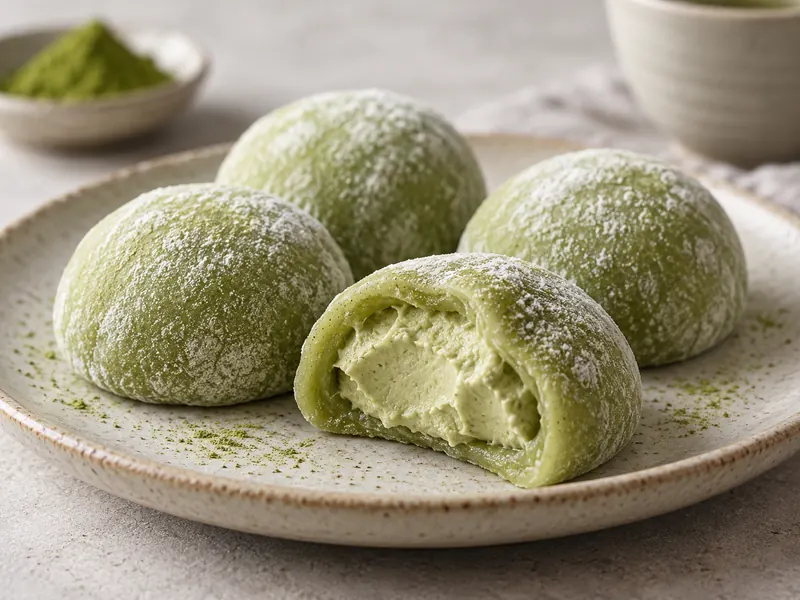
How should matcha mochi stickiness and forming loss be accepted?
Pair instrumental adhesion with depositor release, cutter release, unit-weight variation, and rejected-piece rate. In the 2025 Daifuku study, some japonica glutinous-rice samples were especially sticky and dense, making them harder to swallow and leaving a lingering sensation.
That result belongs to the tested rice systems, not to matcha. Its value is the measurement logic: stickiness affects eating quality and line yield. A bench panel cannot replace forming-loss data.
For procurement, reject supplier comparisons made with different flour bases, cook endpoints, or cooling times. Those variables can overwhelm the effect of the matcha lot.
Key Takeaway: Accept stickiness only when both sensory texture and line release pass.
Which texture attributes define matcha mochi quality?
Measure hardness, adhesiveness, cohesiveness, springiness, and recovery at a fixed time after production. The same 2025 Daifuku research reported that consumers favored complete, smooth pieces with soft, non-sticky texture.
Set separate limits for the unfilled shell and assembled product if the filling adds moisture or fat. Use a fixed sample size, compression geometry, temperature, and elapsed time so results can be compared between lots.
If a softer sample becomes harder to cut or pack, choose the operating balance that protects line yield. Softness alone is not a sufficient release criterion.
Key Takeaway: Use a texture profile and forming result, not one hardness number.
How should frozen matcha mochi be tested?
Run the intended freezing rate, storage temperature, thaw method, and repeated freeze-thaw exposure. Measure syneresis, shape, surface cracking, adhesion, hardness, and color after each defined cycle.
The Daifuku study reported that ice formation increased water mobility and could collapse weak-binding gels after thawing. A second non-matcha study, Functional Properties of Glutinous Rice Flour by Dry-Heat Treatment (2016), tested flour treated at 130°C for two or four hours. The four-hour flour showed syneresis values of 22.17%, 48.69%, 53.47%, and 56.79% across four freeze-thaw cycles.
Those figures describe modified glutinous-rice flour under the study method. They do not set a matcha mochi shelf life. Approve the commercial product in its own package.
Key Takeaway: Keep fresh and frozen approval windows separate.
Can modified-flour results set matcha mochi shelf life?
Modified-flour results can identify useful tests, but they cannot set the finished product's shelf life. Flour treatment, sugar, filling, matcha dose, package barrier, freezing rate, and thaw conditions all change the result.
Use the adjacent studies to choose measurements: syneresis, water mobility, texture, shape, and sensory acceptance. Then validate the actual SKU at planned checkpoints.
For a broader sourcing boundary, the bulk matcha food-manufacturing guide covers supplier documentation, while the food-industry application guide covers wider uses. Neither replaces mochi trials.
Key Takeaway: Use adjacent research to design shelf tests, never to assign shelf life.
How should matcha mochi color and flavor be released?
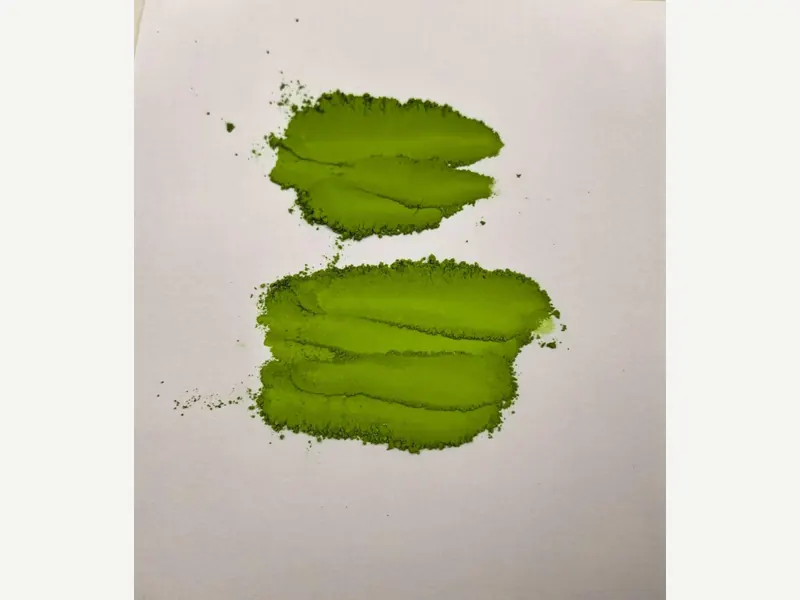
Track L*a*b* values or color difference on fresh and thawed product at a fixed time and lighting condition. Pair those readings with bitterness, astringency, rice aroma, aftertaste, and filling balance.
Color must be measured after the full cook and storage route. Raw powder appearance cannot predict a cooked starch gel. AdoroHu's powder screening and in-house laboratories support ingredient characterization; they do not prove finished-mochi performance.
When the process window is ready, a private-label matcha discussion can align powder specifications with the application trial. Contact AdoroHu with the rice base, process route, target color, and fresh or frozen format.
Key Takeaway: Release color and flavor on the finished, stored mochi.
FAQ
- What matcha grade should a manufacturer test in mochi?
- Start with a culinary grade and approve it in the fixed rice-flour system; grade names alone do not predict forming or freeze-thaw performance.
- Does finer matcha always make smoother mochi?
- No. Particle specification can affect appearance and dispersion, but starch gelatinization, water, and forming conditions also control smoothness.
- Can the fresh matcha mochi formula be used unchanged for frozen sales?
- Only after the frozen product passes the intended freezing, storage, thaw, texture, syneresis, color, and sensory protocol.
- How many freeze-thaw cycles should a buyer run?
- Use the number that represents the product's real distribution risk and add defined abuse cycles when the route can experience temperature excursions.
- Does AdoroHu manufacture finished mochi?
- AdoroHu supplies matcha ingredients and provides raw-powder testing capabilities; finished-mochi manufacturing is outside the documented supply role.
Conclusion
Commercial matcha mochi succeeds when rice-flour behavior, matcha dose, forming, and storage are tested as one controlled system. Send the target flour, process, package, and storage route through the AdoroHu contact page to plan a raw-powder sampling trial.