
Matcha noodles need a fixed cereal base, process format, and cooking test before buyers compare powder lots. Wheat, buckwheat-blend, and rice noodles build structure differently, while fresh, dried, and instant formats expose the powder to different processing and storage conditions. Begin with culinary matcha for noodle formulation trials in one defined platform.
Without that discipline, a water correction can be mistaken for a powder advantage, or a greener dry noodle can fail through boiling loss and weak texture. A useful pilot connects dose, particle distribution, dough handling, cooking performance, and finished flavor.
Fix the cereal and process platform first, then compare matcha doses and lots at equal total solids. Measure dough machinability, cooking loss, cooked texture, color, and flavor under one repeatable method.
In short: Commercial matcha noodles require a platform-specific trial from mixing through cooked-product release.
Key points:
- Treat the published 0.5%, 1%, 1.5%, and 2% levels as flour substitution, not powder addition.
- Evaluate particle size through cooking loss, network strength, and component retention together.
- Approve the finished noodle through a fixed cooking method and lot-linked application data.
Which matcha noodle platform should the buyer formulate first?
Choose one matcha noodle cereal base and process format before comparing suppliers. The abstract of a 2021 study of matcha-fortified rice noodles reports lower cooking loss and greater chewability and stretchability in its treatments. Wheat evidence, by contrast, centers on gluten-network behavior.
Those findings cannot be transferred between rice and wheat systems. Define whether the product is wheat, buckwheat-blend, or rice based and whether it will be fresh, dried, or instant. Then hold flour blend, salt, mixing, forming, drying, and cooking endpoint constant.
| Platform decision | Variables to lock | Primary release question |
|---|---|---|
| Wheat or blend | Flour proteins, salt, water, sheeting | Does the dough sheet and retain gas-free structure? |
| Rice | Rice flour system and forming process | Does the cooked noodle retain chew and integrity? |
| Fresh | Moisture, package, chilled chain | Does texture remain acceptable through intended hold? |
| Dried or instant | Drying and rehydration process | Does cooking performance remain repeatable? |
Key Takeaway: Approve one cereal and process platform before ranking matcha lots.
How should a matcha noodle dose ladder be designed?
Replicate the published matcha noodle method by substituting matcha for wheat flour at 0.5%, 1%, 1.5%, and 2%. A 2022 dried-noodle study used those flour-substitution levels, so describing them as additions would change total solids and misstate the method.
A commercial team may test a different ladder or add powder on top, but that becomes a separate application trial. Label the basis clearly and hold salt, water method, mixing energy, sheet gap, drying, cooking endpoint, and total solids as intended. None of the published levels establishes a universal product optimum.
Key Takeaway: State whether matcha replaces flour or is added, because the basis changes the dough comparison.
How do matcha particle specifications change noodle cooking loss?
Compare at least two matcha particle distributions in the finished noodle formula. A 2020 study of dried noodles with different green-tea powder sizes found that larger particles increased cooking loss. At 2% large-particle powder, holes appeared in the noodle network and breaking strength fell.
The same work found that smaller particles adhering to the surface leached more readily during boiling. Finer powder therefore does not guarantee the best complete result. Buyers should compare cooking loss, breaking strength, broth turbidity, and retained color or flavor before writing a particle specification.
Key Takeaway: Select particle distribution from finished-noodle balance, not fineness alone.
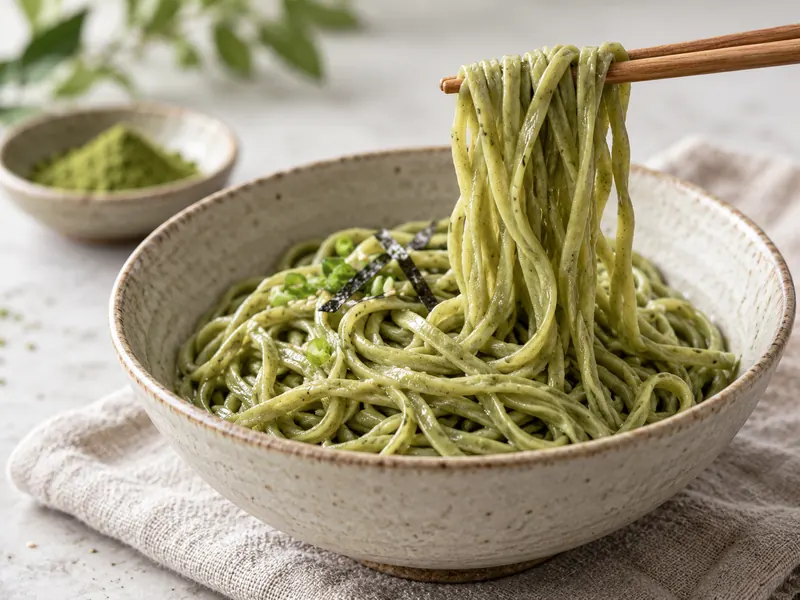
What water correction keeps matcha noodle dough machinable?
Match target dough consistency at every matcha noodle dose and record actual water addition. The 2020 particle-size study found lower cooked-water absorption as particle size and concentration rose, but it does not supply a transferable dough-hydration correction.
Track mixing torque or energy, crumb formation, dough temperature, sheet edge cracking, thickness variation, and cut yield. Add water through a defined rule rather than operator feel alone. Carry the selected correction through cooking, because improved sheeting can still produce excessive loss or a soft cooked strand.
| Process stage | Measurement | Buyer consequence |
|---|---|---|
| Mixing | Water, energy, temperature, crumb formation | Reproducible dough development |
| Sheeting | Edge cracks, thickness, pass count | Line yield and network integrity |
| Cutting | Broken strips and sticking | Saleable output |
| Cooking | Loss, absorption, texture | Consumer performance |
Key Takeaway: Validate hydration through both line handling and cooked-noodle performance.
Which matcha noodle rheology and line-handling tests diagnose failure?
Use mixing stability plus extensibility or dynamic rheology, then connect the result to matcha noodle sheetability and breakage. A 2020 gluten and model-dough study found that matcha reduced disulfide bonds and hindered gluten-network formation. Theanine increased ductility, while tea polyphenols increased toughness through hydrogen-bonded structure.
That mechanistic work does not predict a finished noodle specification. Pair G′/G″, extensibility, or mixing stability with sheet tears, edge condition, thickness variation, and cooked breakage. This keeps an instrument shift tied to a production consequence.
Key Takeaway: Use rheology to explain line behavior, then confirm the diagnosis on the intended noodle process.
How should matcha noodle cooking quality be measured?
Measure optimal cooking time, cooking loss, cooked yield or water absorption, broken-strip rate, and broth turbidity for matcha noodles. Fix noodle mass, water volume, vessel, endpoint, agitation, draining method, and elapsed time before testing texture.
The 2022 matcha noodle study found lower cooking time, cooking loss, and water absorption across its tested range. The 2020 particle study found that larger green-tea particles increased loss. Together, these results show why formulation and particle distribution must be measured in the buyer's own product rather than reduced to one supplier claim.
Use the bulk matcha for food manufacturing framework for supplier controls, while keeping cooking acceptance specific to the noodle.
Key Takeaway: A fixed cooking method is essential for comparing dose, particle distribution, and powder lot.
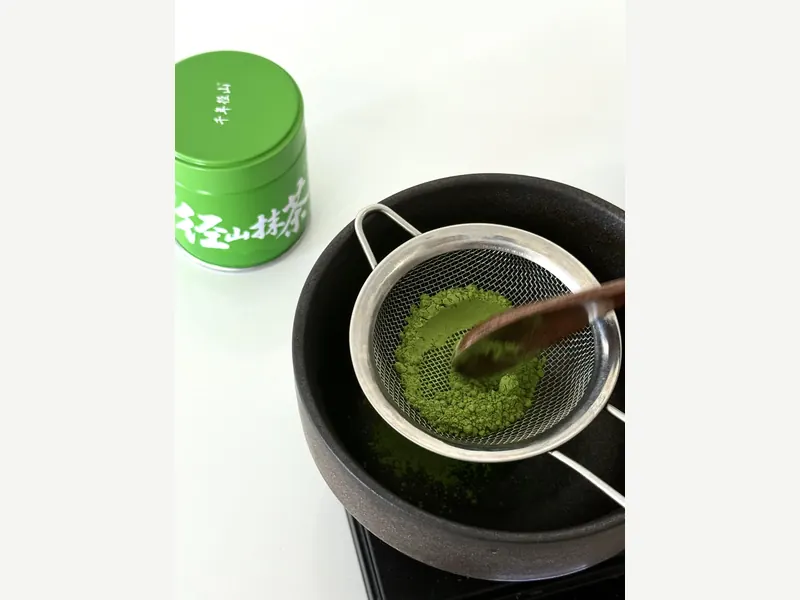
How should cooked matcha noodle color and flavor be approved?
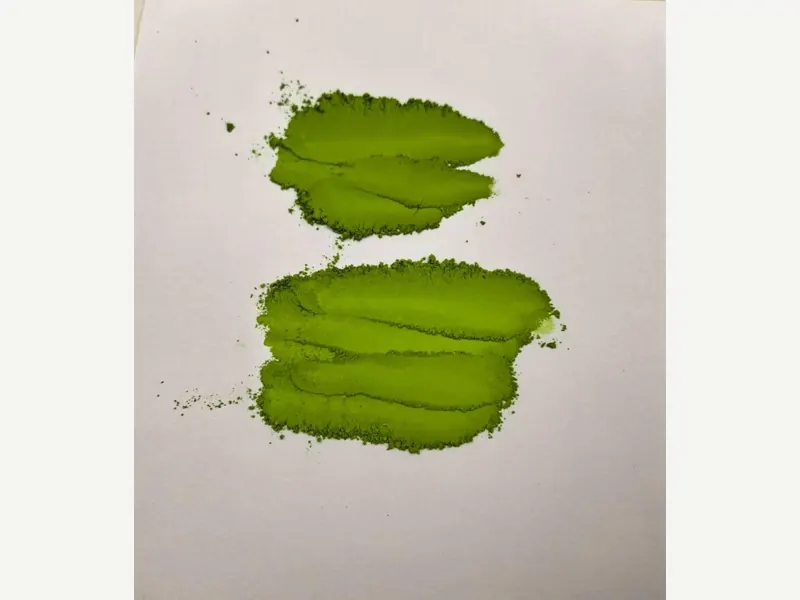
Approve matcha noodle color in both dry and cooked states under fixed lighting and elapsed time. The 2022 dried-noodle study measured darker, greener, and yellower noodles and found that tea type and level changed volatile profiles. A greener reading therefore does not establish the best eating result.
Set Lab* or ΔE limits against an approved control, then score bitterness, astringency, vegetal aroma, cereal flavor, and target-sauce compatibility. The matcha applications in the food industry article can frame application choices, but the cooked noodle remains the release sample.
Key Takeaway: Pair measured color with cooked flavor and aroma before choosing the strongest green result.
What release and shelf protocol should a matcha noodle buyer require?
Release matcha noodles against lot-linked powder identity, particle distribution, color, microbiology, and finished-product cooking and sensory results. Validate the intended moisture, package, and storage chain rather than importing a generic shelf-life period.
The FDA water activity guide defines water activity as an equilibrium ratio and notes that measurement depends on temperature. It supplies no universal noodle water-activity or shelf-life limit. AdoroHu Matcha characterizes raw powder; the noodle manufacturer owns finished-product manufacture and shelf validation. A custom formula development discussion can align the ingredient brief with the application test.
Key Takeaway: Bind release and shelf evidence to the exact noodle, package, measurement temperature, and storage chain.
FAQ
- Should the published 0.5% to 2% matcha ladder be treated as addition?
- No. In the 2022 dried-wheat-noodle study, matcha substituted for flour at 0.5%, 1%, 1.5%, and 2%.
- Does finer matcha always reduce noodle cooking loss?
- No. Particle size affected network integrity and leaching differently, so cooking loss, strength, and retention must be assessed together.
- Can a rice-noodle result set a wheat-noodle specification?
- No. Rice and wheat systems build structure differently and require platform-specific trials.
- Is there a universal water correction for matcha noodles?
- No. Match dough consistency, record actual water, and verify the result through line handling and cooking.
- Does water activity alone establish noodle shelf life?
- No. It must be interpreted with temperature, product moisture, packaging, storage, microbiology, texture, and sensory evidence.
Conclusion
Fix the noodle platform, dose basis, particle comparison, hydration method, and cooking procedure before supplier approval. To arrange raw-powder samples for that work, contact AdoroHu about noodle trials.
Institutional author: AdoroHu Matcha