
Matcha coconut milk formulation works when the team controls two systems at once: suspended tea particles and a coconut oil-in-water emulsion. A drink can taste right at the bench yet develop sediment, a cream layer, oiling-off, or a surface ring after processing. Start with a written product brief and compare prototypes under the intended serving, process, package, and storage conditions. AdoroHu supports beverage teams through matcha private label development.
Characterize the coconut base before changing the matcha. Keep tea sediment separate from coconut creaming in every observation. A formula should advance only after it performs in its intended process and package.
In short: Matcha coconut milk needs a controlled base specification, mixing sequence, and stability test plan.
Key points:
- Compare coconut bases by composition and emulsion type, not by name alone.
- Diagnose suspended solids and oil droplets as different physical problems.
- Confirm the chosen formula through processing, storage, and serving trials.
What should the matcha coconut milk brief define first?
The brief should define product format, serving state, process, package, shelf-life target, and sensory outcome before ingredients are screened. A café concentrate, refrigerated ready-to-drink bottle, ambient product, and dry kit expose matcha coconut milk to different stresses.
State whether consumers will shake, whisk, heat, pour over ice, or drink directly. Record the target colour, coconut intensity, matcha character, sweetness, viscosity, sediment, and separation that remain acceptable at each checkpoint. Define pass and fail descriptions with physical reference samples where possible.
| Brief field | Question to settle | Why it changes the trial |
|---|---|---|
| Serving state | Cold, hot, over ice, or diluted? | Temperature and dilution change viscosity and perception |
| Process | Batch mixing, homogenization, heat treatment? | Shear and heat can change particles and droplets |
| Package | Opaque bottle, carton, pouch, or concentrate pack? | Headspace, light, and agitation differ |
| Use pattern | Single serve or repeated opening? | Opening changes oxygen and handling exposure |
Key Takeaway: Fix the commercial endpoint before optimizing individual ingredients.
How should coconut milk, coconut cream, and beverage bases be compared?
Compare them through supplier specifications and bench measurements because the category name does not define one composition. Fat, total solids, protein, added gums, emulsifiers, sugar, salts, and particle or droplet structure can vary substantially.
Use one matcha dose and one process while screening bases. Observe viscosity, cream-layer height, oil droplets, sediment, flavour release, and colour. Research on coconut milk emulsions shows that fat content, droplet structure, homogenization, and stabilizer addition sequence can change physical stability. Those findings justify measurement, but their exact formulas and settings are not transferable to a commercial matcha drink.
Practitioner decision: reject an inconsistent coconut base specification before adding more stabilizer. Otherwise, the team may spend weeks compensating for raw-material variation that returns in production.
Key Takeaway: Select a defined coconut base, not a generic ingredient label.
Which coconut-base inputs must be documented?
Document fat, protein, total solids, carbohydrate or sugar, minerals, pH, stabilizers, emulsifiers, and any heat treatment that the supplier discloses. Also record lot, age, storage history, and whether the base is intended for dilution.
Build a simple incoming comparison using the same preparation temperature and container. Measure or observe pH, viscosity, density where useful, creaming, visible oil, and flavour. Keep supplier data beside your own result rather than replacing one with the other.
| Input | Possible formulation effect | Evidence to retain |
|---|---|---|
| Fat and total solids | Body, opacity, coconut intensity, creaming | Supplier specification and lot result |
| Protein and emulsifier | Droplet-interface behaviour | Ingredient declaration and process notes |
| Gum system | Viscosity and suspension | Type, level if disclosed, and flow observation |
| Sugar, salt, minerals | Taste, pH, and interactions | Formula calculation and measured pH |
Key Takeaway: Base composition belongs in the formula record because it can explain stability changes wrongly blamed on matcha.
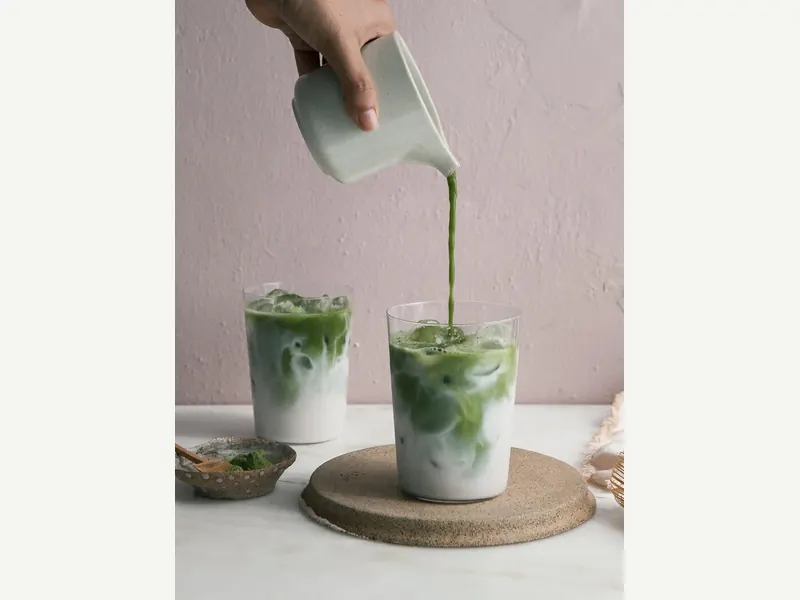
How should matcha grade and dose enter the screen?
Screen matcha grade and dose against the finished product, not the dry powder alone. Dose affects colour, bitterness, astringency, sediment load, and the amount of suspended material the system must carry.
Begin with a small, ordered matrix rather than many simultaneous changes. Hold coconut base, water, sweetener, and process constant while comparing matcha options. A matcha latte application guide can frame sensory questions, while the public scope of ISO/TR 21380:2022 helps separate matcha identity from the blended beverage made with it.
Record prepared colour, aroma, first taste, finish, mouthfeel, sediment, foam, and performance after the intended hold. A stronger green cup is not automatically the better commercial formula.
Key Takeaway: Choose the matcha dose that meets the finished-product brief without creating an avoidable physical or sensory defect.
How should sweetness, salt, pH, and flavour be balanced?
Adjust sweetness, salt, pH, and flavour as separate variables so the team knows which change solved which defect. Coconut aroma can soften or mask matcha, while fat and serving temperature can change flavour release.
Use coded samples and a fixed serving protocol. Compare sweetness onset, coconut-matcha balance, bitterness, astringency, aftertaste, aroma persistence, and coating mouthfeel. Do not use acid merely to brighten flavour without checking emulsion and colour response in the actual base.
Keep sensory adjustments within applicable ingredient and labelling requirements for the destination market. Nutrition and caffeine calculations should be verified from formula inputs and suitable testing where required; the formula team should not infer them from a café recipe.
Key Takeaway: Change one sensory control at a time and recheck physical stability after every pH or solids adjustment.
What mixing order reduces matcha clumps and coconut separation?
A controlled mixing order hydrates and disperses matcha without applying unnecessary stress to the coconut emulsion. The best order depends on the equipment and base, so document temperature, time, shear, vessel geometry, addition rate, and hold time.
Compare direct powder addition with a defined pre-dispersion. Evaluate dry premixing with compatible ingredients where appropriate, adding matcha to an aqueous phase before the coconut base, and adding it into the complete formula. Screen for dry pockets, wall deposits, foam, sediment, oiling-off, and temperature rise.
Original coconut-emulsion research found that homogenization and whether surface-active stabilizers were added before or after it changed droplet structure and creaming. That is direct evidence that sequence can matter in coconut systems. It does not identify a universal sequence for matcha coconut milk, because the studied ingredients and concentrations were different.
Key Takeaway: Approve a mixing sequence only after recording how it affects both tea dispersion and coconut emulsion stability.
When should homogenization or a stabilizer trial be considered?
Consider these trials after the failure mode is identified. Matcha sediment, coconut creaming, flocculation, coalescence, and simple viscosity loss need different responses.
If the coconut base oils off, inspect base composition, process temperature, and droplet behaviour before increasing gum. If matcha settles but the emulsion stays intact, compare particle dispersion, continuous-phase viscosity, and serving instructions. A stabilizer may slow movement while producing an unacceptable texture or flavour.
The 2008 coconut-emulsion study measured particle size, creaming, and microscopy across homogenization and stabilizer sequences. A later open study compared high-shear homogenization, ultrasonication, and microfluidization in a whey-protein and Tween-80 system. These studies support structured trials, but dairy-derived additives and laboratory equipment results must not be transferred as approved commercial settings.
Practitioner decision: choose the least complex formulation and process that meets the brief. Added complexity increases sourcing, labelling, process-control, and change-control work.
Key Takeaway: Match the intervention to the observed failure rather than treating every separation problem with more stabilizer.
How should separation, sediment, and viscosity be measured?
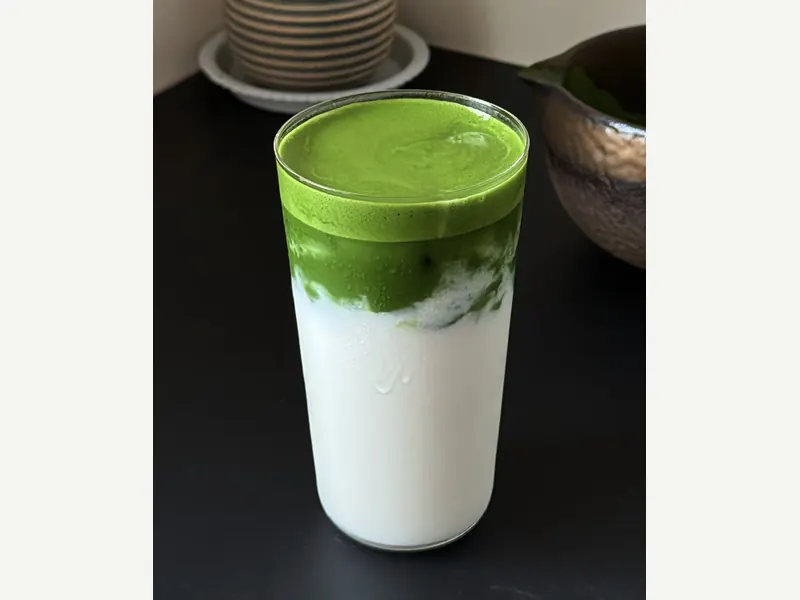
Measure suspension and emulsion outcomes separately at defined times and temperatures. Photographs can support the record when lighting, container, fill, background, and timing remain fixed.
| Observation | Likely system | Practical method |
|---|---|---|
| Dense green layer at bottom | Matcha suspension | Sediment height, redispersion strokes, mass where suitable |
| Pale cream layer at top | Coconut droplets | Cream-layer height and appearance |
| Free oil or ring | Emulsion failure or surface deposition | Standardized visual score and microscopy if available |
| Flow change | Continuous phase or aggregation | Viscosity under a defined method and temperature |
Record whether gentle inversion restores uniformity and whether the change returns. Avoid one vague “separation” score because it hides the mechanism and sends reformulation in the wrong direction.
Key Takeaway: A useful stability record identifies what moved, where it moved, and whether normal handling restores the product.
Which process and storage conditions belong in the test matrix?
Test the conditions the product will actually face, including relevant mixing, heating, chilling, holding, transport agitation, and serving preparation. Add freeze-thaw only when it is a plausible event or deliberate product requirement.
Thermal-treatment research on coconut milk found that heat and freeze-thaw responses depended on the emulsion and stabilizer system. Treat those results as mechanism evidence, not performance claims for a new formula. Build checkpoints around fresh product, post-process product, early storage, later storage, and end-of-life targets.
At every checkpoint, use the same measurements: appearance, cream layer, oiling-off, sediment, viscosity, colour, aroma, taste, package condition, and redispersibility. Link failures to process records instead of judging a final cup without its history.
Key Takeaway: Test the winning prototype through the intended process sequence, not only during static refrigerated storage.
What evidence supports scale-up or rejection?
Scale-up requires a locked formula, defined coconut-base specification, documented process window, repeatable pilot batches, and acceptance results in the intended pack. One successful beaker is not enough.
Review ingredient variation, addition sequence, shear input, temperature history, fill behaviour, headspace, closure, and storage checkpoints together. Use the RTD matcha formulation guide to connect formula work with production questions, then keep this coconut-specific evidence in the project file.
Advance when repeat batches meet sensory and physical criteria. Reformulate when the failure is understood and controllable. Reject a concept when it needs an impractical process, cannot survive intended conditions, or depends on an unstable raw-material specification.
Key Takeaway: Scale-up is a repeatability decision supported by formula, process, package, and shelf evidence.
FAQ
- Does matcha dissolve in coconut milk?
- Matcha is a suspension rather than a truly dissolved ingredient, so dispersion, sediment, and redispersibility must be evaluated in the chosen coconut base.
- Why does matcha coconut milk separate?
- Separation may come from matcha sediment, coconut creaming, oil-droplet coalescence, ingredient interactions, or process conditions; each mechanism needs different evidence and corrective action.
- Should matcha be mixed with water before coconut milk?
- It can be a useful trial, but the preferred sequence must be selected from controlled comparisons of clumping, foam, sediment, oiling-off, sensory quality, and process fit.
- Can dairy matcha-latte research be applied to coconut milk?
- Dairy studies can suggest measurements or mechanisms, but their protein, fat, mineral, and processing results cannot be transferred directly to a coconut emulsion.
- When is a stabilizer needed in matcha coconut milk?
- Consider a stabilizer after identifying the failure mode and confirming that base specification, dispersion, process, and package controls do not already solve it.
- What should a pilot report contain?
- Record ingredient lots, formula, order of addition, equipment, temperature, shear and time, package, storage conditions, checkpoint results, deviations, and the advance, reformulate, or reject decision.
Conclusion
A stable matcha coconut milk product comes from controlling the coconut emulsion and matcha suspension as related but distinct systems. To discuss a commercial formula, base specification, matcha selection, and pilot plan, contact AdoroHu Matcha.
Institutional Author
AdoroHu Matcha