
Matcha pudding commercial formulation begins with the milk-starch-hydrocolloid system, because that system determines spoon texture and whey separation before matcha quality can be judged. Start with culinary matcha for pudding trials and one fixed base formula.
An uncontrolled trial can look thick when filled and still release serum during refrigerated storage. Buyers need measured breaking behavior, calculated gel properties, syneresis, color, sediment, and sensory results at fixed checkpoints.
"Choose the gel family before optimizing matcha dose. Compare formulas only when milk solids, heat, shear, fill temperature, cooling, and storage conditions match."
In short:
Key points:
- Screen starch and hydrocolloid systems before fine-tuning matcha flavor.
- Separate measured breaking force and point from calculated gel strength and rigidity.
- Approve syneresis, color, sediment, and spoon texture through the intended refrigerated shelf.
Which gel system should matcha pudding screen first?
Screen a starch control against selected hydrocolloids before optimizing matcha. The 2024 study Effect of Hydrocolloids on Penetration Tests, Sensory Evaluation, and Syneresis of Milk Pudding found that agar, carrageenans, gellan gum, gelatin, and modified waxy corn starch produced different firmness, elasticity, and serum-release behavior in non-matcha milk puddings.
That adjacent matrix does not validate a matcha formula. It shows that the structure system can dominate the result. Choose two or three viable systems, then add a matcha dose ladder within each.
| Gel route | Main release question | Commercial risk |
|---|---|---|
| Starch-led | Does the spoon texture hold after cooling? | Weak or pasty set |
| Gellan-led | Does low-dose structure limit serum release? | Brittle or unfamiliar bite |
| Carrageenan-led | Is firmness balanced with elasticity? | Excess rigidity or syneresis |
Key Takeaway: Select the gel family before comparing matcha lots.
How should matcha pudding solids be controlled?
Match milk solids and reproduce the published series accurately. The study compared 0.3% hydrocolloids with modified waxy corn starch at 1%, 3%, or 5%, and sucrose at 2.5%, 5%, or 7.5% in reported series. It was not a fully crossed factorial.
For matcha work, add a control and several powder doses while keeping total solids constant. If sugar or starch changes, record that cell as a different formula because both can alter gel response and sensory balance.
Key Takeaway: Keep a clear solids basis so matcha effects remain interpretable.
Which matcha pudding texture tests are distinct?
Measure breaking force and breaking point with a defined penetration method. Then calculate gel strength as force multiplied by distance and rigidity as force divided by distance. These four values are not four independent measurements.
Pair the instrument results with spoon pickup, coating, graininess, and oral melt. The buyer decision should connect each metric to filling, transport, and eating quality.
| Result | Meaning in the tested method | Buyer use |
|---|---|---|
| Breaking force | Force at failure | Firmness during spooning |
| Breaking point | Distance at failure | Deformation before break |
| Gel strength | Force × distance | Calculated gel-strength index |
| Rigidity | Force ÷ distance | Resistance per deformation |
Key Takeaway: Keep measured and calculated texture values correctly labeled.
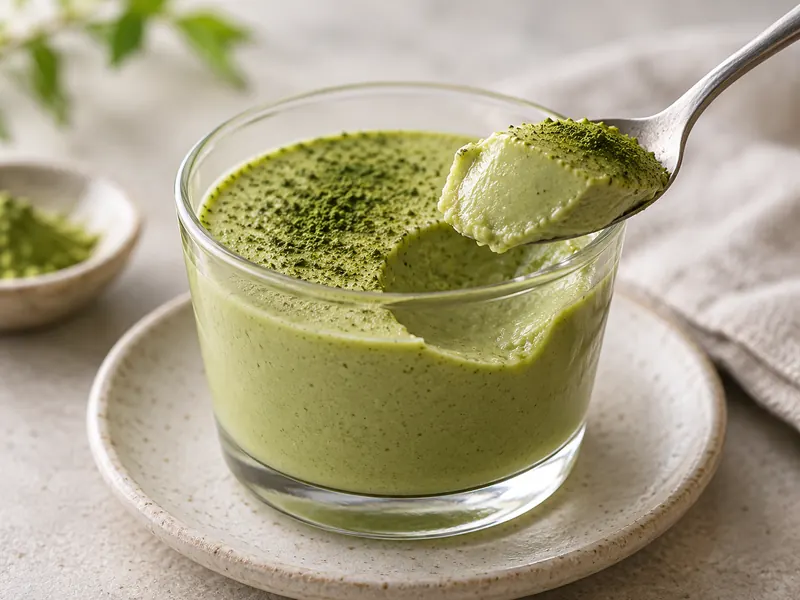
How should matcha pudding syneresis be tested?
Measure expelled serum at defined refrigerated checkpoints. In the 2024 milk-pudding study, syneresis increased over two weeks, and results were evaluated after 7 and 14 days at 4°C.
Use the intended cup, headspace, cooling rate, and transport handling. Weigh separated liquid or apply the same validated method at each checkpoint. A day-one visual inspection cannot establish stability.
Reject any comparison made with different cooling or storage histories. Those differences can change gel contraction and mask the effect of matcha or hydrocolloid selection.
Key Takeaway: Syneresis approval requires fixed time, temperature, package, and method.
What does hydrocolloid choice change in matcha pudding?
Hydrocolloids shift firmness, deformation, and water retention in different directions. In the tested non-matcha systems, gellan gum and iota-carrageenan controlled 14-day syneresis better than the compared systems, while agar and kappa-carrageenan created greater rigidity and strength.
Treat that as a screening signal. Matcha particles and polyphenols may change protein and starch interactions, so the final decision must come from the complete matcha pudding.
For broader supplier controls, use the bulk food-manufacturing sourcing guide alongside the application trial.
Key Takeaway: Choose hydrocolloids by texture and serum control together.
Can the source's selected pudding formula be copied?
No. Among the tested experimental formulations, 5% sucrose, 0.3% gellan gum, and 1% modified waxy corn starch balanced sensory and syneresis results. The study did not prove that combination universally optimal or superior overall to the commercial control.
Matcha can alter color, bitterness, particulate load, and matrix interactions. Use the published formula as one screening cell, not a finished specification.
The matcha food-industry guide defines broader application boundaries but does not supply a pudding optimum.
Key Takeaway: A promising tested matrix is a starting point, not a universal formula.
How should matcha pudding heat and shear be validated?
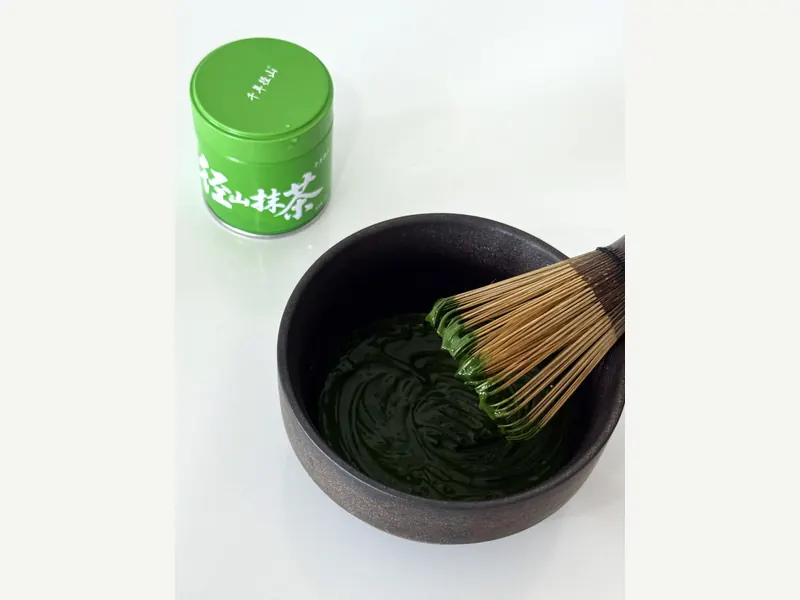
Record powder addition point, peak temperature, holding time, shear speed and duration, fill temperature, and cooling curve. Compare formulas only when those histories match.
Add matcha before and after the highest-heat step in separate cells if the process permits. Measure dispersion, viscosity, color, and set after storage. Reject bench comparisons with unmatched shear, because higher shear can reduce visible clumps while changing the developing gel.
Key Takeaway: Match heat and shear histories before ranking formulas or suppliers.
How should matcha pudding color and sediment be released?
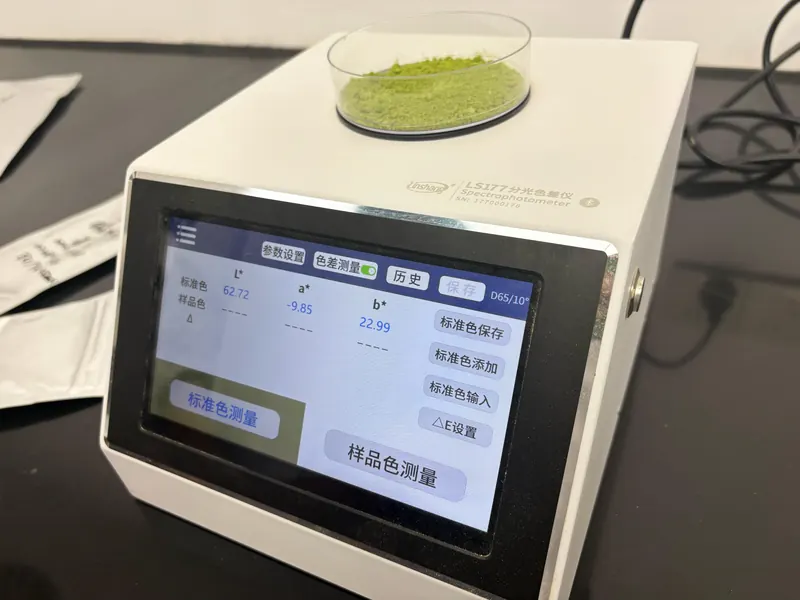
Measure L*a*b* values or color difference after processing and at each storage point. Inspect the cup side and base for sediment, then score bitterness, astringency, dairy balance, graininess, and spoon texture.
Raw powder color cannot predict a heated dairy gel. AdoroHu's ultrasonic screening and in-house laboratories support raw-powder characterization; they do not prove finished-pudding performance.
A private-label matcha discussion can align powder specifications with the trial. Contact AdoroHu with the milk base, gel system, heat process, package, and shelf target.
Key Takeaway: Release color and sediment on the stored finished pudding.
FAQ
- What matcha grade should a pudding manufacturer start with?
- Start with a culinary grade and approve it in the chosen milk-starch-hydrocolloid system rather than relying on the grade name.
- Does more starch always reduce matcha pudding syneresis?
- No. In the adjacent study, starch level changed texture and syneresis, and the best balance depended on the complete tested formulation.
- Can gel strength be read directly from a texture analyzer?
- In the cited method, breaking force and point were measured, while gel strength and rigidity were calculated from those values.
- How long should a matcha pudding stability test run?
- It should cover the intended refrigerated shelf and distribution conditions, with predefined checkpoints for separation, texture, color, and sensory quality.
- Does AdoroHu manufacture finished pudding?
- AdoroHu supplies matcha ingredients and provides raw-powder laboratory capabilities; finished-pudding manufacturing is outside the documented supply role.
Conclusion
Commercial matcha pudding needs one controlled gel system, a traceable process, and refrigerated evidence from the finished cup. Share the base formula, process, and storage target through the AdoroHu contact page when planning powder samples.