
Matcha protein bar development should begin with one protein-and-binder architecture, because that base controls hardening, moisture movement, and water activity before matcha lots can be compared. Start with culinary matcha powder for protein-bar trials in a fixed pressed, no-bake, or baked system.
The difficult part appears after day zero. A bar can leave the line soft and green, then harden, dry, fade, or develop oxidative flavors in storage. A useful pilot follows texture, moisture, water activity, color, and oxidation through the intended package and shelf.
"Fix the protein, binder, fat, piece density, and package before comparing matcha lots. Track puncture force, moisture, water activity, color, and oxidation separately because they can move in different directions."
In short:
Key points:
- Lock the bar architecture and protein source before matcha-dose work.
- Use a defined puncture method and record the analysis window, equilibration, and piece geometry.
- Pair real-time storage with bounded acceleration; never turn an accelerated model into a shelf-life claim.
Which matcha protein bar architecture should be fixed first?
Choose a pressed high-protein bar, date-and-nut no-bake bar, or baked bar before testing powder. Each uses a different binder, water distribution, and protein network, so results cannot be ranked across architectures.
| Architecture | Dominant control | Main aging risk |
|---|---|---|
| Pressed high-protein | Protein-binder interaction | Hardening and water migration |
| Date or nut no-bake | Fruit solids, fat, particle packing | Stickiness and oil migration |
| Baked | Heat-set structure and moisture loss | Firming and color loss |
Use one mixing temperature, forming pressure, piece density, and cooling time. Do not compare matcha lots across different bases; the consequence is an ingredient ranking driven by the bar system.
Key Takeaway: Fix protein and binder architecture before comparing matcha.
How should protein source enter a matcha protein bar design?
Treat whey, pea, and rice protein as separate formulation factors. In the 2025 study Role of protein and lipid oxidation in hardening of high-protein bars during storage, researchers used different fill masses for identical 2.5 cm diameter by 1.3 cm molds because the protein systems had different densities.
That study contained no matcha. It shows why a fixed mold volume does not guarantee a fixed piece mass or density. Record protein lot, protein content, fill mass, dimensions, and density for every cell.
Key Takeaway: Control piece geometry and density when protein source changes.
Which texture method can track matcha protein bar hardening?
Use a defined puncture test and keep its settings unchanged. The 2025 protein-bar study used a 2 mm probe, punctured to 95% strain, and extracted maximum force over the 0 to 10 mm travel window to exclude platform effects. Samples equilibrated at room temperature for at least one hour.
Those settings are a reproducible adjacent method, not universal acceptance limits. Report probe, speed, strain endpoint, analysis window, sample temperature, dimensions, and equilibration time.
| Method field | Study setting | Why it matters |
|---|---|---|
| Probe | 2 mm | Sets local stress geometry |
| Endpoint | 95% strain | Drives near-complete puncture |
| Analysis | Maximum force, 0–10 mm | Excludes platform contact |
| Equilibration | At least 1 hour at room temperature | Reduces temperature bias |
Key Takeaway: A texture number is useful only with its complete method.
What accelerated-aging design is defensible for matcha protein bars?
Use the intended package and real-time storage as the decision basis. Add accelerated storage only to compare mechanisms and rank risks.
The 2025 study sampled days 0, 7, 14, 20, and 42 at 37°C. Bars stayed in their molds inside 69 micrometre Ziploc freezer bags. Temperature, mold, and bag are part of the result boundary.
Build the commercial plan around actual packaging and market temperatures. Reject a day-zero-only color and texture approval, because it says nothing about the claimed shelf.
The matcha shelf-life validation guide explains the broader evidence boundary.
Key Takeaway: Use acceleration to screen risk, then validate the real package and shelf.
How should moisture and water activity be interpreted during hardening?
Read moisture content, water activity, and puncture force as separate measurements. By day 42 in the adjacent study, whey bars lost 33% ± 6–8% moisture and their water activity fell 29% ± 8% without oil and 31% ± 7% with oil. Pea bars lost 22% ± 3–6% moisture, while pea and rice water activity did not change significantly.
These protein-specific results show that moisture loss and water activity do not provide the same information. FDA's Water Activity (aw) in Foods defines water activity as a vapor-pressure ratio under identical conditions and notes its temperature dependence.
Use the matcha water-activity testing guide for the site's wider testing context. Do not claim that matcha prevents drying or hardening.
Key Takeaway: Pair moisture, water activity, and force instead of substituting one for another.
Which oxidation tests distinguish protein-bar hardening mechanisms?
Keep protein and lipid oxidation methods separate. The 2025 study evaluated protein oxidation with tryptophan fluorescence, free sulfhydryl, and carbonyl measurements. It evaluated lipid oxidation with peroxide and thiobarbituric-acid-reactive-substance values.
Compare those results with puncture force and sensory rancidity. A correlation can identify a plausible mechanism, but it does not prove that matcha prevents oxidation or hardening.
For products containing nuts or added oil, record oil type, antioxidant system, headspace, oxygen barrier, and storage temperature. These can change lipid oxidation independently of matcha.
Key Takeaway: Use nonoverlapping protein- and lipid-oxidation methods.
How should matcha color and bitterness be tested in a protein bar?
Measure L*a*b* values or color difference and sensory intensity at day zero and every storage checkpoint. Proteins, syrups, fats, and oxidation can mask green color or shift bitterness.
Use fixed lighting, sample orientation, surface, and elapsed time. Break bars to compare surface and interior if oxygen or drying exposure differs.
The matcha quality comparison guide supports raw-powder evaluation, but finished-bar acceptance belongs to the stored product.
Key Takeaway: Approve matcha color and flavor across storage, not only at day zero.
What belongs in a matcha protein bar pilot-release sheet?
Record protein, binder, fat, and matcha lots; powder dose and addition method; mixing temperature; mold or forming pressure; piece mass, dimensions, and density; texture method; moisture; water activity; color; oxidation; package; and every storage point.
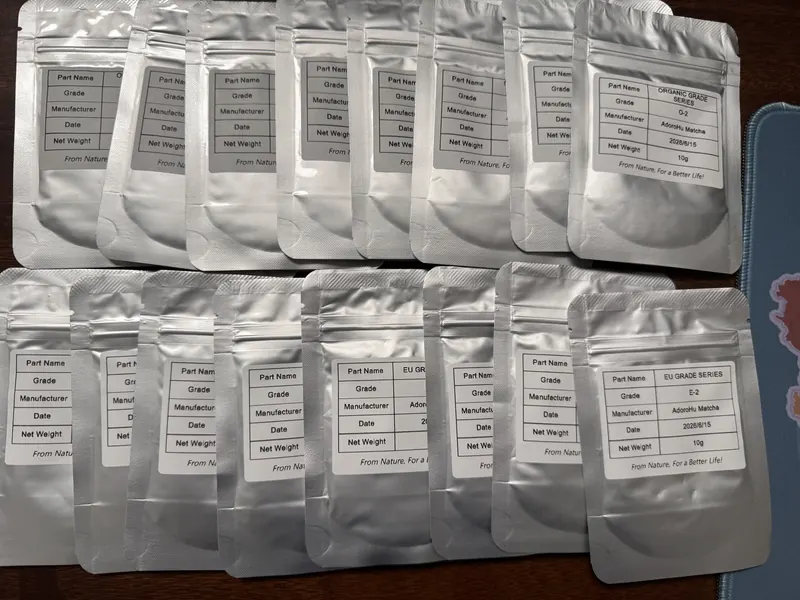
AdoroHu supplies raw matcha and has in-house microbiology and physical-chemical laboratories. Those capabilities support powder documentation and sampling, not a claim that AdoroHu manufactures finished protein bars.
Contact AdoroHu with the protein system, binder, package, storage plan, and target sensory profile.
Key Takeaway: Make the release sheet trace the complete bar, method, package, and shelf.
FAQ
- What matcha grade should a protein-bar manufacturer test first?
- Start with a culinary grade and approve it in the fixed protein, binder, fat, and package system rather than relying on the grade name.
- Does lower water activity prove a matcha protein bar will stay soft?
- No. Water activity, moisture content, and puncture force can change differently, so all three require separate measurements.
- Can accelerated storage define the final shelf life?
- Use acceleration to screen mechanisms and compare formulas, then validate the intended package under real storage conditions.
- Does matcha prevent protein or lipid oxidation in a bar?
- The cited adjacent study did not contain matcha, so a prevention claim requires direct evidence from the finished matcha bar.
- Does AdoroHu manufacture finished protein bars?
- AdoroHu supplies matcha ingredients and raw-powder testing capabilities; finished protein-bar manufacturing is outside the documented supply role.
Conclusion
A commercial matcha protein bar needs a fixed architecture, a reproducible puncture method, and storage evidence that separates moisture, water activity, oxidation, color, and hardening. Use the AdoroHu contact page to plan raw-powder samples for the chosen bar system.