Sourcing high-quality matcha for food processing can be a logistical nightmare for commercial brands. Flavor inconsistency, failing pesticide tests, and visual degradation during thermal processing ruin production runs and kill profit margins. If your ingredient-grade powder turns a muddy brown or tastes overly bitter in your final product, you risk losing customer trust and getting rejected by major retail buyers. Managing international supply chains, fluctuating customs regulations, and unverified supplier claims only adds to the stress. Partnering with a vetted, certified B2B matcha supplier resolves these issues by securing standardized, direct-from-factory grades that are custom-formulated for your specific manufacturing needs.
Sourcing matcha for food processing requires selecting a verified OEM supplier that provides standardized culinary or industrial-grade green tea powder characterized by an ultra-fine mesh size of 800 to 1,000, moisture levels below 5%, and strict global food safety certifications like FSSC 22000 to ensure color retention and taste stability during large-scale manufacturing.
In short: Key points:
- Commercial food manufacturing requires specialized culinary or industrial grades rather than expensive ceremonial options to achieve optimal taste and color stability.
- Reliable OEM partners must provide comprehensive documentation, including batch-specific Certificates of Analysis (COA) with clear microbiological and heavy metal thresholds.
- Navigating minimum order quantities (MOQs), shading times, and import compliance is critical to building a stable, cost-effective B2B supply chain.
What is matcha for food processing and how does it differ from standard green tea powder?
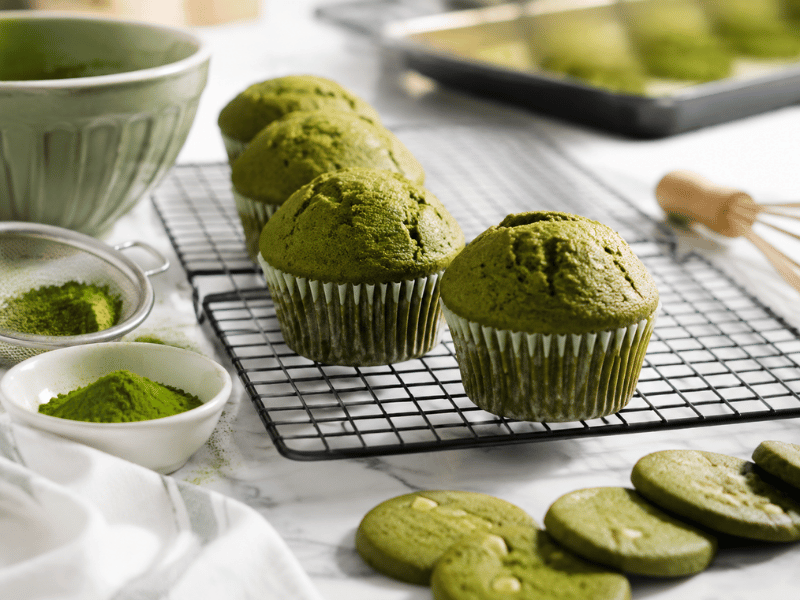
Matcha for food processing is a specialized stone-ground green tea powder derived from shade-grown tencha leaves, engineered to maintain color and flavor stability under industrial processing heat. Selecting authentic matcha for food processing rather than standard green tea powder is crucial because of their divergent production methods. Standard green tea powder is typically made from unshaded sencha leaves, whereas authentic food-grade matcha utilizes shade-grown tencha that has been ground to an ultra-fine mesh size of 800 to 1,000.
Tencha vs. Sencha in Commercial Processing
The fundamental difference lies in the cultivation and processing of the raw leaves. Authentic matcha requires covering the tea plants to block out 90% of sunlight for several weeks before harvest, which forces the plant to overproduce chlorophyll and amino acids like L-theanine. Sencha leaves are grown under direct sunlight and are ground raw, leading to a yellow-brown hue and highly bitter profile that performs poorly in industrial recipes.
Particle Size and Mesh Requirements
Industrial applications require an incredibly fine particle size to ensure seamless integration into batters, liquids, and creams. Standard green tea powder is often coarsely ground, which leads to physical sedimentation and a sandy texture in finished food products.
Here is the thing:
If you use coarse green tea powder, the particles will settle at the bottom of your liquid formulas. Utilizing genuine ground tencha at a strict 800 to 1,000 mesh standard guarantees perfect suspension in liquids, dairy bases, and doughs.
Key Takeaway: Authentic processing matcha requires shade-grown tencha ground to a minimum 800 mesh to achieve permanent suspension and vibrant green visual appeal.
Why is selecting the right grade of matcha for food processing crucial for commercial brands?
Selecting the correct grade of matcha for food processing ensures your product maintains its intended flavor profile and visual appeal without exceeding your cost-of-goods-sold (COGS) targets. Commercial brands must evaluate different culinary and industrial grades of matcha for food processing to find the ideal balance between sensory performance and budget constraints. Relying on an expensive ceremonial grade matcha for baking is a costly mistake because its delicate nuances are destroyed by heat, whereas a robust, vibrant culinary grade holds up beautifully.
The Visual Spectrum: From Emerald to Olive
In food manufacturing, color is the primary indicator of quality for the end consumer. Using a low-grade ingredient matcha in a dairy-based dessert can result in a greyish-brown tint rather than a bright green visual. High-quality culinary grades preserve their green color under heat because of their high natural chlorophyll content.
Chemical Standards: Moisture and Ash Content Limits
Industrial food processing requires raw materials to have low moisture levels to prevent the growth of bacteria and molds. Premium food-grade matcha must maintain a moisture content under 5.0% and an ash content below 6.5%.
But that is only half the story:
You also need to consider how the powder interacts with fats and sugars in your recipe. A higher-astringency culinary grade works perfectly to cut through dairy fat in ice creams, whereas a delicate latte grade is better suited for premium beverages.
| Grade | Intended Application | Visual Profile | Taste Profile | Key Technical Standard | |
|---|---|---|---|---|---|
| Ceremonial | Direct drinking, high-end wellness | Luminous Emerald Green | Sweet, rich umami, no bitterness | First harvest, stone-milled | |
| Latte / Barista | Matcha lattes, RTD beverages | Vivid Bright Green | Creamy, mild astringency | First-second harvest blend | |
| Premium Culinary | Baking, fine confectionery | Bright Green | Robust, balanced bitterness | Ash < 6.5%, Moisture < 5% | |
| Ingredient / Industrial | Ice cream, mass baking, supplements | Yellowish-Green | Earthy, highly astringent | Late harvest, high heat-stability |
Key Takeaway: Brands must match the matcha grade to their specific processing environment, targeting moisture levels under 5% to prevent bacterial growth and clumping.
How do you evaluate the quality standards of a B2B matcha OEM supplier?
Evaluating a B2B matcha OEM supplier requires verifying their global food safety certifications and reviewing their batch-specific heavy metal and microbiological limits. A reputable supplier of matcha for food processing must consistently prove their compliance with international safety protocols rather than just offering verbal quality guarantees. You must demand standard third-party test documents to ensure the safety of your end consumers and prevent costly product recalls.
Non-Negotiable Food Safety Certifications
Your bulk supplier must hold active food safety certifications recognized by the Global Food Safety Initiative (GFSI). These include FSSC 22000, ISO 22000, and HACCP systems, which prove that the factory maintains sterile processing lines, proper foreign matter detection, and clean milling rooms.
Microbiological and Heavy Metal Limits
Because tea leaves are grown outdoors, they are susceptible to environmental contaminants. Standard industrial quality requirements mandate that heavy metal levels stay within safe ranges, specifically lead under 5.0 ppm and arsenic under 2.0 ppm.
Think about it:
A single shipment held up at customs due to high lead levels can ruin your entire manufacturing timeline. Safe sourcing requires partnering with facilities that provide batch-specific Certificates of Analysis (COA) confirming a total plate count under 10,000 cfu/g.
| Metric / Certification | Standard Requirement | Risk of Non-Compliance | Verification Method | |
|---|---|---|---|---|
| Lead Limit | < 5.0 ppm | Import rejection, legal liability | Batch-specific COA | |
| Arsenic Limit | < 2.0 ppm | Health hazards, brand damage | ICP-MS Lab Testing | |
| Total Plate Count | < 10,000 cfu/g | Microbial contamination, spoilage | Petri-film cultivation | |
| FSSC 22000 / ISO 22000 | Active registration | Retailer rejection, audit failures | GFSI portal verification | |
| Halal & Kosher | Certified clean lines | Market exclusion for key demographics | Official certifying body seal |
Key Takeaway: Always verify that your OEM partner provides batch-level COAs showing lead below 5 ppm and holds GFSI-recognized certifications like FSSC 22000.
What are the key price drivers in bulk supply of matcha for food processing?
The primary price drivers in bulk matcha supply are the duration of the shading process, the specific harvest season, and the overall volume of the contract. Understanding how agricultural practices dictate the final wholesale cost of matcha for food processing is essential for negotiating sustainable long-term contracts. Bulk pricing for food-grade green tea powder generally ranges from 10 to 35 per kilogram, depending on whether you require early-spring or late-summer harvests.
Shading Duration vs. Cost of Production
The length of time tea fields are kept shaded represents a massive manual labor and resource investment for Japanese tea farmers. Shading tea leaves for a full 21 days maximizes chlorophyll development, resulting in a vibrant green powder that commands a premium price.
Harvest Timing and Pricing Structures
First-harvest leaves gathered in spring yield the highest L-theanine and amino acid profiles, commanding prices from 25 to 35 per kilogram. Subsequent summer and autumn harvests yield larger, more astringent leaves that are highly cost-effective, typically priced between 10 and 18 per kilogram.
Here is the real story:
Unshaded green tea powder can be produced for under $10/kg, but it will look dull yellow and taste highly bitter in your recipe. Authentic shaded matcha requires intensive manual labor and yields less crop, which naturally commands a higher B2B price but preserves the vibrant green color.
Key Takeaway: High-quality processing matcha shade-grown for 14-21 days costs between 10−35/kg, providing the visual vibrancy cheap alternatives lack.
How does the private label process work for custom matcha OEM formulations?
The private label process for custom matcha OEM formulations involves defining your technical recipe, testing stability, and executing custom packaging steps at the factory level. Creating a proprietary blend utilizing private label matcha allows your brand to stand out in a crowded market with customized flavor or functional notes. When sourcing matcha for food processing, OEM customization can range from pure matcha powder adjustments to complex formulations including sweet green tea powder, functional herbs, and milk powders.
Developing the Custom Formulation Brief
Your brand begins by establishing the desired characteristics of the final product, such as color intensity, sweetness levels, and solubility. The OEM partner uses these guidelines to craft prototype samples using different cultivars like Yabukita or Okumidori.
Blending and Flavor Additives
Custom matcha mixes designed for instant matcha lattes often require blending the tea powder with sweeteners, soluble fibers, or dairy-free creamers.
Let’s look closer:
Many food brands mix premium matcha with cane sugar, fruit powders, or dairy-free creamers to create convenient, high-margin consumer products. Vetted OEM suppliers handle the homogenization, moisture-check, and uniform blending of these ingredients inside sterile facilities to prevent separation during retail storage.
Key Takeaway: Custom OEM formulations allow brands to create unique, value-added products like instant lattes while delegating complex blending to certified facilities.
What are the common packaging and storage specifications for wholesale matcha for food processing?
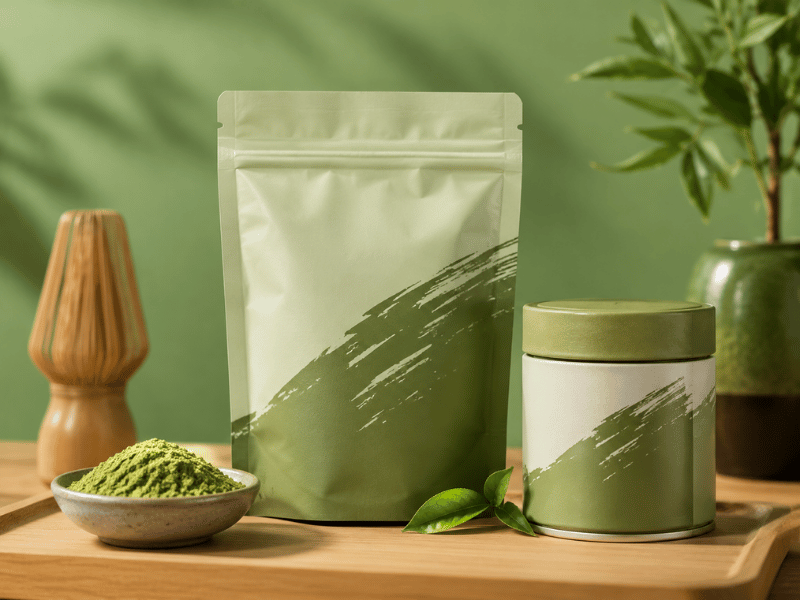
Wholesale matcha must be packaged in multi-layer aluminum foil bags with oxygen absorbers and stored at cold temperatures to prevent oxidation and color degradation. Preserving the delicate sensory qualities of matcha for food processing during transit and storage requires strict environmental controls from the factory to your warehouse. Exposure to oxygen, light, heat, and humidity will rapidly degrade L-theanine and turn your bright green powder into a lifeless, bitter brown.
Barrier Packaging and Nitrogen Flushing
Standard commercial packaging utilizes heavy-duty aluminum foil bags combined with oxygen absorbers and nitrogen flushing to maintain an oxygen-free interior. This active preservation ensures that the tea powder does not interact with ambient air during long-distance shipping.
Cold Chain Logistics and Warehousing Standards
Matcha is highly sensitive to ambient temperature fluctuations above room temperature. Bulk shipments should ideally be transported via refrigerated containers and stored in a cold warehouse at temperatures below 10°C.
This is critical:
You must store bulk matcha at temperatures below 10°C (ideally under 5°C) to achieve a standard commercial shelf life of 18 months. Once a bulk bag is opened at your manufacturing plant, it must be resealed quickly and used within a few weeks to prevent moisture absorption.
Key Takeaway: Storing bulk matcha in nitrogen-flushed aluminum bags at temperatures below 10°C ensures a stable 18-month shelf life.
What are the minimum order quantities (MOQ) and lead times for importing bulk matcha OEM products?
Standard MOQs for bulk importing range from 100kg for stock grades to 500kg for custom OEM packaging, with lead times averaging 15 to 20 days. Managing your raw material inventory requires precise alignment with your supplier’s minimum order requirements and manufacturing turnaround times for bulk matcha . To establish a consistent supply of matcha for food processing, you must evaluate how production scales impact shipment timelines.
Understanding Minimum Order Thresholds (MOQs)
For standard, unbranded bulk bags, suppliers often offer low MOQs starting at 100 kilograms. However, if your brand requires custom-milled particle sizes or custom-printed retail packaging, the manufacturing line setup costs require a higher commitment, typically 500 kilograms.
Production Timelines and Freight Considerations
Once an order is confirmed, milling, quality testing, and packaging require approximately 15 to 20 days at the factory level. From there, shipping logistics dictate your ultimate delivery date.
Keep in mind:
While air freight is fast (typically 5 to 7 days), it is cost-prohibitive for large-scale operations. Most high-volume food brands schedule ocean freight shipments 8 to 12 weeks in advance to optimize shipping costs and maintain inventory safety stock.
Key Takeaway: Plan for 15-20 days of factory lead time and structure your inventory cycles around a standard 100kg bulk or 500kg custom packaging MOQ.
What common sourcing mistakes do food brands make when buying bulk matcha for food processing?
The most common sourcing mistakes include buying on price alone without verifying color stability, neglecting pesticide residue limits, and ignoring physical-chemical specification sheets. Relying on the cheapest available green tea powder rather than verified matcha for food processing is a shortcut that almost always results in finished product failures. Many importers buy low-grade tea powders that look green initially but quickly turn brown under thermal processing or acidic environments.
The Trap of Cheap “Green Tea Powder”
Brokers often sell finely ground sencha or unshaded green tea under the name of “culinary matcha.” While cheap, these powders have an extremely high tannin content, giving them a harsh, unpalatable bitterness that overpowers matcha baking applications.
Ignoring Pesticide MRL Compliance (FDA/EU)
Different countries maintain highly variable standards regarding acceptable agricultural chemical levels. Failing to verify that your import batch complies with FDA or European Union Maximum Residue Limits (MRL) can lead to devastating consequences.
Here is the hard truth:
A batch of green tea that fails pesticide residue tests will be seized and destroyed at the port at your expense. Insist on checking the supplier’s third-party laboratory reports for active chemical compounds before placing bulk deposits.
Key Takeaway: Avoid costly customs rejections and product browning by validating pesticide MRL compliance and thermal stability prior to bulk purchasing.
How do organic certification standards impact your wholesale matcha OEM supply chain?
Organic certification standards impact your supply chain by requiring strict agricultural chemical testing and complete, unbroken transaction traceability from farm to factory. Incorporating certified organic matcha into your product line commands a retail premium but introduces rigorous documentation requirements for your wholesale supply chain. Sourcing certified organic matcha for food processing means every single step—including tea cultivation, harvest, drying, grinding, and packaging—must be certified by accredited bodies to maintain compliance.
Navigating JAS, USDA Organic, and EU Equivalency
To market your product as organic in the United States or Europe, your supplier must hold valid JAS Organic (Japanese Agricultural Standard) certification. Thanks to organic equivalency agreements, JAS-certified tea can easily be imported and sold as USDA Organic or EU Organic, provided the correct import certificates are filed.
Unbroken Traceability and Document Audits
Organic compliance requires that every bulk shipment is accompanied by an official Transaction Certificate (TC). This document verifies that the exact weight of organic matcha shipped matches the agricultural output of certified organic tea farms in Japan.
But here is the catch:
If your broker cannot provide the correct organic transaction certificates for each batch, you cannot legally display the organic seal on your retail packaging. Working with a direct-from-source Japanese manufacturer with established organic farming partnerships simplifies this audit process.
Key Takeaway: Seamless organic marketing requires a direct supplier with certified JAS, USDA, and EU organic pathways and continuous batch traceability.
FAQ
- What is the difference between OEM and private label matcha?Private label involves branding a supplier’s pre-existing matcha formulation, while OEM (Original Equipment Manufacturer) allows you to customize the cultivar blend, mesh size, and packaging specifications to create a unique proprietary product.
- How do I prevent bulk matcha from turning brown in food manufacturing?Prevent browning by choosing a heat-stable culinary or industrial grade matcha with active chlorophyll protection, packaging in vacuum-sealed aluminum bags, storing below 10°C, and minimizing exposure to heat and light during processing.
- What are the mandatory certifications for importing wholesale matcha into the US?The mandatory import documents include FDA facility registration, a Certificate of Analysis (COA) specifying microbiological and heavy metal limits, a Certificate of Origin, and USDA Organic certification if marketed as organic.
- What is the standard MOQ for custom-packaged private label matcha?While stock bulk matcha MOQs start at 100kg, custom-printed retail packaging or custom OEM formulations typically require a minimum order of 500kg to offset setup costs.
- Does Japanese matcha contain heavy metals like lead?Real Japanese matcha from verified farms contains minimal trace elements; however, reputable suppliers must provide a Certificate of Analysis (COA) confirming that lead levels are under 5.0 ppm and arsenic is under 2.0 ppm.
Conclusion
Securing a reliable supply of premium green tea powder is critical for protecting your product quality and scaling your commercial food line. Partnering with a verified, direct-from-factory Japanese OEM supplier ensures you receive consistent, certified, and cost-effective ingredients tailored to your specific application. Ready to elevate your product line with customized formulations and reliable bulk logistics? Submit a sample request today to connect with our B2B sourcing experts.