For most smoothie applications, the best matcha is a culinary or premium grade with a vivid green color, a robust flavor that survives dilution, and a fine particle size that blends without clumping. Ceremonial grade is usually the wrong pick, and here’s the problem most buyers run into: they over-spend on a delicate, expensive powder whose subtle umami simply disappears once banana, mango, or yogurt enters the blender.
That mistake compounds fast at scale. A beverage brand or smoothie chain paying ceremonial prices for a flavor nobody can taste is burning margin on every cup, while a brand that under-spends on a dull, yellowish culinary powder ends up with grey, lifeless smoothies that photograph poorly and lose repeat orders. The grade that wins is the one engineered for blending. This guide breaks down exactly which matcha to source for smoothies, how grades behave once blended, and how to evaluate suppliers like AdoroHu Matcha so your finished drink stays green, tastes clean, and costs what it should.
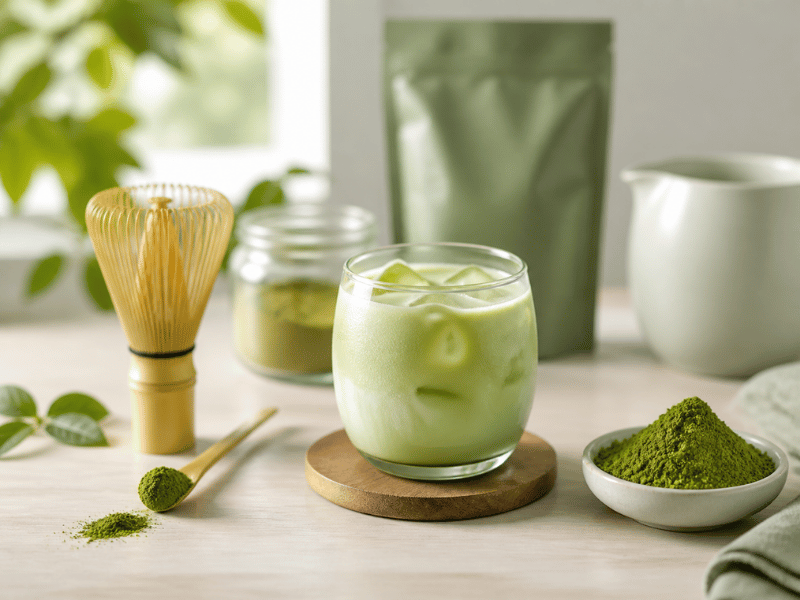
The best matcha for smoothies is a vibrant culinary or premium grade with bold flavor and ultra-fine milling, not ceremonial grade. Smoothies dilute matcha with fruit, dairy, and ice, so a robust powder that holds its green color and grassy taste through blending outperforms a delicate, costly ceremonial powder whose nuance is lost.
In short: smoothies need matcha that fights through other ingredients, so flavor strength, color stability, and milling fineness matter far more than ceremonial prestige.
Key points:
- Culinary and premium grades are purpose-built for blending and cost far less than ceremonial.
- Color retention and particle fineness decide whether your smoothie looks vibrant or grey.
- For B2B buyers, cost-per-serving, batch consistency, and certifications outweigh single-tin taste tests.
Which matcha grade is the best matcha for smoothies?
The best matcha grade for smoothies is culinary grade, with premium grade as a step up when flavor purity matters in a signature product. Here’s the thing most consumer guides get wrong: they treat ceremonial as “best” by default. For a blended drink, that logic breaks down. Ceremonial matcha is made from the youngest first-harvest leaves and tuned for a smooth, naturally sweet taste when whisked with water alone. Drop it into a smoothie and the fruit, milk, and ice flatten that delicate umami completely.
Culinary grade uses slightly more mature leaves with higher catechin content. That gives it a bolder, more astringent profile that stays perceptible through dilution. Industry sources consistently recommend culinary grade for lattes, smoothies, ice cream, and baking for exactly this reason. AdoroHu organizes its culinary grade matcha within an EU Grade Series (E-1 to E-7), letting buyers dial in the precise color-and-flavor point a recipe needs rather than settling for one generic “culinary” powder.
Key Takeaway: Choose culinary grade for everyday smoothie lines and premium grade for hero products; ceremonial grade wastes money in any blended drink.
Why does ceremonial matcha underperform as the best matcha for smoothies?
Ceremonial matcha underperforms in smoothies because its defining quality, delicate sweetness, is destroyed by blending. Let’s be clear about what you’re paying for: ceremonial grade comes from the first shade-grown harvest, where bushes are covered for roughly three weeks to build chlorophyll and L-theanine. That investment produces a mellow, low-bitterness powder meant to be tasted neat.
But a smoothie is an aggressive flavor environment. Frozen banana, mango, citrus, and dairy each carry stronger taste signals than ceremonial matcha’s subtle notes. The result is predictable: you pay a premium for nuance that no drinker will ever detect. Worse, the lower catechin level means ceremonial matcha contributes less of the grassy “green tea” character that smoothie customers actually expect. A robust culinary or premium powder delivers that signature flavor at a fraction of the cost.
Key Takeaway: Save ceremonial grade for whisked tea and tasting flights; in a smoothie its premium price buys flavor that gets blended into oblivion.
What makes the best matcha for smoothies hold its green color?
Color retention in the best matcha for smoothies comes down to chlorophyll content, particle fineness, and freshness, not grade prestige alone. Picture this: two smoothies side by side, one a vivid jade, the other a dull army-grey. The difference sells. A bright green smoothie signals quality and freshness to customers, and that visual is often what drives the repeat order.
Three factors protect that color. First, shade-grown leaves carry far more chlorophyll, the pigment behind the green. Second, stone-milling into an ultra-fine powder disperses pigment evenly so the drink reads as a uniform green rather than speckled. Third, oxidation is the enemy, so freshly milled, properly sealed matcha holds color longer than stale stock. AdoroHu controls all three in-house, shading at its own estate and finishing through a 20-unit stone mill plus ultrasonic screening for consistent ultra-fine particle size.
Particle size and clump prevention
Fineness does double duty: it protects color and stops clumping in cold liquid. Matcha that won’t disperse leaves gritty green specks on the glass.
- Ultra-fine milling lets powder hydrate and suspend evenly, even in cold smoothie bases.
- Coarser, cheaper powders sink and clump, forcing extra blending time on a production line.
- Consistent particle size across batches keeps every smoothie looking identical, which matters for a chain.
Key Takeaway: Specify shade-grown, stone-milled, ultra-fine matcha if you want smoothies that stay vibrant green from blender to glass.
How do matcha grades compare for smoothie use?
For smoothie use, grades compare best across four axes: flavor strength, color, cost, and intended application. Rather than ranking grades good-to-bad, the smart B2B move is matching grade to product tier. Here’s a side-by-side that reflects how blended drinks actually behave.
| Grade | Flavor in a smoothie | Color | Relative cost | Best smoothie use |
|---|---|---|---|---|
| Ceremonial | Too subtle, gets lost | Brightest green | Highest | Avoid for blends; use for neat tea |
| Premium | Clean, balanced, holds up | Vivid green | Mid-high | Signature or “clean-label” smoothies |
| Culinary | Bold, cuts through fruit & dairy | Strong green | Most cost-efficient | Everyday smoothie lines, high volume |
| Organic (any grade) | Matches its base grade | Matches grade | Premium over conventional | Health-positioned, certified products |
Notice the pattern: as you move toward blended applications, culinary grade delivers the most usable flavor per dollar. AdoroHu’s organic matcha is offered across an O-1 to O-6 series, so a brand wanting USDA, EU, or JAS certification can still pick the exact flavor-and-color point its smoothie recipe needs.
Key Takeaway: Match the grade to the product tier, culinary for volume, premium for signature, organic for certified positioning, rather than chasing the “highest” grade.
What flavor and ingredients pair best with the best matcha for smoothies?
The best matcha for smoothies pairs with ingredients that complement its grassy, slightly bitter profile rather than mask it. This is where recipe design protects your margin: choose pairings that let a cost-efficient culinary grade shine, and you never need to over-spend on grade.
Banana and mango add natural sweetness that rounds out matcha’s astringency. Coconut milk and almond milk provide a creamy base without overpowering it. A handful of spinach deepens the green color and stacks nutrition without altering taste. For a balanced antioxidant-forward drink, matcha’s EGCG catechins reinforce the wellness positioning many smoothie brands lean on.
Building a balanced smoothie base
A reliable starting ratio keeps flavor and color consistent across a menu.
- Use 1 to 2 grams (about 1 tsp) of culinary matcha per single smoothie serving.
- Anchor with frozen banana or mango for sweetness and body.
- Use unsweetened plant milk so the matcha’s green tea note stays clean.
Key Takeaway: Design recipes around matcha’s bold, grassy character so an affordable culinary grade tastes intentional, not like a compromise.
How much matcha should you use per smoothie, and what does it cost at scale?
Most smoothies use 1 to 2 grams of matcha per serving, which is the single most important number for B2B cost planning. Let’s run the logic that recipe blogs never cover. At roughly 1.5 grams per drink, a single 1-kilogram bag of culinary matcha yields about 660 servings. That cost-per-serving math, not the price on a retail tin, is what determines a smoothie line’s profitability.
Because AdoroHu prices by grade and quality and quotes lead time against order volume, buyers get a number tied to their actual specification rather than a one-size retail markup. Sourcing in bulk supply formats (20 kg or 25 kg per carton with sealed food-grade liners) drops the per-gram cost dramatically versus retail pouches. For a chain serving thousands of smoothies weekly, that difference is the line between a healthy and a thin margin. You can request a quote tied to your grade, volume, and packaging to get real numbers.
Key Takeaway: Plan around 1 to 2 grams per serving and source in bulk cartons; cost-per-serving, not tin price, decides your smoothie line’s profitability.
What should B2B buyers look for when sourcing the best matcha for smoothies?
B2B buyers sourcing the best matcha for smoothies should prioritize batch consistency, certifications, and food-safety processing over single-tin taste impressions. Here’s what separates a hobbyist purchase from a supply decision: a home cook buys one tin, but a beverage brand needs the same color and flavor in batch 1 and batch 500.
Consistency demands a supplier that controls cultivation through milling. AdoroHu’s 350-hectare self-owned estate, with 150 hectares organic-certified, plus a 1,000 m² purification workshop, exists to deliver that repeatability. Food safety is non-negotiable for any ingredient entering a commercial drink, which is why metal detection and sterilization lines matter.
Certifications that matter for smoothie products
For products sold across markets, the right paperwork prevents customs and labeling headaches.
- USDA Organic (NOP), EU Organic, and JAS Organic for certified-organic smoothie lines.
- ISO 22000 and FDA Registration for food-safety assurance.
- Halal and Rainforest Alliance for broader market and ethical-sourcing claims.
Key Takeaway: Source from a vertically integrated, certified supplier so every smoothie tastes and looks identical, batch after batch, across every market you sell into.
Can you private label the best matcha for smoothies?
Yes, the best matcha for smoothies can be private labeled, and for most beverage brands that’s the smartest route to a branded product. Think about it: instead of reselling someone else’s tin, you launch your own smoothie powder or pre-portioned sachet under your name, at a margin a generic resell can never match.
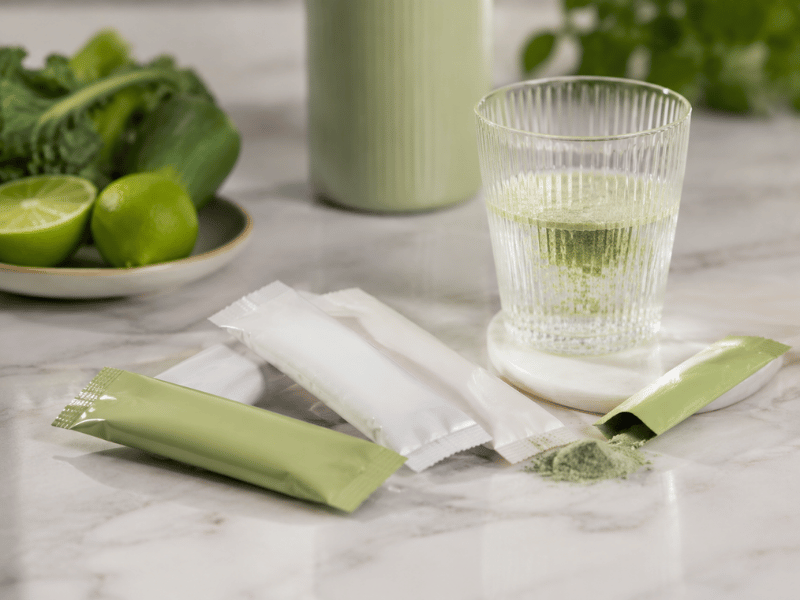
AdoroHu supports full private label and OEM production, from grade selection and custom formula development to retail-ready packaging. Practical formats range from single-serve 1–3 g sachets (ideal for grab-and-go smoothie kits) to zip-lock pouches (30 g–500 g) and bulk cartons for manufacturers. A custom blend can even pre-mix matcha with complementary tea powders for a signature smoothie base no competitor can copy.
Key Takeaway: Private labeling turns a commodity ingredient into a branded smoothie product, with packaging from single-serve sachets to bulk cartons.
What mistakes do buyers make when choosing the best matcha for smoothies?
The most common mistake is choosing matcha by grade prestige instead of by how it performs in a blended drink. Buyers repeatedly fall into the same traps, and each one quietly costs money.
First, over-buying ceremonial grade, paying for delicate flavor that blending erases. Second, under-buying a cheap, dull culinary powder that turns smoothies grey and gritty, hurting the visual that drives repeat sales. Third, ignoring particle size, which causes clumping and longer blend times on a production line. Fourth, sourcing from a trader with no estate control, so color and flavor drift between batches. A supplier that owns its premium matcha supply chain end-to-end eliminates that last and most damaging risk.
Key Takeaway: Stop buying matcha by prestige; evaluate flavor strength, color, fineness, and batch consistency against your actual smoothie recipe.
FAQ
- Is ceremonial or culinary matcha better for smoothies?
- Culinary grade is better for smoothies because its bolder flavor and higher catechin content survive blending with fruit and dairy, while ceremonial grade’s delicate sweetness is lost. Culinary grade also costs significantly less, making it the more practical choice for both home and commercial smoothie use.
- How much matcha do I need per smoothie?
- Most recipes use 1 to 2 grams, roughly one teaspoon, of culinary matcha per single serving. For B2B planning, around 1.5 grams per drink means a 1-kilogram bag yields approximately 660 servings, which is the key figure for calculating cost-per-serving.
- Why does my matcha smoothie turn grey or brown?
- A dull color usually means low chlorophyll, oxidation, or coarse particle size. Fresh, shade-grown, stone-milled matcha holds a vivid green far better. Proper sealing and fast turnover also prevent the oxidation that fades color over time.
- Can I order organic matcha for smoothies in bulk?
- Yes. AdoroHu offers organic matcha certified under USDA (NOP), EU, and JAS standards across its grade series, available in 20 kg and 25 kg bulk cartons with sealed food-grade liners for manufacturers and beverage brands.
- Do you offer samples before a wholesale order?
- Yes. AdoroHu supports sample requests so buyers can test color, flavor, and blend performance before committing to a wholesale or private-label order. Pricing is quoted by grade and quality, and lead time is set against order volume.
Conclusion
The best matcha for smoothies is a vibrant, ultra-fine culinary or premium grade that holds its color and flavor through blending, not an expensive ceremonial powder whose nuance disappears. For any brand building a smoothie line, the decision that protects margin is cost-per-serving and batch consistency, sourced from a supplier that controls cultivation through milling. To match the right grade to your recipe and get pricing tied to your volume, contact AdoroHu Matcha to request a sample or a wholesale quote.