
Clumpy matcha powder is more than just a nuisance; for B2B buyers and food manufacturers, it represents a significant hurdle to operational efficiency and product consistency. When your kitchen or production line faces persistent lumps, it leads to uneven flavor profiles, poor mouthfeel for the end consumer, and wasted inventory. At AdoroHu, we understand that in a high-volume environment, every second spent struggling with poorly textured powder impacts your bottom line. By sourcing premium, private-label matcha and implementing standardized handling protocols, businesses can eliminate these “pain points” and ensure a world-class beverage program.
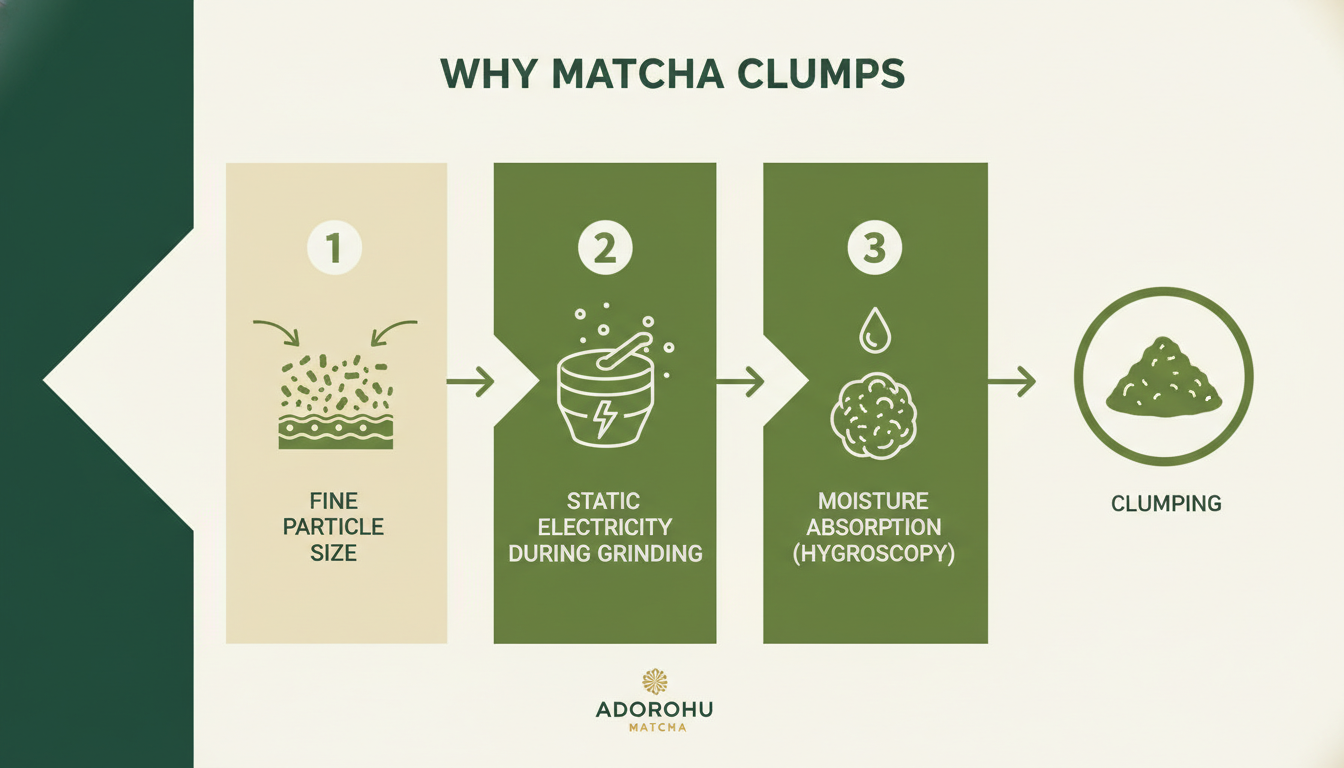
Matcha clumps primarily due to its ultra-fine particle size and the static electricity generated during the traditional stone-grinding process. Additionally, as a highly hygroscopic substance, it readily absorbs moisture from the air, causing particles to bind together. These clumps are often a natural indicator of high-quality, finely milled powder rather than a product defect.
In short: Matcha clumping is a physical reaction to fine grinding and environmental exposure. It is easily managed through proper sifting and humidity-controlled storage.
Key points:
- Static & Particle Size: Fine milling increases surface area and electrostatic attraction.
- Moisture Sensitivity: Humidity causes the powder to “seize” and form hard aggregates.
- Professional Solution: Sifting and the “paste method” are mandatory for B2B consistency.
1. Why is matcha powder naturally prone to clumping?
Matcha is unique because it is a suspension, not a solution. To achieve the creamy mouthfeel required for ceremonial and premium culinary applications, Tencha leaves are stone-ground into particles often smaller than 5–10 microns. This exceptionally fine texture increases the total surface area, making the particles naturally prone to sticking together. Unlike lower-quality teas that may be coarsely ground, premium matcha acts more like flour or cocoa powder, where the sheer density of tiny particles encourages “clumping” as a default state.
2. How does static electricity cause matcha clumps during grinding?
The traditional stone-grinding process—while essential for preserving flavor and color—creates significant friction. This friction generates a static charge within the powder. Because the particles are so light, this electrostatic attraction causes them to cluster into small balls immediately after milling. For high-volume suppliers, managing this charge is a critical part of the packaging process to ensure the product remains workable when it reaches the client.

3. Does the grade of matcha affect how much it clumps?
Paradoxically, higher-grade matcha often clumps more than lower-grade “industrial” powders. Ceremonial grades are ground for much longer periods to achieve a silkier texture, which increases both the static charge and the surface area available for moisture absorption. Culinary grades, which may have a slightly larger particle size, can sometimes appear “looser,” but they lack the vibrant green color and umami profile required for premium applications. For a B2B buyer, seeing clumps in a fresh bag is actually a sign of authentic, stone-ground quality.
4. Why is sifting mandatory for professional matcha preparation?
In a café or restaurant setting, sifting is the single most important step for quality control. Even the most expensive matcha will produce a “gritty” drink if added directly to liquid. Using a fine-mesh stainless steel sifter (or a traditional furui) breaks the electrostatic bonds and aerates the powder. This ensures that when the liquid is added, the particles can be evenly suspended, resulting in the signature froth and smooth texture that customers expect from a premium brand.
5. What environmental factors lead to matcha clumping in bulk storage?
Matcha is hygroscopic, meaning it acts like a sponge for environmental moisture. When stored in humid kitchens or near steam-heavy espresso machines, the powder absorbs water vapor, causing the particles to partially dissolve and then re-crystallize into hard, stubborn lumps. Temperature fluctuations are equally dangerous; moving matcha from a cold refrigerator to a warm room causes condensation to form inside the bag, which can ruin an entire bulk shipment in hours.
6. How can B2B buyers prevent clumping during transport?
The integrity of the wholesale matcha supply chain depends on protective packaging. AdoroHu utilizes multi-layer foil bags with high-barrier properties to block light, oxygen, and moisture. For long-distance transport, maintaining a stable temperature is key. Buyers should ensure their logistics partners avoid “heat soak” in shipping containers, as excessive heat can degrade the powder’s molecular structure, making it more prone to permanent clumping and oxidation.
7. Why does whisking technique matter for a clump-free texture?
Even with sifting, the way you introduce water is vital. Professional baristas use the “paste method”: adding a tiny amount of 70-80°C water to the powder and whisking it into a thick, smooth slurry before adding the rest of the liquid. Using a bamboo whisk (chasen) in a vigorous “W” or “M” motion creates the necessary agitation to break down any micro-clumps. If water is added all at once, or if it is boiling (above 80°C), the matcha can “seize up,” creating a barrier that prevents a smooth blend.
8. What are the risks of using clumpy matcha in food manufacturing?
For large-scale food manufacturers, clumpy matcha is a production risk. In products like ice cream, white chocolate, or baked goods, unsifted clumps result in “green spots”—pockets of intense, bitter powder that haven’t integrated. This leads to inconsistent batches and can damage the brand’s reputation for quality. Automated sifting and pre-mixing into a fat-based or liquid carrier are standard industrial fixes to ensure a homogenous color and flavor across thousands of units.

9. Is there a way to rescue clumped bulk matcha?
If a bulk container has developed lumps due to moisture, it can often be rescued if the flavor hasn’t oxidized. The solution is a mechanical breakdown: sifting the entire batch through a fine sieve while applying gentle pressure with a spatula. If the clumps are “hard” (crystallized), the powder may need to be reserved for culinary applications where it can be blended at high speeds, such as in smoothies or industrial mixers, rather than for traditional tea preparation.
10. How do professional suppliers ensure quality control against clumping?
Top-tier suppliers like AdoroHu implement strict Quality Control (QC) protocols at the source. This includes monitoring moisture content (typically kept below 3-5%) and using nitrogen flushing during the bagging process. By replacing oxygen with nitrogen, we prevent oxidation and moisture ingress during storage. For our B2B partners, we recommend a FIFO (First-In, First-Out) inventory system and the use of smaller “working containers” to minimize the time the main bulk supply is exposed to the air.
FAQ
- Is clumpy matcha a sign that it has gone bad?
- No. In most cases, clumping is a natural result of the fine grinding process and static electricity. However, if the powder is also yellowed or has a stale odor, it may be oxidized.
- What is the best temperature to store bulk matcha to avoid lumps?
- Unopened bulk bags should be kept in a freezer (0°F / -18°C) or refrigerator. Once opened, it should be stored in a cool, dark place (below 25°C) and used within 1–2 months.
- Can I use a blender to remove clumps instead of sifting?
- Yes, for lattes and smoothies, a high-speed blender or an electric milk frother can effectively break up clumps, though sifting remains the gold standard for traditional tea.
- Why does my matcha clump more in the summer?
- Higher humidity levels in the summer increase the moisture the powder absorbs from the air every time the container is opened.
- Should I put a desiccant pack in my matcha tin?
- Yes, using food-grade moisture-absorbing packets in your “working container” can help maintain a dry environment and prolong the powder’s shelf life.
Conclusion
Understanding the science behind clumpy matcha is the first step toward a more efficient and higher-quality beverage program. By recognizing that clumps are a hallmark of finely ground, premium tea, and by implementing professional sifting and storage techniques, B2B buyers can ensure every cup served is smooth, vibrant, and delicious. Ready to upgrade your matcha supply? Contact AdoroHu today to discuss our premium bulk and private-label options tailored for your business needs.