Finding the right ingredients for your commercial bakery or food manufacturing line is a high-stakes challenge. If you source the wrong green tea powder, your baked goods will suffer from dull, brownish colors, bitter flavors, and inconsistent production runs. These quality failures directly translate to lost sales, damaged brand reputation, and wasted ingredient costs. By understanding how to select the best matcha for baking, you can guarantee vibrant green pastries, stable flavor profiles, and highly profitable product lines.
In short:
Key points:
- Culinary grade matcha provides the robust flavor needed to cut through sugar and dairy in baked goods.
- High chlorophyll content is strictly required to prevent oxidation and browning during baking.
- Bulk buyers should verify quality standards, including moisture content below 4%, to ensure long shelf life.
- Working with a reliable OEM supplier guarantees consistent mesh size and batch-to-batch color matching.
What Makes the Best Matcha Powder for Baking?
What exactly defines the ideal matcha powder for baking applications? The best baking matcha requires a specific balance of flavor intensity, color stability, and particle fineness. Unlike drinking teas that prioritize delicate umami, baking matcha must possess a pronounced, slightly astringent flavor profile. This bold taste is essential. It ensures the authentic green tea flavor remains noticeable even after being mixed with heavy ingredients like butter, flour, and sugar.
Here is the secret to baking success:
Commercial bakers rely on culinary grades that are harvested slightly later in the season. These later harvests yield tea leaves (tencha) with a stronger cellular structure and a more robust catechin profile. The high catechin content provides the necessary flavor backbone. Furthermore, optimal baking matcha undergoes precise stone-milling or air-pulverizing. The powder must reach an ultra-fine 80 to 120 mesh size. This fine texture guarantees seamless blending into doughs and batters without clumping.
Key Takeaway: The ideal baking matcha combines a robust flavor profile, high catechin levels, and an ultra-fine mesh size to ensure smooth blending and prominent taste in complex commercial recipes.
Culinary vs. Ceremonial: Which Grade is Better for Bakeries?
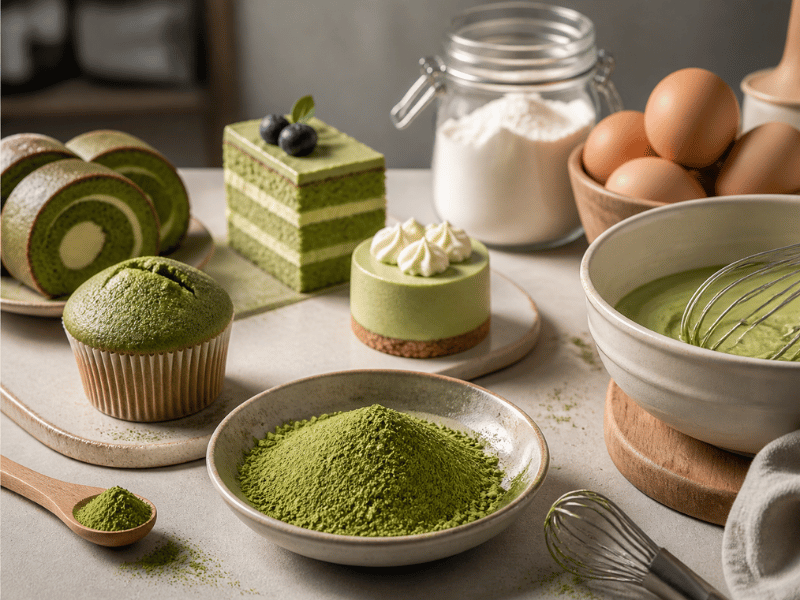
Why do professionals debate over culinary versus ceremonial grades when evaluating the best matcha powder for baking? Ceremonial matcha is crafted from the youngest, first-harvest spring leaves. It offers a delicate, sweet, and highly nuanced umami flavor meant for mixing simply with warm water. However, when you use ceremonial matcha in high-heat baking, its subtle flavor notes are entirely destroyed by the heat, sugars, and fats.
Consider this important difference:
A high-quality culinary grade matcha is intentionally designed for food production. It is usually sourced from second or third harvests. This gives it a bolder, more assertive flavor that effectively cuts through heavy bakery ingredients. Using ceremonial grade for baking is not only an unnecessary expense, but it actually produces an inferior baked product with a muted flavor profile.
| Feature | Ceremonial Grade | Premium Culinary Grade |
|---|---|---|
| Harvest Time | First Spring Harvest | Second/Third Harvest |
| Flavor Profile | Delicate, Sweet, Umami | Bold, Astringent, Robust |
| Best Use Case | Traditional Tea, Light Lattes | Baked Goods, Ice Cream, Confections |
| Baking Performance | Flavor gets lost easily | Flavor shines through fats/sugars |
| Cost Efficiency | Very High Cost | Highly Cost-Effective for Bulk |
Key Takeaway: Premium culinary grade matcha is vastly superior to ceremonial grade for baking, offering the necessary flavor intensity and cost-efficiency required for commercial bakery success.
How Does Heat Affect Matcha Powder in Baked Goods?
What happens on a chemical level when you subject matcha powder for baking to high oven temperatures? Heat is the natural enemy of delicate tea compounds. When green tea powder is exposed to temperatures exceeding 350°F (175°C), the delicate chlorophyll molecules begin to break down rapidly. This degradation process causes the vibrant green color to fade, often turning into an unappetizing yellowish or muddy brown hue.
But wait, there is more to the science.
Beyond color loss, heat also alters the flavor compounds. The Maillard reaction, which occurs between amino acids and reducing sugars during baking, can interact with the L-theanine and catechins in the matcha. If the matcha lacks sufficient robust flavor, the baking heat will completely neutralize its taste. This is why proper formulation and testing are required for any matcha-flavored commercial pastry.
Key Takeaway: High baking temperatures degrade chlorophyll and alter flavor compounds, making it essential to use a robust matcha specifically designed to withstand thermal stress.
How to Prevent Matcha from Turning Brown During Baking?
How can food manufacturers stop their best matcha powder for baking from turning brown? The discoloration of baked matcha products is the most common quality control failure in the industry. This browning is primarily caused by oxidation and the thermal degradation of chlorophyll. To prevent this, professional bakers must control the pH level of their batter.
Here is what you need to know:
Alkaline environments accelerate the browning of matcha. If your recipe uses too much baking soda (which is highly alkaline), the green color will quickly turn brown during baking. To maintain a vibrant green hue, bakers should replace baking soda with baking powder, or introduce a mild acid like a touch of lemon juice or buttermilk to neutralize the pH. Additionally, baking at slightly lower temperatures for a longer duration can help preserve the visual integrity of the chlorophyll.
Common Baking Mistakes
- High pH Batters: Using excess baking soda turns the chlorophyll brown.
- Overbaking: Excessive time in the oven burns the delicate tea particles.
- Poor Storage: Using old, pre-oxidized matcha guarantees a dull final product.
Key Takeaway: To maintain a vibrant green color, control your batter’s pH by avoiding excess baking soda and carefully monitor your oven temperatures to prevent chlorophyll degradation.
What Are the Key Quality Standards for Bulk Baking Matcha?
Which quality parameters matter most when sourcing the best matcha powder for baking in bulk? For food manufacturers, consistency is the ultimate metric of success. Bulk buyers cannot afford batch-to-batch variations in color or flavor. Therefore, rigorous quality control standards are non-negotiable.
Pay attention to these metrics:
First, strictly monitor the moisture content. Premium bulk baking matcha must maintain a moisture level below 4%. Higher moisture leads to clumping, accelerated oxidation, and potential microbial growth. Second, look for comprehensive certifications. Sourcing organic matcha powder with USDA or EU certifications ensures your product is free from heavy metals, pesticides, and radiation. Finally, verify the mesh size consistency, as irregular particle sizes will cause a gritty texture in fine pastries and cakes.
Essential B2B Certifications
- Organic Certification: USDA, EU Organic, or JAS standards.
- Food Safety: FSSC 22000, ISO 9001, or HACCP compliance.
- Purity Testing: COA (Certificate of Analysis) proving safe heavy metal and radiation levels.
Key Takeaway: Reliable bulk baking matcha must meet strict standards for low moisture content, consistent fine mesh size, and possess verifiable organic and food safety certifications.
How Much Does Wholesale Matcha for Baking Cost?
How should procurement teams forecast the cost of the best matcha powder for baking? Understanding pricing dynamics is critical for maintaining profitable bakery margins. The cost of bulk culinary matcha fluctuates based on origin, harvest timing, shading duration, and processing methods.
Here is the bottom line on pricing:
Standard B2B pricing for commercial culinary matcha typically ranges from $15 to $35 per kilogram, depending on the exact specifications and order volumes. Organic certified powders will naturally command a 20% to 30% premium over conventional options. When sourcing wholesale matcha, minimum order quantities (MOQs) play a massive role. Most tier-one suppliers offer significant price breaks at the 50kg, 100kg, and 500kg thresholds. Shipping terms (FOB vs. CIF) and custom packaging will also impact your final landed cost.
Key Takeaway: Wholesale baking matcha generally costs between $15 and $35 per kilogram, with final pricing heavily dependent on organic certification, harvest quality, and bulk order volume.
Top B2B Applications for Culinary Matcha in Food Manufacturing
Where does the best matcha powder for baking generate the most revenue for food brands? Culinary matcha is incredibly versatile, extending far beyond simple cafe pastries. Food manufacturers are rapidly integrating high-quality green tea powder into diverse, high-margin product lines to meet growing consumer demand for functional, plant-based flavors.
Consider these high-growth applications:
Industrial bakeries use culinary matcha for mass-produced cookies, croissants, and sponge cakes. The confectionery sector utilizes it for premium chocolates, truffles, and mochi fillings. Additionally, the dairy and frozen dessert industry heavily relies on bold culinary matcha to flavor commercial ice creams and gelatos, where the tea must combat high butterfat content.
High-Margin Product Categories
- Industrial Pastries: Muffins, pound cakes, and laminated doughs.
- Confections: White chocolate bars, ganache, and traditional Japanese wagashi.
- Frozen Desserts: Premium commercial ice cream and non-dairy frozen treats.
Key Takeaway: Culinary matcha drives significant B2B revenue across diverse applications, including industrial baking, premium chocolate manufacturing, and commercial ice cream production.
How to Store Bulk Matcha Powder for Maximum Shelf Life?
How can commercial facilities protect their investment in the best matcha powder for baking? Proper warehousing and storage are critical to preventing ingredient spoilage. Matcha is highly sensitive to four environmental factors: light, heat, oxygen, and moisture.
Here is how you protect your inventory:
Bulk matcha should always be stored in hermetically sealed, opaque foil bags to block UV light and prevent oxygen ingress. The ideal warehouse temperature for long-term storage is between 5°C and 15°C (41°F to 59°F). If storing in refrigeration units, the matcha must be brought to room temperature before opening to prevent condensation from ruining the powder. When stored correctly in an unopened, nitrogen-flushed commercial bag, premium matcha can maintain its peak quality for 12 to 18 months.
Key Takeaway: Maximize the shelf life of bulk baking matcha by storing it in sealed, opaque packaging within a climate-controlled environment, strictly avoiding heat, light, and humidity.
Can You Use Private Labeling for Matcha Baking Mixes?
Is it possible to build your own brand using the best matcha powder for baking? Absolutely. Many retail brands, specialty bakeries, and baking mix companies do not manufacture their own matcha. Instead, they rely on specialized OEM partners to create custom, ready-to-sell products.
Why does this matter?
Utilizing a matcha private label service allows businesses to launch custom baking mixes, pancake blends, or retail-ready matcha tins without heavy capital investment in processing equipment. A strong OEM partner will handle the raw material sourcing, custom blending, packaging design, and regulatory compliance. This turnkey approach drastically reduces time-to-market and allows brands to scale efficiently while maintaining consistent product quality.
Key Takeaway: Private label manufacturing allows brands to quickly launch custom matcha baking mixes and retail products with low overhead and guaranteed quality control.
How to Choose a Reliable Wholesale Supplier for Baking Matcha?
What criteria should you evaluate when selecting a supplier for the best matcha powder for baking? Your supplier is a direct extension of your manufacturing business. Partnering with the wrong vendor leads to supply chain disruptions, inconsistent flavor profiles, and failed health inspections.
Here is what you must demand:
A reliable B2B supplier must provide full transparency regarding their sourcing regions and production facilities. Always request a current Certificate of Analysis (COA) to verify heavy metal and pesticide compliance before signing a contract. Furthermore, evaluate their supply chain resilience. A tier-one partner should have stable inventory capabilities, clear communication regarding lead times, and the ability to scale up production seamlessly as your bakery business grows.
Key Takeaway: Secure your supply chain by choosing a wholesale partner that offers transparent sourcing, verifiable safety certificates, and reliable scaling capabilities for bulk orders.
FAQ
- Q: Why does my matcha baked good look brown instead of green?
- This is typically caused by high oven temperatures degrading the chlorophyll, or by using a highly alkaline batter containing too much baking soda. Adjusting your pH and lowering the baking temperature will help preserve the green color.
- Q: Can I use ceremonial matcha for commercial baking?
- While possible, it is not recommended. Ceremonial matcha is very expensive and its delicate flavor is easily destroyed by heat and heavy baking ingredients, resulting in a bland final product.
- Q: What is the ideal mesh size for commercial baking matcha?
- For smooth blending and perfect texture in baked goods, you should source matcha that is milled to a fine 80 to 120 mesh size.
- Q: How long does bulk baking matcha last in a commercial warehouse?
- When stored correctly in sealed, airtight, opaque packaging in a cool environment (below 15°C), bulk matcha can retain its quality for 12 to 18 months.
- Q: Do you offer samples for commercial bakeries?
- Yes, professional suppliers typically provide bulk samples so that food manufacturers can conduct rigorous R&D, color testing, and flavor profiling before committing to large POs.
Conclusion
Sourcing the best matcha powder for baking is a critical operational decision that directly impacts the color, flavor, and profitability of your commercial food products. By selecting a high-quality culinary grade with strong flavor retention and strict safety certifications, you ensure a superior final product that consumers will love. Stop wasting money on incorrect grades or unreliable vendors that compromise your brand. To secure consistent, premium ingredients for your next production run, contact us today to request a wholesale quote or discuss custom OEM solutions.