
Compressed air quality works for food manufacturers when every air use has a risk-based specification and evidence from the point where the air can reach product or food-contact surfaces. A compressor-room certificate alone can miss water, oil, particles, or microorganisms introduced farther downstream. For a buyer sourcing premium matcha, that gap can turn a tidy supplier document into an unresolved contamination risk.
Poor compressed air quality is difficult to see during a routine purchase review. A line may use air to move powder, clear a filler, dry a cleaned surface, actuate equipment, or inflate packaging, yet those uses do not expose food in the same way. Buyers need a short evidence chain from intended use to controls, point-of-use results, maintenance, deviations, and release decisions.
Start with the exposure point, not the compressor nameplate. Specify particles, water, and oil separately, then add microbiological controls when the hazard analysis supports them. Test under stated operating conditions at representative points of use and retain the records that explain any corrective action.
In short:
Key points:
- Map each outlet by its possible contact with product, food-contact surfaces, or packaging.
- Treat particle, water, oil, and microbiological evidence as separate questions.
- Approve limits, methods, locations, conditions, maintenance, and change control together.
Where Can Compressed Air Touch Food or Food-Contact Surfaces?
Compressed air can affect food safety wherever it contacts exposed product, a food-contact surface, or the inside of packaging. Begin with a walk-through that follows the air line from generation and treatment to each nozzle, lance, air knife, conveying point, valve, and maintenance connection. This exposure map prevents a low-risk actuator from receiving the same scrutiny as air blown directly across matcha powder.
Use four practical categories: direct product contact, food-contact-surface contact, package-interior contact, and non-contact utility use. Record whether the air is continuous or intermittent, whether product is dry or wet, and whether the outlet sits before or after a kill step. A buyer should also ask whether a failed seal, hose, or valve could change the category during operation.
| Exposure category | Example | Main buyer question | Evidence to request |
|---|---|---|---|
| Direct product contact | Pneumatic conveying or air entering an open powder stream | Can contaminants transfer directly into the lot? | Outlet specification, treatment train, point-of-use results |
| Food-contact-surface contact | Drying or clearing a cleaned filler surface | Is the air suitable for the surface before production resumes? | Sanitation procedure, outlet test, pre-operational release record |
| Package-interior contact | Inflating or clearing an empty package | Can air contaminate the product-contact side of packaging? | Use description, sampling location, filter and maintenance records |
| Non-contact utility | Pneumatic cylinder outside the product zone | Could leaks, exhaust, or maintenance create an indirect route? | Zoning rationale, inspection and leak-control records |
The recommendation is to spend testing effort on the highest-exposure outlets first. Testing every actuator at the same frequency consumes budget without resolving the most consequential product-contact risks.
Key Takeaway: An outlet-by-outlet exposure map gives every later specification, sample, and maintenance record a clear purpose.
What Does FDA Require for Compressed Air in Food Production?
FDA requires mechanically introduced compressed air or other gases to be treated so they do not contaminate food with unlawful indirect food additives. The specific requirement appears in 21 CFR 117.40(g). It applies when gas enters food or cleans food-contact surfaces or equipment.
Section 117.40(g) sets an outcome, not one universal filter grade, ISO class, dew point, oil limit, microbial limit, or sampling schedule. The supplier must translate the intended use and hazard analysis into controls that can achieve that outcome. A buyer consequence follows: “FDA compliant air” is too vague unless the supplier can show which air reaches food or cleaning operations, how it is treated, and how the treatment is verified.
Key Takeaway: Use 21 CFR 117.40(g) to evaluate air that enters food or cleans food-contact equipment, not to invent a universal numeric air specification.
How Should Buyers Read an ISO 8573-1 Compressed Air Class?
Buyers should read an ISO 8573-1 declaration as three separate purity dimensions for particles, water, and oil, together with its sampling location and test conditions. The ISO 8573-1:2010 overview describes purity classes for those three contaminant groups. It also identifies gaseous and microbiological contaminants, but microbiology is not folded into the three-number particle-water-oil statement.
A complete review therefore asks which dimension each class value describes, where the measurement was taken, and which ISO 8573 measurement method or other defined method was used. Pressure, temperature, flow, compressor load, and production state can affect the result or its interpretation. The official ISO page also marks the 2010 edition as due for revision, so contracts should name the edition rather than saying only “latest ISO.”
Do not copy a class from another food plant or from a compressor vendor’s example. ISO 8573-1 organizes measurements; it does not decide which class is suitable for matcha, certify food safety, or set a universal viable-microorganism limit. The better tradeoff is a class selected for each exposure category, even if that produces several justified specifications instead of one simple plant-wide number.
Key Takeaway: Require the full particle-water-oil class statement and its conditions, while treating microbiological verification as a separate control decision.
Which Particle Controls and Tests Matter at the Point of Use?
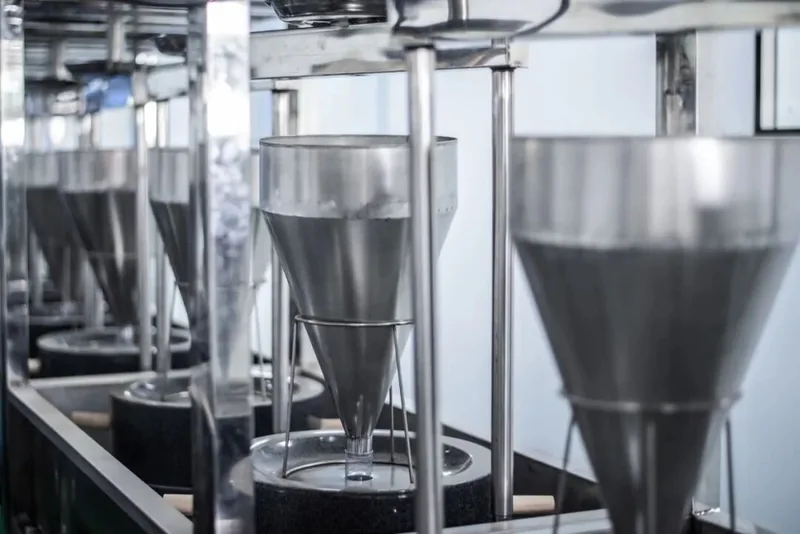
Particle control matters at the final outlet because pipes, corrosion, seals, filters, and maintenance can add solids after central treatment. A clean compressor-room result cannot prove that a distant hose or nozzle remains clean. For direct-contact air, buyers should request the particle specification, measurement range, sample location, flow conditions, and the status of terminal filtration.
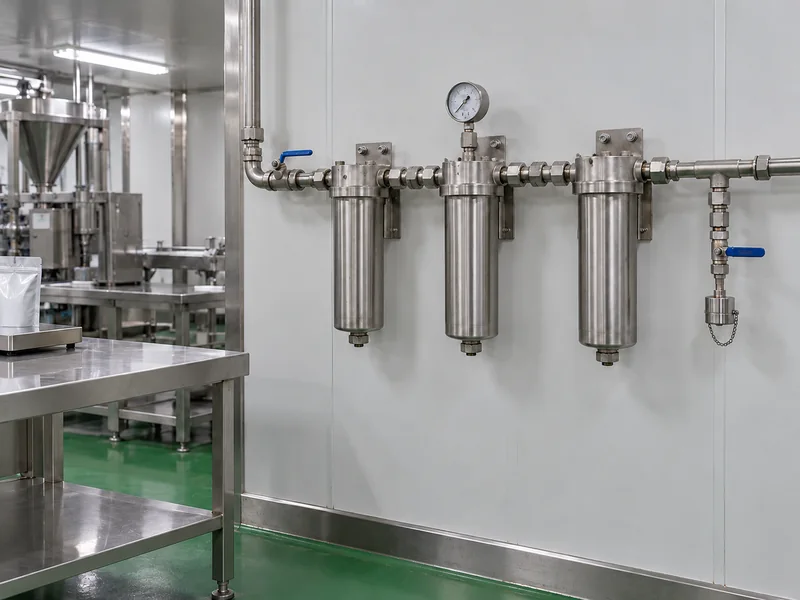
Connect the result to a physical control chain: intake filtration, compressor type, receiver, dryer, distribution material, point-of-use filter, and outlet hygiene. Then ask how filter integrity, differential pressure, installation direction, and replacement intervals are checked. A particle count without maintenance context shows a moment; it does not show whether the system can remain controlled.
There is also a cost tradeoff. Tighter filtration can increase pressure drop and energy demand, especially when filters are undersized or overdue for replacement. Choose the particle limit from product exposure and process need, then size and maintain the treatment train to meet it without compensating with excessive compressor pressure.
Key Takeaway: Point-of-use particle evidence should link the measured result to terminal filtration, distribution condition, and pressure-drop management.
How Should Water, Dew Point, and Relative Humidity Be Evaluated?
Water control should be specified with pressure dew point or another defined moisture measure, rather than room relative humidity alone. Relative humidity describes ambient air at a stated temperature, while pressure dew point describes when water would condense in compressed air at pressure. The two values answer different questions and should not be substituted for each other.
Condensate can support corrosion, carry residues, damage filters, and create conditions that favor microbial survival or growth in parts of the system. Review drains, receivers, low points, dryer performance, distribution slope, seasonal conditions, and shutdown behavior. Sampling during a mild, low-load period may not represent a humid day or peak production demand.
The practical recommendation is to define the moisture measure, location, pressure, operating state, and seasonal challenge in the specification. A very dry target may demand more energy and more complex drying equipment; a looser target can raise condensation risk. The chosen balance should protect the exposed product and equipment under credible worst-case operation.
Key Takeaway: Treat pressure dew point and ambient relative humidity as different measurements, and verify moisture control under stated operating conditions.
Does an Oil-Free Compressor Guarantee Clean Air?
An oil-free compressor does not guarantee that all delivered air is clean. “Oil-free” describes part of the compression design or a certified compressor performance claim; it does not remove particles, intake hydrocarbons, water, pipe residues, microbial contamination, or maintenance chemicals from consideration. The outlet still needs a specification and verification appropriate to its use.
Ask whether the oil result addresses aerosol, liquid, and vapor as applicable to the selected method and risk. Review compressor intake location near vehicle exhaust, roof vents, boiler emissions, or other hydrocarbon sources. Also review lubricated downstream components, temporary hoses, installation compounds, and maintenance practices that could introduce oil after compression.
A buyer gains little from arguing over the marketing label. Request the measured oil result, method, detection capability, sampling point, operating conditions, and response to an excursion. This approach may require more documentation, but it closes the gap between compressor technology and delivered-air quality.
Key Takeaway: Evaluate oil at the point of use and across its possible forms; do not treat an oil-free label as proof of total compressed air quality.
When Does Compressed Air Need Microbiological Monitoring?
Compressed air needs microbiological monitoring when the hazard analysis identifies a credible route from the air system to exposed food, food-contact surfaces, or package interiors. ISO’s particle, water, and oil classes do not establish microbial control. A site must define a viable-microorganism method, sampling device, incubation conditions, reporting basis, and acceptance or action logic suited to its process.
The program should distinguish an air sample from a finished-product microbiological panel. Matcha microbiological testing can assess the lot submitted to the laboratory, while outlet monitoring examines a utility route. Neither result automatically explains the other, and both depend on representative sampling and suitable methods.
There is no universal food-industry CFU limit in the cited FDA and ISO sources. A supplier should derive internal limits from risk, baseline data, product sensitivity, process controls, method capability, and customer or regulatory commitments. When evidence is sparse, trend results and investigate changes rather than presenting an unsupported number as an international rule.
Key Takeaway: Add microbiological monitoring only through a defined risk-based program, and never infer microbial acceptability from particle, water, or oil results.
How Should Point-of-Use Sampling Be Designed?
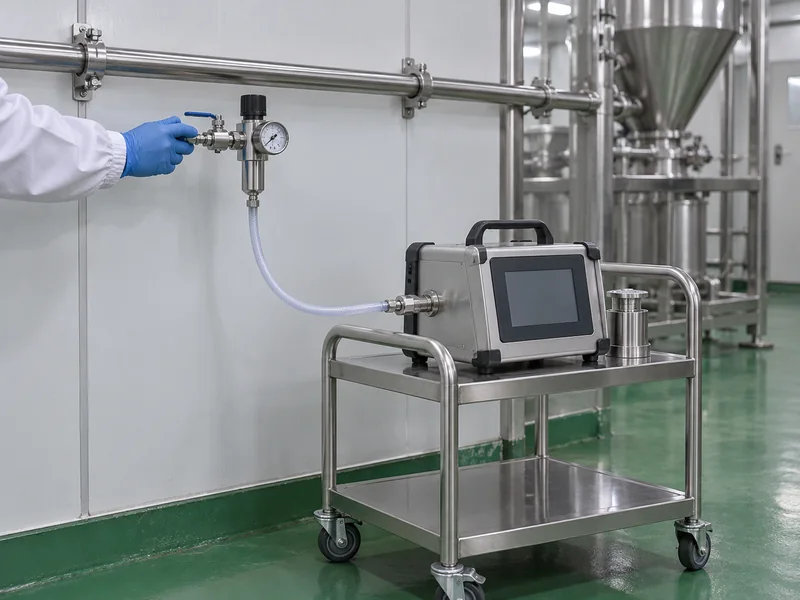
Point-of-use sampling should represent the air that reaches the process under the conditions in which the outlet is normally used. Select representative high-risk, farthest, lowest, recently modified, and historically troublesome points. Record the outlet identity, date, time, production state, pressure, temperature, flow or demand condition, sampler setup, method, and laboratory.
Avoid sampling only from a convenient central header. The result may miss downstream contamination, pressure loss, condensate, damaged terminal filters, or hygienic problems at removable hoses and nozzles. At the same time, testing every outlet on every occasion may be wasteful. A rotating plan can cover comparable low-risk points while retaining fixed sentinel points for trends.
| Sampling choice | What it can show | Main limitation | Better decision use |
|---|---|---|---|
| Compressor-room/header sample | Central treatment performance | Misses downstream additions | Diagnose dryer or main-filter performance |
| Highest-risk product-contact outlet | Delivered quality at a critical exposure point | Represents one outlet and operating state | Release or verify a defined control point |
| Farthest or low-point outlet | Distribution and condensate challenge | May not be the highest product exposure | Stress-test distribution design |
| Rotating comparable outlets | Broader coverage over time | Weaker trend at each individual outlet | Verify a controlled outlet family |
Key Takeaway: Sample where the process is exposed, document the operating conditions, and use a risk-based mix of sentinel and rotating locations.
What Maintenance and Change Controls Keep Air Quality Stable?
Maintenance and change control keep compressed air quality stable by connecting every service action to its contamination risk and requalification need. Under 21 CFR 117.40(d), pneumatic, closed, and automated manufacturing systems must have a design and construction that allows appropriate clean and sanitary maintenance. For a buyer, this supports a specific question beyond the treatment outcome in paragraph (g): can the supplier inspect, clean, service, and return the air system to use without creating a new contamination route?
Sections 117.40(a)(4) and (a)(5) address corrosion resistance and nontoxic food-contact materials; paragraph (a)(6) requires maintained protection against contamination and allergen cross-contact. When compressed air touches a food-contact surface, maintenance records therefore need to cover both the air system and the condition of the surface it reaches. Maintain filters, dryers, drains, receivers, piping, hoses, valves, gauges, samplers, and exposed surfaces under controlled instructions. Record the component identity, work performed, materials used, cleanliness checks, and return-to-service decision.
Changes that deserve review include a new compressor, dryer or filter; altered pressure; extended piping; moved intake; new hose material; changed sanitation chemicals; added outlet; higher demand; or prolonged shutdown. The team should decide before the change whether drawings, hazard analysis, specifications, sampling locations, baselines, or acceptance testing must change.
| Change or event | Immediate question | Typical evidence before acceptance |
|---|---|---|
| Terminal filter replacement | Was the correct element installed hygienically? | Part identity, installation check, integrity or defined outlet test |
| New branch line or hose | Can materials or debris reach product? | Material review, cleaning record, updated map, point-of-use result |
| Dryer alarm or condensate event | Could water have reached exposed outlets? | Alarm history, affected-point assessment, corrective action, retest |
| Capacity or pressure increase | Do treatment and filters still perform at the new demand? | Engineering review and testing at stated operating conditions |
| Long shutdown | Did stagnant sections or condensate create a new hazard? | Restart inspection, drain/sanitation record, risk-based verification |
The tradeoff is planned downtime versus uncertain production risk. A short, defined requalification after a consequential change is usually easier to defend than releasing product first and investigating the utility later.
Key Takeaway: Apply 21 CFR 117.40(d) to maintainable pneumatic or closed systems and 117.40(a)(4)–(6) to affected food-contact surfaces, then document hygienic acceptance before exposed production resumes.
What Evidence Should a Matcha Buyer Request from a Supplier?
A matcha buyer should request a concise, traceable evidence pack that connects air use to risk, specifications, results, and corrective action. Start with the current exposure map and air-system schematic. Then review the point-of-use specification for each relevant outlet family, including particles, water, oil, and any separately justified microbiological requirements.
Ask for representative reports with full class statements or numeric results, methods, locations, conditions, dates, and laboratory identity. Review filter and dryer maintenance, calibration where applicable, deviations, trend reviews, and change-control records. Place these records beside broader matcha specification-sheet requirements so utility evidence supports, rather than replaces, lot-level product controls.
Use the evidence to decide whether the supplier has a coherent control system, not to demand a decorative certificate. If the air never contacts product or food-contact surfaces, the supplier should show that boundary. If it does, the documentation should explain why the chosen specification and monitoring protect that use.
Key Takeaway: Approve the chain from outlet exposure to specification, point-of-use result, maintenance, deviation response, and change control.
FAQ
- What are the three ISO 8573-1 compressed air class dimensions?
- ISO 8573-1 classifies particles, water, and oil as separate dimensions. A buyer should request the complete class statement, sampling location, method, edition, and operating conditions rather than accepting a single unlabeled number.
- Does FDA specify one compressed air quality class for food plants?
- No. 21 CFR 117.40(g) requires mechanically introduced air to be treated so it does not contaminate food with unlawful indirect food additives, but it does not prescribe one universal ISO class, dew point, oil limit, microbial limit, or test frequency.
- Is oil-free compressed air automatically suitable for product contact?
- No. An oil-free compressor does not by itself control intake hydrocarbons, water, particles, microorganisms, downstream residues, or maintenance contamination. Suitability depends on the delivered-air specification and point-of-use evidence.
- Why test compressed air at the point of use?
- Point-of-use testing can detect contamination introduced by distribution piping, condensate, terminal filters, hoses, valves, or maintenance after central treatment. The sample should represent normal or defined challenge operating conditions.
- Does an ISO 8573 particle-water-oil result prove microbiological quality?
- No. Microbiological contamination requires a separately defined viable-microorganism method and risk-based acceptance or action logic. The cited ISO and FDA sources do not establish a universal food-industry CFU limit.
- What compressed air records should a food ingredient buyer request?
- Request the exposure map, air-system schematic, outlet specifications, representative point-of-use reports, methods and conditions, maintenance and calibration records, deviations, corrective actions, trend reviews, and change-control or requalification evidence.
Conclusion
Compressed air approval is strongest when the supplier can trace each exposed outlet from hazard assessment through specification, treatment, testing, maintenance, and release. Buyers evaluating matcha or another dry ingredient can contact AdoroHu to discuss the product application and documentation needed for supplier review.