
Dry basis vs wet basis comparison works only when a buyer identifies the denominator, uses moisture from the same sample, and aligns units and methods before judging compliance. Without those checks, two correct COA numbers can appear to disagree, or an invalid comparison can look precise.
For matcha procurement, dry basis vs wet basis is a contract question as much as a calculation. A premium matcha specification should state whether each result and limit is dry basis or as-is, because moisture changes the apparent concentration per unit of received powder.
Wet-basis moisture, dry-basis moisture, and analyte concentration on a dry basis use different denominators. Convert only after confirming the reported basis, same-sample moisture, units, method, and analyte definition. Carry full precision through the calculation and round once at the end.
In short:
Key points:
- Separate moisture-basis equations from analyte moisture correction.
- Use the analyzed moisture of the same representative sample whenever results are converted.
- Put basis, units, method, and rounding rules into the purchase specification.
What does dry basis vs wet basis mean on a matcha COA?
Dry basis vs wet basis tells the buyer what mass sits in the denominator of a reported result. An as-is or wet-basis concentration uses the total received sample mass, including water. A dry-basis analyte concentration uses only the dry-matter portion.
This changes the number without changing the amount of analyte physically present in that sample. If moisture is above zero, an analyte percentage expressed on a dry basis will be higher than its equivalent as-is percentage because the denominator is smaller.
The buyer should never infer basis from the size of the result. Look for an explicit statement such as “as received,” “as-is,” “wet basis,” “dry basis,” “d.b.,” or “moisture corrected.” Then confirm how the laboratory uses that term.
| COA wording | Denominator | Procurement use |
|---|---|---|
| As-is / as received | Total sample mass at analysis | Describes the material received |
| Wet basis | Usually total wet sample mass | Common moisture and composition basis |
| Dry basis / moisture-free | Dry matter only | Allows moisture-normalized comparison |
| Not stated | Unknown | Cannot support a reliable pass/fail comparison |
Key Takeaway: A COA value without a declared basis is incomplete for comparison.
How is wet-basis moisture calculated?
Wet-basis moisture is the mass of water divided by the total wet sample mass. It answers what fraction of the material as received is water.
Purdue University’s wet-basis moisture module defines wet-basis moisture as the percentage ratio of water weight to total material weight. It also notes that food-industry references to moisture content usually mean wet basis. For a buyer, that makes an unlabeled moisture field risky rather than safely assumed.
Let Mwater be water mass and Mtotal be total sample mass. The equation is:
Mwb = Mwater / M_total
As a percentage:
Mwb(%) = Mwater / M_total × 100
If a 100 g illustrative sample contains 5 g water, wet-basis moisture is 5 / 100 × 100 = 5%. The dry matter is therefore 95 g, or 95% of the received sample.
This example is arithmetic only. It is not an AdoroHu product result, matcha specification, or acceptable moisture threshold. The actual value must come from the relevant lot and laboratory method.
The operational consequence is direct: using wet-basis moisture correctly provides the dry-matter fraction needed for analyte conversion. Using a moisture number with an unknown basis can produce a wrong correction.
Key Takeaway: Wet-basis moisture divides water mass by total as-received mass.
How is dry-basis moisture different from analyte dry basis?
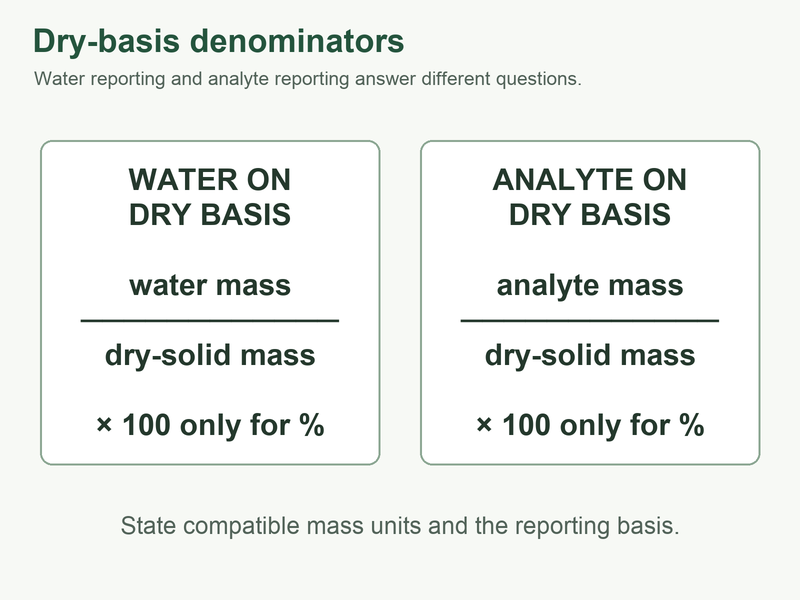
Dry-basis moisture divides water mass by dry-solid mass, while an analyte result on a dry basis divides analyte mass by dry-solid mass. The two expressions share a dry-matter denominator but describe different things.
Purdue’s companion dry-basis module defines dry-basis moisture as the percentage ratio of water weight to dry-matter weight. It explains why dry-basis moisture can exceed 100% and why this basis is useful for tracking drying. That source-specific definition supports the denominator below; it does not turn a moisture result into an analyte concentration.
Let M_dry be dry-solid mass. Dry-basis moisture is:
Mdb = Mwater / M_dry
In the same illustrative 100 g sample with 5 g water and 95 g dry matter, dry-basis moisture is 5 / 95 × 100 = 5.263...%. That is not the same as 5% wet-basis moisture.
Confusion often starts when a COA says “dry basis” beside an analyte and a buyer treats it as a dry-basis moisture equation. Keep the labels explicit: Mwb for wet-basis moisture, Mdb for dry-basis moisture, Cas-is for received analyte concentration, and Cdb for analyte concentration corrected to dry matter.
| Quantity | Numerator | Denominator |
|---|---|---|
Wet-basis moisture M_wb | Water mass | Total wet mass |
Dry-basis moisture M_db | Water mass | Dry-solid mass |
As-is analyte C_as-is | Analyte mass | Total received mass |
Dry-basis analyte C_db | Analyte mass | Dry-solid mass |
Key Takeaway: “Dry-basis moisture” and “analyte on a dry basis” are separate quantities.
What formula converts an as-is analyte result to dry basis?
An as-is analyte result converts to dry basis by dividing it by the dry-matter fraction. The University of Arkansas Division of Agriculture wet/dry conversion tool implements Mdb = Mwb/(100 − Mwb) × 100 and the reverse Mwb = Mdb/(100 + Mdb) × 100 when moisture is entered as percent. Those verified denominator relationships lead to the analyte conversion below when analyte mass is held constant.
Cdb = Cas-is / (1 − M_wb)
When moisture is expressed as a percentage:
Cdb = Cas-is × 100 / (100 − M_wb%)
The reverse conversion is:
Cas-is = Cdb × (1 − M_wb)
The USDA National Range and Pasture Handbook independently states that dry matter is the part of feed that is not water, DM% = 100 − moisture%, and converts as-fed nutrients to dry-matter basis by dividing by percent dry matter and multiplying by 100. The arithmetic applies to concentration conversion when the units and bases are compatible.
Suppose an illustrative COA shows 30.0% analyte as-is and 5.0% wet-basis moisture. Dry matter is 95.0%, so C_db = 30.0 × 100 / 95.0 = 31.578947...%, rounded to 31.58% if two decimal places are required.
Do not interpret the 1.58 percentage-point difference as measurement uncertainty. It is the predictable result of changing the denominator.
Key Takeaway: Divide the as-is concentration by the same sample’s dry-matter fraction.
Why must moisture and analyte results come from the same sample?
Moisture and analyte results should come from the same representative sample because the conversion assumes both values describe one material state. A moisture result from another lot, another sub-sample, or a reference table can create a mathematically neat but materially false result.
FAO food-composition guidance explains that water variation changes the levels of other components and that each dry-matter value should be related to the analyzed water content of the same sample. This supports defensible comparison across food results.
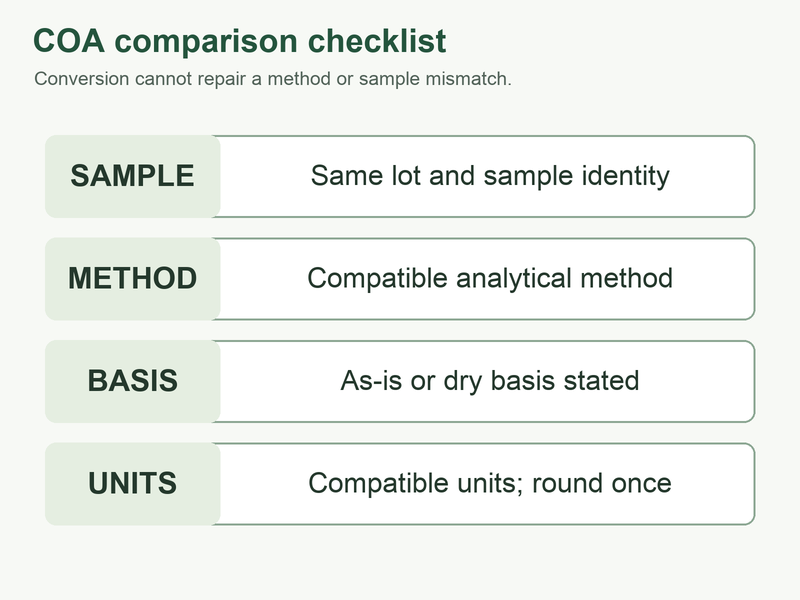
For procurement, request the lot number, sample identifier, test date, moisture method, analyte method, and confirmation that the correction used the same analytical sample or a documented representative split. If a supplier provides a dry-basis result without the paired moisture value, ask for the underlying data.
The practical recommendation is to reject conversions based on a catalog moisture value when the decision is lot release. A typical value may help early formulation estimates, but it should not decide whether a shipment meets a contract.
Key Takeaway: Lot-release conversion needs lot-specific, same-sample moisture evidence.
How should units and method definitions be aligned before conversion?
Units and method definitions must be aligned before conversion because moisture correction cannot reconcile different analytical questions. A percentage, mg/kg, mg/100 g, and g/100 g are not interchangeable without a unit conversion, and similar analyte names may represent different measured fractions.
Check the analyte identity, preparation method, extraction, instrument method, reporting limit, and units. For example, “total polyphenols” from one method may not be comparable with the same label from a different method. Correcting both to dry basis does not solve that method mismatch.
Also check whether the number represents a measured result, a calculated value, a minimum, a maximum, or an average. Converting a supplier’s average to dry basis does not make it comparable with a buyer’s maximum limit. The statistical role of the number remains unchanged after moisture correction.
Units need equal care. To compare mg/kg with a percentage, convert the units using a documented factor before applying the moisture correction. Keep both steps visible in the review sheet. A single combined spreadsheet formula may be compact, but it makes transcription and denominator errors harder to find during an approval review.
Use the broader matcha COA buyer’s guide after the basis check to review lot identity, method, specification, result, and units together.
| Check before conversion | Pass condition | If missing |
|---|---|---|
| Same analyte definition | Both documents measure the same measurand | Stop comparison |
| Same units | Values share units or use a documented conversion | Convert units first |
| Compatible methods | Method scope and preparation are comparable | Ask the laboratory |
| Same basis | Both as-is or both dry basis | Apply moisture correction |
| Same-sample moisture | Paired with the analyte result | Do not use for release |
Key Takeaway: Normalize units and confirm method scope before changing the moisture basis.
How can a buyer compare a dry-basis COA with an as-is specification?
A buyer can compare a dry-basis COA with an as-is specification only by converting one side to the other basis using the correct same-sample moisture. The contract should state which side controls and who performs the conversion.
Suppose an illustrative specification limit is 28.0% as-is, while the COA reports 30.0% dry basis and 6.0% wet-basis moisture. Convert the result to as-is: 30.0 × (1 − 0.06) = 28.2% as-is. The comparable result is therefore 28.2%, not 30.0%.
Alternatively, convert the 28.0% as-is limit to dry basis with the same 6.0% moisture: 28.0 / 0.94 = 29.787...% dry basis. Both routes give the same pass/fail relationship before rounding.
This is an illustrative calculation, not an AdoroHu limit or product result. A purchase agreement should specify whether actual lot moisture may move the dry-basis equivalent of an as-is limit. If that movement is undesirable, write the specification directly on the intended reporting basis.
Key Takeaway: Compare result and limit only after both use one declared basis.

When should calculations be rounded?
Calculations should be rounded once, after the final conversion, according to a rule agreed in the specification. Rounding moisture or intermediate factors too early can change a result near a purchase limit.
Keep the laboratory’s available precision in Mwb and Cas-is through the equation. Then round the final comparable value to the specified number of decimal places or significant figures. Record the unrounded calculation in the review file when a pass/fail decision is close.
For example, 30.0 / 0.95 equals 31.578947.... Rounding the dry-matter fraction first does not matter in this simple example because 0.95 is exact at the stated precision, but a reported moisture of 5.37% gives a longer factor. Premature rounding can then move the final digit.
A rounding rule is not a substitute for measurement uncertainty. This article does not assign guard bands or uncertainty policy; those decisions require the laboratory method, accreditation scope where relevant, contract language, and buyer risk decision.
Key Takeaway: Preserve full precision through the equation and round the final comparable value once.
Why is moisture percentage different from water activity?
Moisture percentage is the mass fraction used in dry basis vs wet basis conversion, while water activity describes the state or availability of water under the test conditions. One cannot be substituted for the other in the concentration formula.
A COA may report both values because they answer different questions. The moisture value supplies the mass denominator correction. Water activity can support product-stability or process discussions, but it does not tell the buyer how many grams of water are present per 100 grams of sample.
The matcha water activity guide covers that separate buyer task. Keeping the two fields separate prevents a serious spreadsheet error: entering an aw result, often shown as a decimal, into 1 − M_wb.
The operational recommendation is to label spreadsheet inputs with both the quantity and unit, such as moisturewbpercent. Avoid a generic cell named “water,” which invites the wrong number.
Key Takeaway: Use moisture mass fraction for basis conversion; never substitute water activity.
What wording belongs in a purchase specification and COA request?
A purchase specification should state the analyte, method or agreed method reference, units, reporting basis, moisture method, conversion responsibility, and rounding rule. Clear wording prevents receiving and supplier teams from creating different answers from the same data.
Use a statement such as: “Report analyte X in mg/kg on an as-is basis. If the laboratory reports dry basis, also report wet-basis moisture from the same sample and provide the unrounded converted as-is result. Round the final contractual result to one decimal place.” Adapt the wording to the actual analyte and contract.
Add the sample and lot identifiers so the values remain traceable. For a supplier comparison, request raw as-is result, moisture, calculated dry-basis result, method, units, and calculation formula in a consistent template.
Do not write a moisture limit merely to make the calculation easier. Any limit needs a product, packaging, stability, process, and market rationale beyond the arithmetic covered here.
Key Takeaway: Put the reporting basis and conversion rule beside every contractual analyte limit.
FAQ
- Is an as-is result the same as a wet-basis result?
- They often use the same total received mass denominator, but the laboratory should confirm its exact terminology and sample condition.
- Why is a dry-basis analyte result usually higher?
- Removing water from the denominator leaves a smaller dry-matter mass, so the same analyte amount has a higher reported concentration.
- What moisture value should be used for a COA conversion?
- Use wet-basis moisture analyzed from the same representative sample as the analyte whenever the conversion supports lot release.
- Can water activity replace moisture in the formula?
- No. Water activity and moisture mass fraction measure different properties, and only the moisture fraction belongs in this conversion.
- Should intermediate conversion values be rounded?
- Keep full available precision through the calculation and round the final comparable result once under the agreed rule.
- Does moisture correction make different laboratory methods comparable?
- No. The analyte definition, method, preparation, units, and reporting basis must all be compatible before comparison.
Conclusion
Dry basis vs wet basis becomes manageable when every value has a named denominator and a paired moisture result. Build the calculation into the purchase specification, preserve precision, and keep method differences outside the conversion. Contact AdoroHu Matcha to discuss a consistent matcha specification and COA request format.