
A food defense plan identifies facility and process points vulnerable to intentional adulteration intended to cause wide-scale public-health harm, then assigns tailored mitigation. Buyers should expect an operating system with monitoring, corrective action, verification, training, and reanalysis rather than a generic security policy.
For matcha buyers, a food defense plan must be assessed at the site that receives, opens, processes, stores, and packs the material. Product discussions may begin with wholesale matcha supply, but a product page cannot establish regulatory coverage or prove how a facility controls intentional harm.
A food defense plan addresses intentional adulteration intended to cause wide-scale public-health harm. It must be built from the facility and process, not the product name alone. Tailored mitigation must be monitored and verified.
In short:
Key points:
- Define the exact item, process, evidence and decision in scope.
- Match controls to the credible mechanism instead of copying a generic template.
- Retain ownership, exceptions, change triggers and verification evidence.
What is a food defense plan?
A food defense plan documents a facility-specific vulnerability assessment and controls for intentional adulteration intended to cause wide-scale public-health harm. 21 CFR 121.5 exempts very small businesses while requiring documentation supporting that status upon request. It also exempts specified activities, including holding food outside liquid-storage tanks and packing, repacking, labeling, or relabeling food when its direct-contact container remains intact. Each exemption has conditions, so a facility must evaluate its own activities and records; maintaining a voluntary plan does not establish exemption or compliance.
For a covered facility, the written plan includes vulnerability assessment, actionable process steps, mitigation strategies, monitoring, corrective action, and verification. A facility relying on an exemption should retain the evidence applicable to that status rather than copying a full-plan claim from another operation.
Keep food defense separate from routine food safety, economically motivated fraud, and recall execution. The systems should exchange escalation and lot information, yet each answers a different initiating event. That separation prevents an ordinary deviation from being treated as a hostile act without evidence.
The controlled plan should identify its scope, responsible qualified personnel, revision, approval, storage, and distribution. Buyers usually need confirmation that these elements exist and operate. They do not need unrestricted access to vulnerability details that could make the site easier to exploit.
Document retention and access should follow the applicable rule and company controls. The review copy can show dates, qualifications, and completed verification while redacting tactical details. This gives a buyer evidence of governance without converting a supplier questionnaire into a distribution channel for sensitive information.
Key Takeaway: A food defense plan documents a facility-specific vulnerability assessment and controls for intentional adulteration intended to cause wide-scale public-health harm.
Who should be on the food defense team?
The team should combine operations, security, quality, maintenance, HR, IT, warehousing, and leadership knowledge. FDA states that a written plan for a covered facility includes the vulnerability assessment, actionable process steps, mitigation strategies, monitoring, corrective action, and verification. The team therefore needs people who can evaluate process reality and people authorized to approve and sustain those elements.
Operations explains actual product flow and workarounds; maintenance knows openings created during repair; HR and contractor management understand access changes; IT covers connected access systems; quality connects holds and records. Give one qualified person authority to reconcile the views and approve changes. The team should document roles without publishing names or sensitive routes to general audiences.
A buyer should ask who approves the plan, who substitutes during absence, and how observations from off-shifts reach that owner. A committee of senior managers can miss temporary staging or inherited access permissions that operators see daily.
Define decision rights before an event. The person who can secure a step may differ from the person who can hold product or contact authorities. Role cards and contact trees reduce delay, but the plan should also specify how outdated names and unavailable backups are corrected.
Key Takeaway: The team should combine operations, security, quality, maintenance, HR, IT, warehousing and leadership knowledge.
How should the facility and process be mapped?
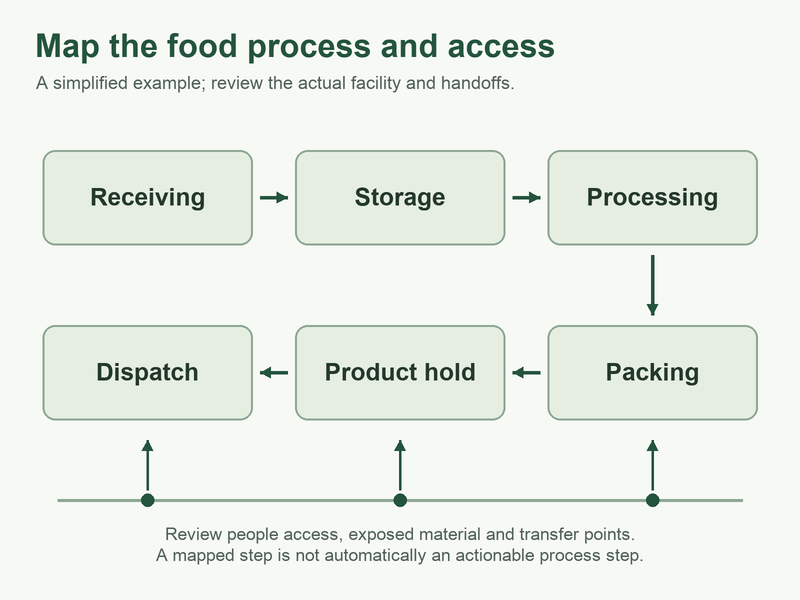
Map receiving, storage, opening, blending, milling, transfer, packing, utilities, rework, waste, and dispatch with access points and handoffs. FDA explains that process characteristics, rather than a food category alone, drive vulnerability. Matcha should therefore not be labeled inherently high or low risk without evaluating the actual facility and process.
Walk the process during receiving, normal production, cleaning, maintenance, changeover, and shutdown. Record where ingredients are exposed, quantities accumulate, access is possible, and material can be distributed downstream. Drawings are a starting point; observations reveal doors propped during deliveries, portable vessels, rework, and temporary work zones.
Map utilities and supporting areas only where their characteristics could affect the assessment. Avoid turning the exercise into a building inventory. The purpose is to connect a process vulnerability with mitigation and response while limiting unnecessary sensitive detail.
| Mapping view | Question for the team | Record retained |
|---|---|---|
| Product flow | Where is material open or accessible? | Step and product state |
| People flow | Who can enter during each shift? | Role and authorization |
| Abnormal work | What changes during cleaning or repair? | Temporary control |
| Distribution | How far could affected material travel? | Lot and destination linkage |
Key Takeaway: Map receiving, storage, opening, blending, milling, transfer, packing, utilities, rework, waste and dispatch with access points and handoffs.
How are actionable process steps identified?
Identify steps where intentional contamination could be introduced and create wide-scale harm, using the applicable assessment method. FDA’s mitigation database is a voluntary starting point; its strategies need tailoring and may need to be combined. Selecting a database entry does not by itself complete a vulnerability assessment or establish compliance.
Evaluate process characteristics and the potential impact of contamination at each step. Food type alone does not settle the rating. The decision should be made by appropriately qualified personnel using the applicable method, with rationale sufficient for authorized review.
Do not publish the detailed vulnerability map. Share controlled evidence under appropriate access rather than circulate the full map; disclosure can create a security problem without improving supplier approval. A buyer can review governance, completion, qualifications, monitoring evidence, and closure records without receiving exact exploitable details.
Record why each evaluated step is or is not actionable using the applicable method. A conclusion based solely on restricted access may be weak if staff routinely bypass the restriction during maintenance. Observed practice should inform the assessment before approval.
Key Takeaway: Identify steps where intentional contamination could be introduced and create wide-scale harm, using the applicable assessment method.
How should mitigation strategies be selected?
Select tailored measures that reduce access, opportunity, or impact at each actionable process step. FDA’s mitigation-strategies database is a voluntary starting point; its options need tailoring and may need combination. Choose measures that change the identified vulnerability. A locked door helps only when the vulnerable activity is behind it and access is controlled in practice.
Test feasibility on every relevant shift. A mitigation that blocks sanitation, emergency egress, or necessary maintenance will invite bypass. Pair physical measures with authorization and response rules, then record why the combination fits the step.
Consider how the control fails. Power loss, network outage, damaged seals, missing staff, and emergency entry can change effectiveness. A fallback should protect product and people without improvising during a suspected event.
Key Takeaway: Select tailored measures that reduce access, opportunity or impact at each actionable process step.
What monitoring belongs in the plan?
Monitoring should state what is checked, how, when, by whom and where the record is kept. Examples include access status, seal checks, restricted-area rounds or controlled ingredient handling, chosen for the actual mitigation. Avoid security theater that produces records without reducing the identified vulnerability. Define missed-check escalation before operation.
Monitoring must be observable and linked to a timely response. Specify the check, frequency or event, responsible role, record, reviewer, and action if the check fails. A completed log with no defined exception response cannot show that the vulnerable step remained controlled.
Choose timing from the mitigation and exposure window. Continuous status, batch checks, and event-based checks provide different assurance. The plan should explain which interval can be bounded if monitoring is missed and who decides product status.
| Monitoring element | Plan question | Failure response |
|---|---|---|
| Condition | What state shows mitigation is operating? | Secure step and assess exposure |
| Timing | When can failure still be caught in time? | Hold affected interval |
| Responsibility | Who checks and who reviews? | Escalate to named backup |
| Record | What proves execution and exception closure? | Correct record and investigate gap |
Key Takeaway: Monitoring should state what is checked, how, when, by whom and where the record is kept.
How should corrective action work?
Corrective action should secure the area or product, restore control, assess affected material and prevent recurrence. FDA plan elements for covered facilities include monitoring, corrective action and verification. Exact actions depend on the event and authority. Do not turn a food-defense deviation into an automatic public recall without assessment.
First restore control and protect potentially affected product. Then bound the time window, people, equipment, lots, and destinations that may be involved. Disposition requires authorized assessment; a missed check does not automatically prove adulteration, and an unexplained breach should not be closed as paperwork alone.
Record immediate correction separately from action addressing recurrence. Preserve evidence, notifications, product holds, release authority, and follow-up. The matcha recall plan supports downstream response if a decision reaches that stage, but recall planning does not replace prevention at an actionable step.
Security and employment decisions may need restricted handling, while product decisions still require traceable quality records. Define the interface so necessary lot and hold information moves without placing sensitive personnel information into broadly accessible systems.
Key Takeaway: Corrective action should secure the area or product, restore control, assess affected material and prevent recurrence.

How should verification test the plan?
Verification should confirm monitoring occurred, mitigation operated and corrective actions closed, with exercises that do not disclose sensitive details. Review records, observe controls and test communications. A tabletop can test decisions; a site challenge can test physical execution when safely designed. Correct weaknesses and preserve evidence of follow-up.
Verification reviews monitoring, observes mitigation, checks corrective-action closure, and tests whether people can execute the response. Tabletop exercises test decisions and communication; controlled site observations test physical execution. Results should identify the exact weakness, assigned correction, due date, and effectiveness check.
Reject “training completed” as the sole verification of a physical mitigation. Staff knowledge and control performance are different evidence. Relying on attendance alone can leave a door, seal, alarm, or handoff failing under normal conditions while the plan appears complete.
Vary verification across shifts and conditions. Repeated announced checks can train staff to perform only for review. A risk-based mix of record review, observation, and exercises gives stronger evidence without exposing the plan to unnecessary audiences.
| Verification method | What it can establish | Main limitation |
|---|---|---|
| Record review | Monitoring and exceptions were documented | May miss staged behavior |
| Direct observation | Control operates during the observed shift | Covers a limited period |
| Tabletop exercise | Roles and escalation decisions are understood | Does not test physical performance |
| Corrective-action follow-up | Weakness was addressed and rechecked | Depends on a defined success criterion |
Key Takeaway: Verification should confirm monitoring occurred, mitigation operated and corrective actions closed, with exercises that do not disclose sensitive details.
What training should employees receive?
Training should match role, access and response authority and teach how to report unusual activity without delay. Protect sensitive plan content while giving staff enough instruction to execute controls. Include contractors and temporary workers where their access matters. Training attendance alone does not prove mitigation works.
Personnel responsible for the vulnerability assessment, mitigation, monitoring, corrective action, and verification need training appropriate to their duties and applicable rule. Operators need concise instructions for their control and escalation. Contractors and temporary staff need boundaries and reporting routes appropriate to their access.
Use scenarios to confirm understanding instead of relying only on attendance. Ask what happens when the normal owner is absent, a badge system is offline, or maintenance opens a restricted area. Keep sensitive plan details limited to people who need them.
Training records should identify role, topic, method, date, and demonstrated understanding. Retrain after relevant changes and when verification shows confusion. Do not give every employee the full vulnerability analysis merely to satisfy a training log.
Key Takeaway: Training should match role, access and response authority and teach how to report unusual activity without delay.
When should the food defense plan be reanalyzed?
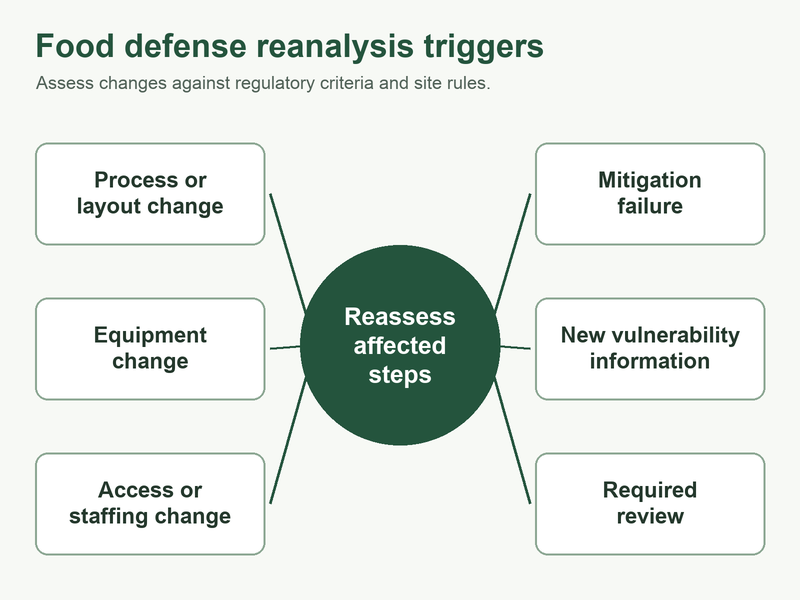
Reanalyze after facility, process, equipment, staffing, access, threat or mitigation changes and at applicable required intervals. Connect the site plan with matcha recall planning for incident response, while keeping prevention and recall roles separate. Use supplier audit evidence for supplier review while keeping the facility plan site-specific. Retain prior versions and closure decisions.
For facilities subject to the rule, 21 CFR 121.157 requires reanalysis of the food defense plan at least once every three years and sooner after specified events. Those events include significant changes that create a new vulnerability or increase one, new vulnerability information, evidence that a mitigation strategy or the plan is ineffective, and an FDA reanalysis requirement.
Preserve prior versions, the reason for reanalysis, the qualified reviewer, changed steps, and completion of follow-up. Supplier audits can confirm governance evidence, but the site retains ownership of its facility-specific plan. Buyers can request product and lot records needed in a scoped supplier review.
Reanalysis is a decision process, not a date change on the cover. The qualified individual reviews affected steps and completes or documents the applicable actions within the rule’s timing. Operational triggers such as layout, equipment, access, or staffing changes matter only when they meet the regulatory criteria or the facility’s stricter internal triggers.
Key Takeaway: Reanalyze after facility, process, equipment, staffing, access, threat or mitigation changes and at applicable required intervals.
FAQ
- What is the purpose of a food defense plan?
- It controls facility and process vulnerabilities to intentional adulteration intended to cause wide-scale harm.
- Is food defense the same as food safety?
- No. Food defense addresses intentional acts; food safety usually addresses unintentional hazards.
- Does every facility have the same requirements?
- No. Coverage, exemptions and plan details depend on jurisdiction, facility and process.
- What is an actionable process step?
- It is a step identified through the applicable vulnerability assessment as requiring tailored mitigation.
- Should mitigation come from a template?
- Templates can organize work, but measures must be tailored to the site and vulnerability.
- When should the plan be updated?
- Update after relevant changes, exercises, failures and applicable reanalysis intervals.
Conclusion
The next decision is whether the facility has identified its actionable process steps and can show that tailored mitigation operates on normal and abnormal shifts. Confirm applicability, exemptions, qualifications, and reanalysis from current requirements before making a compliance conclusion. Request controlled supporting records through AdoroHu Matcha when reviewing a specific supply arrangement.