
A matcha pound cake becomes commercially repeatable when the bakery controls creaming, emulsion, powder incorporation, pan fill, bake endpoint, cooling, slicing, and saleable yield. A home formula may produce one attractive loaf while a production batch varies in crown, center crack, color, crumb, and portion count.
For matcha pound cake, freeze the base formula and equipment before choosing a matcha level. Bakeries can screen options for matcha baking applications and approve the finished cake against their own process limits.
Pound cake depends on a stable fat-water emulsion and controlled air incorporation. Matcha changes the dry phase, color, aroma, and perceived bitterness. A production standard must therefore connect ingredient identity to mixing, fill, baking, cooling, and slicing evidence.
In short:
Key points:
- Define a creaming and emulsion endpoint the mixer operator can recognize and record.
- Incorporate matcha without creating streaks, dry pockets, or unnecessary mixing.
- Approve bake loss, loaf geometry, slice yield, and hold as one commercial result.
What should a matcha pound cake specification include?
A matcha pound cake specification should include named ingredients and lots, formula percentages, mixing sequence, equipment, batter endpoint, fill weight, pan, bake conditions, cooling, portion, packaging, and acceptance limits. “Cream until fluffy” is not transferable between mixers or batch sizes.
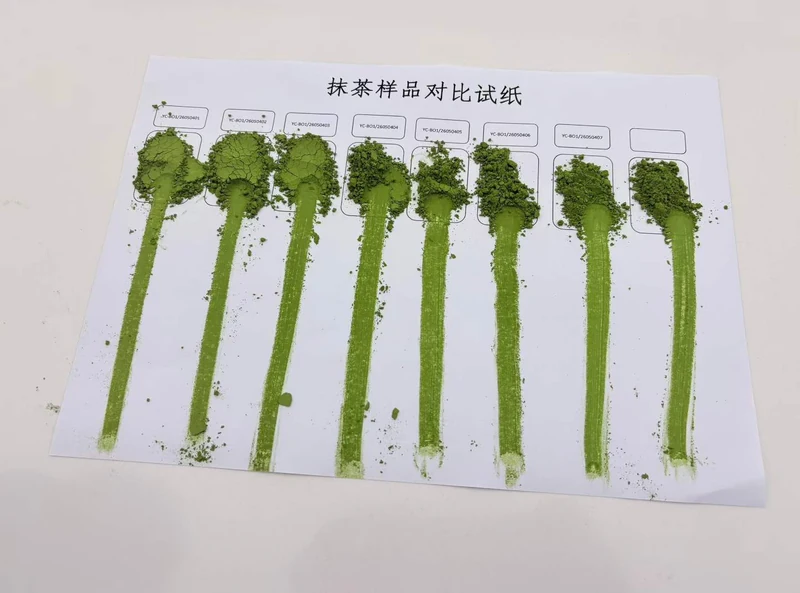
Record the exact powder code rather than “culinary matcha.” AdoroHu identifies E-1/E-2 as Culinary, E-3/E-4 as Premium, and E-5/E-6/E-7 as Ceremonial in its EU Standard Series; O-1/O-2 are Culinary, O-3 Premium, and O-4/O-5/O-6 Ceremonial in its Organic Series. The code preserves sample identity; finished-cake trials determine suitability.
Milk, egg, and wheat are major food allergens in the United States. A pound-cake formula or line change can therefore affect allergen declarations and cross-contact controls as well as texture. Use current FDA food-allergen guidance for US scope and confirm destination-market rules. The ingredient list and facility assessment, not the product name, determine the required controls.
Key Takeaway: Bind the formula to ingredients, equipment, process endpoints, and finished-loaf limits.
How should matcha pound cake butter creaming be controlled?
Control matcha pound cake ingredient temperature, mixer attachment, speed, time, batch load, and endpoint. Creaming builds an air-cell structure, but more air is not automatically better: an over-aerated batter may rise unevenly and lose structure, while poor creaming can produce a dense crumb.
Use observable and measurable endpoints such as batter appearance, temperature, specific gravity, or a validated combination. Record them before adding eggs. A practitioner should stop the trial when the fat is visibly softening or separating even if the timer has not finished; elapsed time cannot rescue an emulsion that has left its usable temperature window.
A 2022 peer-reviewed pound-cake study, “Chickpea Aquafaba-Based Emulsions as a Fat Replacer in Pound Cake,” measured batter density and rheology and linked fat-system changes with cake properties. Its formulations are not matcha formulas, but its method supports density as a traceable indicator of air incorporated during fat-and-sugar beating. Establish an internal range from successful matcha batches rather than importing the paper’s values.
Key Takeaway: Define creaming by the batter state, supported by time and temperature records.
How can the matcha pound cake emulsion stay stable during scale-up?
In matcha pound cake, add eggs in a controlled sequence and confirm each addition is incorporated before the next. Cold liquid, fast addition, or an overloaded mixer can break the emulsion, leaving a curdled batter and uneven crumb.
Track egg temperature, addition increments, mixer action, and batter appearance. If the batter breaks, record the deviation rather than quietly adding flour and declaring recovery. That intervention changes flour hydration and makes the run incomparable.
The same pound-cake study treated batter as a rheological system and evaluated different fat emulsions rather than assuming ingredient substitution was neutral. Changing butter condition, egg addition, or emulsifier system therefore requires renewed batter and finished-cake comparison. The research supports the mechanism, not a universal mixing time or temperature.
| Control | What to record | Failure clue | Decision |
|---|---|---|---|
| Ingredient state | Butter and egg temperature | Hard fat or cold liquid | Condition before mixing |
| Addition | Number and order of increments | Liquid pooling | Slow addition |
| Batter | Appearance and temperature | Curdling or grease | Hold and investigate |
| Scale-up | Bowl load and tool | Dead zones | Change batch size or geometry |
Key Takeaway: Treat egg addition as an emulsion operation, not a timed ingredient dump.
When should matcha enter pound cake batter?
Add matcha through a defined dry blend or controlled slurry route after comparing both in the fixed cake. A dry blend can distribute powder efficiently when sieving and flour blending are controlled. A slurry may reduce visible pockets but adds liquid and can change the emulsion.
Evaluate streaking, specks, batter density, mixing demand, baked color, aroma, bitterness, and crumb. Do not keep mixing only to chase a perfectly uniform green if the crumb begins to toughen. Matcha baking formulation guidance can inform the trial, but the bakery owns its formula and endpoint.
Research on cake batters containing particulate flour replacements reports that added particles can change specific gravity, viscosity, cell structure, and baked volume. Matcha was not the test ingredient, so those papers cannot predict the size or direction of its effect. They do justify holding powder identity and dose constant while the bakery measures batter and loaf outcomes.
Key Takeaway: Choose the incorporation route by batter and baked-loaf evidence, not color alone.
How should matcha pound cake density and pan fill be controlled?
Use matcha pound cake batter density as a process check and pan fill as a portion control. Sample density at the same point and with the same cup method; foam loss during a delayed check can make two identical batches look different.
Published cake studies define batter specific gravity as the mass of a fixed volume of batter divided by the mass of an equal volume of water. They also warn that initial aeration does not alone predict final cake volume because gas retention during baking matters. Use density with baked volume, crumb, and slice data, never as a stand-alone release number.
Condition the cup and water consistently, avoid trapping new air while filling, level without compressing the sample, and measure promptly. These details make the comparison repeatable enough to detect process drift; they do not turn density into a finished-cake specification.
Weigh each pan. Fill position affects heat path, crown, crack, bake time, and finished slice size. Establish a fill range from successful trials rather than copying a home pan volume.
| Measure | Purpose | Consequence of drift |
|---|---|---|
| Batter density | Tracks aeration and emulsion | Dense or fragile crumb |
| Pan tare and fill | Controls loaf mass | Variable bake and portion size |
| Batter hold time | Exposes delay effects | Lost air or uneven hydration |
| Fill sequence | Finds bowl stratification | First/last pan variation |
Key Takeaway: Weigh fills and sample density consistently across the batch.
What controls matcha pound cake cracks and loaf shape?
Control the matcha pound cake center crack through formula, fill, pan geometry, batter leveling, heat input, and any deliberate scoring method. A crack is not automatically a defect; uncontrolled asymmetry, side rupture, collapse, or exposed wet batter is.
Define acceptable crown height, crack position, sidewall, and loaf straightness with photographs and measurements. A decorative scoring step should be validated as part of the process rather than used to hide underlying fill or oven variation.
Key Takeaway: Specify acceptable loaf geometry and trace it back to fill and heat conditions.
How should a matcha pound cake bake endpoint be approved?
Approve the matcha pound cake bake endpoint with several signals: time, oven setting, actual product temperature where appropriate, mass loss, surface and crumb condition. One signal alone can mislead when pan load or oven recovery changes.
Peer-reviewed cake methods calculate baking loss from pre-bake batter mass and cooled cake mass. That gives a reproducible process measure, while the finished crumb confirms whether the loss was acceptable. Cooling interval and weighing procedure must stay fixed; otherwise apparent bake loss includes uncontrolled post-oven evaporation.
The FDA Food Code can support applicable retail-food controls, while local requirements govern the bakery. Product safety and quality validation need qualified review; a color endpoint does not prove either.
Key Takeaway: Use a validated combination of endpoint signals tied to acceptable crumb and loaf mass.
How do cooling and packaging affect matcha pound cake?
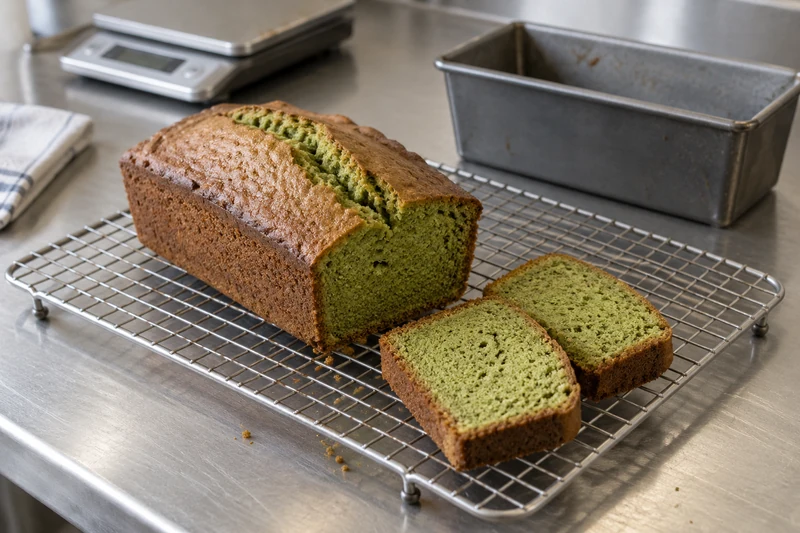
Matcha pound cake cooling must release heat and moisture without drying the loaf or creating condensation in the package. Record depanning point, rack configuration, room conditions, cooling time, and product state at packing.
Packaging too warm can trap moisture; leaving loaves exposed too long can dry edges and shift slice mass. Validate the actual wrap, carton, and service format. Do not claim shelf life from a short sensory check.
Map the cooling rack as part of the trial. Loaves near an airflow source, wall, or warm neighboring rack can cool at different rates. Take representative measurements from more than one position and note when loaves are moved. If slicing occurs the next day, preserve the interim wrap and storage condition in the batch record rather than treating cooling and slicing as unrelated steps.
Check the package after sealing and again after the cake equilibrates. Condensation, oil marks, surface tack, and loss of crust texture can reveal that the pack point or material is unsuitable. These observations help select a package, but they do not establish a market shelf life without an appropriate stability and safety program.
Key Takeaway: Define the product state at depanning, slicing, and packing.
How should a bakery measure matcha pound cake yield?
Calculate saleable matcha pound cake slices after trimming, breakage, visual rejects, and weight rejects. Theoretical slices from loaf length ignore end cuts, irregular crowns, and damaged portions.
| Yield measure | Calculation | Use |
|---|---|---|
| Bake loss | Pre-bake fill minus cooled loaf mass | Tracks moisture and process drift |
| Slice recovery | Saleable slice mass ÷ cooled loaf mass | Reveals trimming and breakage |
| Saleable yield | Conforming slices ÷ planned slices | Measures commercial output |
| Unit cost | Batch cost ÷ conforming slices | Compares viable trials |
The strongest formula is often the one with repeatable slice recovery, even if another loaf looks taller in a single photograph.
Key Takeaway: Cost conforming slices after cooling and trimming.
What evidence should release a matcha pound cake standard?
Release the matcha pound cake standard after repeated batches meet batter, loaf, sensory, slice, and yield limits with named ingredients and equipment. Include first and last pan results, because bowl stratification and oven loading can hide behind an average.
Use an approval panel that can distinguish process defects from preference. Score matcha aroma, bitterness, butter balance, crumb tenderness, moisture, color uniformity, crust, and aftertaste against defined references. Keep consumer preference work separate if the commercial question is process release. A loaf can be pleasant yet outside the geometry or slice limits needed for the intended pack.
Retain enough evidence to diagnose drift: a representative uncut loaf photograph, a center slice, slice-mass distribution, and the mixing and oven records. When a later batch changes, these references are more useful than a single overall score.
Use best matcha for baking to screen ingredient options, then validate the selected powder in the pound-cake process. Revalidate the pound-cake standard after meaningful ingredient, mixer, batch-size, pan, oven, cooling, slice, or package changes.
Key Takeaway: Approve the full production system and retain evidence from repeated batches.

FAQ
- What matcha is suitable for pound cake?
- Screen named powder samples in the fixed formula for baked color, aroma, flavor, crumb, yield, specification fit, and cost.
- Why does matcha pound cake become dense?
- Poor creaming, a broken emulsion, excessive mixing, wrong fill, or an unsuitable bake can each produce a dense result.
- Should matcha be mixed with flour first?
- A controlled dry blend is one viable route; compare it with any slurry route without changing other formula variables.
- How can a bakery keep loaf size consistent?
- Control batter density, pan tare, fill weight, leveling, oven load, endpoint, and cooling loss.
- What should a production trial record?
- Record lots, temperatures, sequence, mixer settings, batter checks, pan fills, bake data, cooled mass, sensory results, slices, and waste.
- When should the cake be revalidated?
- Revalidate after a material ingredient, equipment, batch-size, pan, oven, cooling, packaging, or portion change.
Conclusion
A dependable matcha pound cake comes from controlling the emulsion and following it through fill, bake, cooling, and saleable slices. Contact AdoroHu Matcha to align powder samples and specifications with your bakery trial.