
Laboratory proficiency testing compares a laboratory’s result on an external unknown item with an assigned value or peer group under a defined scheme. It can reveal weakness across the testing process, but one satisfactory round does not prove every method, matrix, analyst, or customer result is correct.
For laboratory proficiency testing in matcha supply, connect the scheme to the method and matrix behind the matcha CoA review. Review provider competence, item handling, scoring, investigation, corrective action, and trends without claiming that AdoroHu operates or participates in a PT program.
Proficiency testing is an external performance exercise using items handled through the routine laboratory process. The report compares participant results through a defined assigned value and statistical design. PT supplements method validation, internal quality control, and accreditation evidence rather than replacing them.
In short:
Key points:
- Select a scheme that matches the laboratory’s method, analyte, matrix, and range.
- Treat PT items like routine samples and prevent coaching or special handling.
- Review questionable and unsatisfactory results through root cause, correction, and effectiveness checks.
What is laboratory proficiency testing?
Laboratory proficiency testing is a structured external comparison that evaluates participant performance against defined criteria. A provider prepares or obtains suitable items, issues instructions, collects results, establishes an assigned value through an appropriate route, and reports participant performance.
The complete process matters. PT can expose problems in receipt, preparation, extraction, calibration, analysis, calculation, transcription, or reporting. It is broader than checking one instrument with a calibration standard.
Define the capability that the exercise is meant to monitor. An analyte name alone is insufficient if routine work covers several matrices, concentration ranges, extraction routes, or reporting forms. The laboratory should be able to explain what the chosen round represents and what it leaves unchallenged.
Clinical CLIA programs also use PT, but their frequency, analytes, and sanctions apply to clinical laboratories under that program. They are not universal food-laboratory requirements.
Key Takeaway: PT tests the laboratory’s end-to-end performance in a defined external exercise, not one isolated instrument response.
How should a laboratory choose a relevant PT scheme?
A laboratory should choose a scheme by matching analyte or organism, matrix, concentration range, method principle, reporting unit, assigned-value design, schedule, and quality-system need. A convenient scheme with the wrong matrix can provide weak evidence for matcha work.
ISO/IEC 17043:2023 specifies competence and impartiality requirements for PT providers and operation of schemes. It is a provider standard and does not impose one participation frequency on every laboratory.
Availability can constrain selection. When no closely matched scheme exists, the laboratory should document the search, assess alternatives, and use another suitable comparison or quality-assurance activity under its governing requirements. It should not relabel a weak substitute as equivalent PT merely to fill a schedule.
| Scheme feature | Review question | Risk if mismatched |
|---|---|---|
| Analyte or organism | Is it the same target? | Wrong analytical capability is challenged |
| Matrix | Does it behave like the routine sample? | Extraction and interference remain untested |
| Range | Is it near routine decisions? | Performance at critical levels is unknown |
| Method grouping | Are comparisons technically meaningful? | Peer statistics can mislead |
| Provider competence | Is the scheme controlled and impartial? | Items or scoring may be unreliable |
Key Takeaway: Select PT for technical relevance first, then confirm schedule and cost.
What does ISO/IEC 17043 say about provider competence?
ISO/IEC 17043 addresses competence, impartiality, and consistent operation of PT providers. Buyers should use the current standard and applicable accreditation information when provider status matters; a marketing claim that a company offers PT is not equivalent to demonstrated provider competence.
Provider review should cover scheme scope, item production, homogeneity and stability, assigned-value approach, statistical design, confidentiality, instructions, report content, complaints, and subcontracting where applicable.
Homogeneity and stability are central because participant differences are interpretable only if items are sufficiently comparable and remain suitable through the round. Review how the provider evaluated these properties and whether shipping or storage excursions require exclusion, qualification, or replacement.
The bounded recommendation is to avoid selecting a scheme solely because it is widely used. Popularity cannot repair a matrix or range mismatch, and provider accreditation outside the chosen scheme scope may not support the exercise.
Key Takeaway: Verify the provider and scheme scope, then judge whether the item and statistics fit the laboratory’s work.

How should PT items be received and tested?
PT items should enter the routine workflow under controlled instructions, with receipt condition, storage, preparation, assignment, equipment, analyst, method version, calculations, and submission recorded. Special handling can make the result look better while defeating the exercise.
NIST’s proficiency-testing planning for state weights-and-measures laboratories shows a process pattern of controlled instructions, reporting, and follow-up tied to ISO/IEC 17043 and ISO 13528. That metrology program is not a food-testing schedule, but its documented workflow is relevant.
Define which communication is allowed during the round. Laboratories should prevent result sharing, referral, repeat testing beyond routine policy, or managerial coaching that would not occur for a normal customer sample.
Assign the item without announcing an expected answer to the analyst. If the scheme permits multiple analysts or methods, plan that work in advance and preserve each result. Do not choose the most favorable replicate after seeing all outcomes unless the routine customer method uses the same documented rule.
Key Takeaway: Handle PT items through the routine process and document any permitted exception transparently.
How are assigned values and PT scores interpreted?
Assigned values may come from reference values, expert laboratories, formulation, consensus, or other scheme-appropriate methods. The report should explain the basis, its uncertainty where relevant, participant distribution, scoring statistic, and interpretation boundaries.
A z score or related statistic is meaningful only within that design. Review sign and magnitude, method subgroup, uncertainty, and any warning thresholds defined by the scheme. Do not convert one score into a universal laboratory grade.
Examine the distribution as well as the flag. A result may fall within an acceptable threshold yet shift consistently in one direction across rounds. Conversely, a single extreme score can come from a transcription or unit error rather than analytical capability. Both patterns need proportionate review.
| Report element | Meaning | Buyer caution |
|---|---|---|
| Assigned value | Comparison target for the round | Source and uncertainty matter |
| Participant result | Laboratory’s submitted value | Confirm units and method |
| Standard deviation for assessment | Scale used in scoring | May be prescribed or derived |
| Performance score | Position under scheme rule | Not a customer-result correction |
| Comments and flags | Scheme-specific interpretation | Read provider definitions |
Key Takeaway: Interpret the score within its assigned-value and statistical design, not as a standalone badge.
What is the difference between PT and a quality-assurance exercise?
Formal PT evaluates participant performance against predetermined criteria, while some interlaboratory or quality-assurance exercises have different purposes. NIST distinguishes quality-assurance programs from formal PT because not every comparison is designed to judge participant performance strictly.
Ask what the exercise was designed to demonstrate. A method comparison, collaborative study, reference-material check, training sample, and PT round can all involve several laboratories but produce different evidence.
Record the exercise type in supplier files so future reviewers do not upgrade its meaning. A collaborative validation study may help characterize a method, while PT monitors participant performance after implementation. Using the right label protects both the laboratory and buyer from unsupported competence claims.
Do not describe participation as proficiency testing unless the provider, assigned value, criteria, and report support that classification. The label can overstate what the exercise showed.
Key Takeaway: Confirm the exercise design before treating interlaboratory participation as PT evidence.
What should happen after an unsatisfactory or questionable result?
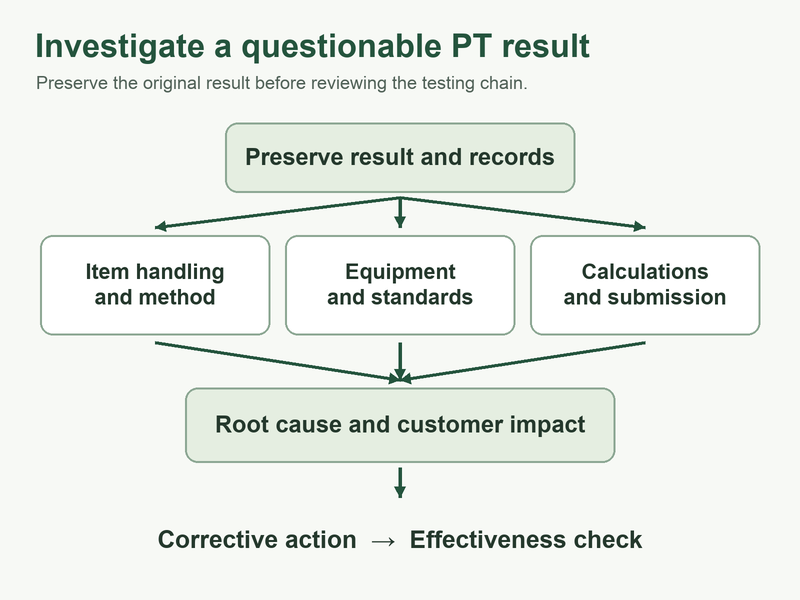
An unsatisfactory or questionable result should trigger a controlled investigation covering sample receipt, preparation, method version, equipment, calibration, standards, analyst actions, calculations, transcription, units, and submission. Preserve the original result and avoid editing the record into compliance.
Identify root cause before choosing correction. Retraining cannot fix a degraded standard, and recalibration cannot repair an extraction error. Assess whether the cause affects customer results before or after the PT round and whether notification or retesting is needed.
Set the impact window from evidence such as quality-control trends, reagent lots, calibration events, instrument maintenance, analyst assignments, and the last acceptable check. Avoid assuming that only results reported after PT receipt are affected; the underlying cause may have started earlier.
| Investigation area | Example evidence | Possible impact |
|---|---|---|
| Item handling | Receipt and storage record | PT item changed before analysis |
| Method execution | Worksheet and preparation | Step omitted or altered |
| Equipment and standards | QC, calibration, lot records | Systematic shift |
| Calculation and units | Raw files and templates | Result converted incorrectly |
| Submission | Portal receipt and timestamps | Correct result reported wrongly |
Key Takeaway: Investigate the entire testing chain and assess impact on customer work before closing the event.
How should corrective-action effectiveness be checked?
Corrective-action effectiveness should be checked with evidence that the cause was removed and performance is controlled. Depending on the cause, evidence may include revised procedure, training demonstration, quality-control recovery, reference material, replicate study, internal blind sample, or a later PT round.
Do not close the action because a form was completed or the next control happened to pass. Define the expected outcome, responsible owner, due date, review period, and residual risk.
Trend satisfactory results too. Method-specific scores, bias direction, analyst groups, and matrices can reveal gradual change before a formal failure. Review trends at a frequency justified by the quality system and scheme schedule, without importing CLIA’s clinical frequency into food testing.
The practical choice is to use the smallest effectiveness check that directly challenges the root cause. Repeating an entire PT round may be slow or unavailable; an unrelated easy check can be fast but meaningless.
Key Takeaway: Match the effectiveness test to the identified cause and document impact on routine results.
How does PT relate to accreditation and method validation?
PT, accreditation, and method validation provide different evidence. PT shows performance in a specific external exercise. Accreditation recognizes competence within a stated scope. Validation and verification establish method suitability under defined conditions.
FDA’s Laboratory Accreditation for Analyses of Foods program requires PT or an approved comparison program for methods in LAAF scope under covered circumstances. That scope is limited; it does not make its annual participation rule universal for all food laboratories or tests.
A laboratory outside LAAF may still use PT through its accreditation or quality system. Buyers should ask which requirement applies rather than assuming a food-wide federal frequency.
Map each evidence item to the same analytical scope before drawing a conclusion. Accreditation may list a method family, the validation may cover one matrix, and the PT round may use another. The buyer needs the overlap among those scopes, not the strongest isolated statement from each document.
Key Takeaway: Review PT beside accreditation scope and method evidence, without treating any one control as a substitute for the others.
What should matcha buyers request and review?
Matcha buyers should request evidence appropriate to risk: relevant scheme identity, provider status, analyte and matrix, participation date, performance conclusion, corrective-action status, and trend review. Confidential details can remain protected while the laboratory shows that the relevant capability is monitored.
For a wholesale matcha program, tie that evidence to the exact product, lot, test, and supplier requirement. A general laboratory brochure cannot show whether the relevant capability is included in the scheme or current review.
Connect PT evidence to the actual test behind the result. A satisfactory pesticide round does not support microbiology, and a clean aqueous item may not represent extraction from fine matcha powder. The matcha pesticide testing guide illustrates why method, market, and matrix scope matter.
Avoid demanding every PT report with every lot. Review detailed reports during laboratory qualification, scope changes, investigations, or high-risk decisions, and monitor current status through agreed supplier records.
Record the review date, covered capability, reviewer, conclusion, limitations, and next trigger so the evidence remains usable after staff or supplier changes.
Preserve the supporting evidence under document control.
Ask whether any relevant corrective action remains open and how affected work is controlled during closure. A current certificate does not erase an unresolved PT event, while one historical issue with verified correction should not automatically disqualify an otherwise competent laboratory.
Key Takeaway: Ask for PT evidence tied to the exact analytical capability, then review trends and open corrective actions.

FAQ
- What is laboratory proficiency testing?
- It is an external exercise that compares a laboratory’s result on an unknown item with an assigned value or peer group under defined criteria.
- Does passing PT prove every laboratory result is correct?
- No. A satisfactory round supports performance for that scheme, analyte, matrix, range, method, and time; it is not universal proof.
- Is PT the same as accreditation?
- No. Accreditation recognizes competence within a scope, while PT evaluates performance in a specific external exercise.
- How often must a food laboratory perform PT?
- Frequency comes from the applicable accreditation, regulatory, customer, or laboratory program; CLIA medical frequencies are not universal food rules.
- What should happen after an unsatisfactory PT result?
- The laboratory should investigate root cause, assess affected customer work, implement corrective action, and verify effectiveness.
- Can an interlaboratory comparison always be called PT?
- No. Confirm that the exercise evaluates participant performance through a defined provider, assigned value, criteria, and report.
Conclusion
Laboratory proficiency testing is useful when the scheme matches the method, matrix, range, and decision behind a food result. Review provider competence, routine handling, scoring, corrective action, and trends without confusing PT with accreditation or validation. For matcha laboratory-document and supplier discussions, contact AdoroHu Matcha with the intended analytical scope.