
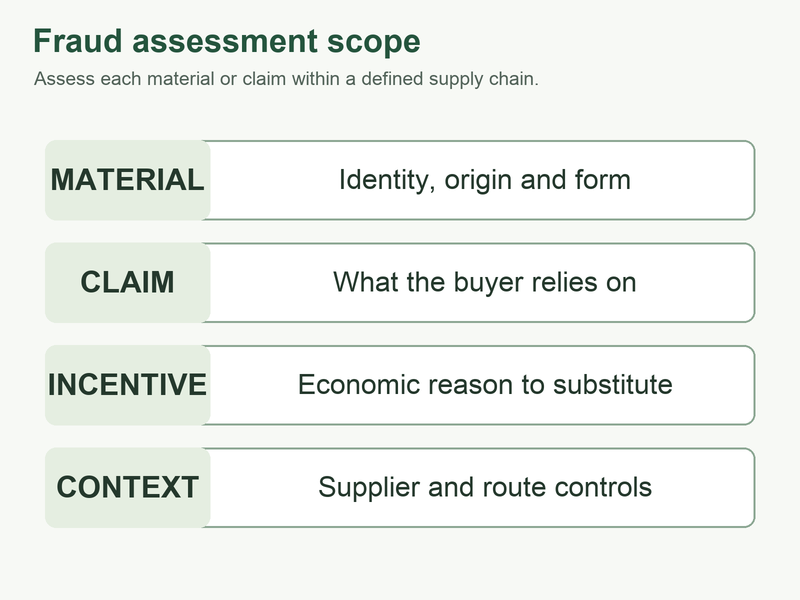
A food fraud vulnerability assessment ranks where economic motive and supply-chain opportunity could compromise a matcha portfolio, then assigns controls to the highest exposures. It prevents procurement teams from treating a certificate, a low price, or one clean result as proof that every material and claim is protected.
The assessment should guide sourcing across product codes, suppliers, origins, claims, and routes. Buyers can begin with records used to verify a matcha supplier, then add fraud-specific evidence about incentive, opportunity, detectability, and consequence. A food fraud vulnerability assessment succeeds only when each rating leads to an owner, action, and review trigger.
A food fraud vulnerability assessment compares economically motivated scenarios across a portfolio. It identifies where a supplier, material, route, or claim needs stronger prevention or detection. It does not certify authenticity or replace claim-specific testing.
In short:
Key points:
- Score each material-supplier-route combination, not a portfolio average.
- Separate economic incentive, opportunity, detectability, and consequence.
- Convert priority ratings into owned mitigation and dated reassessment.
What is a food fraud vulnerability assessment?
A food fraud vulnerability assessment is a structured comparison of economically motivated adulteration scenarios across ingredients, suppliers, and supply routes. The FDA describes economically motivated adulteration as intentional omission, removal, substitution, or addition intended to increase apparent value or reduce production cost. That definition separates economic motive from intentional contamination intended to cause broad harm, which belongs in food defense.
The unit of assessment matters. “Matcha” is too broad because ceremonial, culinary, organic, and blended products carry different claims and price relationships. Score the specific item, supplier, origin, route, and label claim at a stated date. If one item changes supplier or passes through a new broker, create a new line rather than copying the previous rating.
Keep commercial-quality and public-health paths visible. A false grade claim may cause economic loss and misbranding without creating a safety hazard. A substitution that introduces an undeclared allergen may also require food-safety action. The assessment records both consequences without pretending the rules or responses are identical.
Start with a named coordinator, version, approval date, and reassessment date. Procurement owns commercial evidence, quality owns specifications and test interpretation, and regulatory reviews market claims. Clear ownership prevents an unresolved assumption from becoming an approved score through silence.
The output should state whether each scenario is accepted, reduced, or blocked. That status gives purchasing an executable rule and prevents an unfinished assessment from being mistaken for supplier approval.
Key Takeaway: Define the assessment at material, supplier, route, and claim level so it can drive a real decision.
Which matcha materials and claims belong in the assessment?
Every purchased powder, blend component, origin claim, organic claim, grade claim, and critical processing handoff belongs in the food fraud review. FDA notes that fraud may cause economic harm, health risk, and misbranding exposure. Those are consequence categories; they do not replace a scenario for the actual item.
Build the inventory from purchasing codes and approved-supplier records rather than marketing names alone. Include alternates, brokers, repackers, toll processors, and emergency sources. Link each row to its specification and approved claims. For an organic product, certificate scope and transaction records answer different questions from identity testing.
AdoroHu Matcha’s approved range includes ceremonial, premium, culinary, and organic matcha, but that fact does not establish equal vulnerability among grades or lots. A buyer sourcing culinary matcha for food applications should assess its chosen code and chain, not inherit a brand-wide score.
Tie each line to the documents that can change its assessment: specification, approved-supplier entry, label copy, certificate, route map, and contract processor. Exclude items only with a recorded reason. Otherwise, low-volume alternates can disappear from review until a shortage forces their use.
| Portfolio record | Separate assessment when | Decision supported |
|---|---|---|
| Material code | Grade, blend, origin, or claim differs | Which item needs mitigation |
| Supplier route | Broker, repacker, or facility changes | Where visibility is weakest |
| Market claim | Organic, origin, or premium wording changes | Which evidence supports the label |
| Alternate source | Emergency approval or substitution occurs | Whether temporary controls are adequate |
Key Takeaway: Inventory the commercial reality, including alternates and intermediaries, before assigning scores.
How should economic incentive be scored?
Economic incentive should be scored from the value gained by substitution, dilution, omission, or misrepresentation. Useful evidence includes price gaps between grades, sudden shortages, yield pressure, claim premiums, currency movement, and unusually low offers. The score should explain the scenario and cite dated evidence instead of merely labeling an item “high value.”
Fraud is designed to avoid detection, so incident counts and market estimates are incomplete. FDA notes that frequency and economic impact are difficult to estimate. Record confidence beside each input and avoid turning missing evidence into a low score. A quote from one week is weaker than a repeated differential across comparable purchases.
Use bands that provoke action rather than false precision. A three-level scale can work if the team defines what changes a rating and requires review. Treat a large premium with weak independent evidence as a reason to strengthen controls, not proof of fraud. Ignoring the gap risks paying for a claim the buyer cannot defend.
Separate current incentive from structural incentive. A crop shortage may lift the current rating, while an enduring price gap between claims remains relevant after the shortage ends. Recording both prevents teams from lowering controls too quickly when spot prices stabilize.
Key Takeaway: Score plausible financial gain and evidence quality; no detected incident does not prove low incentive.
How does supply-chain opportunity change vulnerability?
Supply-chain opportunity rises when custody, identity, or accountability becomes unclear. Long routes, brokers, unsealed transfers, repacking, commingling, undocumented subcontracting, and remote approvals can create points where material or records change without timely discovery.
Map physical product and information separately. A direct invoice does not prove direct physical custody, while a traceability record may omit who repacked a lot. For each node, identify who owns and handles the product, which identifier survives, whether seals are recorded, and whether quantities reconcile.
FDA explains that reasonably foreseeable economically motivated adulteration affecting food safety belongs in preventive-controls analysis, while integrity-only fraud may fall outside that specific US requirement. Commercial fraud still warrants controls for paid-for origin, grade, and certification claims.
Prefer a shorter, identity-preserved route when two offers are otherwise comparable. More intermediaries may be necessary, but they require stronger chain-of-custody and change-notification evidence.
Quantity reconciliation is useful when its boundaries are explicit. Compare received, processed, lost, reworked, and shipped amounts for the same identity and period. Unexplained imbalance is a prompt for investigation, not automatic proof of adulteration, because measurement and timing differences also matter.
Key Takeaway: Rate opportunity from actual custody and record handoffs, then reduce opacity where it creates exposure.
How should detectability be judged for each fraud scenario?
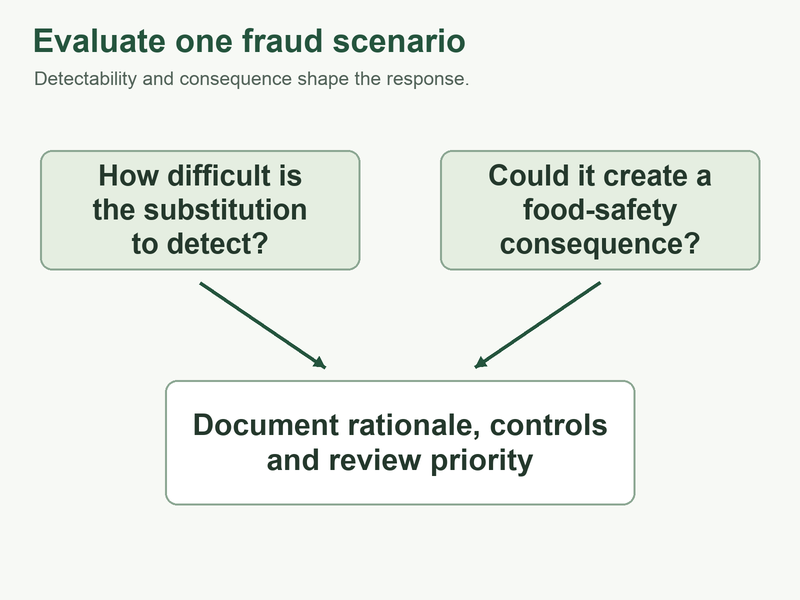
Detectability should be judged against one defined scenario, because no single test or document rules out every form of matcha fraud. A method aimed at one marker may support composition questions while leaving origin, grade, processing, or custody claims unresolved.
Write what could change and what evidence would reveal it. Supplier identity, lot linkage, mass balance, certificate scope, sensory comparison, chemical testing, and packaging controls each see different parts. The guide to matcha authenticity evidence explains claim-level proof; the vulnerability assessment decides which claims deserve that work first.
Rate capability and application. A suitable test adds little protection if sampling misses heterogeneous material, results arrive after release, or failures lack stop-shipment authority. Strong chain controls can reduce opportunity where testing has limits. Record blind spots as residual risk rather than averaging them away.
Define what a negative result permits. It may support release for the tested target and sampling plan, yet it cannot validate an unrelated origin or grade claim. A decision rule should name the target, method, lot, result, reviewer, and remaining evidence needed.
Key Takeaway: Match detection evidence to a named scenario and preserve what the chosen controls cannot see.
When does a food-safety consequence change the response?
A plausible public-health consequence moves the scenario into the proper food-safety analysis as well as the fraud program. Examples include substitution that introduces an undeclared allergen, illegal additive, or contaminant. Quality-only consequences still need commercial action but should not be described as the same regulatory problem.
Use a routing record stating the scenario, affected claim, possible hazard, market, intended use, and decision owner. Quality, regulatory, procurement, and food-safety personnel can determine whether to hold material, seek evidence, or activate a separate hazard evaluation. Keep the route traceable without publishing sensitive controls.
The same case can follow more than one path. A substitution may create both a commercial claim failure and a safety concern. Closing the labeling action should not silently close the hazard review; each owner records a disposition and the coordinator confirms both are complete.
| Consequence | Primary decision path | Minimum record |
|---|---|---|
| Grade or origin unsupported | Commercial quality and labeling | Claim, gap, disposition |
| Certification scope uncertain | Regulatory and procurement | Scope, lot link, market |
| Plausible allergen or unsafe substance | Food-safety escalation | Hazard rationale, hold, investigation |
| Deliberate broad-harm scenario | Food-defense escalation | Restricted notification and response |
Key Takeaway: Route safety, commercial, labeling, and defense consequences properly while retaining one scenario trail.
How should a practical fraud scoring model work?
A practical model defines factors, scales, evidence rules, review authority, and action thresholds before scoring. Keep inherent vulnerability separate from mitigation strength. The residual rating then shows whether existing controls change the decision.
Use the same scale across assessors, but allow “unknown” rather than forcing a number. Calibrate several contrasting materials and compare rationales. If reviewers disagree, identify which fact would resolve the difference. Averaging unsupported judgments hides the evidence gap.
The matrix is an illustrative management tool, not primary-source evidence or a measured fraud probability. Multiplication can exaggerate small scoring differences; addition can let one severe factor disappear. Choose a method the team can explain and connect to actions.
Pilot the scale before portfolio rollout. Give reviewers the same three cases, compare ratings, and revise definitions where evidence produces inconsistent outcomes. Freeze the method for a review cycle so score changes reflect the inputs rather than unnoticed changes to arithmetic.
| Rating component | Evidence question | Action when elevated |
|---|---|---|
| Incentive | What economic gain is plausible now? | Refresh market evidence |
| Opportunity | Where can identity or records change? | Strengthen custody |
| Detectability | Would controls reveal this scenario in time? | Add targeted evidence or hold |
| Consequence | What buyer, legal, or health harm follows? | Escalate authority |
Key Takeaway: Use an explainable matrix that exposes unknowns and links every rating band to an action.
Which mitigations fit high fraud vulnerability?
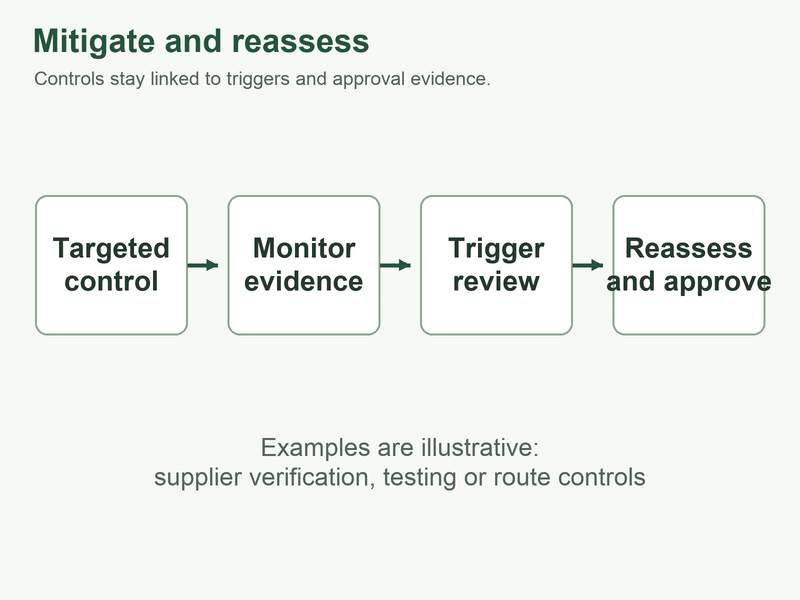
High vulnerability needs controls aimed at the factor that created the rating. Direct sourcing and sealed custody reduce opportunity; claim-specific records and targeted testing improve detectability; alternate qualification can reduce shortage-driven incentive. A longer checklist does not help when it repeats evidence unable to detect the scenario.
Assign a control owner, evidence record, due date, verification method, and residual-risk approver. Supplier approval, mass balance, transaction certificates, change notification, retain samples, and spot testing help only when their scopes match. Testing should not become the default answer to a route that procurement can redesign.
Buyers can use the premium matcha sourcing page to frame product discussions, then request the records their assessment identifies. Product availability or certification lists do not prove controls operated for a particular lot.
Mitigation strength should be demonstrated through application evidence. A contract clause may authorize notification, but only dated notifications or periodic confirmation show the channel functions. A sampling procedure may be sound, but lot-linked results and dispositions show whether it governed release.
Key Takeaway: Select mitigation that changes the elevated factor and verify it operated for the scoped material and route.
What events should trigger reassessment?
Reassess on a defined cadence and whenever evidence changes exposure. Triggers include price spikes, crop shortages, new suppliers, new intermediaries, origin changes, certification changes, unexplained results, complaints, route disruption, ownership changes, and lost traceability.
Preserve the previous score, evidence date, changed input, and approval decision. This history distinguishes a real risk change from a revised method. A new reviewer should see why the rating moved and whether mitigation still addresses the same scenario.
Set alerts where information first appears. Procurement sees unusual pricing and emergency substitutions; quality sees atypical results; regulatory sees claim changes. One coordinator should reconcile signals so functions do not maintain conflicting assessments.
Do not overwrite the earlier version. Retaining the evidence and rationale supports trend review and shows whether mitigation reduced exposure. It also helps distinguish a supplier change from a broader market event affecting several materials at once.
Key Takeaway: Combine routine review dates with event triggers and retain the reason for every score change.
What evidence should approve the completed assessment?
Approval requires complete scope, dated sources, scenario rationales, factor ratings, mitigation owners, residual decisions, and reassessment triggers. The approver should challenge the highest consequences and weakest evidence rather than checking that every cell has a number.
The record is a prioritized control plan, not an authenticity certificate. Link it to supplier approval and specifications while keeping purposes distinct. An audit can confirm that a process exists; it cannot prove every fraud scenario has been prevented.
Before commercial approval, procurement should know which exposures are accepted, reduced, or blocked. If product, pack, supplier, or lot evidence needs alignment, contact AdoroHu Matcha with the exact material and claim under review.
Approval should also state its boundary. A decision for one supplier, facility, route, and claim cannot be transferred to an alternate without review. Put the boundary beside the approval so purchasing cannot mistake an item-level decision for blanket portfolio clearance.
Key Takeaway: Approve only when ratings, controls, limits, owners, and triggers support a documented sourcing decision.
FAQ
- What is an FFVA?
- An FFVA is a structured comparison of economically motivated adulteration vulnerability across materials, suppliers, claims, and routes.
- Is food fraud the same as food defense?
- No. Food fraud centers on economic gain, while food defense addresses intentional adulteration intended to cause broad public-health harm.
- Does a clean authenticity test prove low fraud vulnerability?
- No. A test answers defined targets and may not cover origin, grade, custody, certification, or another substitution scenario.
- Should every matcha product receive one portfolio score?
- No. Grade, supplier, route, claim, and market differences can produce different incentive, opportunity, and consequence ratings.
- How often should a food fraud assessment be reviewed?
- Set a routine cadence and review sooner after shortages, price changes, new routes, supplier changes, incidents, or evidence gaps.
- What should a high vulnerability rating trigger?
- It should trigger a scenario-specific mitigation, named owner, verification record, residual-risk decision, and reassessment date.
Conclusion
The next decision is whether each priority material can proceed with current evidence or needs a changed route, added control, or hold. Record that choice beside the scenario and owner. For sourcing questions tied to a product and claim, contact AdoroHu Matcha.