Sourcing low-quality tea can damage your brand reputation. It results in lackluster products that consumers reject. When your matcha lattes look dull or your baked goods taste bitter, you risk losing valuable customer trust. Choosing high-quality premium matcha from AdoroHu Matcha ensures your business delivers vibrant color. Our rich umami flavor meets the demands of professional kitchens and food manufacturers.
To choose the right matcha powder, prioritize vibrant green color, fine particle size, and authentic Japanese origin. Match the specific grade to your application. Use ceremonial for premium beverages and culinary for food manufacturing. Always verify organic certifications and laboratory test results to ensure safety.
In short:
- Identify the correct grade for your specific product application.
- Verify international organic certifications like JAS, USDA, and EU.
- Evaluate physical attributes including color, micron count, and processing method.
- Confirm origin and traceability to ensure authentic Japanese quality.
What defines high-quality matcha powder for B2B buyers?
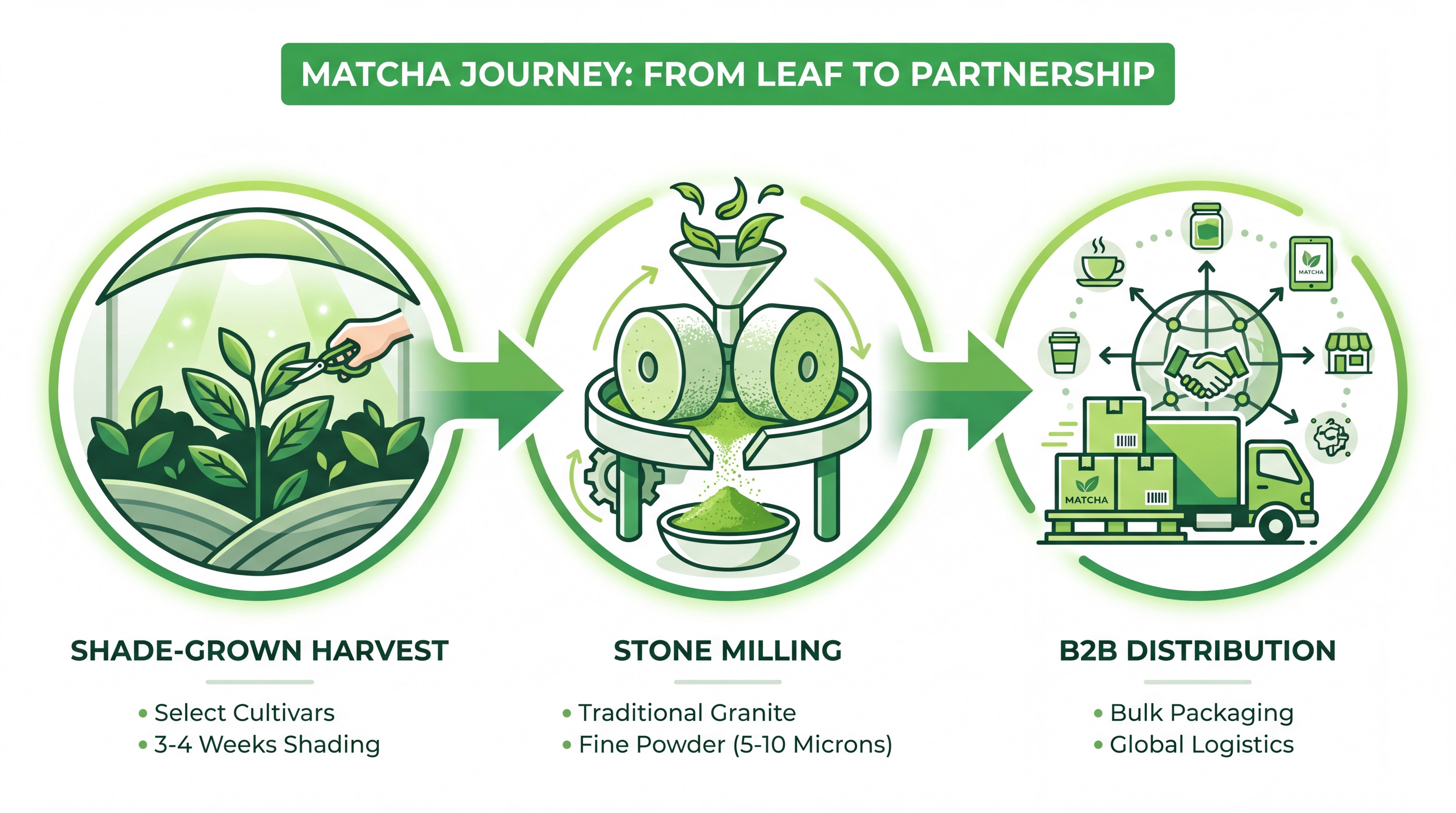
High-quality matcha begins with shade-growing the tea plants. Farmers cover the leaves for three to four weeks before harvest. This process boosts chlorophyll and L-theanine levels. Authentic matcha comes from tencha, which are leaves stripped of stems and veins. Professional buyers should look for a vibrant emerald green color. The powder must offer a deep umami profile with natural sweetness. If the tea smells hay-like or musty, it indicates poor processing or aging.
Which matcha grades are best for your specific application?
Selecting the wrong grade can lead to excessive costs or poor performance. Ceremonial grade is reserved for traditional tea service. It offers a delicate flavor that heavy sweeteners should not mask. Culinary matcha is better for baking and pastry uses. It has a bolder flavor profile that stands up to heat and fats. For high-volume matcha lattes , a premium beverage grade provides the best balance.
How do you evaluate a wholesale matcha powder supplier’s transparency?
A reliable wholesale supplier must provide a Certificate of Analysis (COA). This document verifies the absence of heavy metals and pesticides. Transparency also involves clear traceability to the farm or region. Regions like Uji and Kagoshima are gold standards for Japanese production. Ask your supplier for their quality control protocols. They should demonstrate batch consistency across multiple orders to protect your brand consistency.
How do harvest seasons affect bulk matcha powder pricing?
Harvest timing is the primary driver of bulk pricing. The first harvest (spring) produces the highest quality. Prices for ceremonial spring matcha are typically the highest. The second and third harvests occur in summer and autumn. These harvests are more economical for businesses. These leaves contain more catechins, leading to a sharper, more astringent taste. Later harvests are ideal for cost-sensitive industrial applications where color is secondary to flavor.
What organic certifications are mandatory for importing matcha powder?
Importing organic matcha requires specific documentation to meet international law. The JAS (Japanese Agricultural Standard) is the foundation for all organic Japanese tea. Due to equivalence agreements, JAS-certified products can be sold as USDA Organic. However, you must ensure your supplier provides a National Organic Program (NOP) Import Certificate. For European markets, the EU Organic logo is mandatory. These certifications guarantee the tea was grown without synthetic fertilizers.
Why is particle size critical for beverage stability?
In the beverage industry, particle size determines the suspension of the powder. Matcha does not dissolve; it remains suspended in liquid. A finer particle size, typically 5 to 10 microns, ensures better mixing. Coarser powders will settle at the bottom of the cup quickly. This creates an inconsistent drinking experience for your customers. Fine particles also provide the creamy mouthfeel associated with premium lattes.
How does stone-milling impact your product quality?
Stone-milling is the traditional method using granite wheels. It is a slow process that prevents heat friction. This preserves the delicate antioxidants and color of the tea. Stone-milling produces a unique round particle shape for better froth. Jet-milling uses high-pressure air to break down leaves. While faster and cheaper, it can damage the flavor profile through heat. Most high-end B2B brands insist on stone-milled powder for flagship products.
What should you look for in private label matcha powder packaging?
Your private label packaging must protect the powder from three enemies. These are light, heat, and oxygen. Matcha oxidizes rapidly when exposed to air. Use multi-layer foil bags with high-barrier properties. Nitrogen flushing during the sealing process is a best practice. It maintains long-term freshness and prevents color fading. Ensure the packaging is completely opaque to block UV rays.
What are the most common mistakes B2B buyers make when sourcing matcha?
Many buyers mistakenly choose matcha based solely on the lowest price. This often results in receiving “green tea powder” instead of authentic matcha. Another common pitfall is ignoring aluminum and lead levels in bulk shipments. Always verify that your supplier conducts third-party lab testing. Some buyers also fail to account for shipping lead times from Japan. This can lead to costly stockouts during peak sales seasons.
How do you request and evaluate matcha powder samples effectively?
When requesting samples, always ask for the current lot’s COA. Once the sample arrives, perform a sensory evaluation immediately. Whisk the matcha with water at 80°C to check for froth stability. Evaluate the color stability by leaving the prepared tea out for 30 minutes. If it turns brown quickly, the quality is likely low. Test the matcha in your actual recipe, such as a latte. This ensures the flavor profile integrates with your ingredients.
Frequently Asked Questions
- What is the difference between green tea powder and matcha?
- Matcha is shade-grown and stone-milled, while green tea powder is not.
- Matcha contains significantly higher levels of chlorophyll and L-theanine.
- How long is the shelf life for bulk matcha?
- Unopened bulk matcha typically stays fresh for 12 months.
- Once opened, it should be consumed within 2 months for peak flavor.
- What is the Minimum Order Quantity (MOQ) for wholesale?
- MOQs vary but often start at 1kg for samples and 20kg for bulk pricing.
- Private label services may require higher MOQs depending on the packaging requirements.
- Is ceremonial matcha better than culinary for lattes?
- It depends on your brand positioning and price point.
- Ceremonial offers a smoother taste, while culinary provides a stronger tea flavor.
- Why does my matcha look yellowish?
- Yellowing is a sign of oxidation or poor-quality harvest.
- It may also indicate that the tea was not properly shade-grown or stored.
Conclusion
Choosing the right matcha powder requires a deep understanding of grades and safety standards. By focusing on Japanese origin, organic certification, and particle size, you secure a superior supply chain. AdoroHu Matcha is committed to providing consistent, high-quality wholesale solutions. Ready to elevate your product line with premium Japanese tea? Contact our expert team today for samples and wholesale pricing.