Sourcing high-quality matcha for a commercial brand often feels like a gamble. Many B2B buyers encounter the “sample trap”—receiving a vibrant, premium specimen only to have their bulk order arrive as a dull, yellowish powder that ruins the flavor profile of their products. This inconsistency doesn’t just waste your inventory; it damages your brand reputation and leads to lost customers who demand the authentic Japanese experience. AdoroHu eliminates this risk by providing direct-from-origin wholesale matcha that meets rigorous Japanese laboratory standards, ensuring every batch maintains the color and umami your brand promises.
To identify high-quality matcha, professionals evaluate four key pillars: a vibrant emerald green color (indicating high chlorophyll), an ultra-fine texture of 5-10 microns (achieved through traditional stone-milling), a rich umami flavor profile with minimal bitterness, and a Japanese origin from regions like Uji or Nishio. In a B2B context, quality is further verified through JAS Organic certifications and a Certificate of Analysis (COA) for every batch.
In short:
- Color: Look for vibrant emerald green, not olive or yellow.
- Texture: Should be fine as talcum powder; no grittiness.
- Flavor: Dominated by umami and L-theanine sweetness.
- Documentation: Always require a COA and JAS Organic certification.
- Origin: Authentic matcha must be Japanese (Uji, Kagoshima, Nishio).
What defines high quality matcha in a B2B context?
In the B2B sector, quality is defined by consistency, transparency, and application suitability. While a consumer might judge a single tin, a professional buyer looks for a supplier that can guarantee the same mesh size and color luminosity across hundreds of kilograms. High-quality matcha begins with shade-growing, a process where tencha leaves are covered for 20-30 days before harvest to spike chlorophyll and L-theanine levels.
For a business, high quality also implies safety. This means the product must be backed by rigorous testing for heavy metals, radiation, and pesticide residues. AdoroHu focuses on providing “Industrial Grade” transparency even for culinary tiers, ensuring that whether you are producing a premium beverage or a health supplement, the ingredient remains pure and potent.
How does the region of origin determine the quality of wholesale matcha?
The “terroir” of Japanese tea-growing regions is the most significant determinant of a matcha’s chemical profile. Uji (Kyoto) is globally recognized as the birthplace of matcha, producing a refined, traditional flavor profile with deep umami. Nishio (Aichi) is famous for its high-volume, high-color stability, making it a favorite for B2B culinary applications. Kagoshima has emerged as a leader in organic matcha powder due to its volcanic soil and advanced organic farming infrastructure.
Why is vibrant green color the first sign of premium ceremonial matcha?
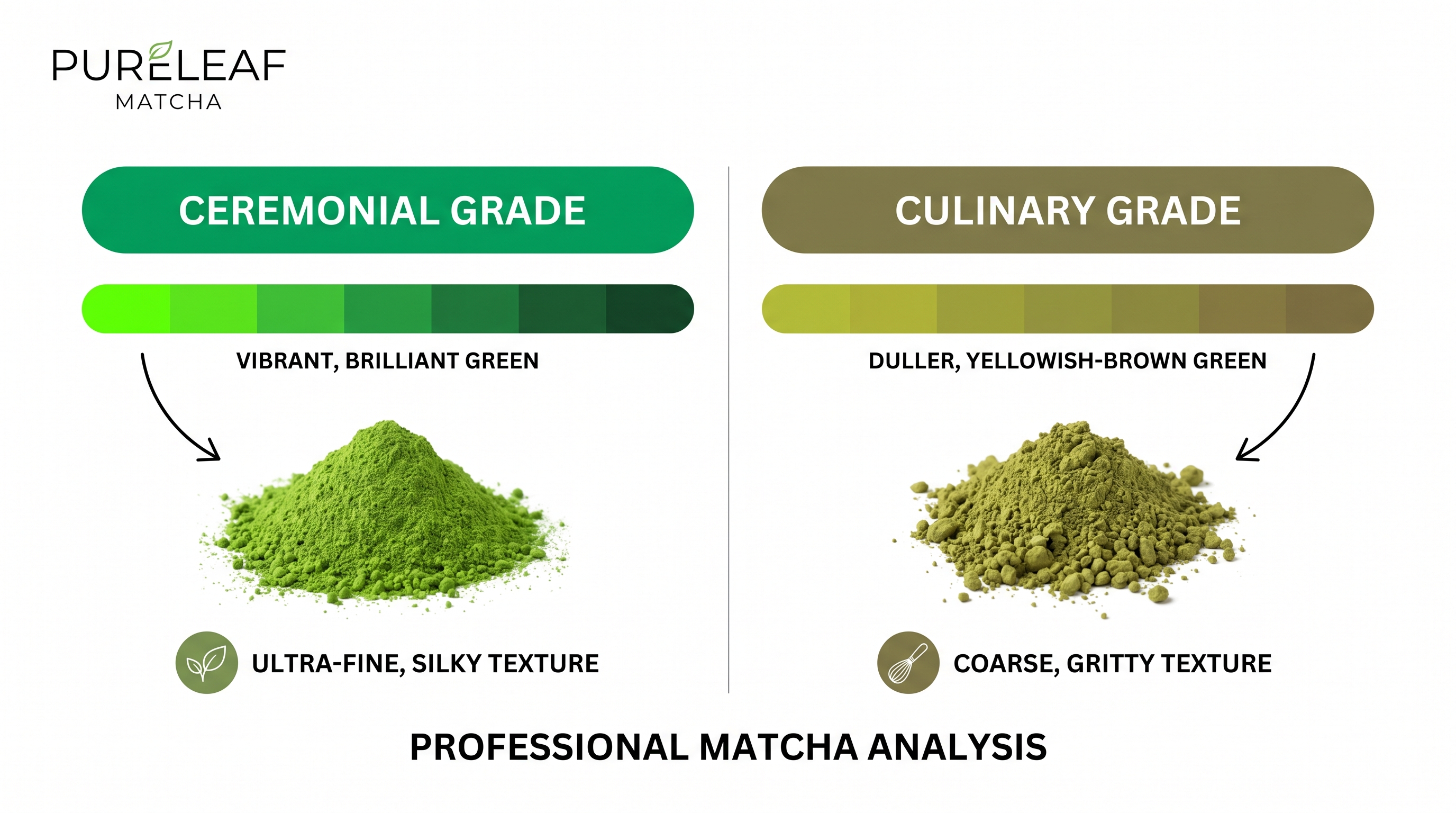
Color is the visual shorthand for chlorophyll content. When tencha leaves are properly shaded, the plant overcompensates by producing massive amounts of chlorophyll to capture limited sunlight. This results in the “electric green” hue characteristic of ceremonial grade matcha.
If a matcha powder appears dull, brownish, or yellowish, it typically indicates one of three failures: the leaves were not shaded, they were harvested late in the season (lower nutrient density), or the powder has oxidized due to poor storage. In wholesale sourcing, a “yellow” tint is a dealbreaker for premium positioning, as it results in unappealing, “muddy” lattes.
How can you distinguish between ceremonial and culinary grade matcha in bulk?
Distinguishing between grades in a bulk environment requires a sensory and chemical understanding. Ceremonial grade is derived from the first harvest (first flush), using only the youngest leaves. Culinary grade often utilizes second or third harvest leaves which have more sun exposure, leading to higher catechin levels and a more astringent taste.
| Feature | Ceremonial Grade | Culinary Grade |
|---|---|---|
| Harvest | First Flush (Spring) | Second/Third Flush (Summer/Autumn) |
| Color | Vibrant Emerald Green | Dull/Olive Green |
| Taste | Sweet Umami, No Bitterness | Robust, Astringent, Bold |
| Texture | Ultra-Fine (Stone-Milled) | Slightly Coarser |
| Best Use | Traditional Whisking, Water | Baking, Lattes, Smoothies |
What role does stone-milling play in the texture of high quality matcha?
Texture is the differentiator between professional matcha and “green tea powder.” High-quality matcha must be stone-milled using granite wheels. This process is slow—often taking an hour to produce just 30 grams of powder—but it prevents the friction heat that can oxidize the tea. The resulting particle size is between 5 and 10 microns.
When you rub premium matcha between your fingers, it should feel like silk or talcum powder. If it feels gritty or like fine sand, it was likely jet-milled or contains ground-up stems and veins (which should be removed during the tencha processing stage). This fineness is what allows the matcha to achieve a “microfoam” or crema when whisked.
What international certifications ensure the quality of organic matcha powder?
For B2B brands, certifications are the only way to verify “organic” claims legally across borders.
- JAS Organic: The Japanese Agricultural Standard is the baseline.
- USDA Organic & EU Organic: Thanks to equivalency agreements, JAS-certified matcha can often be sold under these labels, ensuring no synthetic pesticides or fertilizers were used.
- FSSC 22000 / HACCP: These are food safety management certifications that prove the factory maintains sterile conditions.
- Certificate of Analysis (COA): A batch-specific document detailing microbiological counts (mold, yeast, E. coli) and heavy metal testing.
How do you identify ‘fake’ or low quality matcha from unreliable suppliers?
The market is flooded with “matcha-style” powders that are simply ground sencha or green tea from non-Japanese origins.
- The “Fishy” Smell: Low-quality matcha often smells fishy or like seaweed due to improper drying or poor leaf quality. Premium matcha smells fresh, vegetal, and “sweet-grassy.”
- The Grittiness: If the powder doesn’t dissolve and leaves a sandy residue at the bottom of the cup, it is not authentic matcha.
- Price Suspicions: If a “Ceremonial Grade” is offered at culinary prices (e.g., $15/kg), it is almost certainly a lower-grade powder mislabeled for export.
How does packaging and storage preserve the quality of bulk matcha?
Matcha is highly sensitive to light, heat, and oxygen. Once exposed, it begins to oxidize and lose its vibrant green color and umami flavor within days. High-quality wholesale suppliers like AdoroHu use airtight, light-protective vacuum sealing. For bulk quantities, the use of oxygen absorbers and refrigerated “cold chain” shipping is the gold standard.
What are the current pricing benchmarks for sourcing high quality matcha?
Pricing varies significantly based on harvest and certification. AdoroHu provides tiered B2B pricing to ensure retailers can maintain a 3x-4x margin.
- Premium Ceremonial: Typically ranges from $60–$120 per kg at wholesale volumes.
- High-Grade Culinary: Ranges from $30–$50 per kg.
- Organic Surcharge: Expect a 15–25% premium for verified organic matcha powder.
Buying directly from a manufacturer or specialized importer like AdoroHu reduces the “middleman” markup, allowing for higher quality at a lower price point than generic food distributors.
How do you find a reliable private label matcha manufacturer in Japan?
When looking for a matcha private label partner, transparency is paramount. A reliable manufacturer should provide a full QC checklist before you sign a contract.
Professional QC Checklist for Sourcing:
- Verified Origin: Can they name the prefecture and harvest month?
- Sample Consistency: Does the bulk order match the initial sample provided?
- Documentation: Will they provide a COA for every batch?
- Lead Times: Can they handle sudden volume spikes without compromising quality?
- Packaging: Do they offer nitrogen-flushed packaging to extend shelf life?
Frequently Asked Questions
- Is ceremonial grade matcha healthier than culinary grade?
While both contain antioxidants, ceremonial grade typically has higher levels of L-theanine and chlorophyll, while culinary grade matcha may have slightly higher catechin (antioxidant) levels due to increased sun exposure. - Can I use culinary matcha for drinking?
Yes, but it will be significantly more bitter and astringent. It is better suited for lattes where milk can balance the flavor. - How long does bulk matcha stay fresh?
Unopened and refrigerated, it lasts 12 months. Once opened, it should be used within 1–2 months for peak flavor and color. - Why does my matcha smell like fish?
This usually indicates poor quality leaves, improper steam-processing (oxidation), or high-heat exposure during storage. - What is ‘Tencha’?
Tencha is the name for the shade-grown tea leaves after they have been steamed and dried, but before they are stone-milled into matcha powder.