
A supplier quality agreement works for matcha when it names who controls each quality duty, record, approval, change, and escalation. A generic template can look complete while leaving both parties free to assume the other owns release or investigation.
When a lot fails or a process changes, unclear authority wastes investigation time. For wholesale matcha supply, build the agreement around the exact products, sites, markets, tests, and records in scope. This is operational guidance, not legal advice; qualified counsel should review enforceability and market-specific terms.
A supplier quality agreement defines the quality interface between a buyer and supplier. It should assign responsibility for specifications, sampling, testing, release, nonconformance, changes, records, complaints, audits, and escalation. Commercial terms can remain in a separate purchasing contract.
In short:
Key points:
- Scope the agreement to named products, sites, services, markets, and document versions.
- Give every quality activity one performer, one approver, and a required record.
- Set change, nonconformance, CAPA, complaint, audit, and escalation paths before a problem occurs.
What is a supplier quality agreement for matcha?
A supplier quality agreement is a written allocation of quality responsibilities between the matcha buyer and ingredient supplier. It complements supplier approval and commercial contracting; it does not replace either process.
The purchase agreement handles price, volume, payment, and delivery. The quality agreement handles product conformity, evidence, decisions, and communication. The FDA’s quality-agreement guidance for contract drug manufacturing supports that separation as a governance model, but it is nonbinding drug guidance and does not automatically govern food matcha.
Complete the new matcha supplier onboarding process first. An agreement can assign responsibilities without proving the supplier can perform them.
Key Takeaway: Use the agreement to assign quality work after supplier qualification, while keeping commercial terms separately controlled.
Which products, sites, markets, and documents should the agreement cover?
The agreement should cover named product codes, grades, pack formats, supplier and buyer sites, destination markets, and controlled documents. A supplier quality agreement that says only “matcha powder” leaves too many versions open.
AdoroHu’s approved range includes Ceremonial, Premium, Culinary, and Organic matcha in bulk, retail, and single-serve formats. One approval should not silently extend to another configuration.
List the master specification, approved sample or sensory reference, test methods, packaging drawings, label requirements, and any market evidence by revision. Also name approved manufacturing, testing, storage, and subcontracted sites.
Key Takeaway: Bind the agreement to exact products, sites, markets, services, and document revisions.
How should a supplier quality agreement divide responsibilities?
A supplier quality agreement should give every activity a clear performer, reviewer, approver, notification recipient, and record owner. Shared language such as “both parties ensure quality” is too vague for a lot decision.
| Quality activity | Supplier role to define | Buyer role to define | Required evidence |
|---|---|---|---|
| Specification control | Follow approved revision | Issue or approve requirements | Signed specification and revision history |
| Lot testing and COA | Test by named methods and report results | Review or verify as agreed | Lot-linked COA and raw-data access rule |
| Release | State supplier disposition | Make buyer release decision where assigned | Release status and approver |
| Change control | Assess and notify proposed changes | Review impact and approve where required | Change record and decision |
| Complaint or recall support | Investigate and provide traceability | Coordinate market and customer action | Timeline, records, and closure |
Assign one accountable approver even when several functions contribute. Multiple owners can delay holds, deviations, and shipment decisions.
Key Takeaway: Write each duty as an owner, action, timing rule, approval, and retained record.

Which specification and COA controls belong in the agreement?
The agreement should define the specification hierarchy and what the Certificate of Analysis proves for each lot. A COA without method, units, limits, lot identity, and approval status can create a false sense of control.
For AdoroHu grade references, the EU Standard Series runs from E-1/E-2 Culinary through E-3/E-4 Premium to E-5/E-6/E-7 Ceremonial. The Organic Series runs from O-1/O-2 Culinary through O-3 Premium to O-4/O-5/O-6 Ceremonial. These approved codes show why the commercial name alone is insufficient: the agreement should point to the exact grade and specification revision ordered.
Define which document prevails if a purchase order, specification, artwork, approved sample, or COA conflicts. State how atypical, missing, or corrected results are reviewed.
Key Takeaway: Connect every ordered grade to one controlling specification, method set, and lot-specific COA rule.
How should a quality agreement assign sampling, testing, release, and retains?
Sampling, testing, release, and retain duties should be assigned by product, method, site, and decision authority. The supplier quality agreement must distinguish a supplier’s test result from the buyer’s final acceptance decision.
Define who writes the sampling plan, selects increments, seals and identifies samples, tests them, reviews data, stores retains, and approves release. Set the applicable method and product-market rule rather than copying a universal sample count or retention period.
AdoroHu has in-house microbiology and physical-chemical laboratories. That capability can support product-side measurements within approved methods, but it does not by itself define every test, certify a customer specification, or transfer buyer release authority.
Key Takeaway: Name who samples, tests, reviews, retains, and releases, and tie each action to an approved method and record.
Which changes should the supplier quality agreement require before implementation?
A matcha supplier should notify the buyer before implementing any change that may affect identity, conformity, traceability, certification, packaging, or regulatory suitability. The agreement should distinguish advance-notice changes from urgent events that require immediate containment and communication.
| Change category | Examples to define | Buyer decision |
|---|---|---|
| Product or source | Grade, raw material, origin, sub-supplier | Risk review, sample, or reapproval |
| Process or site | Equipment, processing step, manufacturing or test site | Impact assessment and validation evidence |
| Test or specification | Method, laboratory, limit, reporting format | Equivalence and document revision review |
| Pack or label | Liner, carton, closure, artwork, lot code | Compatibility and market review |
| Certification or status | Scope, suspension, expiry, ownership | Market eligibility and supply action |
Avoid copying a 30-day notice clause from a medical-device template. Set notice from impact, qualification work, inventory exposure, and contract review; one deadline rarely fits every change.
Key Takeaway: Define change categories, evidence, notice path, approval authority, and emergency handling instead of one blanket deadline.
How should the quality agreement control a nonconforming matcha lot?
A nonconforming matcha lot should be identified, contained, reported, investigated, and dispositioned under named authority. The supplier quality agreement should prevent shipment, rework, concession, or destruction from becoming an informal email decision.
Start with the lot, quantity, locations, affected orders, specification, observed result, and immediate containment. Then define who may request retest, approve a deviation, accept under concession, require replacement, or reject the lot.
Use the matcha quality complaint workflow to structure evidence and communication. Avoid automatic retesting until a result passes; that practice can erase the original signal and postpone the real cause.
Key Takeaway: Contain first, preserve the evidence, and let only named authorities decide disposition.

How should a supplier quality agreement define CAPA effectiveness?
CAPA should separate immediate correction from action that removes a cause and prevents recurrence. A supplier quality agreement should state when a corrective-action request is required, who investigates, what evidence closes it, and how effectiveness is checked.
The FDA’s quality-system inspection guide describes a CAPA flow that uses quality-data inputs, investigation, root cause, implementation, documentation, and effectiveness verification. Its cited section is medical-device inspection guidance, so use the workflow as a disciplined model rather than a food-matcha legal requirement.
| CAPA stage | Question the record must answer | Weak substitute to avoid |
|---|---|---|
| Scope and containment | What lots, products, sites, and customers may be affected? | Closing after replacement only |
| Cause investigation | What evidence supports the identified cause? | “Operator error” without analysis |
| Action and implementation | What changed, who owned it, and when did it take effect? | Planned action with no completion proof |
| Effectiveness | What later evidence shows recurrence risk fell? | Repeated training with no outcome check |
Key Takeaway: Close CAPA only after implementation evidence and a defined effectiveness check, not after a response letter arrives.
Which agreement owners handle complaints, recalls, traceability, and records?
Complaint, recall, traceability, and record duties need named contacts, handoff rules, accessible data, and agreed escalation. The quality agreement should make lot history retrievable when time pressure is highest.
Define who receives complaints, preserves samples, investigates, assesses other lots, supplies distribution and production records, supports market action, and communicates closure. Set record types, formats, access rights, and retention rules from the applicable product and market requirements.
Do not invent one universal response deadline. Severity, customer impact, and legal duties vary; the agreement should define risk-based escalation and a separately reviewed schedule.
Key Takeaway: Assign the evidence and communication path before a complaint or market action tests it.
How should audit, escalation, amendment, and review clauses operate?
Audit, escalation, amendment, and review clauses should keep the supplier quality agreement usable after signature. They need practical contacts, access boundaries, approval routes, and version control.
Define routine and for-cause audit rights, evidence access, response ownership, and finding closure. The matcha supplier audit guide helps turn broad access language into a focused evidence plan.
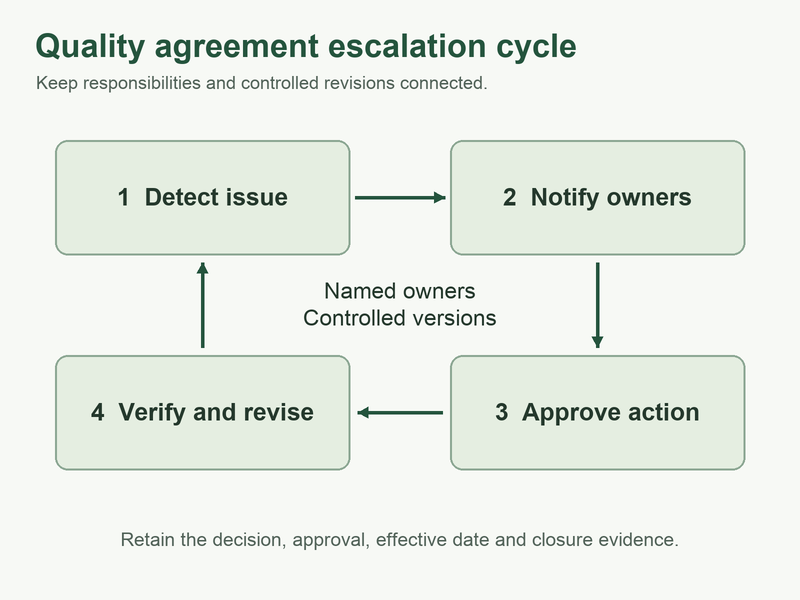
Tie recurring review to evidence from matcha supplier KPIs, complaints, changes, audit findings, and repeat deviations. Require signed amendments or controlled revisions; side emails should not quietly rewrite release authority or specification ownership.
Key Takeaway: Review the agreement against actual performance and change it only through a controlled, approved revision.
FAQ
- What is a supplier quality agreement?
- It is a written allocation of quality responsibilities between a buyer and supplier for defined products, sites, activities, records, approvals, changes, and escalation.
- Is a supplier quality agreement the same as a purchase agreement?
- No. A quality agreement controls quality duties and evidence, while a purchase agreement usually controls price, quantity, payment, delivery, and other commercial terms.
- Should every matcha supplier use the same agreement template?
- No. Use a controlled structure, then tailor product, site, market, test, change, record, audit, and escalation clauses to the actual supply relationship.
- Who should approve a matcha lot for release?
- The agreement should name the supplier disposition role and the buyer release authority, including which records each must review before approval.
- How much change notice should a supplier give?
- Set notice by change type, risk, qualification work, inventory exposure, and applicable contract or market requirements rather than copying one universal deadline.
- When is a supplier corrective action complete?
- It is complete when the agreed action is implemented, documented, approved, and shown effective through the defined follow-up evidence.
Conclusion
A useful supplier quality agreement turns expectations into named actions, approvals, records, and escalation paths for the exact matcha supply relationship. Keep commercial terms separate, scope every clause, and obtain legal review for enforceability and market obligations. Contact AdoroHu Matcha to discuss product specifications, lot documentation, and quality-interface planning for your project.