
A matcha chiffon cake becomes repeatable when foam strength, matcha dose, pan geometry, bake profile and inverted cooling are treated as connected controls. Small changes can collapse loft, toughen crumb or dull the green interior, so a home recipe cannot simply be multiplied. Use this professional matcha pastry sourcing guide to frame the ingredient decision, then build a measured pilot around one pan and one mixing method.
Reliable matcha chiffon cake comes from balancing a fluid oil batter with a stable, foldable meringue. Buyers should approve powder only after the same formula, pan, bake and cooling sequence produces the target loft, crumb and color.
In short:
Key points:
- Fix the product format and pan before comparing ingredients.
- Preserve publisher units when setting matcha and thermal benchmarks.
- Approve grade, foam and cooling against measured release criteria.
What defines a commercial matcha chiffon cake target?
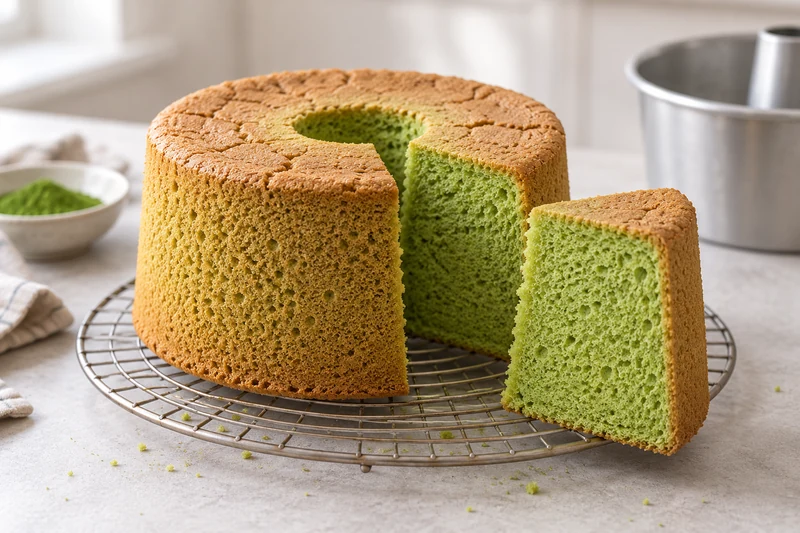
Define the target through height, cell size, resilience, moisture, color and release rather than calling it “light.” Just One Cookbook uses a 17-cm, about 7-inch cake; Serious Eats uses a 13-by-18-inch sheet for a rolled format.
Choose the selling format first because a tall tube cake and a thin sheet demand different batter depth, heat transfer and handling. Avoid comparing their bake times as if they were interchangeable; the consequence is false troubleshooting and unstable yields.
The commercial dessert format guide helps position chiffon beside other service formats.
Key Takeaway: Write measurable loft, crumb, color and release criteria for one format.
How much matcha should a chiffon pilot start with?
Use original recipe quantities as separate starting systems. Just One Cookbook states one heaping tablespoon and notes a level tablespoon weighs 6 g; Serious Eats uses 5 g in the cake and 7 g in 480 ml cream.
Cooking in Chinglish uses 8 g with 55 g cake flour, while Ocha & Co uses 10 g with 55 g self-raising flour. Run each coherent formula before changing dose, because flour, filling and pan shape change how the same number tastes.
| Publisher benchmark | Original formula or format | Useful pilot question |
|---|---|---|
| Just One Cookbook | Heaping 1 tbsp matcha; 17-cm cake | Does the tall cake retain loft and green crumb? |
| Serious Eats | 5 g matcha in a 13-by-18-inch sheet; 7 g in 480 ml cream | Does a roll format need separate cake and filling doses? |
| Cooking in Chinglish | 8 g matcha; 55 g cake flour; 55 g milk; 30 g oil | Does the six-inch system meet crumb and color targets? |
Key Takeaway: Keep each publisher benchmark intact before creating a dose ladder.
Which matcha grade balances color, flavor and cost?
Start with culinary and premium samples in the same cake, then compare baked color and flavor after cooling. The culinary matcha range is a rational base, while premium matcha provides an upper comparator.
AdoroHu maps E-1/E-2 and O-1/O-2 to culinary tiers and E-3/E-4 and O-3 to premium. Choose culinary when heat and sugar erase the premium difference; avoid paying for a subtler grade unless blind tasting shows a saleable gain.
The professional pastry sourcing guide provides the broader baked-application comparison.
Key Takeaway: Buy the grade that survives the actual bake and finish.
How should flour and starch shape matcha chiffon cake crumb?
Lower-protein cake flour usually supports a finer, more tender crumb, while self-raising flour introduces a different leavening assumption. Cooking in Chinglish pairs 55 g cake flour with 8 g matcha; Ocha & Co pairs 55 g self-raising flour with 10 g matcha.
Sift the dry blend consistently and record the flour specification. An A/B test should change flour only, then score height, cell uniformity, resilience and cutting loss. Extra starch or leavening without a control can mask weak foam and create an unhelpful formula.
Key Takeaway: Treat flour type and leavening as declared variables, not silent substitutions.
Which liquid and oil ratios keep matcha chiffon cake tender?
Oil keeps chiffon flexible, while liquid hydrates flour and carries dispersed matcha. Cooking in Chinglish lists 55 g milk and 30 g vegetable oil with 55 g flour; Ocha & Co also lists 55 g milk and 30 g cooking oil.
Weigh the batter before folding and after depositing. Compare emulsification, ribbon behavior and baked spring-back. Avoid adding unmeasured liquid to fix a thick batter, because the extra water changes yield, structure and bake demand.
Key Takeaway: Lock liquid and oil ratios before interpreting foam performance.
How should meringue and folding be controlled in matcha chiffon cake?
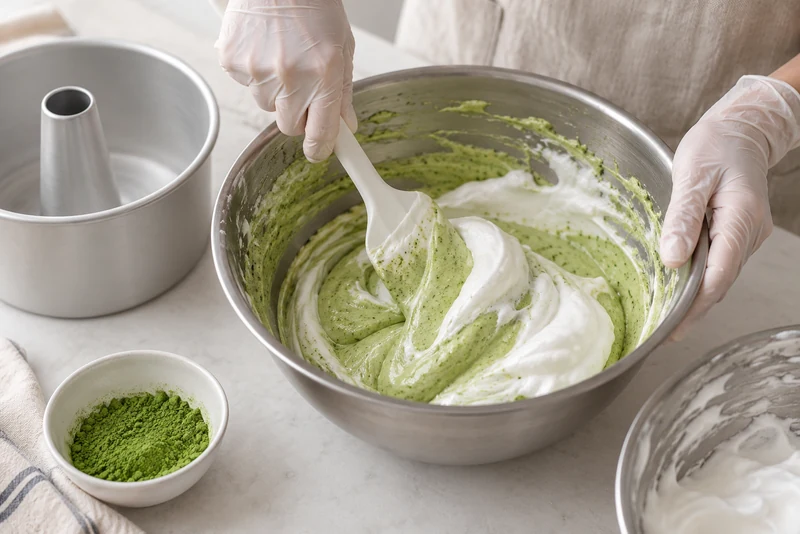
For matcha chiffon cake, build a glossy meringue that holds a flexible peak, then fold it into the base with a defined sequence and endpoint. Dry, clumped foam resists incorporation; underdeveloped foam loses gas before the crumb sets.
Record egg-white temperature, mixer load, speed, sugar sequence, peak shape, batter specific gravity or a consistent cup-weight proxy, and fold count. Choose the least aggressive fold that removes white streaks. Avoid chasing the stiffest peak, because poor folding can cost more loft than the stronger foam provides.
Key Takeaway: Control foam endpoint and fold loss together.
Which pan or sheet format fits a matcha chiffon product?
Use a tube pan for tall freestanding chiffon and a sheet for rolls or cut portions. Serious Eats uses a 13-by-18-inch sheet, while two other benchmarks use 6-inch pans.
Keep pan material, wall geometry, batter weight and release treatment fixed. A nonstick surface can reduce the batter’s ability to climb in some chiffon systems. Choose the pan around saleable geometry; avoid changing pan size while diagnosing the recipe, because heat path and height move together.
| Chiffon release check | Measure after full cooling | Operational consequence |
|---|---|---|
| Structure | Height, side shrinkage, spring-back | Weak foam or underbake cuts saleable yield |
| Crumb | Cell size, tunnels, wet line, cutting loss | Uneven folding causes rejects and rough slices |
| Appearance | Interior green, crust color, finish stability | Excess thermal load weakens the matcha cue |
Key Takeaway: Bind formula approval to one pan geometry and deposit weight.
How should baking protect matcha chiffon loft and green color?
Use the lowest validated thermal load that sets the crumb without leaving a wet core. Benchmarks span 310°F/155°C for 25–30 minutes in a 6-inch pan, 340°F/170°C for 30 minutes in a 17-cm cake, and 350°F/180°C for about 12 minutes in a sheet.
These are not direct alternatives. Record oven mode, load, recovery, rack position and internal release criteria. Avoid raising heat merely to shorten cycle time; the consequence can be a brown crust around an under-set center and greater color loss.
Key Takeaway: Validate time and temperature for the exact depth and oven load.
Which matcha chiffon filling suits the sales channel?
Choose the finish by channel, service temperature and structural load. Serious Eats uses a matcha cream benchmark, while Cooking in Chinglish pairs the cake with black sesame cream.
For packaged slices, compare migration and cut cleanliness after the intended hold. For café service, measure piping stability and assembly time. Keep one plain-cake control, because a strongly flavored filling can hide whether the sponge itself meets the matcha brief.
Key Takeaway: Approve cake and finish separately before approving the assembled SKU.
What should matcha chiffon quality control check after cooling?
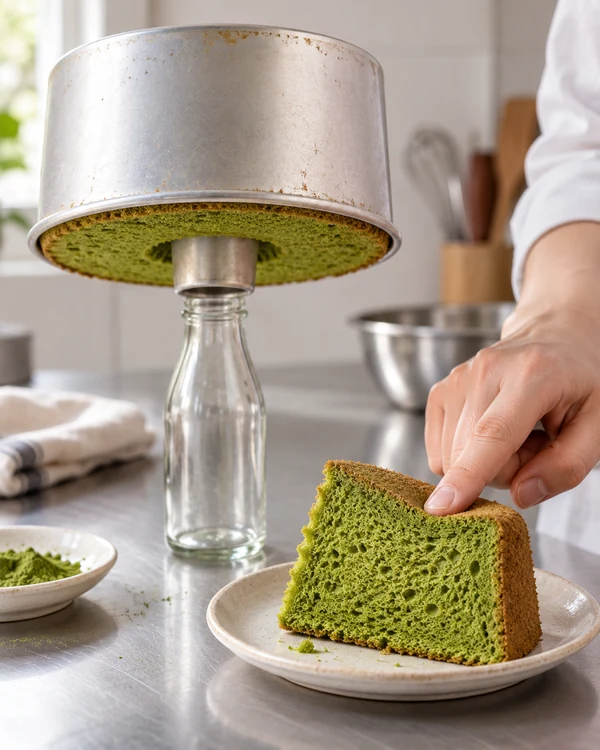
Check height, sidewall, top cracking, shrinkage, cell distribution, spring-back, color, aroma and release after the defined cooling method. Inverted cooling supports the structure of tall chiffon while the crumb sets.
Measure at fixed times after oven exit and after full cooling. Avoid releasing a cake because it looks tall while hot; shrinkage during cooling is the operational defect customers will see. Use a cut map so crumb evaluation samples the center and edge consistently.
Key Takeaway: Release chiffon on cooled measurements, not hot appearance.
What belongs in a supplier-ready matcha chiffon brief?
Specify grade candidates, matcha dose range, flour system, pan, deposit, meringue method, bake, cooling and finish. For U.S. packaged foods, 21 U.S.C. §343(w) requires declaration of nine major allergens under FALCPA as expanded by the FASTER Act: milk, egg, fish, Crustacean shellfish, tree nuts, peanuts, wheat, soybeans and sesame. Apply the FDA major food allergen guidance only to allergens present in the finished formula.
Add projected powder demand, certification needs and acceptance photos under controlled light. AdoroHu’s ultrasonic screening and in-house microbiology and physical-chemical laboratories can support a powder discussion, but the bakery remains responsible for finished-cake validation.
Key Takeaway: Send the supplier a measurable application brief and keep finished-product responsibility clear.
FAQ
- Can chiffon cake be baked in a regular cake pan?
- It can be piloted in different pans, but geometry and surface change heat transfer, climb and cooling, so results need separate validation.
- How much matcha should a chiffon cake use?
- Published benchmarks range across different formulas; preserve each recipe’s units and pan before adjusting dose.
- Why did the chiffon collapse after baking?
- Common process suspects include under-set crumb, foam loss, rough folding, unsuitable pan treatment and incorrect cooling.
- Should chiffon cake cool upside down?
- Tall chiffon formats commonly use inverted cooling to support structure, but the method must match the pan and product format.
- Is culinary matcha suitable for chiffon cake?
- Yes. Compare culinary and premium samples after baking and choose by finished color, flavor and cost.
- What records belong in a chiffon pilot?
- Record ingredient lots, mixer conditions, foam endpoint, batter weight, pan, oven profile, cooling and cooled release results.
Conclusion
Approve matcha chiffon cake only after the cooled sponge meets loft, crumb, color and release targets in the intended pan. Keep the pan, meringue endpoint and bake profile fixed when comparing powder samples. Contact AdoroHu Matcha with the flour system, dose range, baked-color target and expected powder volume.