
Matcha panna cotta stays smooth and evenly green when powder dispersion, dairy ratio, gelatin, heat and fill timing are validated together. Slow gelation can let particles settle, while excessive gelatin turns a delicate chilled dessert rubbery. Start with a controlled base and the commercial matcha dessert guide, then approve the finished cup or unmolded portion after its full set.
A stable matcha panna cotta needs enough gel strength to hold the chosen format without masking creaminess. Teams should disperse matcha before filling, limit damaging heat and measure settling through the full cup.
In short:
Key points:
- Define cup or unmolded format before selecting gel strength.
- Keep sheet and powdered gelatin benchmarks in their original units.
- Validate the actual package, set time and refrigerated hold.
Should matcha panna cotta be sold in a cup or unmolded?
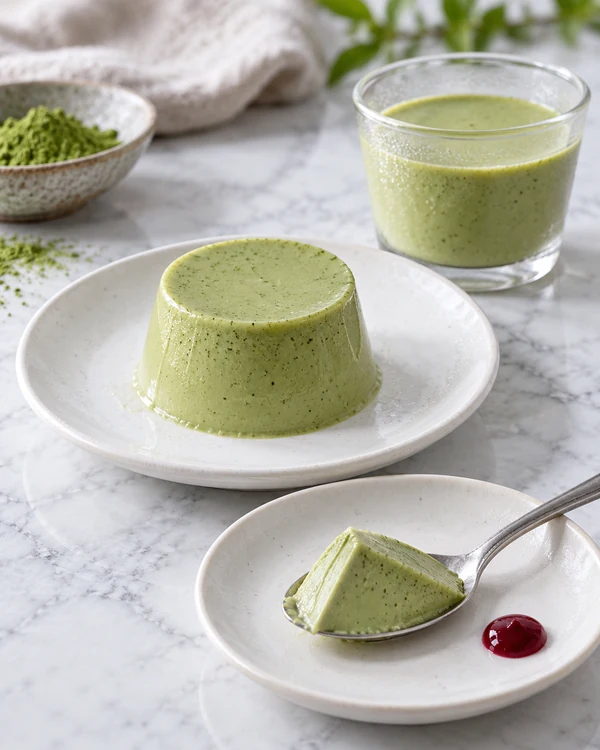
Define whether the matcha panna cotta is an in-cup dessert, an unmolded plate item or a layered retail cup. Manu’s Menu reports four 100 ml (3.5 oz.) portions, while other sources state four or six servings without the same geometry. Cup depth, wall slope and headspace affect cooling, settling and release. In-cup sale supports a softer set and reduces transport damage; unmolding needs enough strength for a clean edge. Choose cup-first for distributed retail unless a freestanding plated shape justifies the tighter release window.
Choose the format before tuning gelatin. Avoid using an unmolding dose for a spoon-from-cup item, because the consequence is unnecessary firmness and weaker creamy perception.
Key Takeaway: Write portion volume, vessel and service method into the first brief.
How much matcha should the first pilot use?
Use publisher doses as separate formulation anchors. Snixy Kitchen uses 2 tbsp with 1 cup milk and 2 cups heavy cream; Jaja Bakes uses 1 tbsp with 120 ml milk and 480 ml cream.
The Pioneer Woman states 2–3 tbsp with 3 cups cream and 1/2 cup milk. Hold the dairy system fixed, then create a small dose ladder. Score top-to-bottom color, bitterness and aroma after the product sets, not only in the warm kettle.
| Publisher benchmark | Original dairy, gelatin and matcha | Format question |
|---|---|---|
| Snixy Kitchen | 1 cup milk; 2 cups cream; 2¼ tsp gelatin; 2 tbsp matcha | Can the six-serving system unmold cleanly? |
| Jaja Bakes | 120 ml milk; 480 ml cream; 3 gelatin sheets; 1 tbsp matcha | Does a richer base need the same release strength? |
| Manu’s Menu | 300 ml cream; 100 ml milk; 6 g sheets or 2 tsp powder; 1½ tsp matcha | Does a 100 ml cup meet spoon and set targets? |
The culinary matcha range gives buyers a practical first sample set.
Key Takeaway: Change matcha dose inside one fixed dairy and gelatin system.
How should cream-to-milk ratio change matcha panna cotta?
More cream raises fat and richness, while more milk changes fluidity and the way matcha presents. Arbor Teas uses equal 1 3/4-cup amounts of cream and milk; Manu’s Menu uses 300 ml cream to 100 ml milk.
Compare one ratio at a time with the same gelatin specification and portion. Measure spoon cut, melt in the mouth and whey separation. A richer formula may need a different matcha dose, but change that only after the texture comparison is complete.
Key Takeaway: Select dairy ratio for sensory target before retuning tea intensity.
Which gelatin format should a matcha panna cotta team validate?
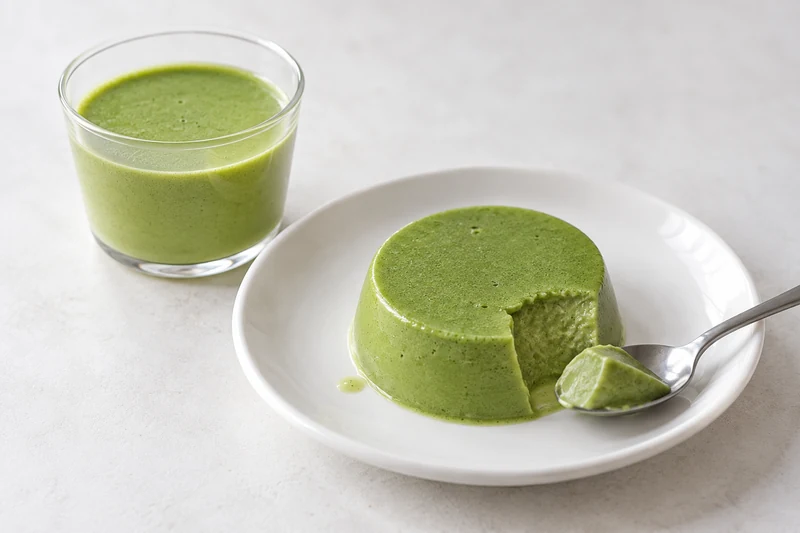
Validate the exact gelatin grade, form and supplier because sheet counts cannot be converted reliably without bloom strength and mass. Benchmarks include 2 1/4 tsp powder, three sheets, 6 g sheets or 2 tsp powder, and 3–4 tsp granulated gelatin.
Run an A/B gel trial around the intended service format. Choose the minimum setting system that survives handling. Avoid copying “three sheets” without a supplier specification, because different sheets can create release failures or a rubbery bite.
The pastry sourcing guide adds ingredient-selection context.
Key Takeaway: Specify gelatin by supplier, form, mass and strength, then validate it.
How can matcha be dispersed without clumps or settling?
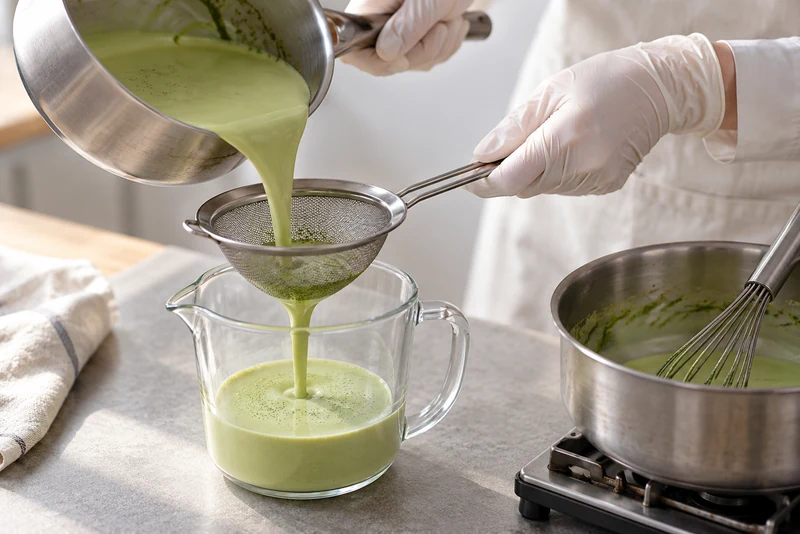
Pre-disperse sifted matcha into a small controlled portion of liquid before blending it through the dairy base. The slurry must be smooth enough to prevent dry pockets and uniform enough to limit a dark sediment band.
Record slurry liquid, temperature, mixing tool, energy, time and delay before fill. Examine the top, middle and bottom of a set cup. AdoroHu’s ultrasonic screening supports discussion of fine powder consistency, but it does not eliminate the manufacturer’s dispersion trial.
Key Takeaway: Approve dispersion by a cut cup, not by the kettle surface.
What heat limits protect dairy texture and matcha quality?
Heat the matcha panna cotta base enough to dissolve the setting system and sugar, but avoid an unnecessary boil. The Pioneer Woman warms milk to about 160°F in its method; that is a publisher benchmark, not a universal process limit.
Measure the actual product temperature and residence time. Add matcha at a defined stage, then compare color and cooked flavor. Avoid prolonged high heat after matcha addition, because the consequence is duller color, stronger bitterness and a larger cooling load.
Key Takeaway: Use the shortest validated heat exposure that fully activates the system.
How long should matcha panna cotta set before release?
Published matcha panna cotta recipes commonly state at least four hours, with some recommending six hours or overnight. Snixy Kitchen gives at least four hours; Arbor Teas gives about six hours and says overnight is best.
Set-time approval should include the actual cup, fill temperature, refrigerator load and portion depth. Record the earliest clean release and the later eating texture. A fixed clock time without product temperature can mislead a busy production team.
| Panna cotta release check | Observe | Buyer consequence |
|---|---|---|
| Dispersion | Top, middle and bottom color | Sediment bands create visible lot inconsistency |
| Gel | Spoon cut, wobble, unmold edge | Too much gel gives a rubbery bite; too little breaks |
| Held cup | Syneresis, surface skin, topping bleed | Package and date-code decisions need actual evidence |
Key Takeaway: Validate set time under the intended portion and cooling load.
Which flavor pairings fit a matcha panna cotta SKU?
Use one pairing that sharpens the intended matcha profile. The references include candied kumquat and other fruit-led finishes; cream, vanilla and fruit acidity all change perceived bitterness and color contrast.
Run the plain control beside one topping at its real use weight. Check migration, color bleed and spoon balance after the intended hold. A garnish that looks bright at assembly may release moisture into the gel later.
Key Takeaway: Approve the topping on the held finished cup, not in isolation.
Which hold checks belong in a matcha panna cotta pilot?
Validate syneresis, settling, surface skin, aroma, color, gel fracture and package integrity across planned refrigerated checkpoints. Snixy Kitchen notes 24–36 hours and The Pioneer Woman notes about five days, but both are publisher observations, not commercial shelf-life proof.
Use the actual package and distribution temperatures. Avoid adopting a recipe note as a date code, because formulation, hygiene, cooling and filling controls differ. Establish safety and quality limits through the manufacturer’s qualified program.
Key Takeaway: Set shelf life from the commercial system’s evidence.
What belongs in a supplier-ready matcha panna cotta specification?
Record matcha grade and dose, dairy ratio, sweetener, gelatin identity, dispersion, heat, fill temperature, portion, set and release criteria. For U.S. packaged foods, 21 U.S.C. §343(w) requires declaration of nine major allergens under FALCPA as expanded by the FASTER Act: milk, egg, fish, Crustacean shellfish, tree nuts, peanuts, wheat, soybeans and sesame. Apply the FDA major food allergen guidance to the actual base and toppings.
Include demand, certifications and target color under controlled light. AdoroHu’s two Class-100,000 clean production workshops and in-house laboratories can support powder qualification, while finished-dessert safety and shelf life remain the manufacturer’s responsibility.
Key Takeaway: Separate powder documentation from finished-product validation.
FAQ
- Can panna cotta use powdered gelatin instead of sheets?
- Yes, but sheet counts and powder amounts are not interchangeable without strength and mass data from the gelatin supplier.
- Why does matcha settle in panna cotta?
- Slow gel development, poor dispersion, particle agglomerates and long fill delays can create a darker bottom layer.
- How long does matcha panna cotta need to set?
- Published recipes commonly state at least four hours, but portion size, fill temperature and refrigeration load must be validated.
- Can panna cotta be sold in its cup?
- Yes. In-cup sale supports a softer set and reduces unmolding damage during distribution.
- Does a home recipe prove commercial shelf life?
- No. The actual formula, hygiene, package, cooling and distribution system require validation.
- Which matcha grade should a buyer test?
- Compare culinary and premium grades in the finished chilled matrix and approve by color, flavor and cost.
Conclusion
Decide cup or unmolded service before setting gelatin strength, then approve dispersion through the top, middle and bottom of the portion. Validate held texture in the actual package rather than borrowing a recipe storage note. Contact AdoroHu Matcha with the dairy or plant base, gelatin specification, color target and forecast demand.