
A matcha ice cream sandwich succeeds commercially when the frozen filling, carrier, portion and service temperature are designed as one product. A crisp cookie that becomes tooth-hard or a soft cake that absorbs melt can turn a promising concept into breakage, messy eating and wasted inventory. Start with a controlled carrier-and-filling pilot, using the matcha baking application to frame ingredient selection, then approve the assembled product at the temperature customers will actually eat it.
A workable matcha ice cream sandwich balances a firm filling with a carrier that yields on the first bite. Teams should lock portion geometry, assembly temperature, wrapping and service tempering before they discuss scale.
In short:
Key points:
- Choose the carrier by frozen bite and channel, not appearance alone.
- Run matcha dose and sweetness as controlled trials in one fixed base.
- Approve the wrapped, tempered sandwich after realistic frozen holding.
Which matcha ice cream sandwich format fits the sales channel?
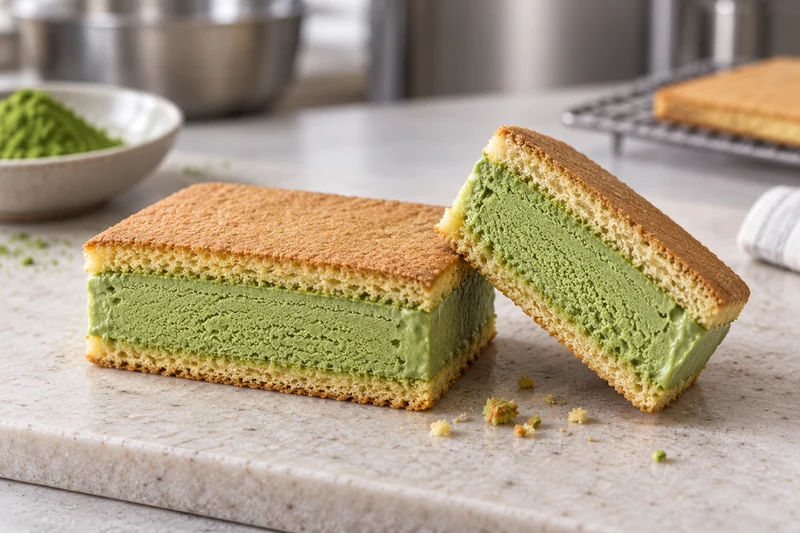
Choose cake slabs for a softer frozen bite, cookie rounds for familiar handling, or waffles and macarons only when their breakage risk fits the channel. Constellation Inspiration reports six strawberry-matcha sandwiches, while Sift & Simmer uses a cake-slab format with 1.5 quarts/3 pints of ice cream. Those formats solve different service problems.
Map hand-held impulse sales, plated desserts and shipped multipacks separately. Record carrier thickness, filling thickness, edge exposure and target eating temperature. Here is the practical choice: avoid a decorative brittle carrier for a product eaten straight from a hard freezer, because fracture and filling squeeze-out raise complaints and scrap.
Key Takeaway: Select the format by frozen bite, handling and pack geometry.
How much matcha should the first sandwich pilot use?
For a matcha sandwich pilot, treat published doses as starting benchmarks, not a universal formula. Constellation Inspiration uses 2 tbsp in a base containing 240 ml whole milk and 480 ml heavy cream. Sift & Simmer states 1 tbsp for its custard variation, while Ninja Baker uses 3 tbsp with 14 oz condensed milk and 2 cups heavy cream.
Keep base mass, fat, sugar and overrun fixed while testing dose. Score color, aroma, bitterness and aftertaste after freezing, because cold suppresses flavor perception. A buyer can then compare cost per finished unit without confusing matcha level with a different base.
| Published system | Original matcha and base benchmark | Pilot decision |
|---|---|---|
| Constellation Inspiration | 2 tbsp; 240 ml whole milk; 480 ml heavy cream | Custard dose and six-piece yield |
| Sift & Simmer | 1 tbsp custard variation; 1.5 quarts/3 pints ice cream | Cake-slab filling depth |
| Ninja Baker | 3 tbsp; 14 oz condensed milk; 2 cups heavy cream | No-churn sweetness and frozen bite |
Key Takeaway: Reproduce one complete benchmark, then change matcha dose alone.
Which matcha grade works best in frozen dairy?
A culinary or premium sample should be compared in the finished frozen matrix before buyers pay for a higher tier. The culinary matcha range provides the logical cost control, while premium matcha can be the sensory comparator.
AdoroHu identifies E-1/E-2 and O-1/O-2 as culinary tiers, with E-3/E-4 and O-3 as premium tiers. Use that structure to request controlled samples. Choose the lowest tier that meets frozen color and flavor targets; avoid defaulting to ceremonial matcha, because fat, sugar and low serving temperature can hide the premium you purchased.
The pastry sourcing guide adds carrier-specific sourcing context.
Key Takeaway: Approve grade by blind finished-product performance and unit economics.
How do fat, sugar and inclusions change matcha intensity?
In matcha ice cream, fat rounds bitterness, sugar changes freeze softness, and inclusions can either sharpen or bury the tea note. Strawberry, vanilla, sesame and tahini appear across the reference recipes, but each changes the sensory baseline.
Run an A/B trial: A keeps the matcha base plain; B adds one inclusion at a fixed rate. Hold carrier and portion constant. Record first-bite aroma, sweetness, melt, aftertaste and visible color. The consequence is clear: changing three variables together may produce a pleasant sample, yet the team will not know which ingredient caused it.
Key Takeaway: Evaluate one inclusion at a time against a plain control.
Which carrier gives a matcha ice cream sandwich a clean frozen bite?
A thin chiffon or cake carrier normally yields more easily than a thick, low-moisture cookie at freezer temperature. Sift & Simmer explicitly favors cake because frozen cookies can become hard; My Three Seasons provides the counterpoint with sesame-tahini cookies baked at 350°F for 12–14 minutes.
Test carriers after the full frozen hold, then temper them for the intended service interval. Measure fracture, tooth resistance, filling squeeze-out and crumb loss. Avoid approving a carrier only at room temperature, because it says little about the sold product and can hide a painful first bite.
The commercial matcha dessert guide helps compare adjacent frozen formats without replacing sandwich testing.
Key Takeaway: Judge the carrier around the target frozen service temperature.
What process order protects matcha sandwich texture during assembly?
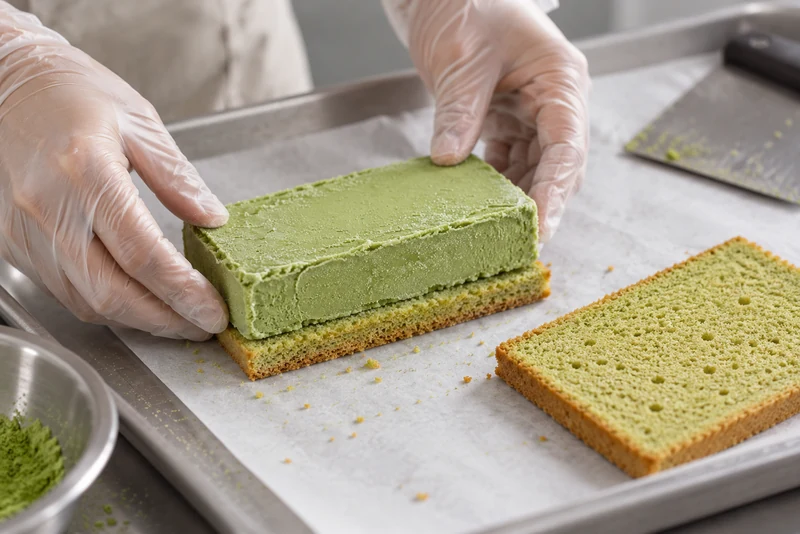
Chill the base, freeze the filling to a cuttable state, cool carriers fully, assemble quickly and refreeze before wrapping. Constellation Inspiration chills its base at least four hours, preferably overnight; My Three Seasons gives 4–6 hours or up to 24 hours.
Define maximum bench time for each tray and return partial trays to cold storage when the limit is reached. Keep cut filling and carriers dimensionally matched. This sequence limits surface melt, crooked stacks and refrozen ice at the seam, which otherwise reduces visual yield.
Key Takeaway: Build assembly around cold components and a measured bench-time limit.
Which temperatures and hold times belong in a matcha sandwich pilot?
Record every thermal step that can change the carrier or filling. Sift & Simmer bakes a 13-by-18-inch cake sheet for 8–10 minutes at a published 375°F, while the sesame-tahini cookie benchmark uses 350°F for 12–14 minutes.
Log base chill, churn or set, slab freeze, assembly, refreeze and service temper. Missed cold time becomes soft cutting, smear and variable portions, so validate each step on the actual equipment.
| Sandwich control | Record at release | Reject when |
|---|---|---|
| Carrier and filling | Thickness, total weight, first-bite resistance | Carrier fractures or filling squeezes out |
| Assembly | Bench time, seam condition, refreeze time | Surface melt creates an icy seam |
| Wrapped hold | Frost, aroma, edge drying, temper window | Package or texture misses the channel target |
Key Takeaway: Bind every result to the exact pan, oven, freezer and elapsed time.
How should matcha sandwich portion size and yield be standardized?
Standardize cut dimensions and filling thickness before calculating yield. Published outcomes range from five to six sandwiches at My Three Seasons to six at Constellation Inspiration, but their shapes and formulas differ.
Create a portion board with target length, width, total weight and tolerance. Weigh carrier pairs and filling separately so drift has a known source. A few grams of excess filling repeated across a large run changes both food cost and wrapper fit.
Key Takeaway: Calculate yield from measured geometry and weight, not the recipe headline.
How should finished matcha sandwiches be wrapped and held?
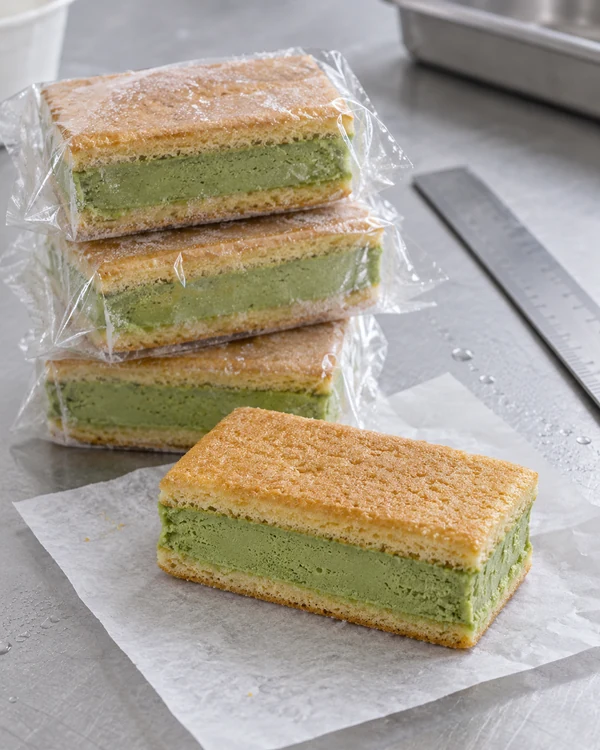
Wrap each sandwich once it is fully firm, using a barrier and seal that limit moisture loss and odor pickup. Sift & Simmer reports up to two months for its individually wrapped cake format; that is a publisher note, not a validated commercial shelf life.
Run hold checkpoints under the actual package and freezer conditions. Inspect frost, carrier softness, cracking, aroma and seal integrity. Avoid printing a shelf-life promise from a home recipe, because commercial validation must reflect your formulation, package and distribution cycle.
Key Takeaway: Validate the complete wrapped system before setting a commercial date.
What should a supplier-ready matcha sandwich specification record?
A supplier-ready brief should identify grade candidates, base composition, dose range, carrier, portion, process, packaging and acceptance tests. For U.S. packaged foods, 21 U.S.C. §343(w) requires declaration of nine major allergens under FALCPA as expanded by the FASTER Act: milk, egg, fish, Crustacean shellfish, tree nuts, peanuts, wheat, soybeans and sesame. Apply the FDA major food allergen guidance only to allergens present in the finished formula.
Include target color, flavor, frozen bite and temper window, plus projected powder demand. AdoroHu operates 20 stone mills, 56 ball mills and 8 continuous ball mills, which lets buyers discuss scale and milling route without implying finished-sandwich validation. The brand supplies matcha; the manufacturer owns the formula and controls.
Key Takeaway: Send a measurable brief that separates powder requirements from finished-product responsibility.
FAQ
- Can a matcha ice cream sandwich use cake instead of cookies?
- Yes. Cake slabs can provide a softer bite from frozen, while cookies offer familiar handling but require frozen-texture testing.
- How much matcha belongs in the ice cream?
- Published recipes use different doses and batch sizes, so reproduce one complete benchmark before changing matcha level.
- Should the product use culinary or ceremonial matcha?
- Start with culinary and premium samples in the finished frozen base; choose the lowest tier that meets the approved sensory target.
- Why does the carrier become too hard?
- Low moisture, thickness and freezer temperature can make cookies difficult to bite, so test the assembled product at service temperature.
- Can a recipe storage note become the commercial shelf life?
- No. Commercial shelf life requires validation of the actual formula, package, freezer and distribution conditions.
- What should buyers send to a matcha supplier?
- Send the base, dose range, target color and flavor, certifications, projected volume and pilot schedule.
Conclusion
Freeze the assembled sandwich before judging whether the carrier, filling and wrapper work together. Record the target eating temperature and acceptable temper window so production and service use the same standard. For powder samples, contact AdoroHu Matcha with the dairy base, carrier, certification needs and projected demand.