
Matcha cream puffs depend on three linked controls: a cooked panade that accepts the right amount of egg, enough steam expansion and oven drying to create a hollow shell, and a chilled matcha filling added near service. Our professional matcha pastry sourcing guide covers the broader ingredient context.
Published recipes offer useful benchmarks, but their yields, dimensions, and bake profiles differ. Keep each source’s exact facts connected rather than constructing a formula from unrelated parts.
Matcha cream puffs require a cooked choux panade, controlled egg addition, steam expansion, a dry hollow shell, and chilled filling added near service. Puff pastry and croissant lamination are outside this product boundary.
In short:
Key points:
- Control panade moisture and egg endpoint before judging oven rise.
- Dry and vent the shell before chilled matcha filling is added.
- Validate filling migration, cooling, and service timing in the actual product.
What defines a matcha cream puff?
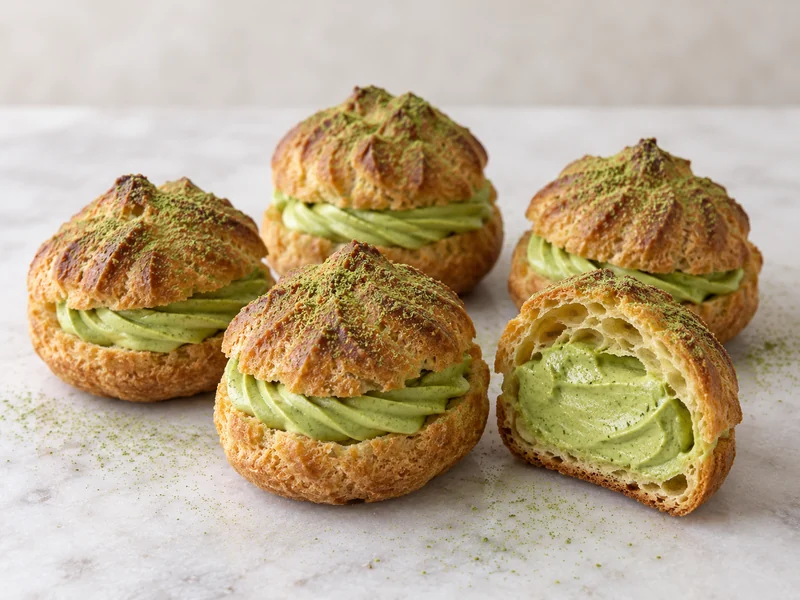
A cream puff is a hollow choux shell with a separate filling. Set shell diameter, cavity, wall thickness, filling weight, surface finish, and service texture. Puff pastry and croissant dough use different expansion systems and are not substitutes for choux.
Key Takeaway: Keep the product to a hollow steam-expanded choux shell with separate filling.
Which published formula should anchor the first trial?
| Benchmark | Exact source facts | Declared yield/time |
|---|---|---|
| A: Teak & Thyme | Choux: 60 g butter, 60 g water, 60 g milk, 70 g flour, 125 g whole eggs; filling includes 1 tablespoon culinary matcha | 8 puffs; 2 hr 5 min total |
| B: Catherine Desserts | Choux: 50 g milk, 50 g water, 45 g butter, 55 g flour, 100 g beaten egg; filling includes 1 tbsp matcha and 200 g milk | 12; 1 hour total |
| C: Little Epicurean | Choux: 1 cup milk, 1/2 cup butter, 1 cup flour, 3 eggs plus 1 white; filling uses 2 teaspoons (5 g) matcha | 20 pieces; 1 hr 25 min total |
These are external benchmarks, not AdoroHu-tested formulas. Use a complete formula as the control before adapting it.
Key Takeaway: Use one complete source formula before adapting choux or filling.
Where should matcha go: shell, craquelin, or filling?
The captured leading recipes place matcha in pastry cream or diplomat cream, protecting its aroma from the shell bake. A matcha craquelin is another visual route, but it adds a baked variable.
Route A is matcha pastry cream: keep plain choux, deposit size, bake, and filling weight fixed, then score tea clarity, custard texture, and chilled color. Route B is matcha diplomat cream: use the same pastry-cream base with a fixed whipped-cream fold, then score lightness, piping definition, and shell-softening rate.
Choose one main location first. Matcha in shell, craquelin, and filling at once removes a useful control.
Key Takeaway: Choose one primary matcha location so aroma and process effects remain diagnosable.
How dry should the panade be before egg addition?
Teak & Thyme stirs the dough around the pot for about 4 minutes, then cools it 5–10 minutes. Catherine Desserts listens for crackling and looks for a thin film, then beats out steam and cools 10 minutes. These are two source-bound endpoints.
| A/B panade check | Exact anchor | Record for scale-up |
|---|---|---|
| A: timed cook | About 4 minutes stirring and spreading | Start/end pan weight, vessel, heat, appearance |
| B: sensory endpoint | Crackling plus thin film on pan | Start/end pan weight, vessel, heat, endpoint photo |
Pan weight adds an objective check because cookware changes how a film appears. Do not force a preset egg amount into an unusually wet or dry panade.
Key Takeaway: Bind the panade endpoint to time or sensory cues plus start-and-end weight.
How should the egg endpoint be judged?
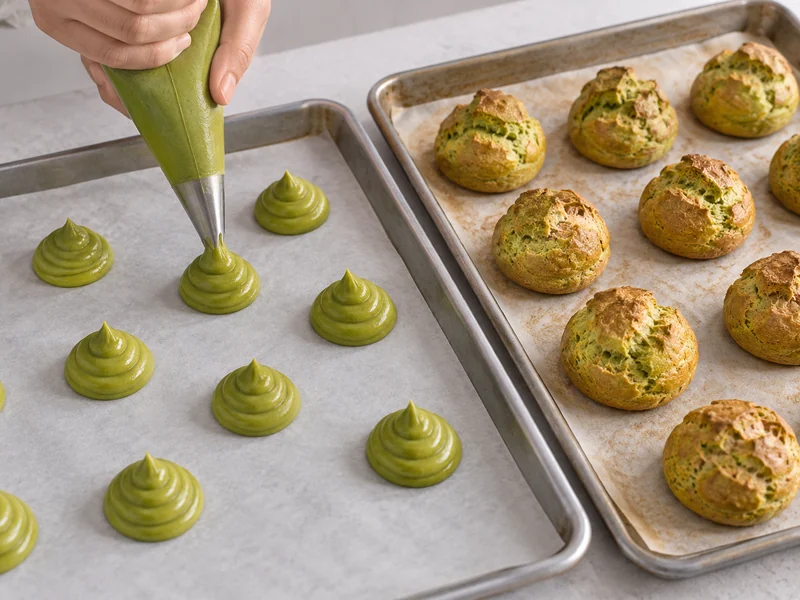
Teak & Thyme adds egg 1/3 at a time after cooling. Catherine Desserts adds beaten egg slowly until the paste is smooth, holds structure, and forms a “V” or “beak” from the spatula. Use the source amount as a ceiling or benchmark while the pipeable endpoint remains the release decision.
Record egg weight actually used, paste temperature, flow from the paddle, and test deposit spread. Excess egg can produce flat weak shells; too little can restrict expansion.
Key Takeaway: Add egg gradually and stop at the pipeable paste endpoint.
How do craquelin dimensions and deposit size interact?
| Benchmark | Craquelin | Choux deposit |
|---|---|---|
| A: Teak & Thyme | Rolled about 1/8 inch, frozen at least 1 hour, cut with 2-inch cutter | 2-inch scoop, 3 inches apart |
| B: Catherine Desserts | Rolled 4 mm, frozen, cut into 4 cm discs | 3.5 cm rounds |
Keep disc thickness, disc diameter, deposit weight, and spacing consistent. Oversized or uneven discs can cap the shell and distort expansion.
Key Takeaway: Match disc dimensions to a standardized choux deposit.
Which two-stage bake profile should be tested?
| Benchmark | First stage | Drying stage | Steam release |
|---|---|---|---|
| A: Teak & Thyme | 400°F for 5 minutes | 350°F for 25–30 minutes | Poke with chopstick in last few minutes |
| B: Catherine Desserts | Preheat 230°C | Reduce to 160°C; bake 25 minutes | Hole in bottom after baking |
| C: Little Epicurean | 375°F for 20 minutes | 325°F for 20–30 minutes | Bake until puffs feel light |
Do not open early. Record oven recovery, tray position, color, height, cavity, wall moisture, cooled weight, and collapse after venting. Height alone does not prove a dry structure.
Key Takeaway: Protect steam expansion first, then dry and vent the shell without opening early.
How should matcha pastry cream be cooled and finished?
Teak & Thyme cooks pastry cream about 8–10 minutes until a spatula trail closes after 1–2 seconds. Little Epicurean tempers 3 tablespoons hot milk with matcha to make a concentrate, then cools pastry cream on a plastic-lined half-sheet pan, using 10–15 minutes in the freezer to reach room temperature.
Those methods create an A/B dispersion trial: dry matcha incorporated into the custard system versus a hot-milk concentrate. Hold matcha dose and custard formula fixed, then compare specks, thickening, flavor, and chilled color. Apply the operation’s food-safety plan for cooling and chilled holding.
Key Takeaway: Compare dispersion routes while applying the validated cooling plan.
When should shells be filled?
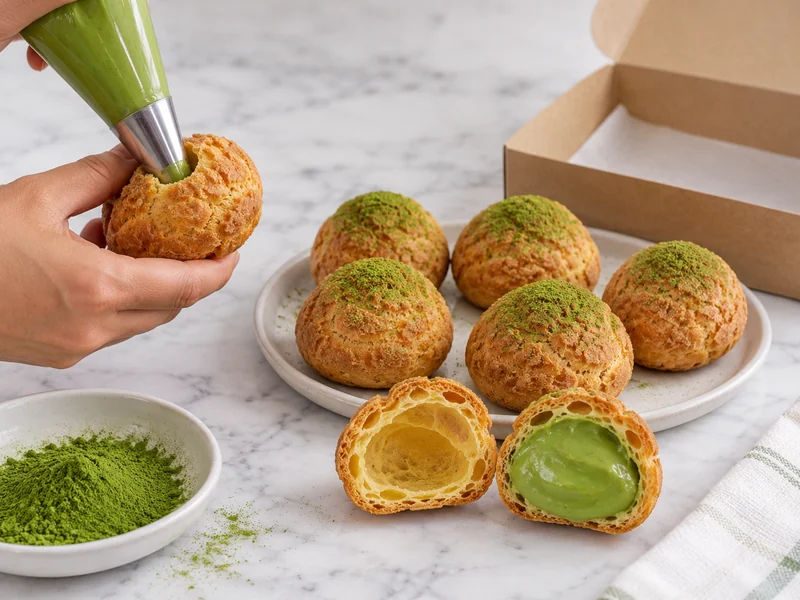
Teak & Thyme fills cooled shells about 4/5 full and advises serving immediately or within an hour. Catherine Desserts states airtight refrigerated storage and consumption within 2 days of filling. Those statements describe different source products and are not transferable shelf-life proof.
Test empty-shell holding separately from filled holding. At the planned service interval, score shell crispness, filling migration, leakage, and portion weight. Shorten fill lead time or add a validated barrier if the shell softens too soon.
Key Takeaway: Fill dry cooled shells as close to service as the validated process allows.
How should matcha be selected for chilled dairy?
Dairy and sugar can mute tea, while cold service reduces aroma. Compare the AdoroHu culinary matcha range at a fixed dose in the finished filling. Use the matcha for baking application page to structure the trial. Approve dispersion, flavor, chilled color, documentation, and cost per saleable puff.
Key Takeaway: Approve powder in the chilled filling and assembled puff.
What must be recorded before scale-up?
Record panade start and end weight, cook endpoint, cooling time, egg used, paste temperature, deposit and craquelin dimensions, oven profile, venting, cooled shell weight, cavity defects, filling temperature and weight, fill time, yield, and rejects. Published yields of 8, 12, and 20 pieces are only denominators for their own formats.
Key Takeaway: Scale from panade, egg, deposit, bake, cavity, filling, yield, and defect records.
Where does supplier support stop?
AdoroHu supplies matcha powder, not cream puffs. The bakery owns formula, allergen controls, sanitation, cooling, labeling, service, and shelf-life validation. Use the commercial matcha dessert guide for adjacent menu work, then contact AdoroHu Matcha with the filling matrix, market, volume, and documentation needs.
Key Takeaway: The powder supplier supports ingredient selection; the bakery validates the filled choux product.
Use the bakery’s validated egg, dairy, allergen, cooling, and sanitation controls; the FDA safe food-handling guidance is an official public baseline, not a cream-puff hold-time rule.
FAQ
- Are matcha cream puffs made with puff pastry?
- No. Classic cream puffs use choux, whose cooked panade expands through steam and then dries into a hollow shell.
- Why did cream puff shells collapse?
- The walls may not have dried enough, the oven may have been opened early, or excess egg may have weakened the paste. Record each endpoint separately.
- How can matcha pastry cream avoid clumps?
- One captured method mixes matcha with 3 tablespoons hot milk into a concentrate before it enters the pastry cream. Compare dispersion in the chilled filling.
- When should matcha cream puffs be filled?
- Fill cooled, dry shells as close to service as operations allow. One source recommends immediate service or within an hour after assembly.
- Can filled cream puffs be made two days ahead?
- One source states consumption within 2 days refrigerated, but that is not proof for another formula. Validate safety and texture for the actual product.
- Does AdoroHu manufacture finished cream puffs?
- No. AdoroHu supplies matcha powder; the bakery develops and validates the finished food.
Conclusion
Consistent matcha cream puffs come from controlling panade moisture, egg endpoint, steam expansion, shell drying, and chilled filling as one system. Exact source benchmarks make trials traceable; the bakery’s measured yield and service window make them commercial.