
Matcha roll cake needs a thin egg-foam sheet that bends around filling without cracking, compressing, or smearing the spiral. That makes sheet geometry, foam endpoint, bake loss, roll temperature, and filling rheology more important than a general cake formula. Buyers can use the matcha pastry sourcing guide to frame the powder comparison.
Develop matcha roll cake as a sheet-and-filling interface. Keep tray size, batter depth, bake profile, cooling, and filling weight fixed while comparing matcha, then inspect a chilled cross-section for cracks, compression, and spiral definition.
In short:
Key points:
- Build enough egg foam for a light sheet without creating dry, weak cells.
- Treat pan size, sheet thickness, and bake time as one linked control.
- Match filling firmness to the sheet at the actual rolling and service temperatures.
What makes matcha roll cake different from general matcha cake?
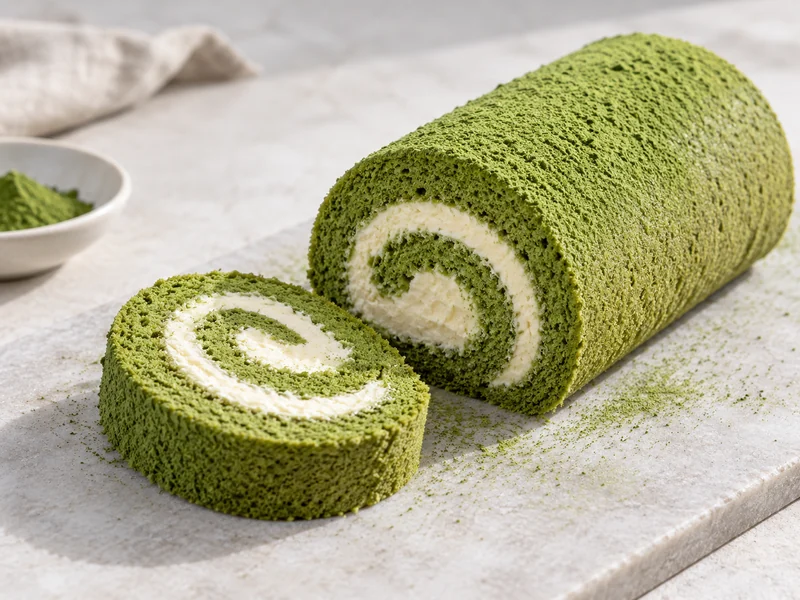
Matcha roll cake is engineered to bend. A layer cake can rely on vertical stacking and a tender crumb, while a roll sheet must survive peeling, filling, the first tight turn, and chilled slicing. Its useful quality measures are sheet thickness, edge dryness, minimum bend radius, skin peeling, spiral compression, and crack count.
Write the acceptance target around a complete chilled slice. A high sheet volume that collapses under cream is less useful than a slightly tighter sheet that rolls cleanly and holds a clear spiral.
Key Takeaway: Judge the sheet by rolling and slicing performance, not by height in the tray.
What matcha and yield benchmarks appear in ranked roll-cake recipes?
Teak & Thyme’s matcha roll cake states 2 tablespoons matcha in the cake plus 1 teaspoon in another component and declares 8 servings. RecipeTin Japan states 10 g / 0.4 oz (2 tbsp) matcha and a yield of 8. Just One Cookbook states 2 Tbsp matcha, identified as 6 g per tablespoon, and one 10-inch (25 cm) Swiss roll.
| Published benchmark | Matcha stated by source | Declared yield | Cake bake time |
|---|---|---|---|
| Teak & Thyme | 2 tablespoons in sheet | 8 servings | 12–15 min |
| RecipeTin Japan | 10 g / 0.4 oz (2 tbsp) | 8 | 16 min |
| Just One Cookbook | 2 Tbsp; source states 6 g each | One 10-inch roll | 12 min |
Keep these formulas separate. The tablespoon-to-gram relationship differs across sources, so merging values would create a false precision.
Key Takeaway: Compare complete source formulas in their original units before creating an internal standard.
How should tray size and sheet thickness be controlled?
Tray area determines batter depth and therefore bake time and flexibility. RecipeTin Japan uses a 28 cm × 28 cm / 11-inch × 11-inch tray. Just One Cookbook uses a 15 × 10-inch (38 × 25-cm) jelly-roll pan. Those pans do not produce equivalent sheets from the same batter mass.
| Tray benchmark | Shape and dimensions | Production implication |
|---|---|---|
| RecipeTin Japan | Square, 28 × 28 cm / 11 × 11 in | Even square sheet; 16-minute source bake |
| Just One Cookbook | Rectangle, 15 × 10 in / 38 × 25 cm | Longer roll axis; 12-minute source bake |
| Plant trial | Current line tray | Set target batter mass and measured depth |
Weigh batter into the tray and measure sheet thickness at the center and corners after cooling. Avoid transferring a bake time to a different area without checking set and flexibility.
Key Takeaway: Bind every bake result to tray area, batter mass, and finished sheet thickness.
Which egg-foam method supports a flexible matcha sheet?
Ranked recipes use separated-egg systems. Teak & Thyme folds about one-third of the meringue into the yolk mixture first, then combines the remainder. RecipeTin Japan adds sugar to developing egg whites in thirds and gives short beating intervals. Just One Cookbook separates four large eggs, keeping whites refrigerated and yolks at room temperature.
Choose one method and record egg weight, temperature, mixer load, peak behavior, and fold sequence. A coarse, dry meringue leaves white flecks and weak interfaces; an underdeveloped foam produces a dense sheet. Avoid adding more baking powder to compensate for poor foam because it will not repair fold damage.
Key Takeaway: Define the foam by observable peak and folding behavior, with mixer time as supporting data.
How should matcha enter roll-cake batter?
Sift matcha with the cake flour and any baking powder before it reaches the foam. Just One Cookbook sifts ¾ cup cake flour, ½ teaspoon baking powder, and 2 Tbsp matcha together. This creates a source-backed dry-blend benchmark without requiring a separate slurry that would change liquid balance.
Fold until the bowl bottom shows no dense green streaks, then stop. Spread promptly so the foam does not sit while operators level the tray. Check several slices across the roll; a single center photograph can miss under-mixed corners.
Key Takeaway: A sifted dry blend and complete bottom scrape protect dispersion with minimal foam loss.
Which bake and cooling profiles preserve rollability?
Teak & Thyme bakes at 350°F for 12–15 minutes and cools about 5 minutes before releasing the sheet. RecipeTin Japan bakes at 170°C / 338°F fan-forced for 16 minutes. Just One Cookbook preheats to 375°F (190°C), notes a 25°F (15°C) convection reduction, and bakes for 12 minutes.
| Source | Oven condition | Stated sheet time | Early handling cue |
|---|---|---|---|
| Teak & Thyme | 350°F | 12–15 min | Release after about 5 min |
| RecipeTin Japan | 170°C / 338°F fan | 16 min | Transfer with baking paper |
| Just One Cookbook | 375°F / 190°C | 12 min | Prepare parchment work surface |
Test a narrow time ladder in the actual oven. Record sheet weight before and after baking, edge color, skin condition, and crack count during a standard bend test.
Key Takeaway: Choose the earliest fully set endpoint that survives release and rolling.
Should a production roll cake be pre-rolled while warm?
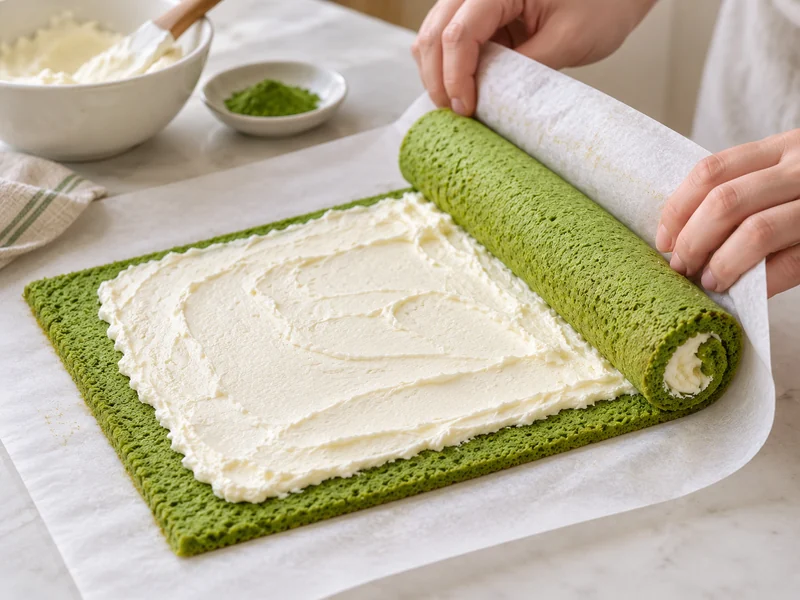
Warm pre-rolling can establish curvature before filling, but it adds a handling step and can trap steam. A cool-roll process needs a sheet formula that stays flexible without that memory. Either can work, but they should not be mixed casually during a matcha comparison.
Run both methods with the same sheet and document cooling time, roll diameter, liner, unrolling damage, and labor. Choose the method with fewer cracks and a manageable service rhythm. Avoid an unvalidated cloth-towel step in commercial production because lint, laundering, and sanitation need explicit control.
Key Takeaway: Select warm pre-roll or cool roll through a controlled crack-and-labor comparison.
How should the filling interface be designed?
The filling must spread without tearing the sheet and hold a spiral after chilling. Set a filling weight per sheet, spread depth, clean closing margin, and roll temperature. Matcha may be concentrated in the sheet or filling, but using a high amount in both can make bitterness harder to diagnose.
Choose one filling system, such as stabilized cream, red-bean cream, or ganache, based on service temperature and cut quality. Avoid a filling that is very firm when cold; it can shear the cake during slicing even if the initial roll looks clean.
Key Takeaway: Match filling firmness to both rolling temperature and chilled slice temperature.
Which matcha grade should buyers test in roll cake?
AdoroHu E-1/E-2 and O-1/O-2 are culinary-tier codes that can organize sample requests. The culinary matcha product page is the product link, while matcha for baking gives the application context.
Compare samples in the same sheet and filling. Score dry dispersion, baked color, cream interaction, chilled tea finish, and documentation. A powder that looks bright in the sheet may taste weak once the filling and cold service mute its aroma.
Key Takeaway: Approve matcha in a chilled filled slice, not in an unfilled warm sheet.
How should roll-cake yield and slicing be costed?
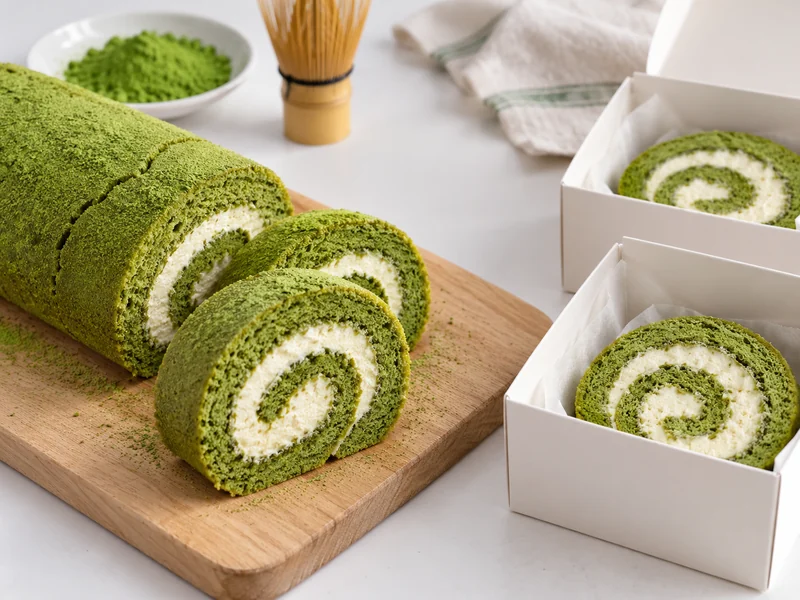
Declared servings of 8 are useful planning references, but slice thickness and trim decide actual saleable yield. Chill to a defined core condition, square the ends under a written trim rule, and use the same knife cleaning routine. Record whole-roll weight, trim, slice count, smear defects, and spiral breakage.
Validate refrigerated holding in the actual filling and package. The commercial matcha cake guide offers adjacent cake context, but it does not establish a roll-cake hold time.
For egg, dairy, allergen, and sanitation controls, use the bakery’s validated plan and local requirements; the FDA safe food-handling guidance is an official public baseline, not a roll-cake hold-time rule.
Key Takeaway: Cost accepted chilled slices after trim, not the source recipe’s serving count.
FAQ
- Why does matcha roll cake crack?
- Common causes include an overbaked edge, dry foam, uneven sheet thickness, a delayed roll, or filling that is too firm.
- What pan is used for matcha roll cake?
- Published examples include a 28 × 28-cm square tray and a 15 × 10-inch jelly-roll pan; each needs its own batter mass and bake.
- Should matcha roll cake be rolled warm?
- Warm pre-rolling is one method. Compare it with a validated cool-roll process using crack count, labor, and spiral quality.
- Can the filling contain matcha too?
- Yes, but choose a dominant matcha location first so bitterness and color can be diagnosed clearly.
- Does AdoroHu manufacture finished roll cakes?
- No. AdoroHu Matcha supplies matcha powder; the bakery owns sheet, filling, safety, and shelf-life validation.
- How should slices be costed?
- Use the accepted chilled slice count after end trim, smears, cracks, and other saleability losses.
Conclusion
A repeatable matcha roll cake links foam, tray area, sheet thickness, bake loss, filling, and chilled slicing. Contact AdoroHu Matcha with the sheet formula, filling type, target certifications, and projected volume when requesting samples.