
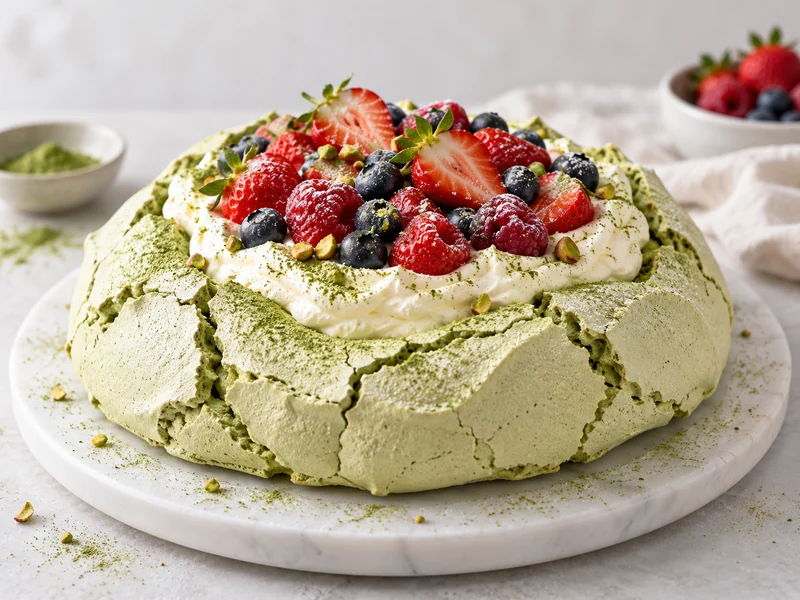
Matcha pavlova is a large meringue dessert with a crisp exterior, soft center, and cream and fruit added near service. It should not be judged by the fully dry snap expected from a small meringue cookie. Our professional matcha pastry sourcing guide explains the wider ingredient context.
Published recipes are useful starting points, but they are not interchangeable formulas. The comparisons below preserve each source’s units, sizes, times, and yields so a bakery can run traceable trials without inventing conversions.
Matcha pavlova is a large shell with a crisp exterior and deliberately soft center. Keep the shell dry until cream-and-fruit assembly, then validate the short service window under the actual humidity and topping load.
In short:
Key points:
- Keep the pavlova large, soft-centered, and distinct from fully dried meringue cookies.
- Compare coherent published shell or cream routes without mixing their assumptions.
- Measure breakage and dressed service quality before setting yield or timing.
What makes matcha pavlova different from matcha meringue?
A pavlova is designed around contrast: a large shell must carry toppings while retaining a softer center. A meringue cookie is small and normally dried through. Write a target for diameter, portion count, shell thickness, center texture, topping weight, and assembly-to-service time before mixing.
Key Takeaway: Protect the soft-center target and dressed-dessert service role.
Which published formula is the better first benchmark?
| Benchmark | Exact source facts | Trial question |
|---|---|---|
| A: Host the Toast | 8 large egg whites; 2 1/4 cups sugar; 3 tablespoons cornstarch; 1 1/2 tablespoons matcha; 10–12 servings | Can a matcha-bearing wreath shell deliver the target color and soft center? |
| B: The Little Epicurean | 6 large egg whites; 1 1/2 cups sugar; 2 1/2 teaspoon cornstarch; matcha appears as 1 teaspoon in coconut cream; 9-inch circle | Does matcha cream give a fresher tea note and cleaner shell control? |
These are external recipe benchmarks, not AdoroHu-tested formulas. Do not combine one source’s dose with the other’s process and call the result validated.
Key Takeaway: Run one complete source system before adapting dose, shape, or process.
Should matcha go in the shell or the cream?
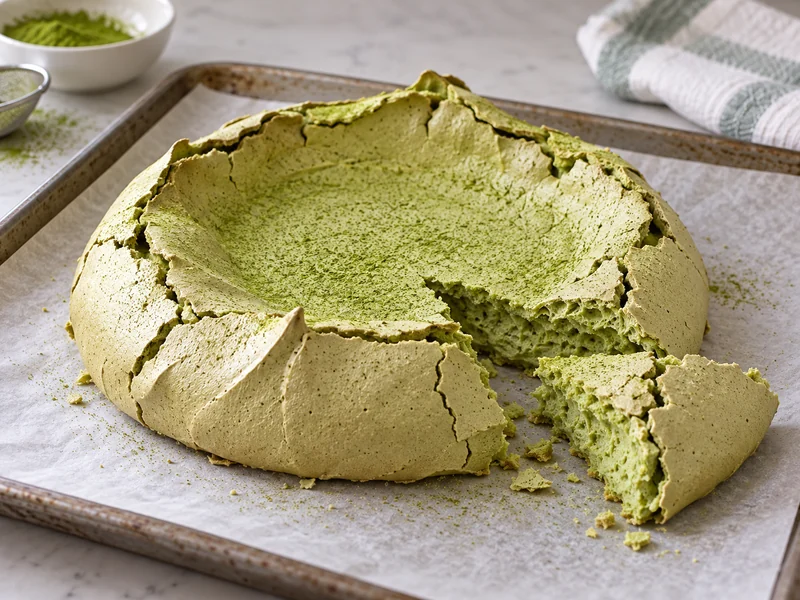
Shell placement creates integrated color but exposes matcha to the full bake. Cream placement avoids that heat and lets the team evaluate a plain shell separately.
| A/B route | Exact published anchor | Hold fixed | Compare |
|---|---|---|---|
| A: matcha shell | Host the Toast: 1 1/2 tablespoons matcha; topping uses 2 cups heavy cream and 1/4 cup powdered sugar | Wreath size, bake, cooling, topping weight | Color, bitterness, cracks, center softness |
| B: matcha cream | The Little Epicurean: 1 teaspoon matcha with 14 oz coconut cream and 1/3 cup powdered sugar | 9-inch shell, bake, cooling, topping weight | Tea aroma, cream stability, fruit contrast |
Choose one route first. A high matcha dose in both parts removes the clean control.
Key Takeaway: Choose one primary matcha location so heat exposure and flavor remain diagnosable.
How should sugar, acid, and starch be controlled?
Host the Toast uses 1 tablespoon lemon juice and 3 tablespoons cornstarch with 8 whites. The Little Epicurean uses 1/8 teaspoon cream of tartar, 1 teaspoon lemon juice, and 2 1/2 teaspoon cornstarch with 6 whites. Keep each system intact during the first comparison.
Add sugar gradually and record the foam endpoint. Avoid changing acid, starch, matcha dose, and oven settings together; a one-variable record makes weeping, spreading, or cracking easier to diagnose.
Key Takeaway: Keep each source stability system intact during the first comparison.
What shape and oven profile should be tested?
| Process point | A: Host the Toast | B: The Little Epicurean |
|---|---|---|
| Shape | Circle traced from a bowl, formed as a wreath | 9-inch circle on parchment |
| Start | Preheat 400°F, reduce to 200°F when loaded | Preheat and bake at 250°F |
| Bake | 1 hour 30 minutes | 90 minutes, undisturbed |
| Oven cooling | At least 2 hours in switched-off oven | 1 hour in switched-off oven |
Run either profile as a complete benchmark. Record verified oven temperature, deposit weight, dimensions, cooled weight, cracks, and center texture. A wreath and solid disc do not shed moisture identically.
Key Takeaway: Bind bake and cooling results to exact shell geometry.
How late should cream and fruit be added?
Host the Toast advises decorating no more than a couple of hours ahead because the pavlova softens. The Little Epicurean chills canned coconut cream at least 6 hours and says overnight or longer is best; its nectarines are tossed with 2 tablespoons brown sugar and 1 teaspoon lemon juice, adding free moisture.
| Service test | Assembly timing | Score |
|---|---|---|
| A | Immediately before tasting | Crispness, slicing, fruit adhesion |
| B | Planned service lead time | Tack, liquid migration, center compression |
| C | Components held separately for the same time | Whether shell or topping caused the change |
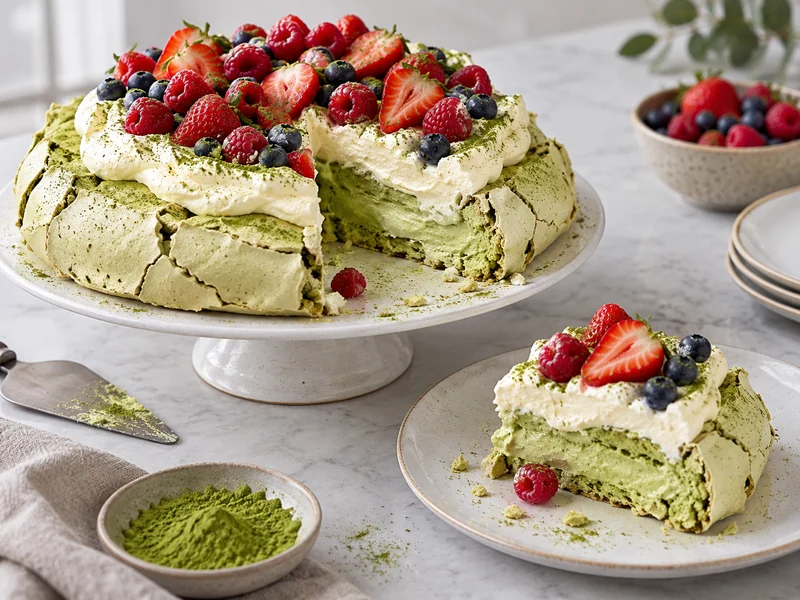
Drain fruit and standardize topping weight. A naked-shell hold does not establish a dressed pavlova’s service life.
Key Takeaway: Validate the dressed assembly-to-service interval, not an empty shell alone.
How can a bakery control humidity and breakage?
Cool fully before enclosing the shell, then use a dry moisture-resistant container that prevents contact damage. Record room humidity and breakage at transfer, storage, assembly, and portioning. Usable yield means saleable portions after those losses.
Key Takeaway: Count saleable portions after storage, transfer, assembly, and cutting losses.
How should matcha be selected for this matrix?
Judge matcha with the sugar, fat, and fruit. Screen samples from the AdoroHu culinary matcha range at fixed dose and lighting. Use the matcha for baking page for the broader trial workflow. Approve flavor, color, dispersion, documentation, and cost against finished yield.
Key Takeaway: Approve powder in the complete sugar, cream, and fruit matrix.
What should the scale-up record contain?
Record ingredient lots, source formula, mixer, foam endpoint, deposit weight, dimensions, oven setpoint and verified temperature, cooling protocol, cooled weight, topping weights, assembly time, and defects. The source-declared 10–12 servings is a planning denominator, not a guaranteed commercial yield.
Key Takeaway: Scale from traceable ingredient, foam, geometry, oven, topping, and defect records.
Where does supplier support stop?
AdoroHu supplies matcha powder, not finished pavlova. The bakery owns formulation, allergens, sanitation, labeling, food safety, package choice, and shelf-life claims. The commercial matcha dessert guide maps adjacent menu work; contact AdoroHu Matcha with the matrix, volume, market, and documentation needs.
Key Takeaway: The powder supplier supports ingredient selection; the bakery validates the finished dessert.
Use the bakery’s validated egg, dairy, allergen, and sanitation controls; the FDA safe food-handling guidance is an official public baseline, not a pavlova shelf-life rule.
FAQ
- What is the difference between matcha pavlova and matcha meringue?
- Pavlova is a large shell designed for a crisp exterior, softer center, and cream-and-fruit assembly. Meringue cookies are smaller and usually dried through.
- Can matcha go in pavlova cream instead of the shell?
- Yes. One captured benchmark uses 1 teaspoon in coconut cream; another uses 1 1/2 tablespoons in the shell. Test them as separate systems.
- Why does pavlova soften after decorating?
- Cream and fruit transfer moisture to the sugar-rich shell. Standardize topping weight and validate the real assembly-to-service interval.
- What size should a matcha pavlova be?
- Published examples include a traced wreath and a 9-inch circle. Choose the intended portions, then validate that geometry’s bake.
- Can a published pavlova yield be used for costing?
- It is a planning benchmark. Final costing should use saleable portions measured after breakage and service losses.
- Does AdoroHu sell finished matcha pavlova?
- No. AdoroHu supplies matcha powder; the food business develops and validates the dessert.
Conclusion
Build matcha pavlova around its intended soft-center format, then compare coherent source benchmarks without mixing their assumptions. The decisive trial includes cream, fruit, assembly timing, and actual portion yield.