
Matcha croissant development should compare dough, filling, and post-bake placement before powder dose is optimized. Matcha in laminated dough can interact with mixing and layer formation, while filling or finish placement shifts the burden to dispersion, migration, or surface appearance. Begin with culinary matcha for croissant trials under one fixed lamination process.
Oven lift alone is a weak commercial endpoint. A croissant can rise and still spread, lose layer continuity, form a fine closed crumb, or become too firm during retail hold.
Choose matcha placement first, then control dough and fat temperature through every fold. Approve layer continuity, height and width expansion, pore structure, firmness, color, flavor, and the intended hold together.
In short: Matcha croissant approval connects powder placement with controlled lamination and finished-product structure.
Key points:
- Compare dough, filling, and post-bake placement before choosing dose.
- Record dough and fat temperature at every lamination stage.
- Keep whole-croissant texture analysis separate from laminating-fat mechanics.
Should matcha croissant flavor sit in dough, filling, or finish?
Run dough, filling, and post-bake matcha croissant cells before selecting placement. Dough placement tests whether the powder can survive mixing, lamination, proofing, and baking without unacceptable structure or color. Filling placement avoids direct lamination effects but introduces distribution and migration questions. A finish can preserve aroma but raises adhesion and serving-consistency issues.
Hold total matcha dose, dough formula, fat, folds, proof, bake, and sample age constant. Score tea aroma, bitterness, color, layer continuity, expansion, crumb, and hold texture. Choose the least complex placement that meets the brief so powder quality is not blamed for unnecessary lamination stress.
| Placement | Main process exposure | Key acceptance question |
|---|---|---|
| Dough | Mixing, folds, proof, bake | Does structure remain continuous and well lifted? |
| Filling | Deposition, bake, moisture migration | Does flavor remain even without damaging layers? |
| Post-bake finish | Surface adhesion and service | Is coverage repeatable through handling? |
Key Takeaway: Fix placement before dose so process damage and powder performance stay distinguishable.
What temperature window should a matcha croissant lamination trial control?
Record dough and fat temperature at every fold in a matcha croissant trial. A 2025 croissant lamination study tested laminating-fat mechanics at 10°C, 15°C, and 20°C because plasticity changes with application temperature.
Those temperatures are study conditions, not a universal production window. Set a working range for the chosen fat, dough, room, and equipment, then record temperature before lock-in, folds, resting, sheeting, and makeup. A powder comparison made outside that window cannot separate ingredient effects from brittle or overly soft fat.
Key Takeaway: Compare matcha lots only after the lamination temperature window is controlled and recorded.
How should matcha croissant layer continuity be inspected?
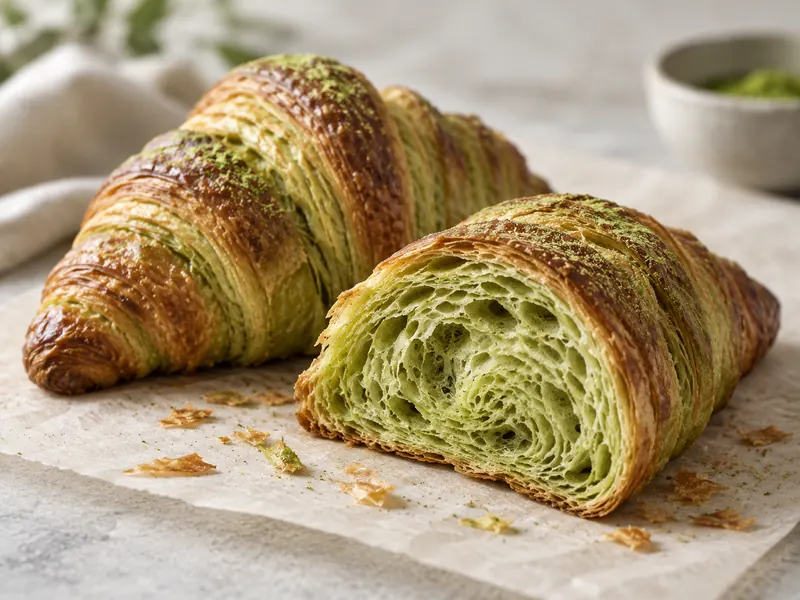
Inspect matcha croissant cross-sections for continuous alternating dough and fat layers. In the 2025 lamination study, butter and margarine controls produced continuous layers and honeycomb-like pores, while disrupted layers retained steam less effectively and reduced lift.
Photograph a fixed cut plane under consistent lighting and score breaks, merging, fat pockets, and continuity across a defined sample count. If useful, apply the study's stained-cross-section concept during development, while keeping the final release method practical for the bakery.
Key Takeaway: Layer continuity reveals lamination damage before volume alone explains the failure.
Which matcha croissant expansion measurements matter?
Measure matcha croissant specific volume plus height and width expansion. The 2025 study found that softer fat-replacer systems produced lower height expansion and greater width spread. A single lift measurement would miss that flatter, wider shape.
Fix piece weight, makeup dimensions, proof endpoint, bake profile, and cooling time. Report height, width, specific volume, and shape ratio against the approved control. The industrial bakery matcha sourcing guide can support raw-material comparison while the croissant metrics decide application acceptance.
| Measurement | Method control | Failure detected |
|---|---|---|
| Height expansion | Fixed pre- and post-bake landmarks | Weak lift |
| Width expansion | Same landmarks and cooling time | Excess spread |
| Specific volume | Defined displacement method | Overall aeration loss |
| Shape ratio | Height relative to width | Flat product despite apparent volume |
Key Takeaway: Pair height, width, and specific volume so spread is not mistaken for successful expansion.
How should matcha croissant crumb structure be accepted?
Quantify pore distribution and honeycomb continuity in matcha croissant crumb under fixed proof and bake conditions. The 2025 lamination study linked disrupted layering with finer pores and fewer large air cells. This provides a method direction, not a universal pore specification.
Cut samples at the same position and cooling age, then measure pore size distribution, orientation, wall thickness, and dense zones. Pair image analysis with layer-continuity scores and expansion results. A high-volume piece with irregular tunnels or compressed zones may still fail slicing, filling, or eating quality.
Key Takeaway: Define crumb acceptance through repeatable image measurements and the intended product style.
How should matcha croissant firmness be measured?
Measure whole matcha croissant firmness with the correct product method. The 2025 study used a P25 cylindrical probe, 2 mm/s test speed, 50% maximum compression, a 0.049 N trigger, and 5 seconds between compressions for whole-croissant texture profile analysis.
The study's 36 mm probe and 5 mm compression belonged to laminating-fat characterization, not the baked croissant. Keep those methods separate. For product comparison, fix sample orientation, cooling time, temperature, and test location, then pair instrumental firmness with flake and crispness assessment.
Key Takeaway: Use the P25 whole-product method for croissants and reserve the 36 mm/5 mm test for fat mechanics.
What hold test should matcha croissant buyers require?
Repeat matcha croissant firmness and sensory flake or crispness at day 0 and after the intended retail hold. In the 2025 study, butter-control firmness increased 3.7-fold and margarine-control firmness increased 3.4-fold after 24 hours. Those ratios show why oven-fresh acceptance is incomplete.
Use the actual package, display condition, temperature, and elapsed time. Record mass change, firmness, flake loss, crispness, aroma, and filling migration where applicable. Reject a green formula that passes oven lift but misses the commercial hold target.
Key Takeaway: Approve the croissant at the customer's expected eating time, not only after cooling.
What powder controls belong in matcha croissant approval?
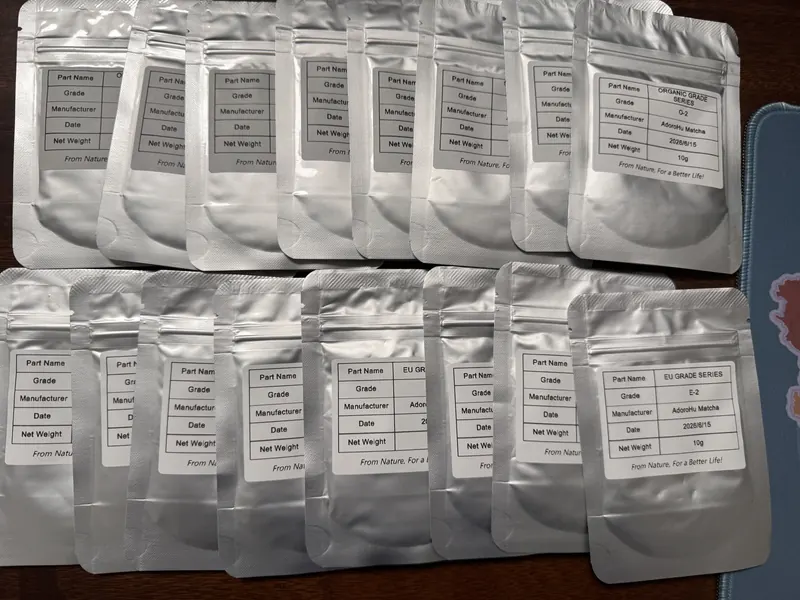
Lock matcha lot, particle distribution, color, moisture, and dose while lamination variables remain fixed. Use a retained powder control and repeat the chosen placement cell when a new lot or specification revision arrives.
The matcha baking application page and matcha bakery heat and color guide can help build the raw-powder brief. AdoroHu Matcha supplies the powder; the bakery owns laminated-product manufacture, safety, and hold validation.
Key Takeaway: Release a powder lot through a fixed placement and lamination process against a retained control.
FAQ
- Should matcha go in croissant dough, filling, or a finish?
- Test all three placements under one process, then choose the simplest route that meets flavor, color, structure, and hold targets.
- Are 10°C, 15°C, and 20°C universal lamination temperatures?
- No. They were temperatures used for fat-mechanics testing in the 2025 study and must be adapted to the chosen fat and process.
- Can oven height alone approve a matcha croissant?
- No. Measure width spread, specific volume, layer continuity, and crumb structure as well.
- Does the 36 mm probe and 5 mm compression measure whole-croissant firmness?
- No. That setup characterized laminating fat; whole-croissant TPA used a P25 probe, 2 mm/s, 50% compression, a 0.049 N trigger, and a 5-second interval.
- Why should firmness be repeated after hold?
- The butter and margarine controls in the 2025 study became 3.4- to 3.7-fold firmer after 24 hours, so fresh texture cannot establish retail-hold performance.
Conclusion
Choose placement, control lamination temperature, and connect layers, expansion, crumb, and firmness through the intended hold. To arrange raw-powder samples, contact AdoroHu about croissant trials.
Institutional author: AdoroHu Matcha