
Matcha donut commercial formulation starts by choosing whether matcha belongs in the dough, filling, glaze, or finish, because each position sees different heat, oil, and moisture. Test that placement with culinary matcha for donut trials before fine-tuning dose.
The wrong test can blame powder quality for a frying problem. Oil temperature recovery, flip timing, crust dehydration, crumb moisture, and cooling all change color and texture.
"Choose matcha placement before optimizing dose. Approve the donut after the real display hold, because a formula that looks right at the fryer can soften, darken, or lose its finish before sale."
In short:
Key points:
- Separate dough, filling, glaze, and dusting trials instead of treating placement as interchangeable.
- Lock oil temperature, load, frying time, flip point, draining, and cooling before supplier comparison.
- Measure crust and crumb independently, then repeat color, texture, oil, and finish checks through display hold.
Should matcha donut flavor sit in dough, filling, glaze, or dusting?
Run separate placement cells because dough matcha receives the full frying process, filling sees a different heat path, and glaze or dusting is applied after frying. A result from one route cannot approve another.
| Placement | Main exposure | First approval question |
|---|---|---|
| Dough | Frying heat, oil, water loss | Does crumb color and aroma survive? |
| Filling | Heating and moisture migration | Does filling remain stable? |
| Glaze | Warm surface and display humidity | Does glaze stay even and non-tacky? |
| Dusting | Surface oil and handling | Does powder adhere without blotching? |
Choose placement before dose so heat damage is not mistaken for weak matcha. Keep flour, proof, unit weight, and fry conditions fixed within the dough cell.
Key Takeaway: Placement is the first formulation decision.
What frying profile should matcha donut trials lock?
Lock oil type, temperature, batch load, recovery, frying time, flip point, and drain method. The 2024 study Multi-agent simulation of doughnut deep fat frying considering two domain heating media and sample flipping modeled doughnut frying at 180°C and measured different heat and moisture behavior on the oil-contact and upper surfaces.
That non-matcha experiment defines useful process controls. It does not establish 180°C as a universal matcha-donut setting. Pilot the actual fryer and product geometry.
Key Takeaway: Compare formulas only under the same measured frying profile.
How quickly does matcha donut moisture move during frying?
In the 180°C study, total moisture fell from 46.9% to about 39% on a dry basis, while crust moisture fell below 9%. That steep surface dehydration creates the environment in which dough-phase matcha color and aroma must survive.
Measure total, crust, and crumb moisture separately at fixed times. A single whole-donut moisture value can hide a dry crust and moist center.
| Zone | Study observation | Application use |
|---|---|---|
| Whole donut | 46.9% to about 39% dry basis | Track total water loss |
| Crust | Fell below 9% dry basis | Interpret color and crispness |
| Crumb | Rose to about 59% dry basis | Interpret softness and filling behavior |
Key Takeaway: Use separate crust and crumb measurements.
Why must matcha donut flip timing be controlled?
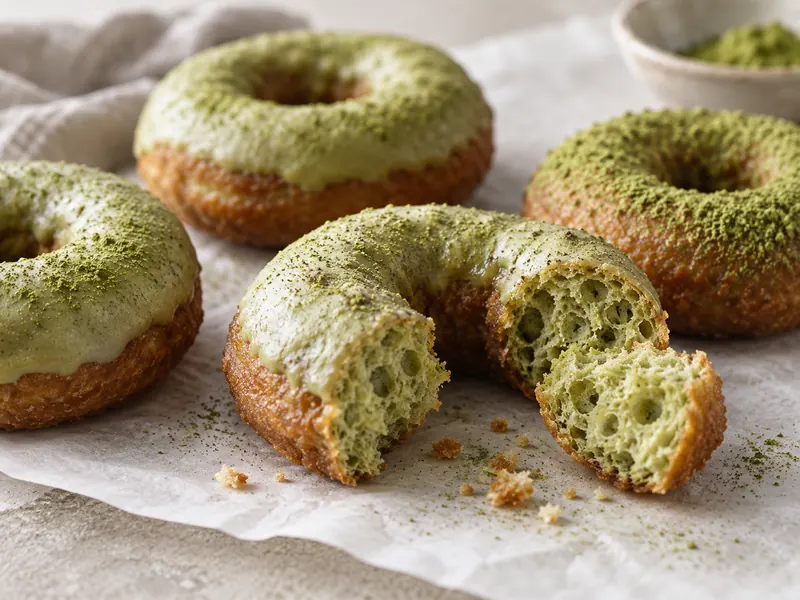
Before flipping in the cited experiment, the oil-contact bottom reached about 15% moisture after 150 seconds, while the upper surface had lost only about 30% of its initial moisture. The two sides therefore entered the second frying phase in different states.
Record the flip time and identify top and bottom during color and texture checks. If one side consistently darkens or absorbs more finish, change the process before changing matcha grade.
This is a strong production judgment: reject supplier comparisons made with inconsistent flip timing or fryer recovery. The consequence is a false lot ranking.
Key Takeaway: Treat top and bottom as separate surfaces during development.
How should matcha donut oil uptake be measured?
Measure total oil and, where the method permits, surface and crust oil after a fixed drain and cooling time. The frying study observed roughly 4 to 30 g oil per 100 g dry matter, with rapid uptake during the first two minutes.
Those values belong to its product and model. Use them to justify timed sampling, not as a finished-product specification. Unit size, proof, crust porosity, oil condition, and temperature recovery can change uptake.
The industrial bakery sourcing guide covers ingredient procurement. Oil uptake remains a finished-donut process result.
Key Takeaway: Bind every oil result to drain time, cooling time, and fry conditions.
What happens inside matcha donut crumb?
Crumb moisture in the 180°C study rose from 46.9% to about 59% dry basis through evaporation, diffusion, and condensation. Moisture moved inward even while the exterior dried.
This explains why crust color and crumb softness can move in different directions. Measure center temperature, crumb moisture, firmness, cell structure, and matcha sensory intensity after a fixed cooling period.
For dough-phase matcha, approve the crumb rather than relying on surface appearance. A bright glaze can conceal a dull or bitter interior.
Key Takeaway: Crumb moisture and flavor need their own release checks.
How should matcha donut color and flavor be approved?
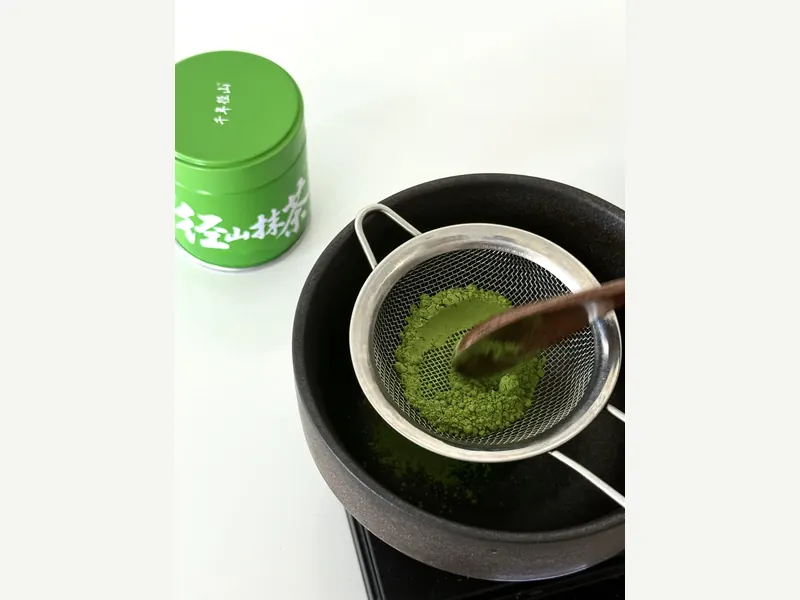
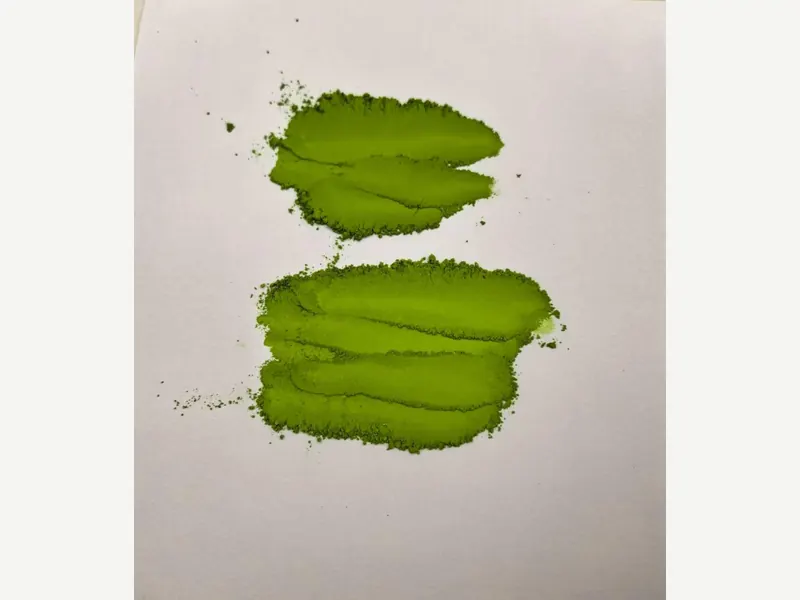
Measure crust and crumb L*a*b* values or color difference separately. Score vegetal aroma, bitterness, astringency, fried flavor, sweetness, and any filling or glaze interaction after cooling.
Set distinct targets for each placement route. Dough matcha should be judged in the crumb; glaze and dusting should be judged for coverage, green uniformity, and flavor balance.
The bakery heat and color guide gives broader context, but the fryer trial owns the donut decision.
Key Takeaway: Approve color and flavor by product zone and placement route.
What display-hold test should matcha donut buyers require?
At fixed hold points, measure glaze tack, dust loss, oil migration, crust firmness, crumb moisture, color, and sensory quality. Use the intended tray, liner, temperature, humidity, and cover.
Reject a formula approved only hot from the fryer. Retail hold can soften the crust, move oil into glaze, dissolve dusting, and change perceived color.
The matcha-for-baking service can align raw-powder targets with the selected placement. Contact AdoroHu with the donut type, fryer profile, placement route, and hold conditions.
Key Takeaway: The sell-time donut, not the fryer-exit donut, sets acceptance.
FAQ
- What matcha grade should a commercial donut trial use?
- Start with a culinary grade and approve it in the selected dough, filling, glaze, or dusting route under controlled frying and hold conditions.
- Can one matcha dose work in dough and glaze?
- Do not assume so. Dough faces frying heat and oil, while glaze has different water, sugar, and surface-contact conditions.
- Does a lower oil result always mean a better donut?
- No. Oil, moisture, volume, crust texture, flavor, and hold performance must be accepted together.
- When should matcha donut color be measured?
- Measure after a fixed cooling time and again through the intended display hold, with crust and crumb recorded separately.
- Does AdoroHu manufacture finished donuts?
- AdoroHu supplies matcha ingredients and provides raw-powder testing capabilities; finished-donut manufacturing is outside the documented supply role.
Conclusion
Commercial matcha donuts need a fixed placement route, controlled frying, zone-specific measurements, and proof from the display hold. Share the formula type and fryer conditions through the AdoroHu contact page when planning raw-powder samples.