
Matcha entremet development works best when the pastry team assigns a clear job to every layer before adjusting the matcha. A mousse, insert, sponge, crunch and glaze do not experience the same water, fat, air or freeze-thaw conditions. If every component carries the same tea load, the finished cake can taste flat, cut poorly and show little visual contrast. Start with one assembly drawing and a culinary powder suitable for the intended application; the matcha for baking guide gives buyers a useful product starting point.
A commercial entremet is a system of interfaces, not a stack of independent recipes. Put the main matcha signal in one or two components, then make the other layers support contrast, clean cutting and stable release. Confirm the finished design through repeated freeze-thaw and service trials.
In short:
Key points:
- Give each layer a measurable role before choosing the matcha level.
- Test interfaces and thawed slices, not components in isolation.
- Treat every formula and process number below as a trial value, not a validated specification.
Which layer should carry the main matcha flavor in an entremet?
The main matcha flavor should sit in one dominant component, with any second matcha layer serving a different visual or finishing role. The My Bare Cupboard benchmark places green-tea powder in both mousse and mirror glaze, while the tart pomegranate jelly supplies contrast. Its mousse notes 5 g matcha plus 3 g green tea in the modified home formula; that quantity is source-specific, not a commercial dose. In many designs that is the mousse or a concentrated insert, while the sponge provides support and the glaze protects appearance. The correct choice depends on fat level, serving temperature, sweetness and the competing fruit, nut or chocolate notes.
| Primary carrier | Main advantage | Main tradeoff | Check after thawing |
|---|---|---|---|
| Mousse | Broad flavor across each bite | Dilution by cream and air | Aroma, color and set |
| Insert | Strong contrast and clear identity | Hard interface if too firm | Slice adhesion and bite |
| Sponge | Efficient solids delivery | Heat can mute color and aroma | Crumb strength and dryness |
| Glaze | Immediate visual signal | Thin layer gives limited flavor | Coverage and condensation |
A practical first screen keeps the total formula fixed and changes only the carrier. That isolates the effect of placement from the effect of total powder.
Key Takeaway: Choose one primary carrier and one supporting carrier before changing total matcha use.
How should the mousse and insert be balanced?
The mousse and insert should be sized and set as a matched pair so the insert stays centered and the thawed slice cuts without pulling apart. In the source, the pomegranate jelly uses 280 g juice, 25 g sugar and 10 g gelatin sheets, is set in a square pan, then cut into eight pieces matching the joconde. Those values support an insert-thickness A/B for this home architecture only. A soft mousse around a very hard frozen insert can tear at the boundary. A weak insert can migrate into the mousse or disappear as the cake thaws.
Run an interface trial
- Cast the same insert thickness across all samples.
- Hold mousse density and deposit temperature constant.
- Freeze, thaw and cut on the intended service schedule.
- Record separation, smearing and flavor sequence.
The commercial matcha mousse guide covers aeration as a single-component problem. For an entremet, the extra question is whether that mousse remains compatible with the adjacent frozen layers.
Key Takeaway: Approve the mousse and insert as a paired interface, not as two successful bench recipes.
What should the sponge contribute to a matcha entremet?
The sponge should close the mould, carry the layers and provide a clean base without becoming the dominant matcha carrier. The source cuts eight joconde pieces to 2 1/2 by 1 1/4 inches and chills them until assembly. That observed geometry supports an A/B between the reference length-and-width footprint and one controlled alternative, while the actual mould and deposit mass remain fixed. Matcha in the sponge may deepen the tea note, but heat exposure and a dark baked surface can reduce the visual payoff. A neutral or lightly flavored sponge may create better contrast when the mousse already carries the main dose.
Use an illustrative A/B trial: A keeps the sponge neutral; B adds the planned matcha while holding flour, liquid and piece thickness constant. Compare height, breakage, color and syrup pickup. This is a formulation screen, not a universal dosage recommendation.
Key Takeaway: Keep matcha out of the sponge unless it adds a clear sensory or visual benefit after assembly.
How can pastry teams prevent layers from sliding or separating?
Layers stay together when deposit timing, surface condition and relative firmness create good contact. Frost on an insert, a skinned mousse surface or excess loose crumb can interrupt adhesion. Conversely, a warm deposit may melt a frozen interface and create an uneven boundary.
| Failure | Likely place to inspect | Useful corrective trial |
|---|---|---|
| Insert pulls free | Frost or incompatible firmness | Shorter exposed hold; paired firmness test |
| Sponge slides | Loose crumb or excess syrup | Brush control; thinner syrup application |
| Glaze peels | Condensation or surface damage | Surface-temperature and hold-time comparison |
| Slice smears | Incomplete thaw profile | Defined cut-time window after thaw |
For every trial, photograph the same cut face and score the boundary at the same elapsed time. That makes interface decisions easier to compare across shifts.
Key Takeaway: Diagnose separation at the failing interface before reformulating the whole cake.
When should matcha be dispersed during entremet production?
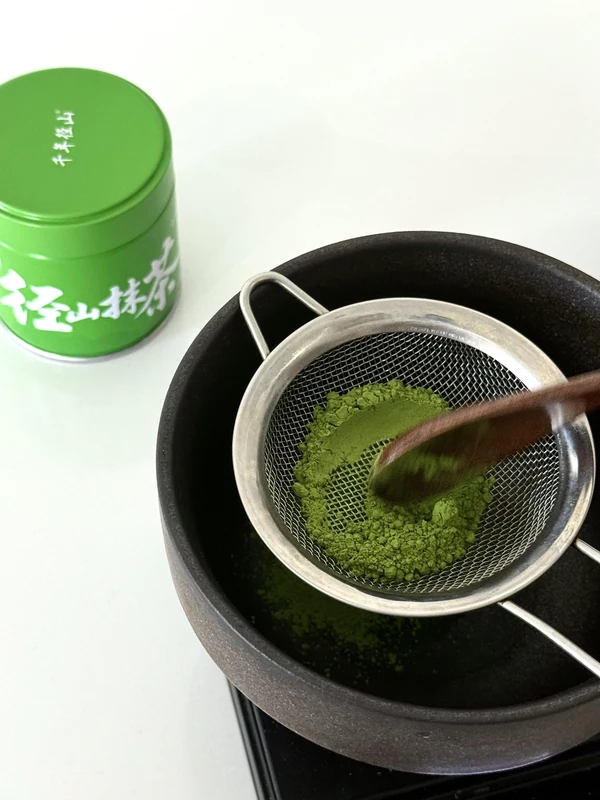
Matcha should be dispersed at a stage that wets the powder completely without exposing it to unnecessary heat or uncontrolled extra liquid. Dry addition into a finished aerated mousse can leave green specks. Adding an informal slurry can change solids, sweetness and final set.
Protect the formula balance
- Take dispersion liquid from the approved formula.
- Sift the powder before wetting when agglomerates are present.
- Compare the same mixing energy and batch temperature.
- Check the finished component, not only the fresh slurry.
Powder particle behavior is discussed in the matcha particle-size specification guide. Particle size can inform incoming specifications, but it does not replace application testing in the chosen fat, dairy, chocolate or hydrocolloid system.
Key Takeaway: Build the dispersion step into the formula rather than adding extra liquid as a rescue.
How should freeze-thaw performance be tested?
Freeze-thaw performance should be tested on the complete entremet through the exact unmould, glaze and thaw sequence. The source freezes the assembled mini cakes for at least four hours, preferably overnight, returns unmoulded pieces to the freezer for 30 minutes before glazing, then thaws them in the refrigerator for at least two hours before serving. These are home-recipe observations, not validated commercial limits, but they define three distinct checkpoints for a schedule A/B. A layer that looks stable while frozen may release water, shrink or soften after thawing. The resulting moisture can dull the sponge, loosen a glaze or blur the matcha color.
An illustrative test matrix can separate causes:
| Sample | Variable changed | Keep fixed | Observe |
|---|---|---|---|
| A | Baseline assembly | Layer weights, mold, package | Reference slice |
| B | Longer frozen hold | Formula and thaw method | Shrinkage and ice damage |
| C | Alternate thaw sequence | Formula and frozen hold | Weeping and cut quality |
| D | Revised barrier layer | Other components | Moisture migration |
These are experimental labels, not claimed commercial results. Under 21 CFR 117.160, covered facilities validate applicable preventive controls with scientific and technical evidence. A dessert trial cannot stand in for that facility-specific work.
Key Takeaway: Test the complete packaged cake across the real frozen hold and thaw sequence.
How can teams preserve color without making the dessert bitter?
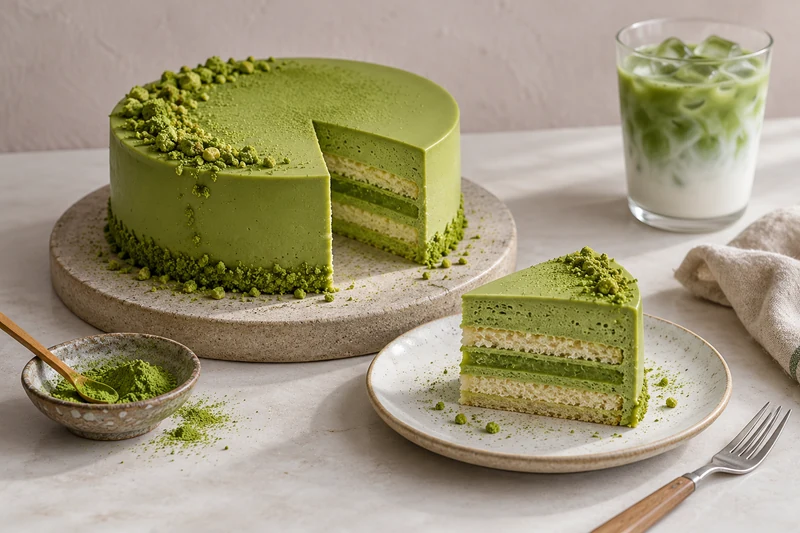
Color should be managed through powder selection, carrier choice, heat exposure and storage protection rather than by raising matcha until the cake looks green. Extra powder can intensify bitterness and dryness while still failing to solve oxidation or poor contrast.
Compare samples under the same light, background and elapsed time. Record instrumental color only when the team has a defined method; otherwise use coded visual assessment with fixed conditions. Also score aroma, sweetness, dairy notes and aftertaste because the greenest sample may not be the best product.
Key Takeaway: Select color and flavor together, using controlled comparisons instead of dose escalation.
How should the matcha mirror glaze be treated as its own component?
The mirror glaze should be developed separately from the mousse because it has a different sugar, fat, gelatin and application-temperature system. The source makes a white-chocolate glaze with matcha paste, strains it, cools it to 30°C/86°F and pours it over frozen pieces. It also notes that the full glaze yield is excessive for the eight mini cakes and suggests a half recipe.
A useful A/B keeps the frozen cake constant and compares one versus the minimum additional pass needed for complete coverage. Record pickup mass, transparency, pooling, edge coverage and whether the added pass overwhelms the pomegranate–mousse balance. Do not copy the source temperature or formula as a validated plant setting.
Key Takeaway: Treat glaze pickup and coverage as a separate yield decision, not as leftover mousse formulation.
Which allergens and labels require an early review?
Entremet development should review allergens before pilot production because cream, milk, egg, wheat, soy and tree nuts can enter different layers. Changing a glaze, chocolate, sponge or nut component can alter both the ingredient statement and the cross-contact plan.
The FDA major-allergen resource lists nine major food allergens in the United States and explains food-source labeling. Pure matcha is not one of those nine, but AdoroHu cannot determine the allergen status of a customer’s finished entremet or facility.
Build one layer-by-layer review
- List every ingredient and processing aid by component.
- Identify the food source of each applicable allergen.
- Review rework, shared utensils and changeover order.
- Recheck the finished label after any component change.
Key Takeaway: Treat allergen review as an assembly-level task because one changed layer changes the finished product.
What should a buyer include in the matcha brief?
A matcha brief should identify the primary carrier, target appearance, competing flavors, process exposure and evaluation method. It should also state whether organic certification, a grade series or particular documentation is required. AdoroHu supplies pure matcha powder, not finished entremets, mousse premixes or validated pastry processes.
Buyers can compare culinary matcha options using a fixed cake architecture. Send the supplier the target market, component map, benchmark sample, storage route and the results of controlled trials. That is more useful than asking for a universally “best” powder without application context.
Key Takeaway: Brief the powder supplier with the full layer map and trial method, while keeping final-product validation with the manufacturer.
FAQ
- Which layer should contain the most matcha in an entremet?
- Use the layer that delivers the clearest aroma and color without weakening the assembly; compare mousse and insert carriers in the finished cake.
- Can matcha be added to every entremet layer?
- It can be trialed in several layers, but repeating it everywhere often reduces contrast and makes bitterness harder to control.
- Why do entremet layers separate after thawing?
- Frost, condensation, incompatible firmness, loose crumb, deposit timing or moisture migration can weaken an interface.
- Does matcha change an entremet’s shelf life?
- Shelf life must be established for the complete formula, process, package and storage route; matcha alone does not provide a universal answer.
- Is culinary matcha suitable for entremet trials?
- Culinary matcha is a practical starting category, but the team should compare selected lots in its actual mousse, insert, sponge and glaze system.
- Does AdoroHu manufacture matcha entremets?
- No. AdoroHu supplies pure matcha powder as an ingredient; the finished dessert manufacturer owns formulation, processing and validation.
Conclusion
A stable matcha entremet begins with component roles, interface tests and a defined freeze-thaw sequence. Keep supplier evaluation separate from finished-dessert validation, and carry the winning powder through the complete packaged-cake trial. To discuss powder grade, documentation and application goals, contact AdoroHu Matcha.