
Matcha financiers need the almond richness, browned-butter aroma, and moist small-cake center that define a financier. Matcha has to remain clear inside that toasted, high-fat matrix. Buyers comparing powders can use the matcha pastry sourcing guide before moving into formula trials.
Build matcha financiers around almond meal, egg whites, browned butter, and a shallow mold. Keep butter endpoint, deposit, and pan fixed while comparing matcha, then judge the cakes only after the crumb and butter have cooled.
In short:
Key points:
- Preserve the financier’s almond, egg-white, and browned-butter structure.
- Compare source recipes in their original units instead of inventing conversions.
- Measure accepted pieces, bake loss, and mold release before scale-up.
What defines matcha financiers for a bakery line?
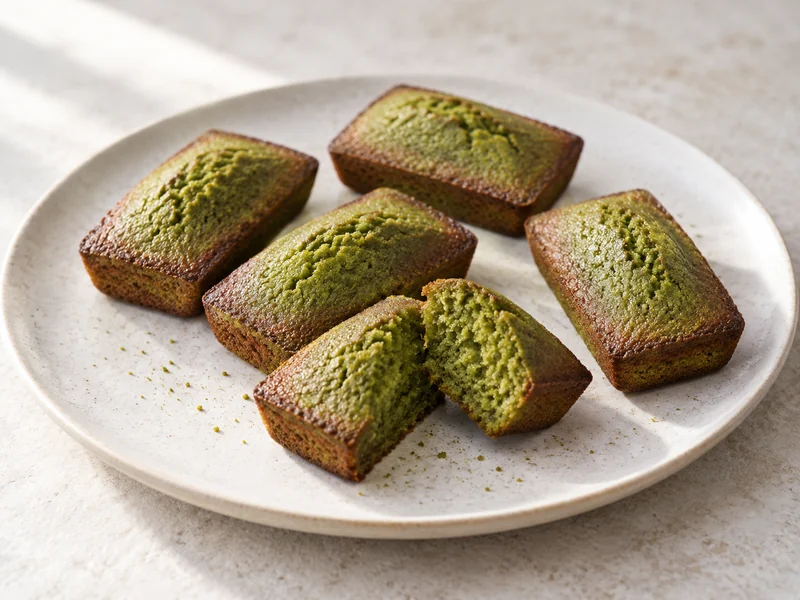
Matcha financiers are compact almond cakes made with egg whites and browned butter. They are not miniature generic sponges. The shallow mold creates a broad browned surface and a short path to the moist center, so mold dimensions directly influence crust-to-crumb ratio.
Write the product brief around piece weight, top crust, almond texture, center moisture, release, and cooled tea finish. A tall muffin-shaped piece may use the same batter, but it changes the eating experience and bake time enough to require a separate specification.
Key Takeaway: Keep almond, browned butter, egg whites, and shallow geometry visible in the product brief.
What matcha quantity and yield do published financiers provide?
Little Curly Kitchen’s matcha financiers state 2 tablespoons matcha powder and a recipe yield of 24. The recipe also says to divide the batter among 12 wells, so a commercial developer should clarify whether the declared yield reflects more than one pan or a smaller portion before using it for costing.
| Source fact | Published value | Production question |
|---|---|---|
| Matcha | 2 tablespoons | Does this level remain balanced after cooling? |
| Declared yield | 24 | What portion definition produces 24 pieces? |
| Pan instruction | 12 wells | Is a second pan or second bake implied? |
| Prep and cook time | 15 min; 10 min | Which steps occupy labor and oven capacity? |
This apparent yield-versus-pan mismatch is useful: it shows why an operator must weigh deposits and count accepted pieces rather than cost from a recipe card alone.
Key Takeaway: Verify the portion behind a published yield before using it as a cost denominator.
How should browned butter be standardized for matcha financiers?
Browned butter contributes nutty milk solids and also loses water during cooking. Little Curly Kitchen instructs the baker to heat butter over medium heat, swirl regularly, and remove it when the milk solids brown at the bottom of the pan. That is a sensory endpoint, not a fixed final mass.
Record the butter’s starting weight, finished weight, color reference, and temperature when added to the batter. Choose a target that supports almond and matcha without turning the crumb brown enough to obscure green. Avoid changing the butter endpoint during a matcha-grade test; the flavor and moisture shift would make the powder comparison unreadable.
Key Takeaway: A repeatable browned-butter endpoint protects both formula water balance and tea evaluation.
How do almond meal and egg whites shape financier texture?
Almond meal supplies fat and a coarse protein structure, while egg whites bind water and set the small cake. Financier batter generally uses unwhipped or lightly loosened whites rather than a meringue, so egg weight and mixing order matter more than maximum foam volume.
Use one almond meal lot and sieve specification during development. Standardize egg-white temperature and weight. If the crumb is oily, check butter incorporation and almond particle size before adding more flour; extra flour can turn a financier into a firmer cake without solving the original dispersion issue.
Key Takeaway: Control almond particle size and egg-white weight before modifying the flour phase.
Which mold and deposit controls suit matcha financiers?
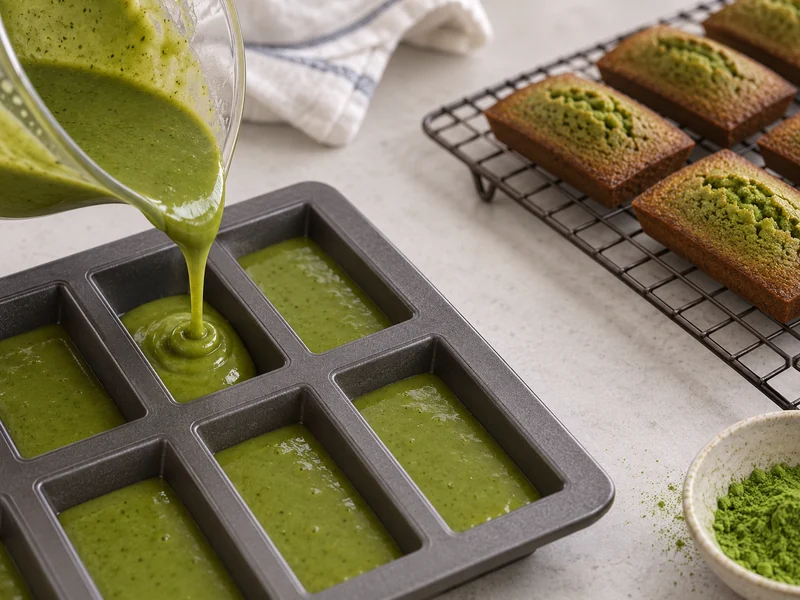
The ranked benchmark uses a buttered mini muffin pan and divides batter among 12 wells. Its stated bake is 10–12 minutes at 400°F/200°C. A traditional rectangular financier mold is shallower and will not transfer that time directly.
| Variable | Mini-muffin benchmark | Rectangular-mold trial |
|---|---|---|
| Geometry | Round well | Shallow rectangle |
| Published fill instruction | Divide among 12 wells | Set by target piece weight |
| Published heat | 400°F/200°C | Start as a comparison only |
| Published time | 10–12 min | Determine from set and bake loss |
Deposit ten cavities onto a scale during the pilot. Choose the mold that matches the intended merchandising and packing density. Avoid mixing mold types on one tray because edge and center pieces will already experience different airflow.
Key Takeaway: Re-establish bake time whenever mold depth or shape changes.
How should matcha be dispersed in financier batter?
Sift matcha with the wheat flour and other fine dry ingredients before mixing with almond meal. Almond particles can conceal matcha clumps until the cake is cut. A staged dry blend gives the powder more opportunity to distribute without prolonged mixing after the egg whites enter.
Inspect the mixed batter at the bowl bottom and cut several cooled cakes from different tray positions. Green specks point to blending failure; pale streaks can show incomplete butter incorporation. Avoid adding water to create a matcha slurry unless the formula is deliberately rebalanced, because financiers have little free water to absorb that change.
Key Takeaway: Use a controlled dry preblend and verify dispersion in cut cakes from across the tray.
What bake endpoint protects matcha and browned-butter flavor?
Little Curly Kitchen uses 400°F/200°C for 10–12 minutes and removes the cakes when a toothpick comes out clean. That endpoint is a published home-recipe benchmark, not a commercial limit. A bakery should pair it with piece weight, actual oven temperature, top color, edge set, and cooled center texture.
Run a time ladder with the same mold and deposit. Choose the earliest point that releases cleanly and has a set center. Avoid baking for maximum brown color: the additional toast can cover matcha and reduce finished yield through moisture loss.
Key Takeaway: Select the bake endpoint by release, set, and cooled flavor rather than surface darkness alone.
Which additions support matcha financiers without changing the format?
Pistachio, sesame, citrus zest, or a thin chocolate accent can support an almond cake, but each changes cost and may obscure the base matcha comparison. Develop the plain financier first, then introduce one addition at a time.
Choose an inclusion that can be deposited consistently in a 12- or 24-piece batch. Avoid wet fruit in the first production version; local moisture around the fruit changes set, release, and storage behavior. If a topping is added, count pieces lost through shedding or pack damage.
Key Takeaway: Add one costed accent only after the plain matcha financier meets its specification.
Which matcha grade should buyers compare in financiers?
AdoroHu’s E-1/E-2 and O-1/O-2 codes identify culinary tiers suitable for an almond-and-butter application trial. The culinary matcha product page is the product destination, and the matcha for baking page describes the application route.
Compare the samples in one approved financier formula with the same browned-butter batch. Score dispersion, top and cut color, almond balance, cooled tea finish, and documentation. A more expensive grade should advance only when the finished cake demonstrates a useful difference.
Key Takeaway: Qualify the powder in the browned-butter and almond matrix, not in water alone.
How should a bakery cost and pack matcha financiers?
Cost from actual accepted yield after cooling. Record batter weight, deposit weight, post-bake weight, release damage, and pieces outside the color or texture target. The published yield of 24 can start a worksheet, but the bakery’s mold and portion decide the real denominator.
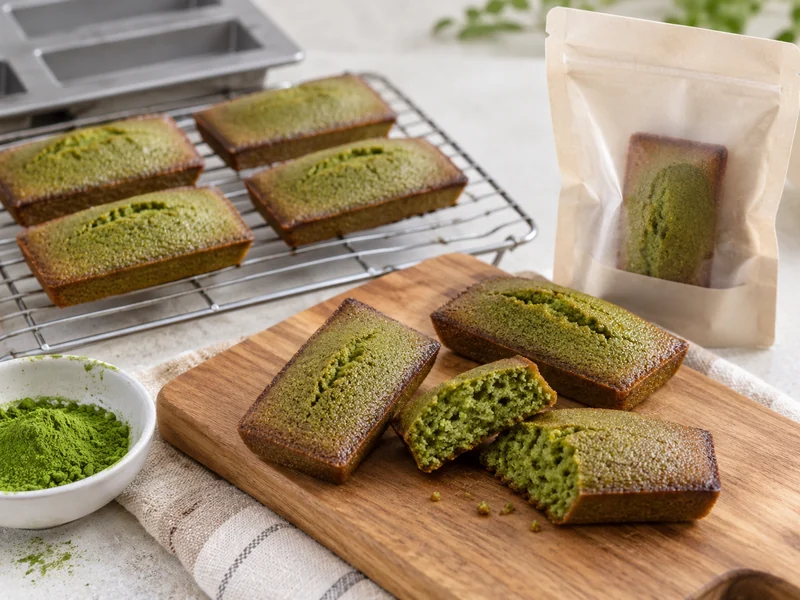
Cool the cakes before closing the pack, then validate texture and aroma in the selected barrier and distribution route. The commercial dessert guide can help position the product in a wider range, but it provides no financier shelf-life claim.
For egg, allergen, and sanitation controls, follow the bakery’s validated plan and local requirements; the FDA safe food-handling guidance is an official public baseline rather than a financier-specific process limit.
Key Takeaway: Use accepted cooled yield and the actual package to make the commercial decision.
FAQ
- Do matcha financiers require almond flour?
- Almond meal or flour is part of the financier’s defining structure and flavor; removing it creates a different small cake.
- Are financier egg whites whipped into meringue?
- Many financier systems use unwhipped or lightly loosened whites. Follow the selected formula and control egg weight rather than adding foam by assumption.
- Why weigh browned butter after cooking?
- Browning evaporates water, so finished weight helps the bakery keep batch water and butter contribution consistent.
- Can a mini muffin pan replace a financier mold?
- It can create a saleable variant, but the deeper round shape needs its own deposit, bake, and texture specification.
- Does AdoroHu manufacture matcha financiers?
- No. AdoroHu Matcha supplies matcha powder; the bakery owns the finished formula and validation.
- How is financier shelf life established?
- Test the actual cake, cooling process, package, storage, and distribution conditions; a published recipe cannot establish it.
Conclusion
The strongest matcha financier trial locks browned butter, almond meal, egg whites, mold, and deposit before comparing tea samples. Contact AdoroHu Matcha with the target mold, formula, certifications, and expected volume to plan ingredient samples.