
Matcha tart development depends on a crisp shell, a smooth tea filling, controlled moisture migration, and a cut that remains clean at service temperature. The shell and filling must be developed as an interface. The matcha pastry sourcing guide provides the wider powder-selection framework.
Put matcha in one dominant tart component, then control shell bake, filling set, assembly timing, chill, and slicing. Compare source recipes in their original units and validate the finished tart in its actual package.
In short:
Key points:
- Decide whether matcha belongs in the shell, filling, or finish.
- Match filling moisture and set to the shell and service window.
- Cost accepted slices after trim, fruit loss, and cut defects.
Which matcha tart architecture should a bakery choose?
A matcha tart can use a neutral shell with matcha pastry cream, a matcha ganache, or tea in the shell. Choose one dominant tea location first. Multiple green layers make bitterness and color easier to add than to diagnose.
Specify shell thickness, filling depth, cut temperature, slice weight, edge fracture, and crispness at the intended service point. Avoid choosing architecture from a photograph alone; a beautiful soft filling may not survive takeaway handling.
Key Takeaway: The service model should select the shell-and-filling architecture.
What matcha and yield benchmarks appear in ranked tart recipes?
Love & Olive Oil’s matcha strawberry tart states 1 teaspoon sifted matcha in the pastry cream and yields 4 servings. Sift & Simmer states 15 g matcha and yields 8. These are different fillings and tart sizes, so the quantities must remain with their source systems.
| Published benchmark | Matcha stated | Declared yield | Total time stated |
|---|---|---|---|
| Love & Olive Oil | 1 teaspoon, sifted | 4 servings | 180 min |
| Sift & Simmer | 15 g | 8 | 225 min |
Reproduce the chosen source as a benchmark, then measure actual tart diameter, fill depth, and slice mass. Do not infer that the higher matcha number is stronger without considering the full formula.
Key Takeaway: Compare matcha quantity only inside the source tart’s filling and yield context.
How should a tart shell be chilled and baked?
Love & Olive Oil chills dough at least 30 minutes or overnight and describes 6-inch tarts. Sift & Simmer chills dough 1 hour, chills the shaped crust in the freezer 15 minutes, then bakes at 400°F/204°C for 15 minutes in its first bake stage.
| Shell control | Love & Olive Oil | Sift & Simmer |
|---|---|---|
| Dough chill | At least 30 min or overnight | 1 hour |
| Shaped-shell chill | Source workflow | 15 min freezer |
| Pan reference | 6-inch tart option | Removable-bottom tart pan |
| Heat reference | Source formula | 400°F/204°C for 15 min |
Use one shell thickness and pan in the comparison. Record shrinkage, corner slump, bottom color, release, and break. Choose the shortest chill that controls shape in the actual kitchen.
Key Takeaway: Bind shell chill and bake to measured shrinkage and crispness.
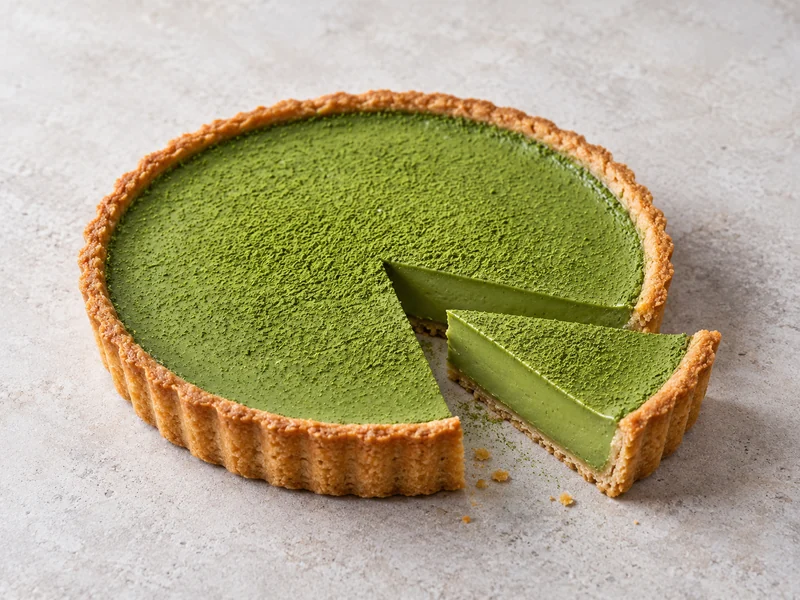
How should matcha pastry cream be dispersed and cooked?
Love & Olive Oil sifts 1 teaspoon matcha and tempers the yolk mixture by adding hot milk about ¼ cup at a time until about half the milk is incorporated. The mixture then returns to low heat. That staged tempering is a useful benchmark for smoothness.
Record milk temperature, matcha dispersion step, tempering additions, cook time, finished cream weight, and cooling method. Avoid rushing on high heat; curdled or lumpy cream is a process defect, not something more matcha can hide.
Key Takeaway: A sifted matcha and staged temper support a smooth pastry-cream filling.
Which filling system suits clean commercial slices?
Pastry cream gives a softer spoonable bite, ganache gives a firmer chilled cut, and baked custard creates its own heat and egg-control requirements. Select the system from service temperature, delivery distance, and slice handling.
Set a fill depth and test the first, middle, and final slice from a whole tart. Choose the filling that cuts without dragging or squeezing from the shell. Avoid making a soft cream artificially firm only for photography; that may create a waxy chilled texture.
Key Takeaway: Filling set must support the actual cut and eating temperature.
How can a bakery slow shell-to-filling moisture migration?
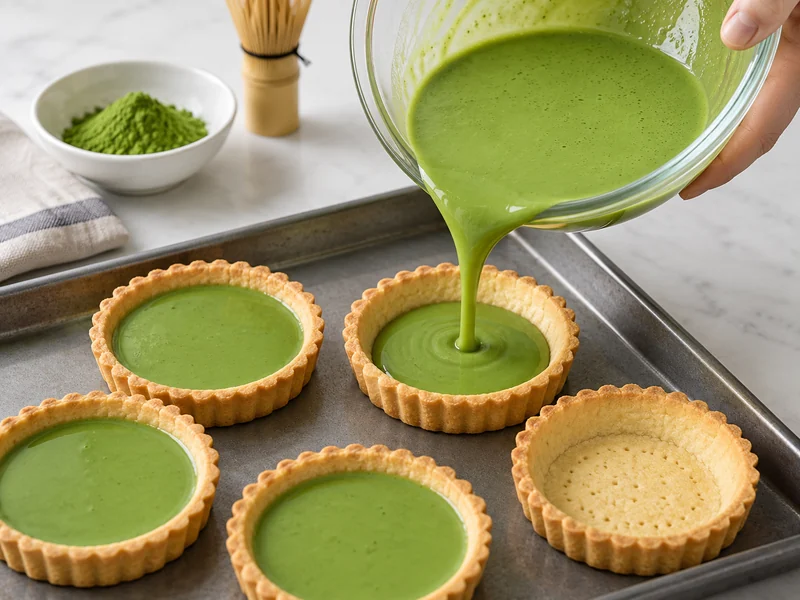
Cool the shell fully, apply a compatible barrier if the concept allows it, and fill as late as the production model permits. Fruit, pastry cream, ganache, and condensation create different moisture loads.
| Assembly test | Fill lead time | What to score |
|---|---|---|
| Same-day control | Defined short interval | Bottom crispness and clean cut |
| Refrigerated hold | Intended service interval | Softening and condensation |
| Fruit-garnished hold | Same interval | Juice bleed and shell wetting |
Choose the assembly lead that preserves the specification. Do not turn this quality check into an unsupported shelf-life claim.
Key Takeaway: Measure shell crispness after the real fill-to-service interval.
How should strawberry or other fruit be added?
Strawberry supplies acidity and a clear visual cue, but cut fruit releases water onto the filling and shell. Standardize fruit variety, cut, drained weight, placement, and garnish timing. Count bruised or leaking fruit in the cost model.
Choose a fruit format that survives the service window. Avoid assembling wet sliced fruit far ahead of sale; the consequence is surface bleeding and faster shell softening. Citrus zest or a thin chocolate layer may provide contrast with less free water.
Key Takeaway: Fruit design is also a moisture and labor decision.
Which matcha grade should buyers test in tart filling?
AdoroHu E-1/E-2 and O-1/O-2 identify culinary tiers for sampling. The culinary matcha product page is the product destination, while matcha for baking gives application context.
Compare samples in the selected filling after chilling. Score dispersion, tea aroma, bitterness, filling color, fruit interaction, and documentation. AdoroHu supplies powder rather than finished tarts.
Key Takeaway: Approve matcha in the chilled filling and complete assembled slice.
How should tart slicing, holding, and cost be validated?
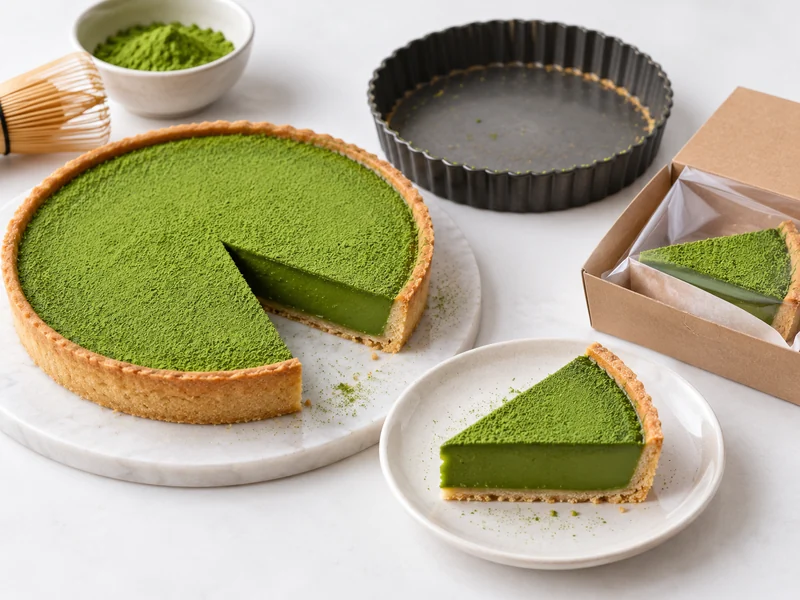
Standardize chill time, blade temperature, blade cleaning, and slice angle. Record whole-tart weight, shell or filling trim, fruit loss, accepted slice count, and smear or breakage defects. Cost per accepted slice, not the recipe’s declared serving count.
Use the operation’s validated controls for egg- or dairy-based fillings and local requirements. The FDA safe food-handling guidance is a public baseline, not a tart-specific safety limit. The commercial dessert guide offers adjacent menu context only.
Key Takeaway: Validate quality and safety in the actual filling, package, and cold chain.
FAQ
- Should matcha go in the tart shell or filling?
- Choose one dominant location first; filling usually makes dispersion and chilled flavor easier to evaluate.
- How long do published tart doughs chill?
- Ranked examples specify at least 30 minutes or overnight and 1 hour, with one adding a 15-minute freezer chill after shaping.
- Why does a tart shell become soft?
- Filling water, fruit juice, condensation, a pale bake, and long assembly lead can all move moisture into the shell.
- How is matcha pastry cream kept smooth?
- Sift the matcha, temper gradually with hot milk, and cook with controlled heat according to the selected formula.
- Does AdoroHu manufacture finished matcha tarts?
- No. AdoroHu Matcha supplies matcha powder; the bakery owns filling, shell, safety, and shelf-life validation.
- Can a recipe’s storage note become a commercial shelf life?
- No. Validate the actual tart, assembly, package, storage, and distribution route.
Conclusion
A stable matcha tart connects shell bake, filling set, moisture migration, fruit timing, and chilled slicing. Contact AdoroHu Matcha with the filling system, target certifications, and expected volume when requesting samples.