
Matcha creme brulee is a baked egg-yolk custard finished with a thin torched sugar crust shortly before service. A restaurant testing culinary matcha powder should control ramekin volume, water-bath depth, custard endpoint, chill, topping sugar, and the time between torching and the guest’s first spoonful.
Published benchmarks use the same five-yolk core but differ in dairy volume, matcha dose, oven temperature, ramekin count, and finishing sugar. Those linked facts are useful starting evidence, not AdoroHu-tested recipes.
A good matcha crème brûlée benchmark has a silky, gently set custard and a brittle sugar lid. Develop the custard and the torch service as two connected processes. Recipe chill notes do not validate commercial shelf life.
In short:
Key points:
- Match ramekin volume and fill before comparing bake time.
- Temper and strain the custard to control curdling, clumps, and bubbles.
- Torch near service so the crust stays crisp above the cold custard.
Which matcha creme brulee benchmark fits the ramekin?
The matcha creme brulee benchmark must fit the ramekin count and volume. Cooking Therapy states four ramekins from 2 cups cream, 5 yolks, ½ cup sugar, and 1 tbsp matcha. Just One Cookbook states six 4 oz/120 ml ramekins from 1½ cups cream, 1½ cups milk, 5 yolks, ½ cup sugar, and 1 tbsp matcha.
Vanilla Bean Cuisine also states six 4-ounce ramekins, but uses 2 cups cream, ½ cup milk, 5 yolks, and only 1 tsp matcha.
| Published benchmark | Dairy and matcha | Ramekins and bake |
|---|---|---|
| Cooking Therapy | 2 cups cream; 1 tbsp matcha | 4; 325°F; 30–40 min |
| Just One Cookbook | 1½ cups cream + 1½ cups milk; 1 tbsp matcha | six 4 oz; 300°F; 30–40 min |
| Vanilla Bean Cuisine | 2 cups cream + ½ cup milk; 1 tsp matcha | six 4 oz; 325°F; 30–35 min |
Key Takeaway: Choose the dairy volume and ramekin geometry as one benchmark before comparing dose.
How should matcha be dispersed in the custard dairy?
Matcha for creme brulee should be sifted or whisked into the dairy phase before yolks are tempered. Just One Cookbook heats cream, milk, and 1 tbsp matcha together. Cooking Therapy heats cream and emphasizes avoiding clumps in its supporting method.
Record dairy temperature, sieve, whisk time, visible foam, and specks. Matcha that remains clumped after the dairy is hot will be difficult to remove without overworking the custard.
Avoid boiling the dairy to force dispersion. The consequence can be excessive evaporation, cooked dairy flavor, and a changed ratio before the eggs enter.
Key Takeaway: Approve a smooth dairy dispersion before tempering the yolks.
Why does tempering matter in matcha creme brulee?
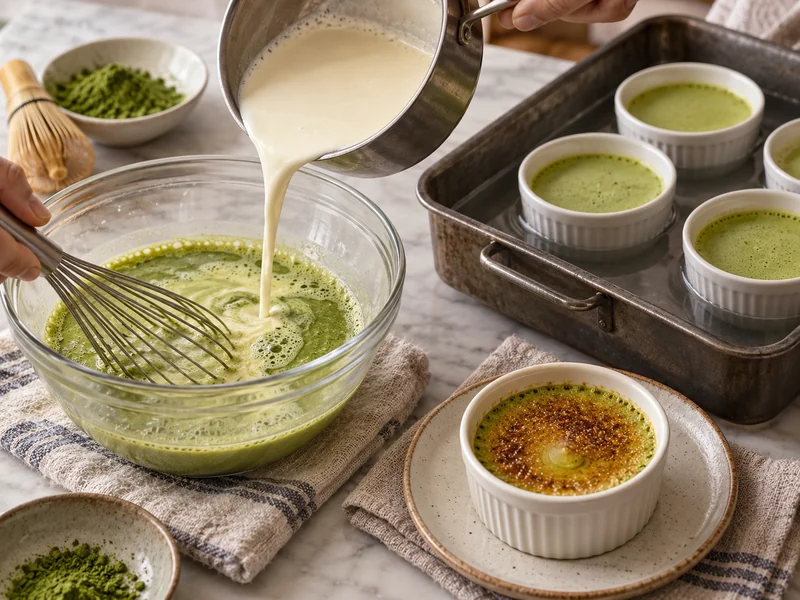
Tempering matcha creme brulee matters because hot dairy can coagulate yolk proteins before the mixture reaches the ramekin. Add the warm dairy gradually to the yolk-sugar mixture while whisking, then strain if the control method calls for it.
All three numeric benchmarks use five yolks, but their dairy totals differ. That means the egg concentration and set will differ even before oven temperature or ramekin depth changes.
Choose a tempering addition count or timed stream and keep it fixed. Reject a batch with cooked egg flecks; torching cannot repair a grainy custard.
Key Takeaway: Standardize tempering because the five-yolk number does not make the formulas equivalent.
How should the matcha creme brulee water bath be controlled?
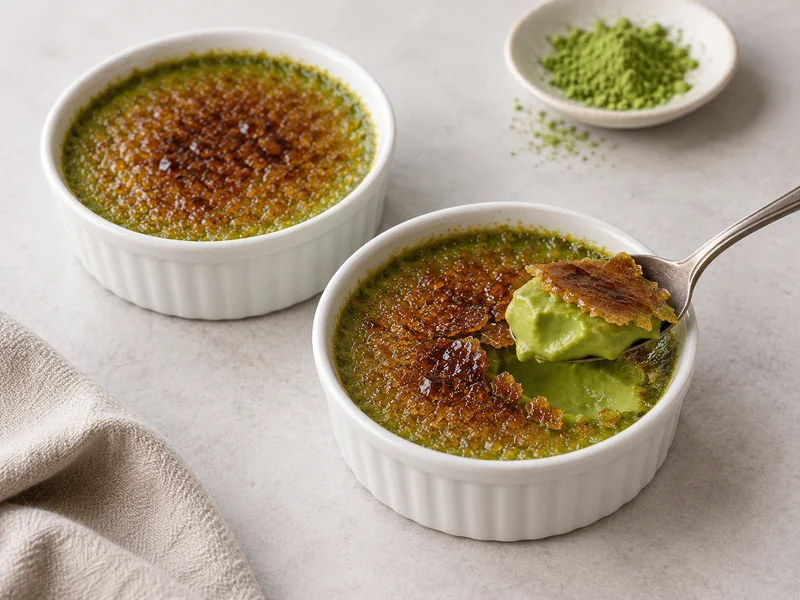
The matcha creme brulee water bath should surround matched ramekins with a defined hot-water depth. Just One Cookbook calls for boiling water halfway up the ramekin sides. Vanilla Bean Cuisine calls for very hot water about three-quarters of the way up. Cooking Therapy lists 2 cups hot water for four ramekins in a 9-by-9-inch dish.
| Water-bath variable | Record | Reason |
|---|---|---|
| Starting water temperature | actual reading | changes heat-up behavior |
| Water depth | half or three-quarter ramekin height | changes side heating |
| Ramekin spacing | fixed layout | affects circulation and handling |
| Fill weight | each ramekin | controls custard depth |
Avoid mixing ramekin sizes in one bake. The consequence is staggered set and unreliable timing.
Key Takeaway: Treat water depth, ramekin size and fill as part of the bake specification.
What is the right custard endpoint for matcha creme brulee?
The right matcha creme brulee endpoint is set at the edge with a slight center wobble, followed by complete chilling. Just One Cookbook states about 30–40 minutes at 300°F/150°C. Vanilla Bean Cuisine states 30–35 minutes at 325°F. Cooking Therapy begins checking at 30 minutes and adds 1–2 minutes when the custard jiggles too much.
Those observations are more transferable than one clock time. Record fill weight, oven mode, rack, bath depth, edge set, center motion, and actual bake time. If a product temperature is introduced, it must be validated for that formula rather than borrowed without evidence.
Key Takeaway: Use a defined visual set with matched geometry; the clock confirms the batch rather than defines every custard.
Which matcha grade fits an egg-yolk and cream custard?
A matcha creme brulee custard softens bitterness but can mute tea aroma. AdoroHu identifies E-1/E-2 and O-1/O-2 as Culinary grades, with higher numbers within each series indicating deeper color, more sweetness and less bitterness.
Compare adjacent grades in the same custard and evaluate after the full chill. Choose the higher grade only if the cold custard has a cleaner finish or useful color gain beneath the caramelized top.
Avoid comparing a 1 tsp formula with a 1 tbsp formula as if the difference came from grade. Dose and dairy volume are already different.
Key Takeaway: Hold dose and dairy constant during grade selection.
How long should the custard chill before torching?
Matcha creme brulee should chill until the custard is fully cold and set before sugar is applied. Cooking Therapy states 2 hours at room temperature plus at least 2 hours refrigerated. Just One Cookbook states at least 4 hours and ideally overnight. Vanilla Bean Cuisine states at least 3 hours.
Select a route that fits food-safety controls and service planning, then validate it for the actual kitchen. Recipe text about holding for several days is not commercial shelf-life evidence.
The FDA Food Code is a model code that jurisdictions may adopt; operators need the rules and food-safety plan that apply to their location and product.
Key Takeaway: Build service around a fully chilled custard and locally applicable controls, not a copied storage note.
How should the matcha creme brulee sugar crust be standardized?
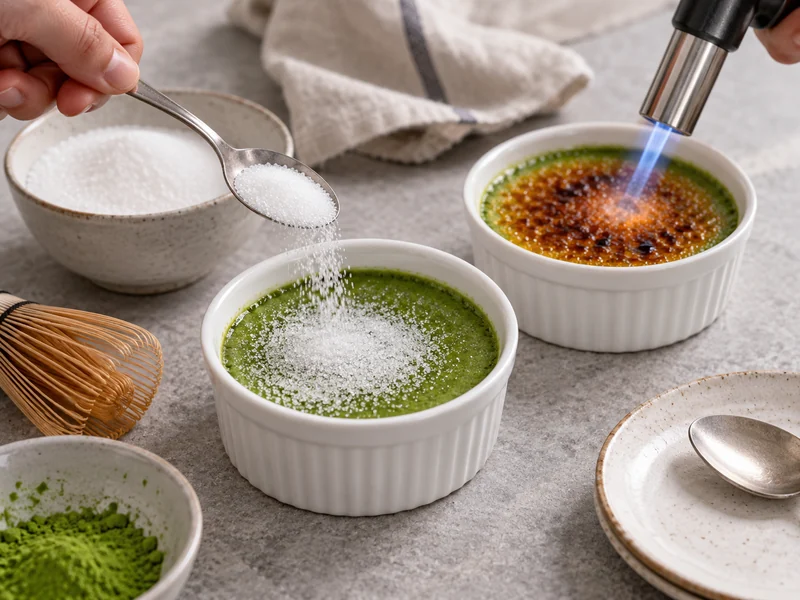
The matcha creme brulee sugar crust should be thin, even, and torched close to service. Just One Cookbook states 2 tbsp topping sugar total, described as 1 tsp per serving for six. Vanilla Bean Cuisine states 12 tsp topping sugar for six ramekins, or 2 tsp each. Those are materially different crust loads.
Test one measured sugar weight or volume per ramekin, a fixed torch distance, pass count, and rest before serving. Record glassy coverage, burnt spots, un-melted grains, and time until the crust softens.
Choose the lower load when it creates a complete brittle lid. Avoid torching far ahead; moisture migrates from the custard and softens the customer-facing crack.
Key Takeaway: Measure topping sugar per ramekin and torch against the real service clock.
What should a matcha creme brulee service and sourcing brief include?
A matcha creme brulee brief should include dairy system, five-yolk batch size, matcha dose, ramekin volume, fill weight, bath depth, oven setting, endpoint, chill route, topping sugar, torch timing, market and required certifications.
The custard contains egg and milk, and shared equipment may add other concerns. The FDA allergen overview provides U.S. context. AdoroHu supplies pure matcha rather than prepared custard. Teams can review the food application pathway, the dessert sourcing guide, and the matcha baking guide before they contact AdoroHu Matcha.
Key Takeaway: Specify custard geometry and service timing in the powder request.
FAQ
- Why do matcha creme brulee recipes with five yolks bake differently?
- Their dairy volume, ramekin count, fill depth, oven temperature and water bath differ, so five yolks alone do not define the set.
- Can 1 tsp and 1 tbsp matcha benchmarks be compared directly?
- No. Their dairy systems and doses differ; compare grades only inside one fixed formula.
- How high should the water bath reach?
- Published examples use halfway or three-quarters up the ramekins. Choose one with the selected ramekin and validate the set.
- When is the baked custard done?
- The edges should be set while the center retains a slight wobble, followed by full chilling under the kitchen’s validated process.
- How much sugar belongs on each ramekin?
- Published examples state 1 or 2 tsp per serving. Test the lowest measured amount that forms a complete brittle crust.
- Can crème brûlée be torched hours before service?
- That risks a softened crust as moisture migrates from the custard. Validate a near-service torch window.