
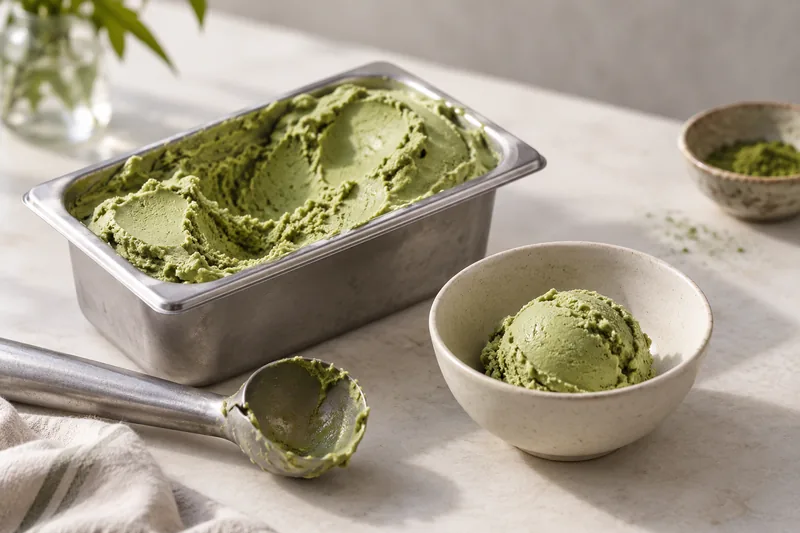
Matcha gelato needs a sugar system, overrun target, and serving temperature that release tea flavor without making the pan hard, sweet, or weak. A dense frozen base exposes grit and bitterness that a warmer liquid sample will not predict.
Develop matcha gelato from the served scoop backward. The commercial matcha ice cream guide supplies adjacent context, while gelato trials must connect sugar balance, air, cabinet hold, and scoop behavior.
Fix the base, sugar blend, aging, freezing method, and serving condition before comparing matcha. Approve flavor, overrun, scoopability, melt, and cabinet performance together.
In short:
Key points:
- Evaluate sugar changes through sweetness and freezing behavior at the same time.
- Measure overrun with one defined method and connect it to flavor density.
- Approve the pan at service temperature and at the end of its display window.
What should a commercial matcha gelato brief define?
Define the service cabinet, pan depth, target serving temperature, dairy or plant base, tea intensity, texture, portion size, and expected display time. Matcha gelato for immediate restaurant service differs from product hardened for later distribution.
Include a cost target and a sensory reference. Without them, teams often raise matcha dose to chase color while ignoring balance and yield.
Key Takeaway: Tie the formula to one service and distribution model.
How is gelato development different from ice cream?
Gelato commonly uses less incorporated air and is served warmer than hard ice cream, producing a denser bite and more immediate flavor release. Those differences must be measured in the actual process rather than assumed from the product name.
Use the site’s commercial matcha ice cream guide as adjacent context, then establish separate gelato limits for overrun, draw or scoop behavior, melt, and cabinet hold.
| Base comparison | Hold constant | Buyer question |
|---|---|---|
| Lower-fat base | Matcha dose, sugars, process | Does tea read clearly without thin body? |
| Richer base | Matcha dose, sugars, process | Does fat mute aroma or improve finish? |
| Plant-based base | Matcha dose, total solids, process | Is texture stable without masking tea? |
Key Takeaway: Give gelato its own process limits.
How should matcha dose be selected in a dense frozen base?
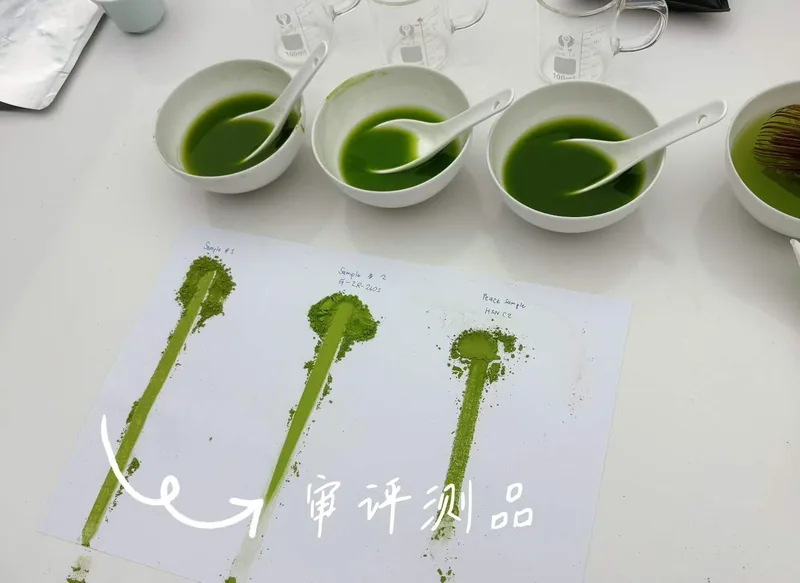
AdoroHu’s grade ladder identifies E-3/E-4 as conventional Premium and O-3 as Organic Premium. Use those codes for controlled samples, then decide from finished gelato. Screen several doses in one locked base and taste them at service temperature. Record tea aroma, umami, bitterness, astringency, color, and aftertaste. A dense base can carry strong flavor, but excess matcha can become drying as the sample warms.
Choose the lowest dose that remains recognizable through the intended display window. This protects cost and reduces the risk of a harsh finish.
For sourcing trials, compare representative samples against the application target rather than relying on labels alone. The premium matcha powder page provides the relevant product route.
Key Takeaway: Select dose at service temperature and end of hold.
How do fat and milk solids change tea perception?
Fat can soften bitterness and slow flavor release, while milk solids add body and their own cooked or dairy notes. Compare matched bases rather than treating fat percentage as the only variable. Record total solids and ingredient composition with each sample.
A richer base is not automatically more premium for matcha. When tea identity is the product promise, excessive richness can mute aroma and make a higher matcha dose necessary.
Key Takeaway: Use only enough richness to support texture and tea release.
How should the sugar system be evaluated?
Sugars control sweetness, freezing behavior, scoopability, and melt. Evaluate the sugar blend through a balance calculation and trial; do not replace one sugar by weight without considering its sweetness and freezing effect.
The tradeoff is operational. A softer gelato may serve easily but lose shape in the cabinet, while a firmer formula can feel icy or resist scooping.
| Sugar-system result | Service effect | Next trial |
|---|---|---|
| Too firm at service | Hard scoop, muted release | Rebalance freezing behavior |
| Soft but overly sweet | Easy scoop, weak tea identity | Change sugar blend, not only total sugar |
| Acceptable scoop and melt | Usable cabinet behavior | Confirm repeat batch and hold |
Key Takeaway: Approve sweetness and serving texture together.
What dispersion step prevents grit and speckling?
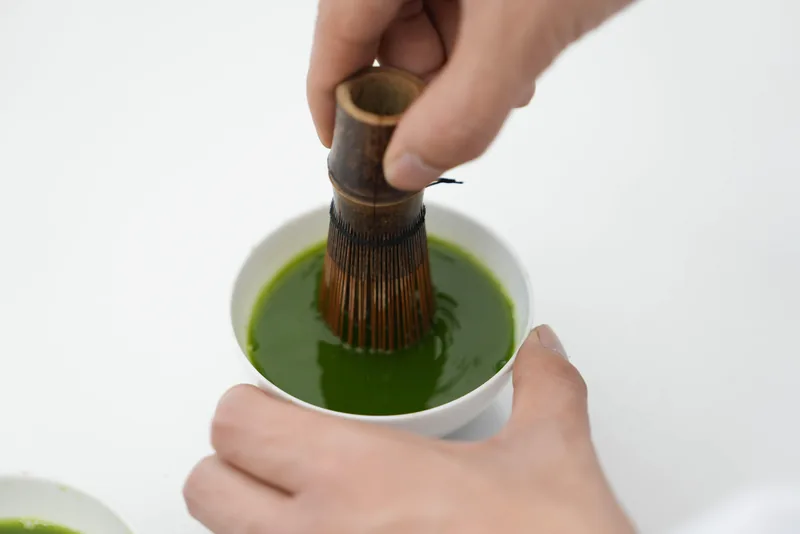
AdoroHu uses ultrasonic screening and multiple milling routes, including 20 stone mills, 56 ball mills, and 8 continuous ball mills. Confirm that comparison lots follow the agreed process and specification. Sift matcha and disperse it into a controlled portion of the mix before full blending. Record temperature, shear, time, and addition order. Inspect both the aged mix and frozen gelato because particles can become more obvious in a dense product.
Do not keep adding shear after the target is reached. Excess processing can add heat or air and change the base.
Key Takeaway: Define a minimum effective dispersion process.
How should aging, freezing, and overrun be tested?
Hold aging time and temperature constant, then record freezer settings, batch size, extraction temperature, finished volume, and mass. Calculate overrun from a defined method and connect it to flavor density and melt.
A low-overrun target is useful only when the freezer can reproduce it. Compare repeat batches and the first and last extraction portions.
Keep this decision connected to the wider application context in bulk matcha for food manufacturing.
Key Takeaway: Validate the full freezing sequence, not only the recipe.
What should cabinet-hold testing include?
Under 21 CFR 117.80, manufacturing and holding controls must minimize microbial growth, allergen cross-contact, contamination, and deterioration. Track surface color, oxidation, crusting, scoopability, melt, and sensory change across the intended display time. Use the real pan, cover practice, lighting, and cabinet setting. Sample from different pan locations because surface and center conditions differ.
Shorter pans or smaller batches may protect quality better than formulation changes. That choice can raise labor but reduce aged product and color drift.
| Overrun and service check | Record | Decision use |
|---|---|---|
| Mix and finished volume/mass | Defined overrun calculation | Flavor density and yield |
| Extraction condition | Temperature and texture | Freezer repeatability |
| Cabinet sample | Scoop, melt, color, flavor | Display-window release |
Key Takeaway: Choose display practice together with the formula.
What evidence should release commercial matcha gelato?
AdoroHu’s in-house microbiology and physical-chemical laboratories can support lot-linked powder COA inputs. Its 10 kg and 20 kg formats use sealed food-grade liners, so pack choice should reflect batch use and post-opening storage. The release file should include the locked formula, ingredient specifications, balance calculation, matcha lot, aging and freezing settings, overrun method, service temperature, cabinet checks, allergen review, and approvers. The process controls should align with 21 CFR 117.80 for manufacturing, holding, contamination, and allergen cross-contact.
For packaged distribution, add representative hardening, storage, transport, and shelf-life work. A cabinet trial alone does not support a packaged-life claim.
Key Takeaway: Release the exact process and service window tested.
FAQ
- Is matcha gelato the same as matcha ice cream?
- They are related frozen desserts, but gelato development usually targets a denser product with different air incorporation, service temperature, and flavor release.
- Why can matcha gelato taste bitter as it melts?
- Warming changes sweetness and flavor release, while a high matcha dose can expose astringency, so evaluate the full serving period.
- How should matcha be added to gelato mix?
- Use a documented sifting and pre-dispersion step, then verify the aged mix and frozen product for specks, grit, and settling.
- What does overrun change in matcha gelato?
- Overrun changes flavor density, body, yield, melt, and portion economics, so it needs a defined measurement method and approval range.
- Can a cabinet test prove packaged shelf life?
- No. Packaged distribution adds hardening, storage, transport, and time conditions that require representative validation.
Conclusion
Commercial matcha gelato needs a balanced sugar system, repeatable overrun, and a cabinet window that preserves scoopability and tea identity. Share the base, freezer, service temperature, and trial volume through the contact page for a focused sample plan.