
Matcha hazelnut spread becomes repeatable only when the buyer defines the product system and production endpoint. Matcha hazelnut spread is a low-water, fat-continuous system in which white chocolate, hazelnut butter, matcha, and salt determine flow and flavor. Its commercial task is not cream-cheese smoothing or plant-milk suspension. The buyer must distinguish particle grit, fat crystallization, and true oil separation before changing the matcha. Start powder comparison with culinary matcha in one fixed formulation.
Published recipes supply useful quantities, sequences, and failure observations. They do not validate commercial equipment, safety, or shelf life. The article below uses those benchmarks as questions for a controlled pilot.
Matcha hazelnut spread should be approved against a written product brief, controlled process record, and finished-product checks. A change in the structural base, process route, or package can invalidate an earlier matcha comparison.
In short:
Key points:
- Define the exact product architecture before comparing powder.
- Use published measurements to identify variables, not to set factory limits.
- Approve the cooled, packed product under its intended route.
What should a hazelnut-spread brief specify?
Record whether the product is a retail jar, bakery filling, swirl, or warm sauce; then define serving temperature, package, sweetness, and target flow. A spread that works on toast may leak from a bun or seize in a depositor. One word, “smooth,” cannot cover all four uses.
Key Takeaway: Record whether the product is a retail jar, bakery filling, swirl, or warm sauce; then define serving temperature, package, sweetness, and target flow.
Which matcha should be screened in the spread?
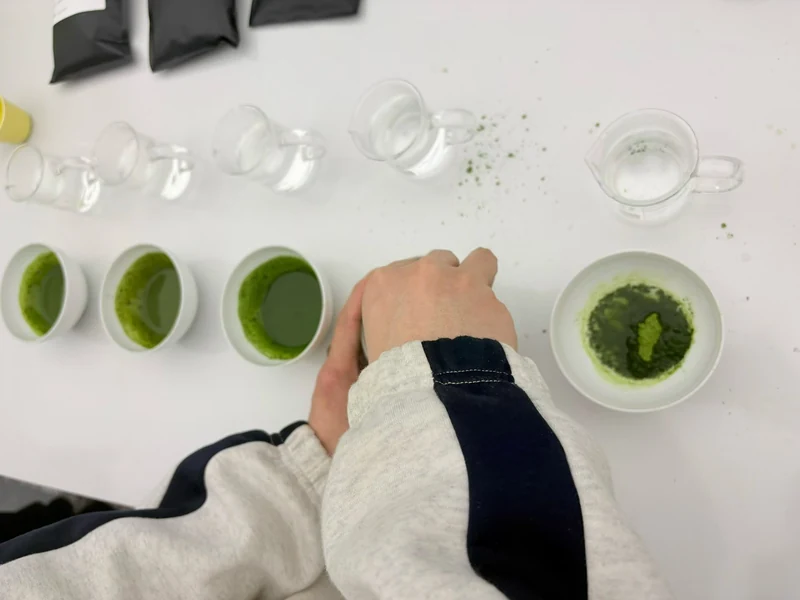
Use a culinary tier as the practical starting point and compare it in the finished matrix. AdoroHu codes E-1/E-2 and O-1/O-2 as culinary; white chocolate and roasted hazelnut can mask aroma while fine solids change viscosity. Pay for an upgrade only after a blinded spread comparison shows value.
The matcha particle-size guide defines the nearest existing technical boundary.
Key Takeaway: Use a culinary tier as the practical starting point and compare it in the finished matrix.
What does the four-ingredient benchmark teach?
The published formula uses 50 g white chocolate, 50 g pure hazelnut butter, 6 g matcha, and salt. It melts chocolate with matcha before adding hazelnut butter in increments. Those quantities and order identify fat balance, dispersion, and addition sequence as variables, not as a commercial specification.
| Published component | Amount | Variable exposed |
|---|---|---|
| White chocolate | 50 g | Fat and sugar base |
| Pure hazelnut butter | 50 g | Nut solids and oil |
| Matcha | 6 g | Flavor, color, fine solids |
| Salt | Pinch | Flavor balance |
Key Takeaway: The published formula uses 50 g white chocolate, 50 g pure hazelnut butter, 6 g matcha, and salt.
Why does hazelnut-butter identity matter?
The article distinguishes 100% hazelnut butter from hazelnut paste that may already contain sugar or oil. That difference changes solids, sweetness, flow, and label composition before matcha enters the formula. Procurement should record the nut-base specification rather than accept the same ingredient name across suppliers.
Key Takeaway: The article distinguishes 100% hazelnut butter from hazelnut paste that may already contain sugar or oil.
How should matcha enter the white-chocolate phase?
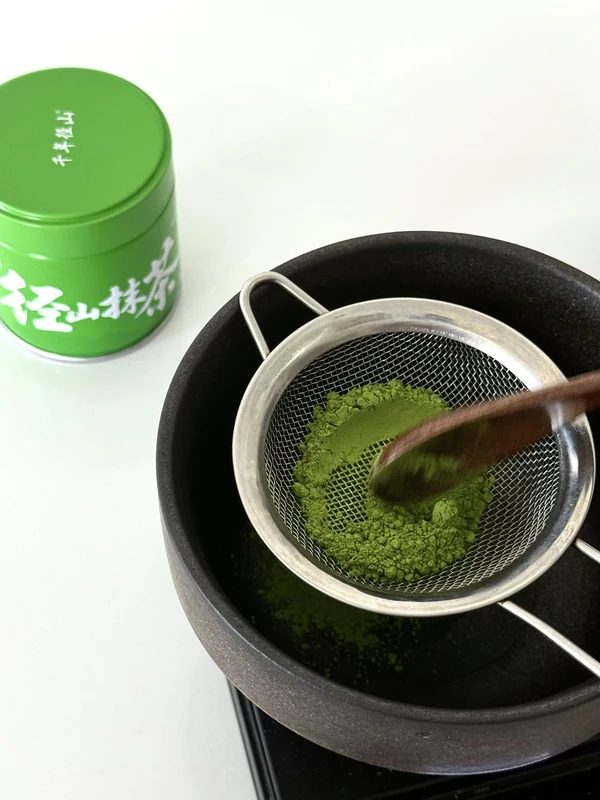
Add matcha through a controlled sift or pre-blend into the melted chocolate phase, then incorporate hazelnut butter gradually. Inspect for streaks before filling. Late dry addition can create local thickening, while unnecessary heat exposure can change color and fat crystallization.
Key Takeaway: Add matcha through a controlled sift or pre-blend into the melted chocolate phase, then incorporate hazelnut butter gradually.
How can grit be separated from viscosity?
Evaluate perceived particles and flow at the same temperature. Matcha, sugar, milk powder, and hazelnut solids all contribute to texture, so raw matcha particle size alone cannot explain a gritty spread. A drawdown or simple line-flow check should be paired with sensory review.
Batch evidence worth keeping
- Ingredient and formula identities.
- The process condition tied to the failure mode.
- Finished-unit evidence from more than one tray or location.
| Symptom | Do not assume | Check |
|---|---|---|
| Grit | Matcha is too coarse | Sugar, nut solids, refining, dispersion |
| Too firm | Needs more oil | Temperature and fat crystallization |
| Surface oil | Matcha caused separation | Nut paste and fat compatibility |
| Weak tea aroma | Dose is too low | Roast level and sweetness |
Key Takeaway: Evaluate perceived particles and flow at the same temperature.
What should an oil-separation hold measure?
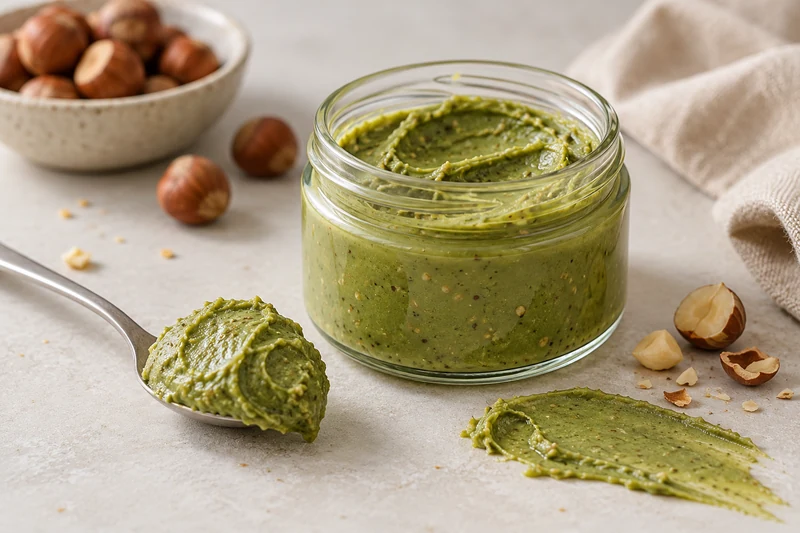
Use matched jars to record surface oil, firmness, spoon or depositor flow, and recovery after the intended storage condition. A refrigerator can solidify white chocolate and mask separation; warming the jar restores flow but does not prove the system is stable. The reference’s water-bath suggestion is a serving remedy, not shelf-life evidence.
The matcha sensory evaluation guide provides a useful adjacent comparison without taking over this product task.
Key Takeaway: Use matched jars to record surface oil, firmness, spoon or depositor flow, and recovery after the intended storage condition.
Which flavor trade-off deserves a structured test?
Cross roast intensity with matcha dose while keeping sugar and salt fixed. Darker roast can bury tea aroma, while more powder can increase dryness and viscosity. I would reject an over-roasted base before adding sweetness because rescuing it with sugar narrows the spread’s bakery uses.
Use the FDA major-allergen factsheet for ingredients actually present. Do not infer a finished-food safety limit from an ingredient blog.
Key Takeaway: Cross roast intensity with matcha dose while keeping sugar and salt fixed.
Which allergen and approval records belong in the handoff?
Hazelnut is a tree nut, and white chocolate may add milk or soy. Record the nut and chocolate specifications, matcha lot, melt and addition sequence, fill temperature, flow result, oil hold, sensory approval, and package. AdoroHu supplies pure matcha powder, not hazelnut butter, white chocolate, premix, or finished spread.
Key Takeaway: Hazelnut is a tree nut, and white chocolate may add milk or soy.
FAQ
- Why does matcha hazelnut spread become solid?
- White-chocolate fat crystallization and temperature can firm the spread; warm-service recovery does not prove storage stability.
- Can hazelnut butter and hazelnut paste be treated as the same input?
- No. A paste may contain added sugar or oil, which changes solids, sweetness, flow, and labeling.
- Does finer matcha guarantee a smooth spread?
- No. Sugar, milk powder, hazelnut solids, refining, and fat balance also shape perceived grit.
- Can the published 50:50 chocolate-to-hazelnut ratio be scaled directly?
- No. It is a home benchmark and must be rebuilt for the intended use, equipment, package, and serving temperature.
- Is hazelnut a major allergen in the United States?
- Yes. Hazelnut is a tree nut, one of the major allergen categories identified by FDA.
Conclusion
A useful matcha hazelnut spread approval joins one matcha lot to a defined formula, process, finished-product result, and change rule. Send the application constraints through the AdoroHu Matcha contact page when requesting pure matcha powder samples.