
Matcha souffle is an oven-baked ramekin dessert made from a flavored base folded with egg-white foam and served immediately. Souffle pancakes are outside this process boundary. The matcha pastry sourcing guide can frame the ingredient decision before kitchen trials.
A matcha souffle rises through controlled egg foam, prepared ramekin walls, and a short oven bake. Standardize ramekin volume, base temperature, foam endpoint, fill weight, oven recovery, and time to table.
In short:
Key points:
- Keep the project to oven-baked ramekins and immediate service.
- Use published matcha, ramekin, temperature, and time figures as trial benchmarks.
- Build firing and pickup capacity into the menu decision.
What is the exact boundary of a matcha souffle?
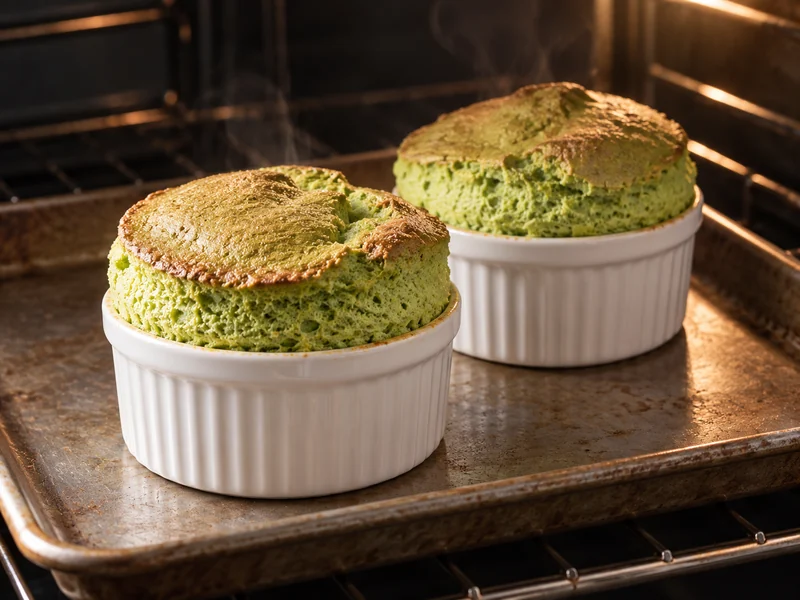
A matcha souffle is a warm, oven-baked egg-foam dessert portioned into individual ramekins. Its sides rise above the rim, while the center remains delicate. A griddle-cooked souffle pancake has different heat transfer, shaping, and holding requirements and should not enter the same trial.
Specify ramekin volume, fill weight, rise above rim, center texture, surface color, and seconds from oven to table. Collapse after service is normal; the commercial question is whether the kitchen can present the dessert before that loss becomes unacceptable.
Key Takeaway: Define the item as an oven ramekin souffle with immediate service.
What matcha quantities and yields appear in published souffles?
Just One Cookbook’s matcha souffle states 1–2 Tbsp matcha, identifying 1 Tbsp as 6 g, and yields 4. Cooking Therapy states 1 tbsp plus 1 tsp matcha in its base and 1 tsp for another component, yielding 2 people.
| Published benchmark | Matcha stated by source | Declared yield | Cook time |
|---|---|---|---|
| Just One Cookbook | 1–2 Tbsp; 1 Tbsp = 6 g | 4 | 15 min |
| Cooking Therapy | 1 tbsp + 1 tsp; plus 1 tsp | 2 people | 11 min |
These are separate formulas. Keep the original units and placement of matcha rather than adding every quantity into one dose.
Key Takeaway: Reproduce each source formula intact before changing matcha level.
Which ramekins should a matcha souffle trial use?
Just One Cookbook uses four 4-oz (½-cup) ramekins. Cooking Therapy uses two ramekins stated as 4 inches in diameter. Volume and diameter are not interchangeable specifications; wall height and material affect rise and bake.
| Source | Ramekin instruction | Preparation |
|---|---|---|
| Just One Cookbook | Four 4-oz / ½-cup ramekins | ½ Tbsp butter total, upward strokes; 1 tsp sugar each |
| Cooking Therapy | Two ramekins, 4 inches diameter | Brush with melted butter; coat with sugar |
| Kitchen trial | One matched ramekin lot | Weigh coating and batter fill |
Use identical ramekins from one lot. Weigh batter into each and keep the rims clean. Avoid mixing ceramic thicknesses in one oven load because heat response will obscure formula differences.
Key Takeaway: Bind every rise result to ramekin volume, geometry, material, and fill weight.
Why are butter strokes and sugar coating used on ramekins?
The Just One Cookbook benchmark brushes room-temperature butter upward and uses 1 tsp sugar in each ramekin, then chills them. The stated purpose is to give the souffle something to grip while climbing. Cooking Therapy also uses melted butter and sugar.
For a line trial, standardize the brush, butter mass, stroke direction, sugar mass, and chill time. Inspect bare patches and sugar clumps before filling. Choose the method that produces uniform rise with an acceptable release and eating texture.
Key Takeaway: Treat ramekin preparation as a measured process step, not a decorative habit.
How should the matcha base be prepared?
The base must be smooth enough to fold with foam and thick enough to support it. Cooking Therapy adds matcha powder and milk to a saucepan and whisks before heating. That gives a direct dispersion route for its formula. Other souffle systems sift matcha with flour and sugar.
Record matcha addition point, liquid temperature, cook time, final base weight, and base temperature at folding. A stiff cold base leaves streaks; an overly hot base damages foam. Avoid thinning with an unmeasured splash of milk because it changes both viscosity and yield.
Key Takeaway: Define a smooth base and a repeatable folding-temperature window.
What meringue endpoint supports matcha souffle rise?
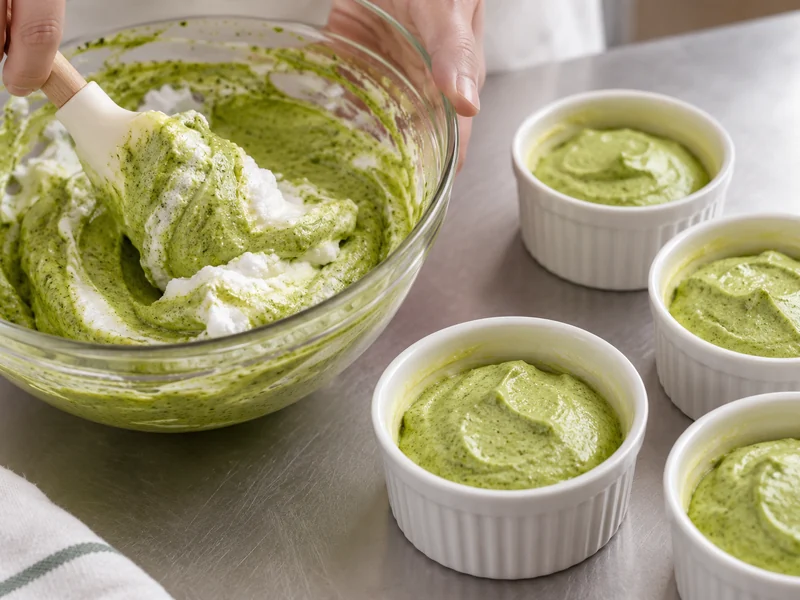
The egg whites should form a glossy, flexible foam that holds structure without dry clumps. The base first needs a smaller foam portion to lighten it; the remaining foam can then be folded with fewer strokes.
Record egg-white weight and temperature, mixer load, sugar-addition sequence, peak behavior, and fold count. Choose the endpoint that gives uniform small cells and an even rise. Avoid whipping to the driest possible peak; coarse foam interfaces can split and leave a streaked batter.
Key Takeaway: Flexible glossy foam folds more evenly than a dry, clumped meringue.
Which oven profiles are useful souffle benchmarks?
Just One Cookbook preheats to 400ºF (200ºC), notes a 25ºF (15ºC) reduction for convection, and reports 15 minutes cooking. Cooking Therapy also preheats to 400°F and reports 11 minutes. An air-fryer source in the research set uses 330°F for 12 minutes and explicitly says not to open during that period; that is a different appliance trial.
| Equipment benchmark | Temperature | Time stated | Control risk |
|---|---|---|---|
| Conventional oven, JOC | 400ºF / 200ºC | 15 min | Load and recovery |
| Oven, Cooking Therapy | 400°F | 11 min | Ramekin geometry |
| Air fryer source | 330°F | 12 min | Airflow and small cavity |
Measure oven recovery after loading and keep the door closed until the defined check. Choose the earliest endpoint that gives the intended center and stable rise.
Key Takeaway: Do not transfer an air-fryer time to a ramekin oven process without a new trial.
How should a restaurant organize immediate souffle service?
Map the order from firing to table: base portion, foam fold if made to order, ramekin fill, bake, pickup, garnish, and server travel. Time each step during a realistic service simulation. A formula that works in an empty kitchen may fail when the oven is loaded with other items.
Choose a limited number of simultaneous orders that the oven and pass can support. Avoid holding finished souffles for photographs or batching them ahead of demand; visible collapse is built into the format.
Key Takeaway: Menu viability depends on firing capacity and seconds to table, not only recipe quality.
Which matcha grade should buyers test in souffle?
AdoroHu E-1/E-2 and O-1/O-2 identify culinary tiers for sample comparison. The culinary matcha product page is the product destination, and matcha for baking gives application context.
Compare samples in the same warm base, ramekin, and bake. Score dispersion, aroma at the table, bitterness, color, and documentation. AdoroHu supplies powder; it does not produce or validate the finished souffle.
Key Takeaway: Approve matcha in the warm served souffle under the intended kitchen process.
How should egg handling and release criteria be documented?
The restaurant must apply its validated egg handling, cooking, allergen, and sanitation controls under local requirements. The FDA safe food-handling guidance is a public reference, not a souffle-specific cooking limit.
Release records should capture ramekin lot, fill weight, oven load, actual bake time, visible rise, center target, and time to service. The commercial dessert guide may help menu positioning but does not establish safety or hold time.
Key Takeaway: Separate immediate quality timing from the operation’s validated food-safety controls.
FAQ
- Is matcha souffle the same as souffle pancakes?
- No. This product is baked in ramekins in an oven and served immediately; souffle pancakes are griddle-cooked.
- What ramekin size does a published matcha souffle use?
- One ranked source uses four 4-oz (½-cup) ramekins; another describes 4-inch-diameter ramekins.
- Why is sugar added to the ramekin?
- In the published method, butter and sugar prepare the wall and provide a surface for the batter to climb.
- How long does matcha souffle bake?
- Ranked oven recipes report 11 and 15 minutes at 400°F, but the actual endpoint depends on ramekin and oven.
- Does AdoroHu make finished souffles?
- No. AdoroHu Matcha supplies matcha powder; the restaurant owns formula, egg controls, and service.
- Can a souffle be held for later service?
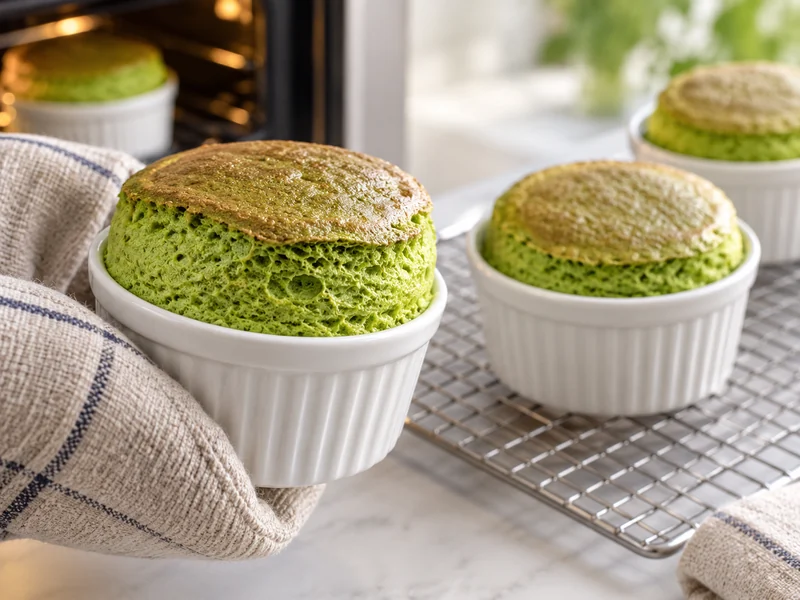
- It begins losing height after baking, so service must be organized for immediate pickup rather than a promised hold.
Conclusion
Matcha souffle is a strict oven-ramekin process whose commercial success depends on repeatable foam, ramekin preparation, oven recovery, and immediate service. Contact AdoroHu Matcha with the base, ramekin, certification needs, and projected volume when requesting samples.