
Matcha lead times for B2B buyers typically run 2 to 4 weeks for a standard restock, 3 to 5 weeks for a first order including sampling, and 6 to 10 weeks during the first-harvest peak season, depending on grade, order size, sourcing model, and season. Here’s the planning gap that catches buyers off guard: most assume one fixed “lead time,” when in reality it is the sum of several stages that each stretch or compress with conditions.
That assumption causes stockouts. A café that reorders at its usual 2-week pace heading into a spring iced-latte rush can wait 8 weeks during first-harvest season and run dry mid-peak. A brand that does not budget sample-and-evaluation time into a first order misjudges its launch date. A buyer who never asks how a supplier sources cannot tell whether 3 weeks is realistic or optimistic. Understanding matcha lead times means understanding the stages and the variables. This guide breaks both down, and shows how an estate-controlled matcha supplier keeps lead times more stable than a trader buying at auction.
Matcha lead times vary by stage and condition. A standard restock for an existing buyer typically takes 2 to 4 weeks; a first order including sampling and evaluation runs about 3 to 5 weeks; and first-harvest peak season (late spring) can extend popular grades to 6 to 10 weeks. The total is the sum of inquiry, sampling, contract, production, freight, and customs stages. Order size, grade availability, sourcing model (direct vs distributor, overseas vs local warehouse), and season all shift it. Planning orders 1 to 2 months ahead of peak demand is the key to avoiding stockouts.
In short: matcha lead times run roughly 2 to 4 weeks standard, 3 to 5 weeks for a first order, and 6 to 10 weeks at peak, so plan ahead of demand.
Key points:
- A standard restock runs 2 to 4 weeks; a first order with sampling runs 3 to 5 weeks.
- First-harvest peak season can extend popular grades to 6 to 10 weeks.
- Lead time is the sum of inquiry, sampling, contract, production, freight, and customs stages.
What is a typical matcha lead time for B2B orders?
A typical matcha lead time is 2 to 4 weeks for a standard wholesale restock, though a first order takes longer. Here’s the baseline to plan around: an established buyer reordering a known product sits at the short end, while a new buyer starting from scratch should budget more.
The numbers vary with relationship and conditions. For an existing customer reordering a familiar grade, 2 to 4 weeks is normal in regular season. A first order runs longer, around 3 to 5 weeks, because it includes sampling and evaluation before production even begins. Subsequent orders then compress toward 2 weeks as the relationship and specifications are already established. These are regular-season figures; peak season changes them substantially, as covered below. The experienced view: ask a supplier for their lead time both in regular season and at peak, since a single quoted number hides the seasonal swing. A reliable premium matcha supplier will give you both.
Key Takeaway: Budget 2 to 4 weeks for a standard restock and 3 to 5 weeks for a first order including sampling; subsequent orders compress toward 2 weeks, but always ask for both regular-season and peak-season lead times, since one number hides the swing.
What stages make up a matcha lead time?
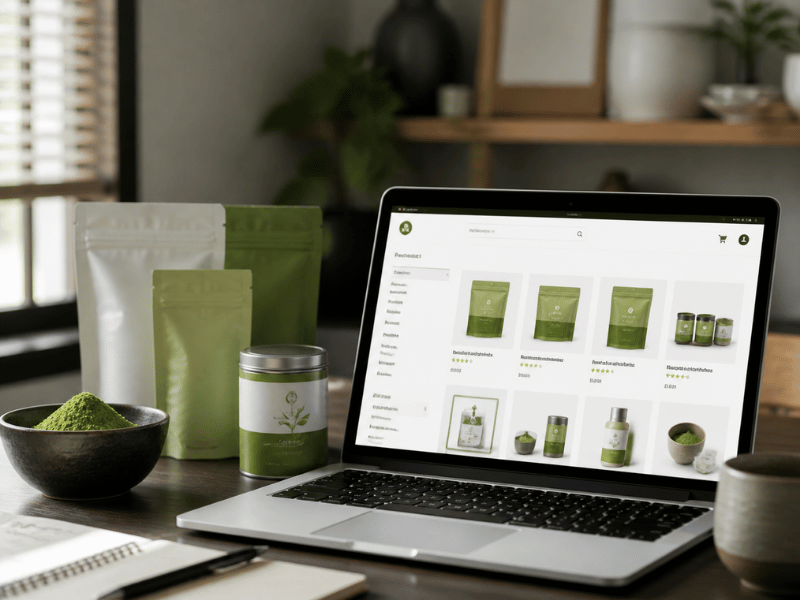
Matcha lead time is the sum of several sequential stages, not a single block of time. Here’s what you are actually waiting through: each stage has its own duration, and a delay in any one extends the whole.
Breaking it into stages makes the timeline predictable.
- Inquiry and quote: initial contact, grade recommendation, and pricing, often a few days.
- Sampling and evaluation: roughly 1 week to ship samples plus 1 week to evaluate (first order only).
- Contract and payment: agreeing terms and clearing the deposit, a few days to a week.
- Production and packing: preparing and packing your grade and format, around 1 to 2 weeks.
- Freight: roughly 1 week by air, or several weeks by sea for large bulk.
- Customs clearance: typically 1 to 3 days if documentation is complete, longer if flagged.
The judgment: the stages you can compress are sampling (skipped on reorders) and freight (air vs sea), while production and customs are harder to rush. Confirming documentation early, as covered in any matcha supplier vetting process, prevents the customs stage from blowing out.
Key Takeaway: Lead time is the sum of inquiry, sampling, contract, production, freight, and customs stages; sampling and freight are the compressible stages, while production and customs are not, so a delay in any single stage extends the whole timeline.
Why do matcha lead times vary so much between suppliers?
Matcha lead times vary because suppliers differ in sourcing model, inventory, and location. Here’s why one supplier quotes 3 days and another 10 weeks: they are not selling the same supply chain, even if the product looks similar.
Several structural factors drive the spread. A supplier shipping from a local in-country warehouse can deliver in days, but trades off freshness and grade selection, while a producer shipping direct from origin takes weeks but offers the freshest, fullest range. A vertically integrated producer that controls its own harvest can plan production, whereas a trader buying lots at auction is exposed to availability swings. Order size matters too: a small order from warehouse stock ships fast, while a large custom order needs a production run. The experienced read: a very short lead time usually means warehoused, pre-packed stock, while origin-direct and custom orders take longer but offer more control. AdoroHu’s 350-hectare self-owned estate and 3,000-tonne capacity allow planned production rather than scrambling for auction lots, which keeps lead times steadier through the season.
Key Takeaway: Lead times vary by sourcing model, inventory, and location: local-warehouse stock ships in days but limits freshness and range, while origin-direct and custom orders take weeks but offer control, and estate-controlled production stays steadier than auction-dependent trading.
How does peak season affect matcha lead times?
Peak season extends matcha lead times significantly, especially around the first harvest and the spring-summer demand surge. Here’s the seasonal trap: the time you most want matcha is the time it takes longest to get.
Two peaks compound. The first-harvest (ichibancha) season in late spring is when the most sought-after new-crop matcha is produced, and demand for it spikes, pushing lead times for popular grades to 6 to 10 weeks at some suppliers. Separately, café demand surges in spring and summer as iced matcha lattes sell, straining supply just as the harvest bottleneck hits. The result is that a 2-to-4-week regular lead time can double or more at peak. The experienced rule: place orders 1 to 2 months ahead of your peak season so supply is secured before lead times stretch, a discipline detailed in any bulk matcha buying plan. Waiting until demand peaks is the single most common cause of a stockout.
Key Takeaway: Peak season, first harvest plus the spring-summer café surge, can double regular lead times to 6 to 10 weeks for popular grades; order 1 to 2 months ahead of your peak so supply is locked before lead times stretch, since waiting until demand peaks causes stockouts.
How does order size and customization affect matcha lead time?
Larger and more customized matcha orders take longer, because they require dedicated production rather than shipping from stock. Here’s the trade-off: the more tailored your order, the more lead time it needs.
Size and customization each add time. A small order matching a supplier’s standard stock can ship quickly, while a large-volume order needs a scheduled production run. Customization adds further: private-label packaging, a custom grade blend, or specific particle-size or format requirements all require setup time beyond the matcha itself. The judgment from experience: separate your “ingredient lead time” from your “packaging lead time,” since custom printed pouches or tins often take longer to produce than the matcha and can become the real bottleneck. A buyer planning a private label launch should budget packaging production in parallel with matcha production, not after. Standardized bulk formats are always the fastest path when speed matters most.
Key Takeaway: Larger and customized orders take longer because they need dedicated production, not stock; separate ingredient lead time from packaging lead time, since custom pouches or tins often take longer than the matcha itself and become the real bottleneck, so run them in parallel.
How can B2B buyers reduce or manage matcha lead times?
You manage matcha lead times by forecasting demand, ordering ahead, and building a supplier relationship that earns priority. Here’s the mindset shift: lead time is not just the supplier’s number, it is something you actively manage through planning.
Several levers are in your control.
- Forecast usage and place orders 1 to 2 months ahead of peak demand.
- Reorder a familiar product to skip the sampling stage and compress the timeline.
- Choose air freight or local-warehouse stock when speed matters, accepting the trade-offs.
- Establish a direct, ongoing relationship, since repeat buyers often get supply priority.
- Hold safety stock sized to your lead time, so a delay never empties your shelf.
The experienced safeguard: in a tightening market, an annual allocation contract locks both volume and timing, insulating you from peak-season lead-time spikes, an approach worth weighing alongside the figures in a matcha bulk price analysis. Planning ahead beats chasing a faster supplier mid-shortage.
Key Takeaway: Manage lead times by forecasting and ordering 1 to 2 months ahead, reordering familiar products to skip sampling, holding safety stock sized to your lead time, and building a direct relationship for priority; in a tight market, an allocation contract locks volume and timing against peak spikes.
How do lead times differ for direct sourcing versus distributors?
Direct sourcing and distributor sourcing offer different lead-time profiles, each with trade-offs. Here’s the core difference: a distributor holds local stock for speed, while direct sourcing trades some speed for freshness, range, and cost control.
The two models suit different needs. A domestic distributor or a producer with a local warehouse can deliver in days because the stock is already in-country, ideal for urgent or small reorders, but the selection is limited to what they stock and the price includes their markup. Direct sourcing from the producer takes longer per order, weeks rather than days, but gives the freshest product, the full grade range, custom options, and a lower cost without the distributor margin. The judgment: many mature buyers run a hybrid, holding a local safety buffer for speed while sourcing the bulk of volume direct for cost and freshness. Understanding the full route also matters when you import matcha yourself, since customs adds a stage a domestic distributor absorbs for you.
Key Takeaway: Distributors deliver in days from local stock but limit range and add markup, while direct sourcing takes weeks but offers freshness, full range, and lower cost; many buyers run a hybrid, a local buffer for speed plus direct sourcing for the bulk, to balance both.
What happens when matcha lead times are not planned for?
When lead times are not planned for, the result is stockouts, rushed premium-priced orders, or forced quality compromises. Here’s the cascade: a missed lead time does not just delay one order, it disrupts your whole operation.
The consequences compound quickly. Running out mid-peak means lost sales and disappointed customers in your highest-demand window. Scrambling for a fast replacement often means paying a premium for air freight or accepting whatever grade is available rather than your specified one. Switching suppliers under pressure risks a product your customers will notice is different. The experienced view: the cost of a stockout, lost revenue plus emergency sourcing plus quality risk, vastly exceeds the minor working-capital cost of ordering early and holding safety stock. This is why supply reliability, not just price, should anchor supplier choice, the same principle behind sourcing from a reliable supply operation with capacity headroom.
Key Takeaway: Unplanned lead times cause stockouts, premium-priced rush orders, and quality compromises, each disrupting the wider operation; the cost of a stockout far exceeds the working-capital cost of ordering early and holding safety stock, so anchor supplier choice on reliability, not just price.

FAQ
- How long does a matcha wholesale order take?
- A standard restock for an existing buyer typically takes 2 to 4 weeks in regular season. A first order takes longer, around 3 to 5 weeks, because it includes sampling and evaluation before production. Subsequent orders compress toward 2 weeks once your specifications and relationship are established.
- Why are matcha lead times longer in spring?
- Because late spring is the first-harvest (ichibancha) season, when the most sought-after new-crop matcha is produced and demand for it spikes, while café demand also surges with iced matcha lattes. These pressures combine to extend lead times for popular grades to 6 to 10 weeks at some suppliers, so order 1 to 2 months ahead.
- Why do different suppliers quote such different lead times?
- Because they use different sourcing models. A supplier shipping from a local in-country warehouse can deliver in days but with limited freshness and range, while a producer shipping direct from origin takes weeks but offers the freshest, fullest selection. Order size and whether the product is stocked or custom-produced also shift the timeline.
- How far ahead should I order matcha to avoid stockouts?
- Place orders 1 to 2 months ahead of your peak demand season, and hold safety stock sized to your normal lead time so a delay never empties your shelf. In a tight market, an annual allocation contract that locks both volume and timing protects you from peak-season lead-time spikes.
- Does ordering a larger or custom matcha order take longer?
- Yes. Large-volume orders need a scheduled production run rather than shipping from stock, and customization, private-label packaging, custom blends, or specific formats, adds setup time. Custom printed packaging often takes longer to produce than the matcha itself, so budget packaging and ingredient lead times in parallel.
Conclusion
Matcha lead times are not a single fixed number but the sum of inquiry, sampling, contract, production, freight, and customs stages, running roughly 2 to 4 weeks for a standard restock, 3 to 5 weeks for a first order, and 6 to 10 weeks at peak season. The decisive takeaway is that lead time is something you manage, through forecasting, ordering ahead of peak, holding safety stock, and choosing a supplier with the capacity to stay reliable when demand surges. To plan a supply schedule around dependable, estate-controlled lead times, contact AdoroHu Matcha to request samples and a wholesale quote matched to your volume and season.