
Matcha madeleines succeed when the batter forms a distinct hump, releases from the shell mold, and still tastes of tea after the butter-rich cake cools. A bakery therefore needs to control aeration, rest, deposit, pan preparation, and oven profile together. The broader matcha pastry sourcing guide explains why dry-powder appearance alone cannot select the ingredient.
Published recipes give useful starting points, though they are not AdoroHu formulas or validated commercial processes. The comparisons below retain each creator’s units and connect the benchmark to a test a production team can run.
Matcha madeleines need a rested butter batter, a prepared shell pan, and an oven profile that sets the ridges before the cake dries. Compare deposits and bake profiles with the same pan, then judge hump, release, crumb, and tea flavor after cooling.
In short:
Key points:
- Define a shell-shaped cake with a visible hump, not a generic green sponge.
- Use published dose, rest, pan, and bake figures as separate trial benchmarks.
- Cost from accepted cooled pieces and validate the chosen package independently.
What makes matcha madeleines different from small sponge cakes?
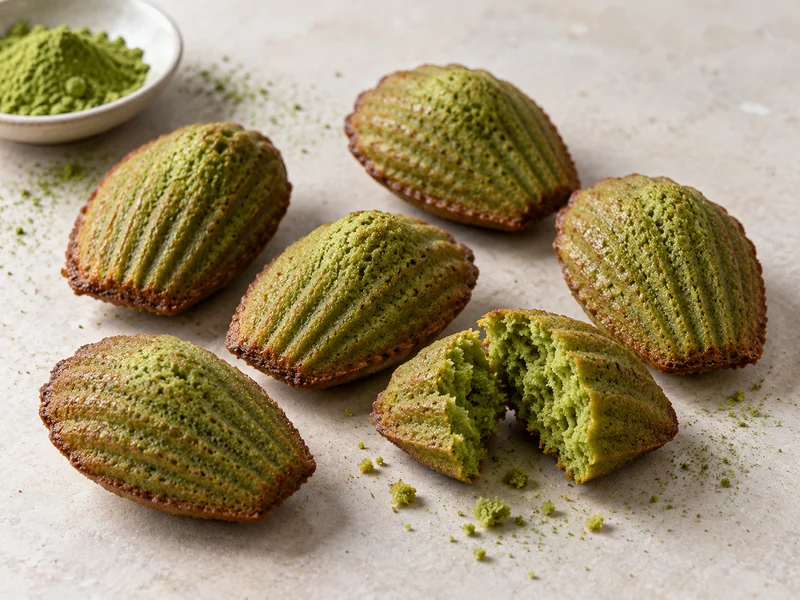
Matcha madeleines are small butter cakes whose identity comes from their ribbed shell face and raised back. Those two surfaces heat differently: the thin ridges brown first, while the deeper center must expand and set. A flat cake may taste acceptable but fails the format and changes how many pieces can be sold as first quality.
Set an acceptance card before formulation. Record shell definition, hump height, release damage, center crumb, edge color, and cooled tea finish. Photograph both faces under fixed light. This makes a pan-release defect visibly different from a low-aeration defect.
Key Takeaway: Approve the shell, hump, and cooled crumb together; color alone does not define the product.
How much matcha do published madeleine recipes use?
Published matcha madeleine recipes use different matcha quantities, yields, and flour systems, so each should remain a separate benchmark. Just One Cookbook’s matcha madeleines state 1 Tbsp matcha, identified there as 6 g, with 1 cup flour and a yield of 24. Teak & Thyme states 2 teaspoons matcha with 100 g flour for 12 madeleines. The Little Epicurean states 2 teaspoons matcha with 90 g flour for 12.
| Published benchmark | Matcha stated by source | Flour stated by source | Declared yield |
|---|---|---|---|
| Just One Cookbook | 1 Tbsp (6 g) | 1 cup | 24 |
| Teak & Thyme | 2 teaspoons | 100 g | 12 |
| The Little Epicurean | 2 teaspoons | 90 g | 12 |
Do not convert the teaspoon examples to grams without a source-specific weighed value. For procurement, keep each formula intact, bake it as a benchmark, then create internal variants around the best-performing system.
Key Takeaway: Use the published quantities as distinct test formulas, not as a universal dose range.
Why does batter rest matter for the madeleine hump?
Batter rest changes temperature, viscosity, flour hydration, and how quickly the deposited center spreads. Three ranked recipes make the rest operationally visible: Just One Cookbook specifies 3 hours or overnight, Teak & Thyme specifies 1 hour, and The Little Epicurean specifies at least 3 hours, preferably overnight.
Run the rest test from one mixed batch. Split it into labeled containers, deposit after 1 hour and 3 hours, and keep the same pan, deposit tool, and oven load. An overnight arm can follow if the production schedule needs it. Record deposit spread before baking and hump height after cooling.
Choose the shortest rest that repeatedly clears the specification. Avoid selecting the longest rest merely because a home recipe recommends it; unnecessary refrigerator occupancy and delayed changeovers reduce line capacity.
Key Takeaway: A rest decision should connect hump performance to refrigerator time and production scheduling.
Which pan fill and preparation should a bakery compare?
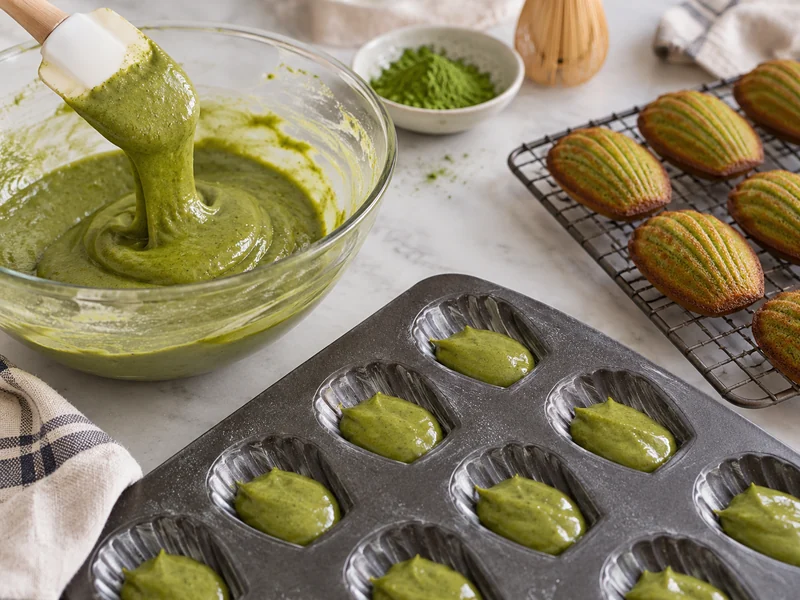
Pan preparation determines whether the ridges survive release. Just One Cookbook uses two 12-well pans, brushes the molds with butter, dusts with flour, and deposits 1 Tbsp batter in each mold. Teak & Thyme also butters the depressions but deposits about 2 teaspoons. The Little Epicurean butters and flours a 12-cavity pan and fills each cavity ¾ full.
| Pan test | Deposit instruction | Release treatment | What to inspect |
|---|---|---|---|
| JOC benchmark | 1 Tbsp per mold | Butter and flour | Ridge damage and piece weight |
| T&T benchmark | About 2 teaspoons | Butter | Spread and shell definition |
| TLE benchmark | ¾ full | Butter and flour | Hump, overflow, and release |
Weigh ten deposits after choosing a volumetric starting point. Volume is fast for recipe comparison, while weight exposes operator and scoop variation. Reject a release treatment that leaves flour patches on the green surface or tears the ribs.
Key Takeaway: Standardize deposit weight and pan release before blaming matcha for poor shell detail.
How should matcha madeleines be mixed without losing volume?
Matcha should be sifted with the dry ingredients so it enters as a fine, even solid. Just One Cookbook sifts flour, salt, baking powder, and matcha together, then combines that dry phase with frothy eggs and milk. Teak & Thyme beats eggs and sugar until pale and thick for at least 8–9 minutes before later folding.
These are different aeration systems. A bakery should choose one and record egg temperature, mixer load, whisk speed, visual endpoint, fold count, and melted-butter temperature. A green streak near the bowl bottom shows incomplete folding; a low, tight cake points to lost air or excess mixing.
Avoid adding extra liquid simply to disperse matcha. The added water changes viscosity and bake behavior, obscuring whether sifting and folding would have solved the problem.
Key Takeaway: Keep the selected egg-aeration method intact while testing matcha dispersion.
Which oven profiles are useful madeleine benchmarks?
The ranked recipes show three materially different heat strategies. Just One Cookbook bakes at 375°F (190°C) for 11–13 minutes. Teak & Thyme starts at 400°F for 5 minutes, then lowers to 350°F for another 5–7 minutes. Lemons + Anchovies preheats to 425°F, reduces immediately to 350°F, and bakes for 13 minutes, checking at 11.
| Source profile | Initial heat | Later heat | Stated bake time |
|---|---|---|---|
| Just One Cookbook | 375°F (190°C) | Same | 11–13 min |
| Teak & Thyme | 400°F for 5 min | 350°F | 5–7 min more |
| Lemons + Anchovies | 425°F preheat | 350°F immediately | 13 min; check at 11 |
Commercial ovens recover differently after loading. Log actual cavity temperature and tray position, then compare hump, edge color, spring-back, and bake loss. Choose the profile with the broadest acceptable window, because a one-minute window is difficult to execute during peak production.
Key Takeaway: Select an oven profile by repeatable hump and moisture performance, not by the highest starting temperature.
When should a bakery add white chocolate or brown butter?
White chocolate shells and brown butter are separate product variants, not automatic improvements. Teak & Thyme uses 200 g white chocolate plus ½ teaspoon matcha for its coating stage after the cakes cool. Brown butter changes water content and milk-solid flavor, so it should be trialed against the approved plain-butter control rather than substituted mid-test.
Choose a coating when it improves merchandising and survives the expected handling temperature. Avoid using it to cover weak tea flavor; the result adds material, labor, and allergen complexity while leaving the base cake unresolved. If brown butter is tested, record starting and finished butter weights so evaporation does not silently change the formula.
Key Takeaway: Treat coating and browned butter as costed variants after the base madeleine passes.
Which matcha grade should buyers trial in madeleines?
A culinary grade with a clear flavor in butter, egg, and sugar is the practical starting point. AdoroHu’s E-1/E-2 and O-1/O-2 codes identify culinary tiers, which lets buyers request comparable samples without implying that the powder supplier has validated the finished cake. The culinary matcha product page provides the relevant product route, while the matcha for baking page frames the application.
Approve a lot using the same formula, pan, and oven profile. Compare dry dispersion, baked color, cooled aroma, bitterness, and documentation. A higher grade is only useful if the finished-product gain justifies its cost.
Key Takeaway: Select matcha in the cooled madeleine and bind the approved sample to its documentation.
How should matcha madeleine yield and packaging be validated?
Declared recipe yield is a planning denominator, not a commercial yield guarantee. Count accepted pieces after release and cooling, then divide ingredient and labor cost by that accepted count. Track broken ribs, flat backs, overflow, and underweight pieces as separate losses.
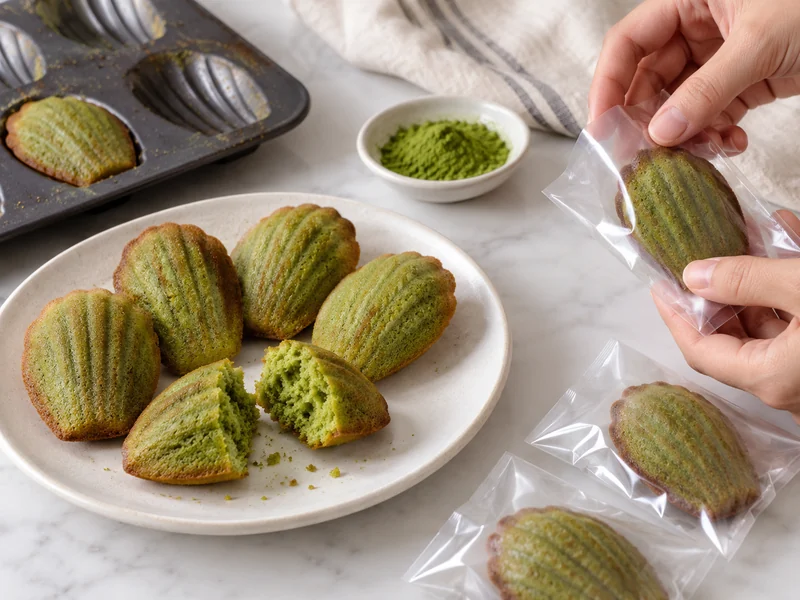
Cool fully before closing the package. Trapped warmth can create condensation and soften the ridges. Establish the sales window through the actual formula, cooling routine, film or tray, storage, and distribution test. The commercial dessert guide can help position the item beside other formats, but it does not replace madeleine-specific validation.
For ingredient handling and sanitation, apply the bakery’s validated plan and local requirements; the FDA safe food-handling guidance is an official public baseline, not a madeleine shelf-life standard.
Key Takeaway: Cost accepted cooled pieces and validate the real pack before assigning a shelf life.
FAQ
- Why do matcha madeleines need a shell pan?
- The pan creates the ribbed face and deeper center that distinguish a madeleine from a small sponge cake.
- Can a bakery skip the batter rest?
- It can test a no-rest control, but published benchmarks use rests from 1 hour to overnight. Compare hump and spread before changing the schedule.
- How much batter goes into each madeleine mold?
- Published instructions range from about 2 teaspoons to 1 Tbsp or ¾ full. Weigh deposits after selecting the pan-specific starting point.
- What oven temperature is used for matcha madeleines?
- Published profiles include a steady 375°F (190°C) bake and hotter starts followed by a reduction to 350°F.
- Does AdoroHu manufacture matcha madeleines?
- No. AdoroHu Matcha supplies matcha powder; the bakery develops and validates the finished product.
- Can a published recipe establish commercial shelf life?
- No. Shelf life requires validation of the actual formula, process, package, storage, and distribution conditions.
Conclusion
Matcha madeleines become repeatable when the bakery connects a published benchmark to its own pan, deposit, rest, and oven data. For sample selection, contact AdoroHu Matcha with the target formula, market, certification needs, and expected volume.