
Matcha meringue cookies are small piped pieces that must dry through, release cleanly, and stay crisp in a moisture-barrier pack. That target separates them from soft-centered pavlova. Our professional matcha pastry sourcing guide explains the wider ingredient context.
Published recipes differ sharply in dose, piece count, shape, and drying schedule. Preserve those exact facts as benchmark systems rather than averaging them into an invented formula.
Matcha meringue cookies are small piped pieces dried through for a crisp center and clean snap. Standardize foam, deposit geometry, low-temperature drying, cooling, and a moisture-barrier pack before assigning yield or storage.
In short:
Key points:
- Keep the product small and fully dried, distinct from soft-centered pavlova.
- Preserve each published dose, shape, and drying schedule as one benchmark system.
- Approve snap after cooling and package exposure, not at the oven door.
What defines a production-ready matcha meringue?
Set target piece weight, pipe shape, dry-center endpoint, snap, color, and packed condition. A warm crisp cookie may soften after equilibration, so approve it after full cooling and a package trial.
Key Takeaway: Release only a defined small geometry with a dry center and packed snap.
Which published dose and yield should anchor trials?
| Benchmark | Exact formula anchors | Declared output |
|---|---|---|
| A: Bakers Brigade | 5 egg whites, 1 1/2 cups superfine sugar, 2 teaspoons matcha, 2 teaspoons freeze-dried strawberry | 4 dozen |
| B: Passionate Pantry | 210 to 250 g whites, 330 g caster sugar, 2 level tsp matcha, 1 tsp cream of tartar, 1 tbls cornflour, 2 tsp vinegar | 32 mini meringues |
| C: Food Network | 3 whites, 3/4 cup superfine sugar, 2 tablespoons matcha, 1/2 teaspoon cream of tartar | 16 to 18 |
These are external benchmarks, not AdoroHu formulas. Units and piece definitions differ, so evaluate each recipe’s output before procurement or costing.
Key Takeaway: Keep source dose, egg system, shape, and declared yield connected.
How should matcha enter the foam?
Bakers Brigade uses 2 teaspoons matcha with its finished 5-white foam. Passionate Pantry removes 3 tablespoons from 330 g sugar, makes a lump-free blend with 2 level tsp matcha, then adds it gradually.
| A/B route | Exact source method | Production question |
|---|---|---|
| A: late addition | Bakers Brigade: 2 teaspoons matcha with 5 whites | Does the foam keep volume without green clumps? |
| B: sugar preblend | Passionate Pantry: 3 tablespoons reserved sugar plus 2 level tsp matcha | Does preblending improve dispersion and piping? |
Keep mixer load, egg temperature, pipe size, and drying profile fixed. Score specks, density, spread, cracks, and bitter spots.
Key Takeaway: Compare late addition and sugar preblend with all other process variables fixed.
What foam endpoint supports clean piping?
Bakers Brigade reports about 5–7 minutes of beating until sugar dissolves. Food Network beats to thick, glossy stiff peaks, about 6 more minutes after additions. Record bowl temperature, mixer setting, time, and visual endpoint. Stop before the foam turns rough; dry foam pipes raggedly and may leak syrup.
Key Takeaway: Stop at a glossy pipeable foam before it becomes rough or leaks syrup.
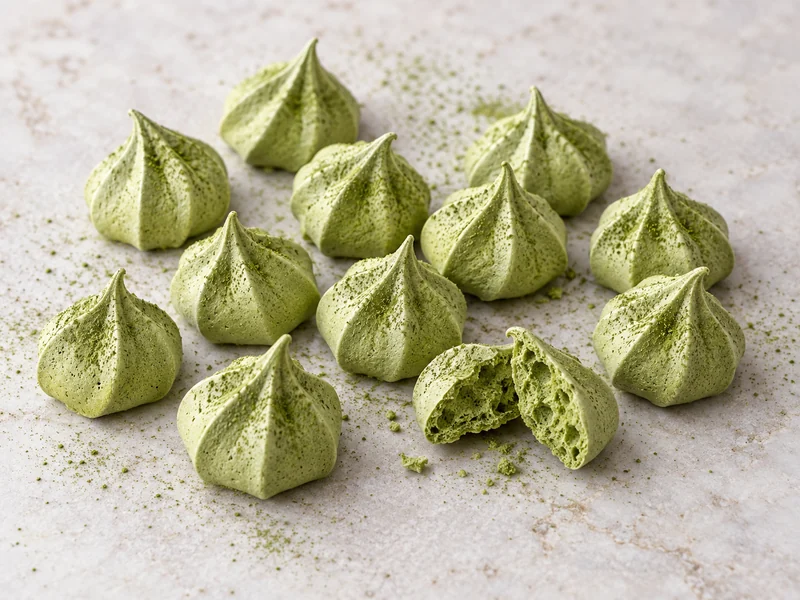
How do pipe size and spacing change drying?
| Detail | A: Bakers Brigade | B: Food Network |
|---|---|---|
| Opening or shape | Bag opening cut to 7/8 inch | Spirals 2 inches wide and 3 inches tall |
| Spacing | At least 1/2 inch | About 2 inches |
| Yield | 4 dozen | 16 to 18 |
These deposits cannot share an assumed dry time. Standardize piece weight and weigh samples before and after drying. Mixed sizes hide wet centers among crisp pieces.
Key Takeaway: Set one piece weight and spacing because geometry controls drying time.
Which low-temperature profile should be tested?
| Benchmark | Oven and active bake | Post-bake drying |
|---|---|---|
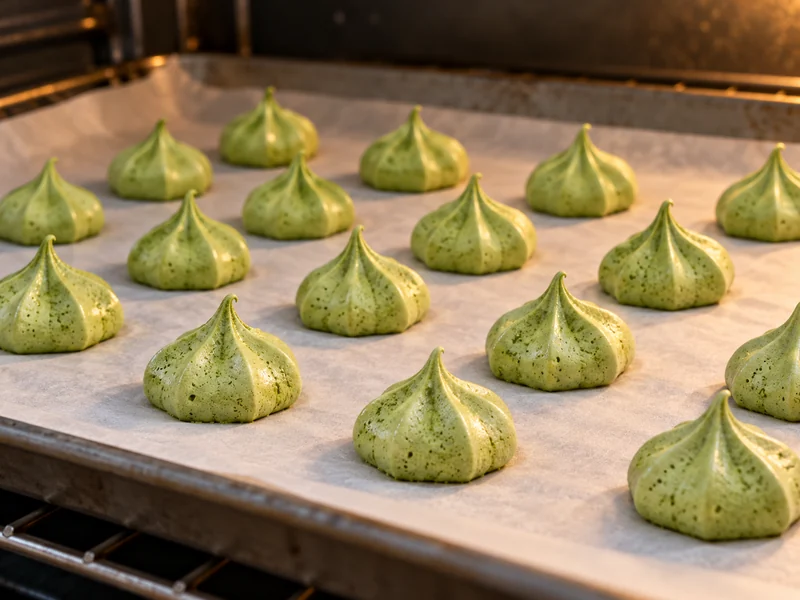
| A: Bakers Brigade | Heat sugar at 400°F about 5 minutes; reduce to 200°F; bake 30–40 minutes | Cool in switched-off oven overnight, or completely on trays |
| B: Passionate Pantry | Preheat 150°C fan; reduce to 120°C; bake 50 minutes | Switched-off oven at least 3 hours, usually overnight |
| C: Food Network | 250°F for 1 hour | Switched-off oven about 3 hours or overnight |
Run each profile with its stated shape and formula before adapting it. Record actual oven temperature, rack, clean release, center fracture, and cooled weight.
Key Takeaway: Run a complete source drying profile before adapting heat or time.
How can full drying be verified?
Break pieces from the coolest and warmest tray zones. The center must meet the defined dry texture, not merely feel dry outside. Record the percentage releasing cleanly. If exteriors color before centers dry, check piece weight and verified temperature before raising heat.
Key Takeaway: Break cooled samples from multiple tray zones and verify the center.
What packaging trial protects the snap?
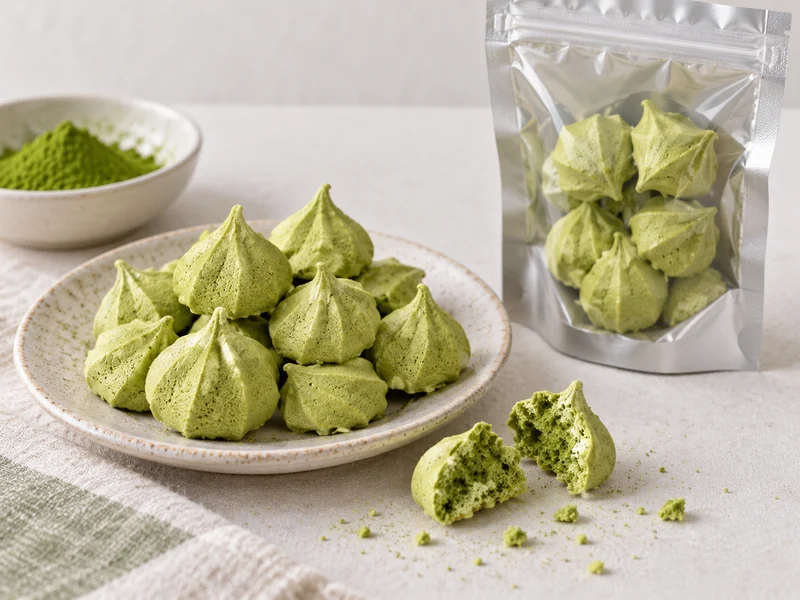
Bakers Brigade states airtight storage for up to 2 weeks, but that is not a commercial shelf-life result for another formula or climate. Pack fully cooled cookies in candidate moisture barriers. Compare an unpacked control with sealed samples, recording snap, tack, clumping, aroma, and seal integrity.
Key Takeaway: Validate snap in the actual sealed moisture barrier and climate.
How should matcha be selected for a dry cookie?
Drying and sugar alter bitterness and aroma. Screen the AdoroHu culinary matcha range in the finished cookie. The matcha for baking page provides the wider trial workflow. Approve color after cooling and packed holding, not in fresh foam.
Key Takeaway: Approve color and flavor after drying, cooling, and packed holding.
What must a scale-up record capture?
Record whites and temperature, sugar, matcha dose and unit, addition sequence, mixer load, foam endpoint, tip, piece weight, tray map, verified oven profile, cooled weight, yield, rejects, and package. Cost saleable packed pieces, not a borrowed 4 dozen, 32 minis, or 16–18 shapes.
Key Takeaway: Cost saleable packed pieces from a traceable foam, deposit, oven, and pack record.
Where does supplier support stop?
AdoroHu supplies powder, not finished meringues. The manufacturer owns formula, allergens, sanitation, labeling, package validation, and shelf life. Use the commercial matcha dessert guide for adjacent concepts, then contact AdoroHu Matcha with the product, volume, market, and documentation needs.
Key Takeaway: The powder supplier supports ingredient selection; the manufacturer validates the cookie and package.
Use the manufacturer’s validated egg, allergen, sanitation, and packaging controls; the FDA safe food-handling guidance is an official public baseline, not a meringue shelf-life rule.
FAQ
- What is the difference between matcha meringue and pavlova?
- Meringues are small pieces normally dried through for snap. Pavlova is a large shell intended to retain a softer center and carry toppings.
- How much matcha do published meringue recipes use?
- Captured examples range from 2 teaspoons with 5 whites to 2 tablespoons with 3 whites. Test the complete systems because yields and shapes differ.
- Why are matcha meringues sticky?
- They may be under-dried or may have absorbed ambient moisture. Check the center and validate a moisture-barrier package.
- Should matcha be folded in or mixed with sugar?
- Both appear in published methods. Compare late addition with a lump-free sugar preblend while other variables stay fixed.
- Can matcha meringues be stored for two weeks?
- One source states up to 2 weeks airtight. That is a benchmark, not proof for another recipe or package.
- Does AdoroHu make finished matcha meringues?
- No. AdoroHu supplies matcha powder; the manufacturer owns the finished product and validation.
Conclusion
Reliable matcha meringue production starts with defined geometry, glossy foam, complete low-temperature drying, and moisture protection. Keep every source’s dose, shape, and schedule connected during trials.