
Matcha jelly needs one declared gel system because agar and gelatin require different activation, setting, texture, and label decisions. A team can pair either with culinary matcha powder, but it should never substitute them one-for-one.
Published examples provide useful numbers for agar cubes, gelatin cubes, and layered coconut jelly. They are external recipe benchmarks, not AdoroHu-tested formulas or commercial shelf-life evidence.
Start matcha jelly development by choosing agar or gelatin and the intended use: cubes, spoonable dessert, parfait layer, or drink inclusion. Lock liquid depth, set time, and cut size before comparing powder grades. Finished-product claims depend on every ingredient and process.
In short:
Key points:
- Agar and gelatin are separate product systems.
- Mold depth changes cut yield and apparent firmness.
- Evaluate settling, syneresis, cut strength, and service behavior after the full set.
Should matcha jelly use agar or gelatin?
Matcha jelly should use agar when a plant-based, firmer cut is required and gelatin when a softer elastic set fits the product. Saltnpepperhere uses 1 tsp or 3 g agar with a final liquid level of 2 cups. Mochi Mommy uses one 7 g packet gelatin with 1½ cups combined hot and cold water.
| Gel system | Published matcha and gel | Stated use facts |
|---|---|---|
| Agar | 4 tsp/7 g matcha; 1 tsp/3 g agar | 2–3 yield; ½–¾-inch liquid depth; set at least 4 hr |
| Gelatin | 1 tbsp matcha; 7 g gelatin | yield 4; 6-inch square or 5×7-inch container; chill 3 hr |
| Gelatin | 4 g matcha; 5 g gelatin | 250 ml hot water; yield 2 |
Choose the system from texture, service, and label needs. Avoid swapping the same gram amount into the other system; the consequence is an uncontrolled set and possibly an incorrect vegan claim.
Key Takeaway: Select gel chemistry before dose, flavor, or mold optimization.
What does agar activation require in matcha jelly?
Agar matcha jelly requires a heating step that activates the agar before setting. Saltnpepperhere simmers agar, sugar, and water gently for one minute. Urban Platter brings each agar-containing coconut layer to a boil and simmers the first layer for one minute.
Record boil onset, one-minute hold, agitation, batch mass and time to filling. Matcha addition can be staged separately to reduce unnecessary heat exposure, but any change from the source must be labeled as a trial.
Avoid treating a warm dissolve as equivalent to agar activation. The consequence may be a weak or uneven gel that fails during cutting or drink service.
Key Takeaway: Make the activation hold observable and repeatable for the chosen agar formula.
How should matcha temperature be controlled in jelly?
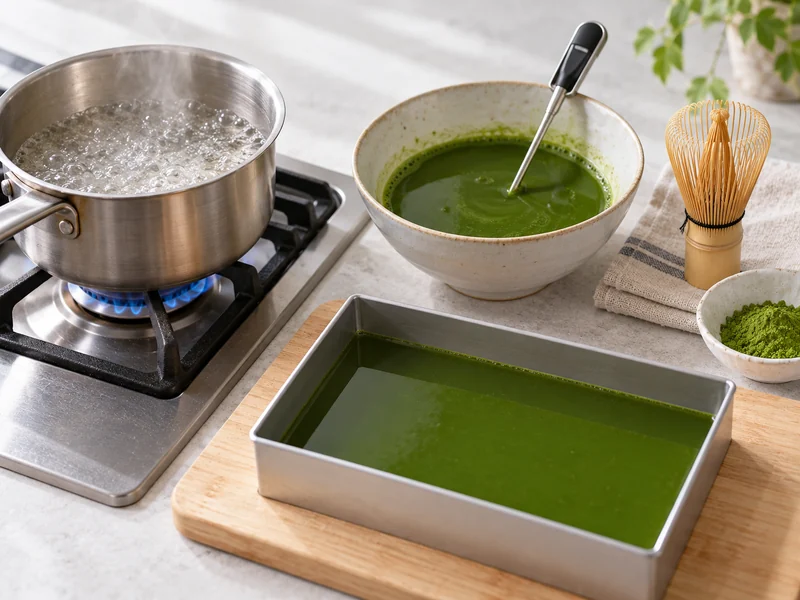
Matcha jelly temperature should be controlled independently from gel activation when the source supports it. Saltnpepperhere specifies 175°F/80°C water for its matcha dispersion, then adds cold water to bring the total to the 2-cup level.
That gives a practical first benchmark: activate agar, cool slightly, prepare the matcha at the stated water temperature, combine, and fill. Record temperature at dispersion and at filling, because both can affect color and premature setting.
Do not assume boiling water is required for matcha simply because agar needs boiling. Keeping those steps separate protects both process clarity and tea quality.
Key Takeaway: Separate gel activation temperature from matcha dispersion temperature.
How do mold depth and cut size change matcha jelly?
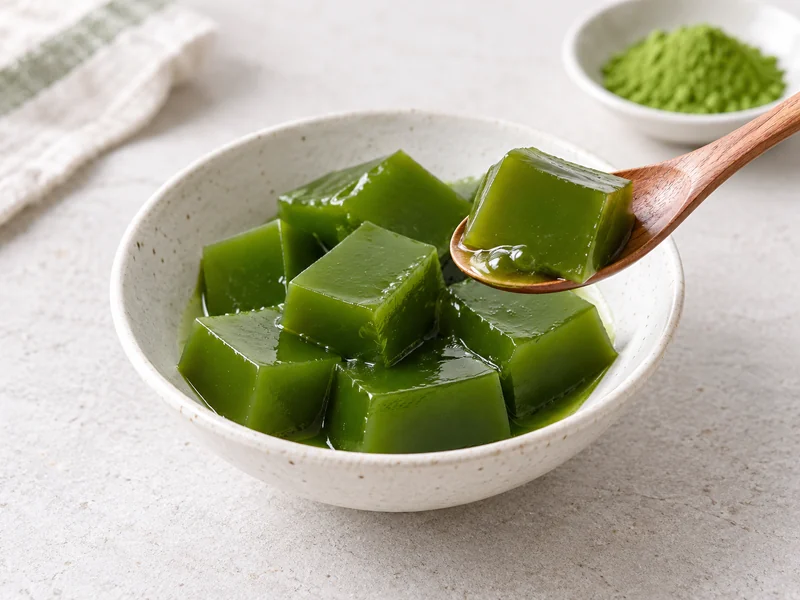
Mold depth changes matcha jelly set perception, cooling time, and cube yield. Saltnpepperhere recommends liquid ½ to ¾ inch deep in a 7½-by-5-inch dish. Mochi Mommy recommends a 6-inch square or 5-by-7-inch container for cubes.
Choose one filled depth and record actual liquid weight, mold dimensions, set time, cube dimensions, intact count and trim. A deeper gel may feel softer in the center and create larger beverage cubes; a shallow gel offers more top area and may dry faster at exposed edges.
Key Takeaway: Specify filled depth before comparing gel strength or cost per cube.
How should layered matcha jelly be developed?
Layered matcha jelly should be developed only after each individual gel sets correctly. Urban Platter’s published example uses 1½ tsp agar in a coconut-milk layer and another 1½ tsp agar in a coconut-water matcha layer, with 2 tsp matcha dispersed in ¼ cup warm water.
The source pours about ¼ cup first layer into each serving bowl and refrigerates at least 10 minutes before the next layer. That is an external timing benchmark for layer adhesion, not a universal production setting.
Test whether the second pour melts, separates from, or traps condensation on the first. Reject a visually sharp layer if it slides during spooning or transport.
Key Takeaway: Qualify each gel and the interface; a clean photograph does not prove layer stability.
Which matcha grade works in a gel dessert?
A matcha jelly dessert exposes color clearly, but condensed milk, coconut, or service milk can shift both color and flavor. AdoroHu identifies E-1/E-2 and O-1/O-2 as Culinary grades, with higher numbers in each series indicating deeper color, more sweetness and less bitterness.
Compare adjacent grades in the same gel system and depth. Judge center cubes after the complete set and in the intended serving liquid. Choose the step-up only when its customer-facing gain supports cost.
Avoid comparing a 7 g agar formula with a 4 g gelatin formula to select grade. Gel and liquid differences would dominate the result.
Key Takeaway: Hold gel system, liquid and depth constant during grade selection.
How should matcha jelly settling and syneresis be checked?
Matcha jelly settling and syneresis should be checked through the full vertical cut and during intended service. Photograph top, center and bottom; record dark sediment, surface water, cut-edge weeping, cube breakage and liquid clouding.
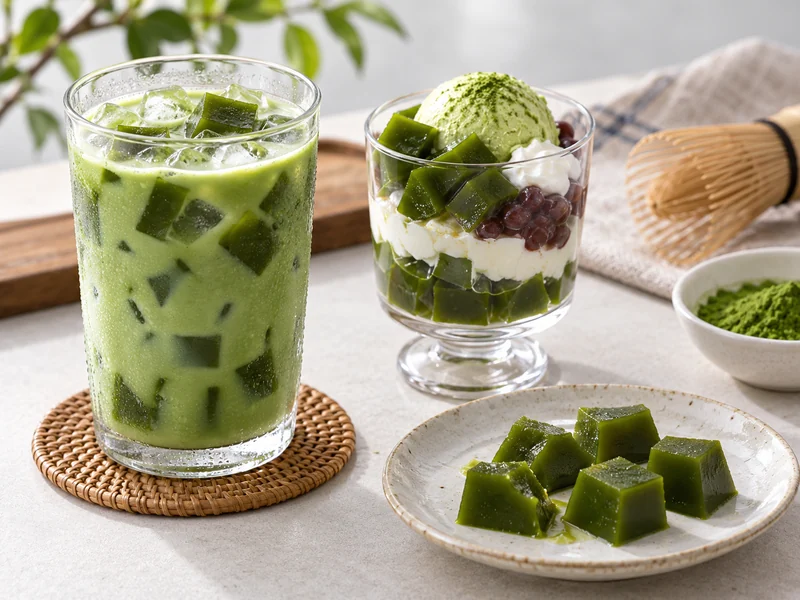
For beverage cubes, test the real straw size and drink temperature. For parfaits, test layer weight and spooning. These proposed trials are decision tools, not published performance claims.
| Service format | Check after setting | Reject when |
|---|---|---|
| Beverage cubes | straw clearance, breakage, liquid clouding | cubes block service or shed sediment |
| Parfait layer | adhesion, spoon cut, syneresis | layers slide or release water |
| Plain dessert | wobble, clean cut, matcha settling | top and bottom differ visibly |
The matcha dessert sourcing guide helps compare adjacent applications, and the matcha baking guide provides wider food context.
Key Takeaway: Evaluate the gel in its final service liquid or layer stack, not only on a plate.
What must a matcha jelly label and supplier brief state?
A matcha jelly label and supplier brief should state agar or gelatin, liquid base, sweetener, matcha dose, activation method, mold depth, cut, service use, market, and required certifications. Gelatin does not fit a vegan claim; milk or condensed milk changes allergens.
The FDA allergen overview provides U.S. context. AdoroHu supplies pure matcha, not finished jelly. Buyers can review the food application pathway and contact AdoroHu Matcha with the selected gel system.
Key Takeaway: Put gel identity and service format in the sample request.
FAQ
- Can agar replace gelatin one-for-one in matcha jelly?
- No. They activate and set differently, so each needs its own complete formula and process.
- Why does one agar recipe boil for one minute?
- The published method uses that hold to activate its agar system before setting.
- Is 175°F/80°C a universal jelly temperature?
- No. It is the matcha-dispersion water temperature in one published agar recipe, separate from agar activation.
- How deep should matcha jelly be poured?
- One published benchmark recommends ½ to ¾ inch. Validate depth for the intended cube, cooling, texture and service.
- Can gelatin matcha jelly be called vegan?
- No. A vegan product needs a suitable plant-based gel and review of every other ingredient and process.
- Does a three- or four-hour set prove shelf life?
- No. Set time is a process checkpoint; shelf life needs product-specific safety, pack, storage and sensory work.