
Matcha caramel in this guide means a cooked soft candy that is cast, set, cut, and wrapped. It does not mean a latte, macchiato, syrup, or dessert sauce. The one complete published recipe benchmark uses matcha powder, cream, two sugars, corn syrup, butter, and a 121°C/250°F endpoint.
The published Matcha Green Tea Caramels recipe from nobizlikedoughbiz provides the complete numeric candy benchmark used below. Its figures should anchor the first reproduction rather than imply a universal caramel formula.
A useful matcha caramel benchmark preserves the published 20 cm pan, 10 g matcha, 355 g cream, sugar system, thermometer endpoint, and 60-piece yield as one external formula. It is not an AdoroHu-tested recipe or a universal safe process.
In short:
Key points:
- Keep cooked candy separate from drinks, sauces, and flavored syrups.
- Control thermometer placement, sidewall crystals, final temperature, and pan depth.
- Cost wrapped pieces from actual accepted yield after setting and cutting.
What product does “matcha caramel” mean here?
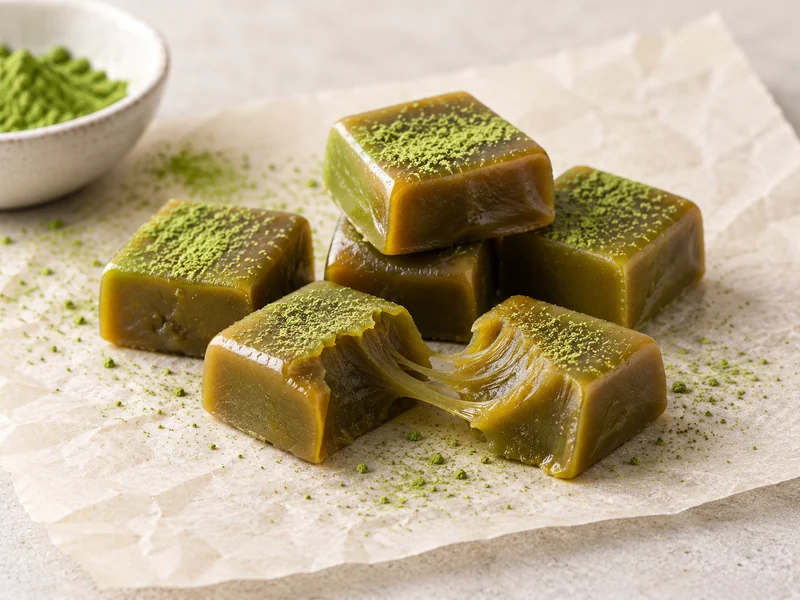
Matcha caramel means a chewy cooked candy made by boiling a sugar, dairy, fat, and matcha mixture to a defined endpoint. The published benchmark is cast into a lined 20 cm or 8-inch square pan, set at room temperature, and cut after at least five hours.
Caramel matcha drinks belong to a separate beverage brief because they do not supply the cooked-candy yield, endpoint, set, or cut needed here.
Key Takeaway: Use only cooked-candy evidence to design a cooked matcha caramel.
What does the published 60-piece caramel benchmark contain?
The published matcha caramel benchmark states 10 g matcha, 355 g heavy cream, 200 g granulated sugar, 100 g light brown sugar, 80 g light corn syrup, 6 g salt, 5 g vanilla, and 14 g butter. It states a yield of 60.
| Formula role | Published quantity | Buyer implication |
|---|---|---|
| Matcha | 10 g | Powder cost can be divided by accepted pieces after trial |
| Cream | 355 g | Dairy composition and allergen control matter |
| Total listed sugars and syrup | 380 g | Crystallization and sweetness belong to the system |
| Butter | 14 g plus pan grease | Fat and release method must remain controlled |
These figures form one linked external recipe. Changing cream, syrup, or sugar while evaluating matcha would break the benchmark.
Key Takeaway: Reproduce the complete formula before varying the tea ingredient.
Why does thermometer placement matter for matcha caramel?
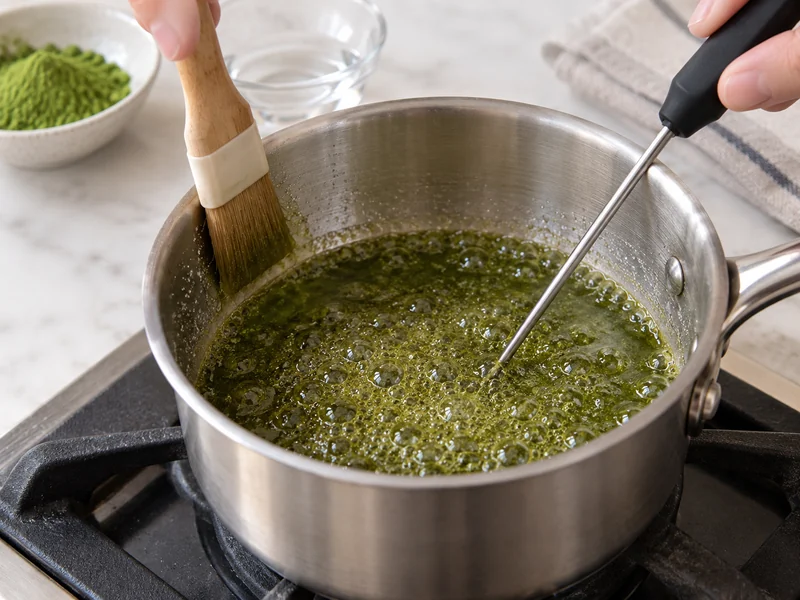
Thermometer placement matters because the published matcha caramel method calls for 121°C/250°F and warns that the digital thermometer must not touch the pan bottom. Contact with the hotter metal can give a misleading reading.
Record thermometer model, calibration check, probe depth, pan dimensions, batch weight and heating rate. The stated endpoint is a source-specific candy condition, not a food-safety guarantee or a universal setting for other formulas.
Choose a fixture that keeps the probe in the candy mass. Avoid holding the probe by hand for the whole cook when depth changes; the consequence is inconsistent endpoint and chew.
Key Takeaway: Control probe position before adjusting endpoint temperature.
How should crystallization be controlled in cooked matcha caramel?
Cooked matcha caramel should minimize stray sugar crystals on the saucepan wall. The published method brushes the sides with a water-moistened pastry brush as the mixture boils. It also uses corn syrup within the formula.
Standardize the brush step, stirring schedule, pan cleanliness, and any scraping during casting. Once the cook begins, unplanned sidewall scraping can return crystals to the mass.
Reject a grainy set before evaluating matcha flavor. Graininess is a sugar-process failure and can make the tea seem harsher than it is.
Key Takeaway: Diagnose crystallization from the sugar process before changing powder.
When should matcha be dispersed into the caramel?
Matcha is dispersed into part of the cream before the published caramel cook, then combined with the remaining cream, sugars, and syrup. That provides a concrete route for the first bench reproduction.
Record the cream fraction used, its temperature, whisking time, sieve, visible specks, and delay before cooking. Do not convert the 10 g dose to spoons or substitute a dry addition without labeling a new trial.
The dairy phase can mute bitterness but also makes clumps harder to see once boiling begins. Inspect the predispersion before it enters the saucepan.
Key Takeaway: Approve the matcha-cream dispersion before committing the batch to the cook.
How do pan depth and set time affect matcha caramel cutting?
Pan depth and set time determine the matcha caramel’s piece geometry and handling. The source uses a 20 cm/8-inch square pan, leaves foil overhang for removal, and sets the uncovered slab for at least five hours or overnight.
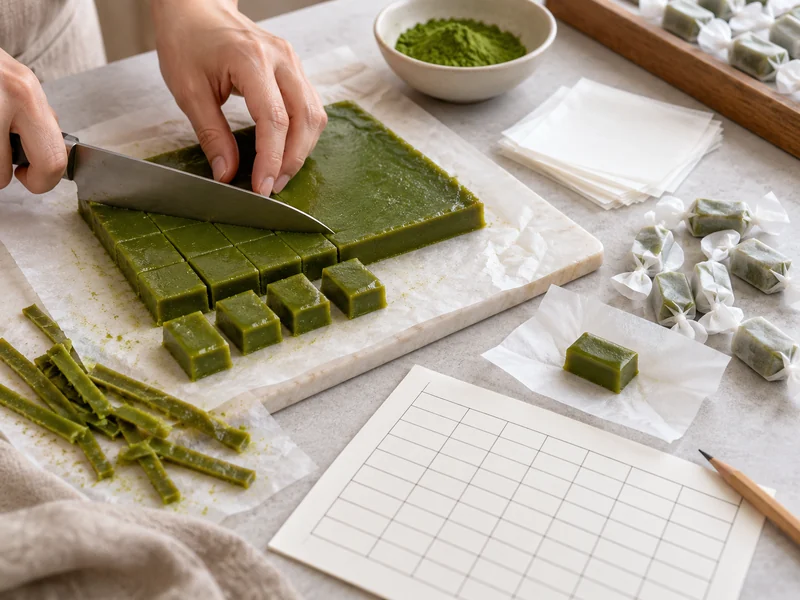
Measure the cast slab depth at several points, then record room conditions, set duration, release, knife treatment, cut dimensions, and wrapper adhesion. A 60-piece stated yield is only a denominator candidate until the team’s actual pieces pass weight and shape tolerances.
Avoid chilling merely to accelerate the source’s room-temperature set unless tested as a separate process. The consequence can be a different cutting and wrapper behavior.
Key Takeaway: Keep cast depth and set conditions with the 60-piece benchmark.
Which matcha grade should a caramel team test?
A caramel team should start with culinary matcha because 380 g of listed sugars and syrup plus dairy create a strong matrix. AdoroHu’s E-1/E-2 and O-1/O-2 are Culinary grades; higher numbers within each series indicate deeper color, more sweetness and less bitterness.
Blind-code equal center pieces from matched cooks. Choose a grade step-up only if the candy keeps a clearer tea finish or better color after the full set.
Avoid comparing powders across cooks with different endpoints. A few degrees of endpoint variation can change chew enough to distort sensory preference.
Key Takeaway: Match endpoint and piece position before comparing matcha grades.
How should 60-piece yield become a commercial cost?
The stated 60-piece matcha caramel yield becomes commercially useful only after actual slab and cut data are collected. Record total slab weight, edge trim, number of intact pieces, average piece weight, wrapper rejects and labor per accepted piece.
| Cost input | Measure from pilot | Why it matters |
|---|---|---|
| Matcha | 10 g source dose retained | powder cost per accepted piece |
| Cooking loss | pre-cook versus cast weight | yield and pan capacity |
| Cutting loss | trim and malformed pieces | realistic saleable count |
| Wrapping | time and failed seals | labor and material cost |
The dessert sourcing guide supports ingredient choices, while the matcha baking guide provides adjacent confectionery context.
Key Takeaway: Price the wrapped accepted piece, not one-sixtieth of the ingredient bill.
What must a cooked matcha caramel label and supplier brief include?
A cooked matcha caramel label and supplier brief must reflect dairy, the full ingredient system, shared equipment, market rules, and the selected grade. The FDA allergen overview provides U.S. context for milk and other major allergens.
AdoroHu supplies pure matcha powder, not finished candy. Buyers can review its food application pathway and contact AdoroHu Matcha with the 10 g benchmark, heat endpoint, target piece, market and documentation needs.
Key Takeaway: Brief the supplier on the cooked candy matrix, not the broader caramel flavor trend.
FAQ
- Does this matcha caramel guide cover lattes or sauces?
- No. It covers cooked soft caramel candy that is cast, set, cut, and wrapped.
- Is 121°C/250°F a universal matcha caramel endpoint?
- No. It is the endpoint in one published formula and must be reproduced with its system before any controlled adjustment.
- Why must the thermometer avoid the pan bottom?
- The metal bottom can be hotter than the candy mass and produce a misleading endpoint reading.
- Can 10 g matcha be converted to teaspoons?
- Do not invent a conversion. Preserve the published gram dose or measure a new internal standard directly.
- Does a stated yield of 60 guarantee 60 saleable pieces?
- No. Cut size, trim, malformed pieces, wrapper failures and actual slab weight determine accepted yield.
- Can the five-hour room-temperature set prove shelf life?
- No. It is a processing step in one recipe, not a validated storage or shelf-life claim.