
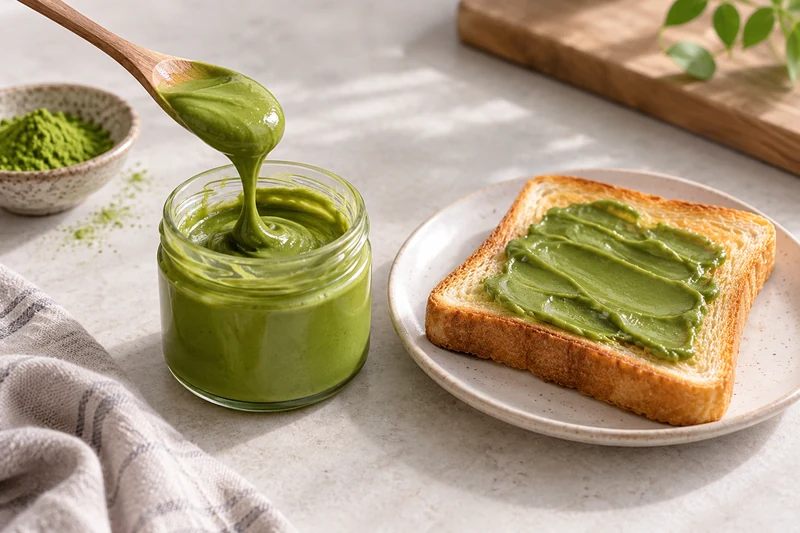
Matcha milk jam becomes smooth and spreadable when the dairy concentration, powder dispersion and cooled endpoint are developed as one process. A green, fluid kettle sample can become dull, gritty or too firm after cooling. Fix the milk, cream, sugar and solids system first, then compare matcha lots in that same baseline. AdoroHu supplies pure powder rather than finished spread; buyers can begin with its culinary matcha range.
Milk jam is a concentrated dairy system, so the hot appearance is not the final specification. Disperse matcha without adding unplanned water, follow concentration with more than elapsed time, and judge viscosity after a defined cooling period. Validate the finished process and shelf life independently.
In short:
Key points:
- Separate matcha dispersion from milk concentration so one problem does not hide another.
- Define the endpoint from cooled spread performance, not a hot saucepan line alone.
- Treat the published six-ingredient home recipe as a benchmark, not a commercial process.
What does the published matcha milk jam recipe establish?
The Sift & Simmer reference establishes a useful home-scale sequence: six ingredients, a water-based matcha dispersion, heated milk and cream, gradual screened addition, reduction and a cooled-thickening check. Its printed formula uses matcha, hot water, sugar, dry milk powder or cornstarch, whole milk and heavy cream. It reports reducing the mixture by about half and notes that the spread thickens further as it cools.
Those observations identify variables worth testing, but they do not establish a factory endpoint, validated heat treatment or commercial shelf life. Vessel geometry, evaporation rate, agitation and batch mass all change scale-up behavior.
Key Takeaway: Use the reference to define trial questions, not to copy a home method into production.
When should matcha enter the milk concentration process?
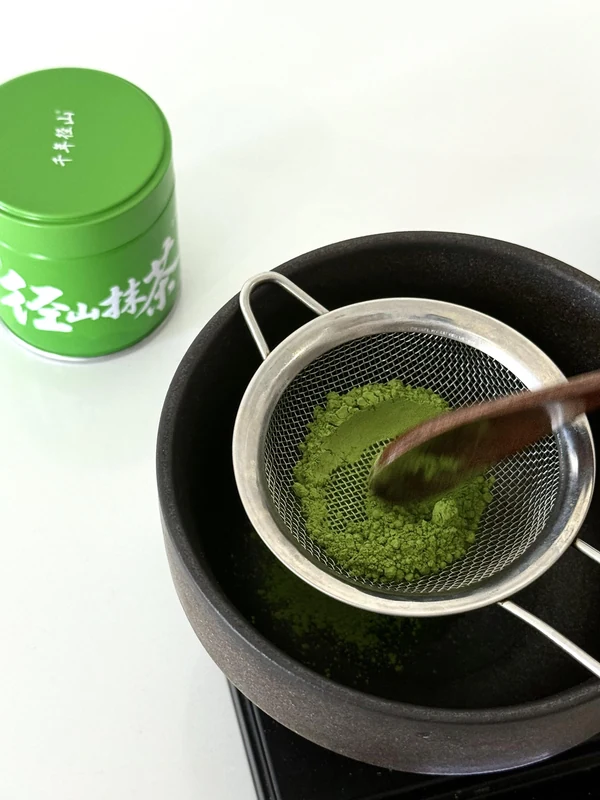
Matcha should enter after it has been fully wetted and while the dairy phase can still distribute it uniformly. Adding dry powder late risks specks; adding it too early increases heat exposure and makes color loss harder to diagnose. The reference disperses matcha with sugar and milk powder in hot water, then strains that mixture into warmed milk and cream.
A commercial team should compare at least two addition points while keeping total water and solids constant. Early addition tests heat exposure; later addition tests dispersion and microbial/process implications that the manufacturer must assess.
| Trial | Matcha addition | Main question | Hold constant |
|---|---|---|---|
| A | Before major concentration | Does longer heat mute color or aroma? | Formula, vessel, endpoint |
| B | During concentration | Does shorter exposure improve color without specks? | Total water and matcha lot |
Key Takeaway: Choose addition timing from finished color, aroma and uniformity, with all added water included in the formula.
How can matcha milk jam avoid grittiness?
Grittiness falls when the powder is sifted, wetted completely and screened before it enters the dairy phase. The reference uses hot water, disperses sugar and milk powder with the matcha, and passes the mixture through a sieve. That sequence addresses visible lumps, but a commercial trial must also check sediment, palate texture and re-agglomeration after cooling.
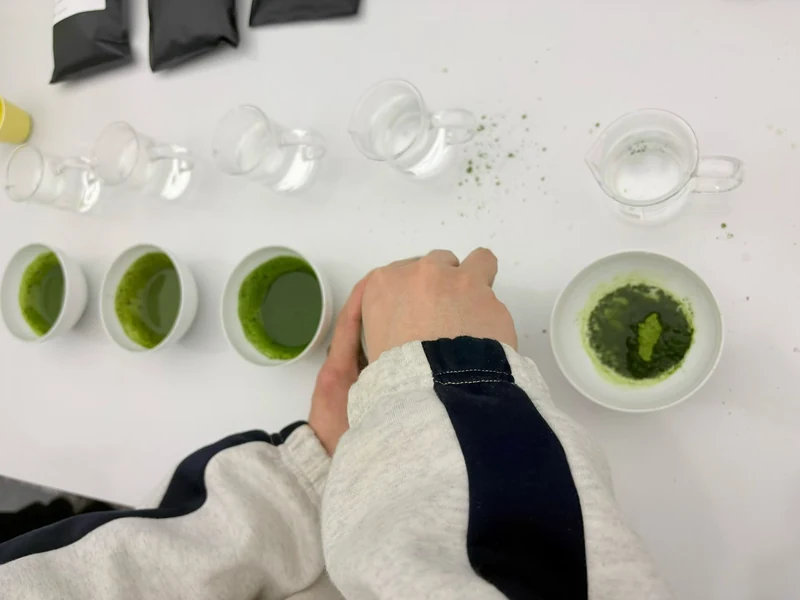
Compare one specified powder lot through two dispersion routes. Keep liquid mass, mixing energy and temperature recorded. Do not add extra water to rescue a thick slurry, because that changes concentration time and final solids.
Key Takeaway: Approve dispersion after cooling, when fine particles and weak agglomerates are easier to detect on the palate.
How should milk, cream and added solids be balanced?
Milk, cream and added milk solids should be treated as a single concentration system because each changes richness, evaporation behavior and cooled viscosity. The home benchmark uses whole milk, heavy cream and dry milk powder, while mentioning cornstarch as a substitution. Those routes are not equivalent: milk powder adds dairy solids and flavor; starch builds a different texture.
| Route | What it changes | Main risk | Commercial check |
|---|---|---|---|
| More dairy solids | Body and cooked-milk character | Chalky or overly dense finish | Cooled spread and flavor |
| Starch route | Faster viscosity build | Pasty texture or masking | Shear and filling behavior |
| Cream adjustment | Fat and richness | Emulsion or flavor imbalance | Oil release and mouthfeel |
Key Takeaway: Treat milk powder and starch as separate product architectures rather than direct drop-in equivalents.
How should the concentration endpoint be defined?
The endpoint should combine mass loss or solids evidence with cooled viscosity and application performance. The reference uses reduction by about half and a visible line when the pot is scraped. Both are practical home cues, yet neither alone controls a larger process.
Record initial and final batch mass, sampling temperature and the time before viscosity assessment. Then test the intended use: spreading on bread, depositing as a filling or pumping through production equipment. An endpoint that works for toast may be too soft for a bun or too firm for automated dosing.
Key Takeaway: Define endpoint by the cooled job the spread must perform, supported by reproducible process measurements.
How can browning be separated from matcha color loss?
Browning can be separated from matcha color loss by running a no-matcha dairy control beside the matcha batch. Milk concentration and sugar heating create their own color and cooked notes. Without a control, developers may blame the powder for changes caused by the base.
Use the same dairy mix, vessel and endpoint. Compare base color, matcha color, aroma and cooked flavor at matched times. If the control browns strongly, reformulating the powder level will not correct the underlying heat history.
Key Takeaway: Keep a no-matcha control so dairy browning does not masquerade as poor matcha performance.
Which food-safety and allergen controls apply?
The manufacturer must determine controls from its finished dairy spread, process and facility rather than from the blog recipe. Milk is a U.S. major allergen, and other ingredients or shared equipment can introduce soy, tree nuts or additional allergens. The FDA allergen overview supports food-source labeling, while 21 CFR 117.135 requires appropriate written preventive controls for covered facilities.
The reference says its home product is refrigerated and not suitable for room-temperature storage. Its stated refrigerator duration is home-recipe advice, not evidence for a commercial label. A manufacturer needs product-specific process, package and stability evidence.
Key Takeaway: Never convert the reference’s refrigerator guidance into a commercial shelf-life claim.
How should packaging and storage trials be built?
Packaging trials should challenge the filled container, headspace, light exposure, closure and intended distribution temperature. Matcha color may fade while the dairy phase also thickens, separates or develops cooked flavor. Testing only an open cup misses the effects of the real package.
Evaluate fill consistency, cooled viscosity, surface skin, oiling, color, odor and microbial/stability criteria chosen by the qualified team. The FDA notes that water activity affects stability, but water activity alone does not establish shelf life.
Key Takeaway: Set shelf life from the complete packaged product under its real storage route.
What should a matcha milk jam buyer send the supplier?
A buyer should send the dairy base, target use, addition point, heat exposure, cooled viscosity method, benchmark and required documents. Include coded results from the same formula rather than photographs from unrelated kitchen batches. For adjacent boundaries, compare the site’s matcha caramel guide and matcha custard guide: milk jam owns reduction and spread viscosity, not dry caramel stages or custard gelation.
AdoroHu’s E-1/E-2 and O-1/O-2 are culinary tiers; higher numbers within each series indicate higher quality. That grade framework can organize samples, but the customer’s finished spread trial must decide fit.
Key Takeaway: Give the supplier a controlled application brief, while keeping finished-product validation with the manufacturer.
FAQ
- Why is matcha milk jam gritty?
- Dry pockets, incomplete wetting, weak screening or re-agglomeration can leave grit; assess the cooled spread, not only the warm mix.
- When should matcha be added to milk jam?
- Compare defined addition points with the same formula and total water, then choose from finished color, aroma and uniformity.
- Can milk powder be replaced with cornstarch?
- The home reference offers that substitution, but the two ingredients build different dairy flavor and texture systems and require separate trials.
- How do you know when milk jam is concentrated enough?
- Combine reproducible process evidence with cooled viscosity and performance in the intended spreading, filling or depositing use.
- Can commercial matcha milk jam use the reference shelf life?
- No. The published duration is home-recipe guidance; commercial shelf life needs evidence for the actual formula, process, package and storage route.
- Does AdoroHu manufacture matcha milk jam?
- No. AdoroHu supplies pure matcha powder as an ingredient; the finished spread manufacturer owns formulation, processing and validation.
Conclusion
Smooth matcha milk jam comes from a controlled dispersion, a defined concentration endpoint and evaluation after cooling. Keep the home recipe as a benchmark and build commercial decisions from measured finished-product evidence. Contact AdoroHu Matcha with the dairy system, target use and trial results.